




| Name | Earliest Attestation | Period |
|---|---|---|
| 𒀭𒊩𒌆𒅁 (Ninurta) | God-lists of Shuruppak (Fara) | Early Dynastic IIIa, c. 2600 BCE |
| 𒀭𒊩𒌆𒅁 (Ningirsu) | Royal inscriptions of Ur-Nanshe | Early Dynastic IIIb, c. 2500 BCE |
23 min read
NINURTA
author: High Priest Zevios Metathronos
co-author: Novice Priest Karnonnos
Hieratic Information about Ninurta
| Divine Names | |
|---|---|
| Ninurta (𒀭𒊩𒌆𒅁) | "Lord of Grain," the champion-god of Nippur |
| Ninĝirsu (𒀭𒊩𒌆𒄈𒋢) | "Lord of Girsu," his Lagašite counterpart |
| |
| The name divides into nin, "lord," and the sign read urta or ib, understood as a word for barley or grain. Behind the farmer stands the hero: the same god who orders the fields also slays the mountain-monster and recovers the Tablet of Destinies. | |
| Divine Symbols | |
| |
| Divine Forces | |
| |
| Important Titles | |
| |
| Names Across Civilizations | |
| Sumerian | Ninurta / Ninĝirsu (𒀭𒊩𒌆𒅁) |
| Akkadian / Babylonian | Ninurta, Uta-ulu, Umunrasha |
| Assyrian | Ninurta, paired with Ashur and Mullissu |
I. Etymology
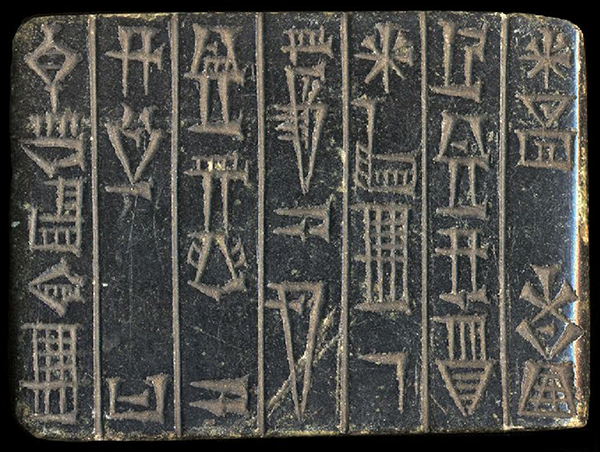
Ningirsu dedication: “For Ningirsu, Enlil’s mighty warrior, his Master; Gudea, ensi of Lagash”
Ninurta means "Lord of Grains", showing his connection to farming but also as an occult allegory governing the direction of humanity from basal "seeds" to mature grains able to produce sustenance. The name parallels the mythological contest of Cattle and Grain as symbolic mountains of heaven and earth in Sumerian texts always connected to the divine status of the ancient Nippar as a city. The last cuneiform element of his name is the .ib or .URTA cuneiform of Sumerian in particular.1,2,3
He is also cross-identified with Ningirsu, the patron god of the city of Girsu, near Lagash, whose cult developed separately and convergently. The etymology of Ningirsu, beyond it rendering him the Lord of that precinct, is debatable; it may mean Lord of the House of Captives.4,5,3
His name could also be written Nímurta alternatively in the oldest texts, which exists alongside the standard form. He was also linked to being the great Ensi of Nippar (Ansi-gal Enlil-la), the supreme governor of Enlil's sacred temple which literally translates as farm manager. These titles were shared with the king's broadly similar titulary in essence. His wife Ninnibru being called Queen of Nippar ties him to the city also. Another important name for Ninurta is Uta-Ulu, a later widely-used title at the time of Isin's power. Other names included Umunrasha, a Neo-Assyrian name.2,6,3
The god stands among the very oldest deities in the written record. His name, and that of his Lagašite double Ninĝirsu, belongs to the Early Dynastic period of the mid-third millennium BCE. Ninĝirsu is named already in the earliest royal inscriptions of the state of Lagash, from Ur-Nanše and his successors onward, where he is the city's warrior-lord and the "hero of Enlil." In the same horizon the theology of Nippur takes shape in the god-lists of Šuruppak (Fara) and Abu Salabikh and in the Zame Hymns, where the son of Enlil already holds his place among the great powers. There is thus no single first line one can point to; the god is present at the moment writing itself becomes able to record the pantheon, which makes him one of the earliest attested gods anywhere.7,8,9,10,2
Sources: Frayne, Royal Inscriptions of Mesopotamia, Early Periods 1 (2008); Krebernik and Lisman, The Sumerian Zame Hymns (2020); van Dijk, LUGAL UD ME-LÁM-bi NIR-ĜÁL (1983); Cooper, The Return of Ninurta to Nippur (1978); Edzard, Gudea and His Dynasty (1997); Grayson, Assyrian Rulers of the Early First Millennium BC I (1991).7,8,5,4,11,12
II. Ninurta's Ancient Myth
Ninurta was the great divine hero of Sumer, the champion of the ancient city of Nippar. His holy endeavors as recorded in Sumerian, then Akkadian, Babylonian and Assyrian myth across three whole millennia attested to the endurance of this divine figure, and the central mythos of his recovery of the Sacred Tablets of the Gods from the Anzu in the Lugale ties together his sacred functions as hero, kingmaker, the master of divination and agriculture par excellence.2,13
Such mythological roles for historians unveiled a major royal and civic cult with the decoding of ancient Sumerian artefacts; Ninurta was the guardian and tutor of all kings. In the most occult sense, he represents a corridor between humanity and divinity, laden symbolically with heroic acts of monster slaying.2
Ninurta is first attested in third millennia BC lists of Sumerian divinities and, consequentially, he is actually one of the oldest attested Gods on record. His sanctuary, Nippar, prided itself on being named one of the most ancient and arcane cities on the face of the earth, being a city primarily dedicated to the head god of the heavens, Enlil, in which the great hero took his eternal position as Enlil's son and resident overseer in the realm of the humans.8,10,14
Like Skanda, Ninurta is said to be born in the mountains. The adult exploits of Ninurta are established in the Lugal-e, his primary text. He is the acting hero throughout as he confronts Asag, defeats him, reorganizes the conquered mountain, redirects the waters into the Tigris, and judges the stones. The entire myth is structured around Ninurta's campaign and his ordering of the world following the sequence. At the beginning, Ninurta is seated in divine splendor while his mace, the Car-ur, looks towards the mountains, sensing trouble.2,5,15,16
The mace reports that Asag has arisen in the mountains, backed by rebellious stones raiding the cities. The land is subjected to great famine from the corruption of the rivers. Ninurta rides out like a storm across the breadth of the peaks and devastates the enemy cities, angling for confrontation. Enraged, Asag makes the sky deep red with blood, sets fire to the beds of reeds, renders the fields barren like potash while ripping at the sky and earth with his claws.5,14
From a dramatic mountain peak and surrounded by his armies, Ninurta sees the evil monster and cuts through his forces to reach him, ultimately 'flattening him like a wave' with a brutal assault. The victory leads to the restoration of pure, fresh water and reviving the proper sustenance of the realm. In a cryptic monologue, Ninurta assigns destinies to the stones, blessing some and cursing others.5,15
In the first fragmentary Old Babylonian myths of the Anzu, he, as Ningirsu, is the hero who defeats the monster after the theft of the Tablet of Destinies. The later Babylonian versions expand the scope of the text into an epic format where the triumph and honors of Ninurta are emphasized.17,18,19,20,21
During the Neo-Assyrian era, the myth was layered with ideals amenable to royalty, specifically treating the Anzu as a parallel for chaos and rebellion. The myth begins with Anzû as a trusted guardian of Enlil, but he rebels and steals the Tablet of Destinies, thereby disrupting the structure of divine kingship itself. The Gods panic, promptly seeking a warrior capable of defeating him. Ninurta finally accepts the mission. Anzû's possession of the Tablet lets him undo or deflect Ninurta's attacks, which creates the poem's central dramatic complication.2,19,20
The hero then shifts from direct assault to a more cunning tactic: the storm wind is invoked to unbalance Anzû and expose him. Once Anzû's wings fail, Ninurta cuts them off and pierces him, then Ninurta returns the Tablet to Enlil and is rewarded with elevated status or apotheosis among the gods.19,20
III. Epithets
Ninurta's names gather around his functions rather than around a single cult title, and the great study of the god sorts them into a handful of standing images: the monster-slayer, the farmer, the healer who lifts sickness once evil is beaten back, and the god envisaged as star and arrow. Each of these carried its own epithets, and each in turn tied the god to the person of the king.2,3
The oldest of the honorifics is already fixed in the Sargonic Collection of Sumerian Temple Hymns, where the son of Enlil is the sag-kal pirig kur-gal-e tu-da, "the foremost, the lion, whom the Great Mountain engendered." Alongside it stand titles that survived for two thousand years: Uta-ulu, "Sun of the South"; the "conqueror of the Kur"; and, from his farming aspect, the "upright diadem of Ashnan," the grain-goddess.22,2,3
| Epithet | Meaning | Domain |
|---|---|---|
| Sag-kal pirig | Foremost one, the lion whom the Great Mountain begot | The warrior-son of Enlil, from the Temple Hymns |
| Uta-ulu | Sun of the South | His radiant, storm-bringing aspect, current from Isin on |
| Lugal (King of Battle) | The warrior-king of the campaign myths | The martial hero, sharpened in Assyria |
| Engar/Ensi | Farmer, the estate-manager of the god | His agricultural office at Nippur |
Sources: Annus, The God Ninurta in the Mythology and Royal Ideology of Ancient Mesopotamia (2002); Streck, "Ninurta/Ninĝirsu," Reallexikon der Assyriologie 9 (1998–2001); Sjöberg and Bergmann, The Collection of the Sumerian Temple Hymns (1969).2,3,22
A word of restraint belongs here, as with any god who has drawn a modern following. The tablets give Ninurta a mace that speaks, a bow, a plough, and the Arrow among the stars; they do not give him the elaborate weapon-hoards and cosmic ranks that later popular retellings supply. What is attested is enough, and it is severe: the storm that flattens the mountain, the word that fixes the fates of the stones, the arm that returns the stolen Tablet to Enlil.2
IV. Temple Complexes of Enlil's Lord
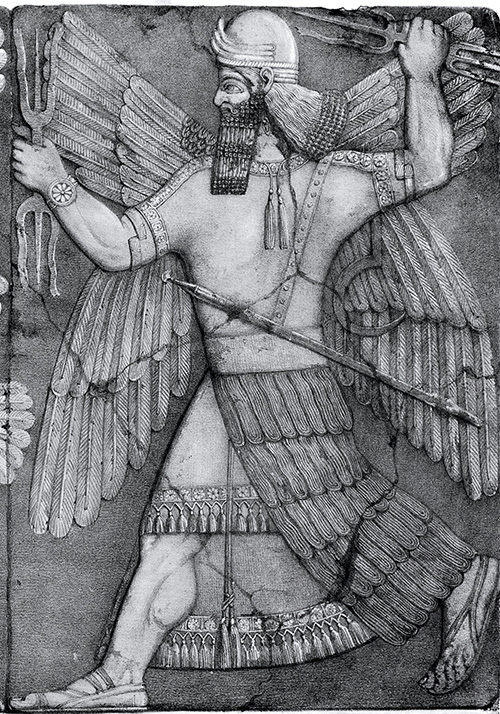
Assyrian stone relief from the temple of Ninurta at Kalhu
The temple of Ninurta at Nippur is mentioned from the late pre-Sargonic or early Sargonic period onwards. In the Collection of Sumerian Temple Hymns, originating in the Sargonic period, Ninurta is for the first time attested as the son of Enlil, bearing the epithet sag-kal pirig kur-gal-e tu-da, "the foremost, the lion, whom the Great Mountain (= Enlil) engendered." Ninurta's shrine was probably situated on the western side of Nippur together with the palace (e-gal), where the governor of the city (ensi) resided. The Ekur temple and the priests of Enlil were assigned to the east bank of Nippur where the assembly of the citizens convened.2,22,23
In ancient times, the main temple, the Ešumeša of Nippur, was the most important center of his worship. Ninurta's temples were close in proximity to his father Enlil, or in later periods, often combined with those of the scribal God, Nebo, whose functions were often combined with his. At Girsu, he was worshiped as the central deity of the area at the E-ninnu; the Gudea texts have Ninurta calling it his home.2,11,9,23,24
The Babylonians also built a temple to him called the Ehursagtila that was of particular importance, as it is commonly attested in inscriptions. Deep into the Assyrian ascendancy over the area, the Temple of Ninurta at Kalhu was constructed next to the royal palace and at the center of the city's major attractions, because the Assyrians revived major aspects of his cult and made him a particular fixation of the king's right to rule.23,12,10
V. Ninurta as Guide for Kings
Ninurta particularly seemed to function as a guide for kings as he is crowned as a king in the myths and became a divine role model, a patron of what it is to be regal. This is also seemingly connected to the function of his priesthood. Because the kings of Sumer were regarded as divine, with this tendency becoming extremely marked during the subsequent centuries under the Akkadian Empire, the parallel between heaven and earth was replicated constantly.2,25
Kings were invested by the priests of Enlil himself, and because the head God was also the honorary father of the endowed, there existed a kind of symbolic relationship between the ruler and Ninurta at all times. The Akitu or New Year festival of Ninurta was linked to royal ritual, while Annus states that the king acted out the role of the divine champion at particular points. He shared this distinction with another God, Nanna, who was the patron of the ancient city Ur.1,2,13
His kingly attributes have strong agricultural overtones, as the ensi title indicates. The god who managed Enlil's fields also managed, at one remove, the fields of the realm through the person of the king, so that the same figure who fixed the fate of the stones after the mountain-war stood behind the fixing of the ruler's fate in the assembly at Nippur.2,6
VI. Starry Tablets
However, one particular role of Ninurta is more mysterious, relating to the myth of the Tablets of Destiny: he was one of the head deities of divination and the reading of stars. Archeologists and experts of Mesopotamian civilization found that the priesthood of Ninurta appeared to be particularly skilled astrologers and masters of divination.2,26,27
These roles are linked into the myth of taking the tablets from Anzu, the lord of chaos, as well as his speeches to the army of stones, which scholars like Annus have connected to divination and occult matters. The same tradition remembered a darker sequel, told in the tale of Ninurta and the Turtle, in which the hero's grasp at the wisdom of the Abzu is checked by Enki; mastery over fate, the story warns, is not the hero's to seize outright.2,28
The planetary and starry auspice also related to Ninurta's relationship with Nebo, the scribe of the Gods. In the learned tradition the god is fixed in the sky twice over: as the planet Saturn, the steady one, and as the Arrow, the star the astronomers call Sirius, which he looses across the heavens. His divine powers over soothsayers are pointed, relating to his symbolism in contorting the powers of fate and agitating against destiny. It was said that interpretation of astrology is one of Ninurta's gifts to humanity.2,26,29
VII. Car-Ur
The weapon at the side of the hero throughout all of his campaigns is the Car-ur. In Sumerian, it is called Shar Ur, which means “Smasher of Thousands.” It is no ordinary club in that the weapons is personified as a living being: it flies over great spaces without interference, speaks with its master, serves as an observer for the enemy, carries the messages from Enlil to Ninurta, and can even be shaped into a winged lion. In the earlier Lagashite guise of Ningirsu, it is again a principal weapon. A portion of a Gudea monument might possibly depict it as a large club standing upright before the deity5,11,15,24,30
In the Lugal-e, the Car-ur plays a role almost equal to that of the hero. It was the first to sense the rebellion in the mountains, and warned the king. It carried out the orders of Enlil, specifically those to fight, and when Ninurta flees before Asag like a frightened bird in the poetic description of the events, it was the Car-ur that turned him around and reminded him of his past glories and encouraged him to complete the kill.5,16
"Lord, the mountain has bred a rival against you; the rebel stones have risen and the rivers run foul. Turn, hero, and remember your name; the fame of this day is already yours."
, after Lugal-e (the Exploits of Ninurta), paraphrased
The cleverness of the Car-ur’s strategy reaches new heights in the Anzu poem. After the theft of the Tablet of Destiny by the Anzu which is able to turn back any arrow or counteract any spell cast, Ninurta is unable to defeat him using brute strength. Much like the rules of winning the Nemean Lion or Cerberus, he sends the Car-ur on a journey from the mountain battlegrounds to the sweet waters of Eridu, where wise Ea resides. The Car-ur returns to Ninurta carrying his counsel. With that strategic thinking, Anzu is forced to relinquish possession of the Tablets. After the battle is won, and Ninurta enters Angim in triumph, the Car-ur rests against the Ekur, Enlil’s house.4,19,20,31
VIII. Ninurta as War God
Ninurta of the bow, the arrow, the mace and the sickle-sword is one aspect of his identity, coming after the agrarian god of fields and waters.1,2,10
In his role as kingly guide, Ninurta was also considered to be a war-like god, a position established in certain early variations of the Lugale where he is named King of Battle, yet that convention is also something that becomes increasingly prominent in the Neo-Assyrian Empire in the most mature period of independent Mesopotamian history two thousand years later.2,5,12
Ninurta's warlike characteristics can be seen in an inscription found on the wall of Esarhadon's saga. His father Sennacherib was murdered by his brother in law inside the Temple of Ninurta. He invoked Ninurta to assist him in obtaining both divine guidance as a ruler and assistance in pursuing revenge against his family members. The use of Ninurta as a site for these actions rested on the previously proposed identification of the Biblical Nisroch, the deity within whose temple the books of Kings and Isaiah report the assassination took place. The temple would have been used as a center of worship for Ninurta due to its identification with the cult of Ninurta centered on Kalhu since Ashurnasirpal II.32,33,34
IX. Ninurta and Nabu
From approximately the 8th century BCE onward, the name Ninurta was to be supplanted in Babylonia almost entirely by that of Nabu. Nabu was known as the scribe-god of Borsippa. The old Nippur triad of Enlil-the-Father, Ninlil-the-Mother and Ninurta-the-Son were replaced in later pantheons: as Marduk, Zarpanitu and Nabu in Babylonia; as Asshur, Mullissu and Ninurta in Assyria. The configuration continued long after the names disappeared.2,35
What Nabu inherited was, to a great degree, some of the roles of Ninurta. Nabu became the author of the tablet of destinies at the new year, the patron of scribes who usurped the position formerly occupied by the goddess Nisaba, lord of wisdom. His relationship to his father Marduk was modeled directly after that of Ninurta to Enlil. This learned aspect had an ancient Sumerian basis: In the myth of Ninurta's journey to Eridu, the hero acquired his powers in the abzu of Ea and determined fate in its council; thus establishing etiologically why the warrior gained wisdom. These apparent aspects, however, lack the greater context for why the roles of Mesopotamia's Hermes and Heracles would overlap.1,35,36,37
While in Babylonia, Nabu served as the royal son who arrives at the New Year to free his father, but in Assyria at the exact same time, it was Ninurta instead who held that same avenging role. Their stellar signatures probably answered one another. Saturn served as the sign for Ninurta, while Mercury represented Nabu, thus the association made previously between the celestial tablets, Ninurta and Nabu had a genuine astrological context within tradition. Even long after their temples fell, Nebo was still remembered in the Bible.2,29,38
X. How Ninurta Became Nimrod
The book of Genesis describes Nimrod as being the son of Cush and great-grandson of Noah, "the first man to appear on earth and first to be powerful," and also a "mighty hunter before the Lord." It states that "Babel, Erech and Akkad in the land of Shinar were where the Empire of Nimrod began", from there he went to Assyria and established Ninevah, Calah and Resen. He is the only figure in the Bible with such a colossal lineage.39
The earliest and most popular hypothesis posits Nimrod to have been descended from Ninurta and Ningirsu. This theory fits well. The reason is because both Nimrod and Ninurta are described as strong warriors, both are the patrons of particular cities, and what is perhaps the best evidence is that according to the Bible, Calah (which means "strong") was built by Nimrod. Kalhu was the city upon which the Assyrians would build the center of Ninurta's war cult. Therefore a god who promised to help assure a king's victories and had a temple at the top of Kalhu, is likely to be remembered as the first world conqueror, beyond the obvious Herculean associations.40,12,2
Other scholars have preferred to see behind Nimrod the warrior-god Marduk, or a historical king such as Sargon of Akkad, his grandson Naram-Sin, or the Assyrian Tukulti-Ninurta I, or else a composite of several heroes figures.40,41
As with many extra-Biblical expositions demonizing the divine order, the "mighty hunter before the LORD" was reread as a hunter against God by the time of the Second Temple, and Nimrod became the the tyrannical tower-builder of Babel by the time of Josephus, the archetype of the rebel king, the tyrant who sets his kingdom against heaven, an afterlife in which the heroic story of apotheosis became demonic and evil rebellion in attempting to reach the heavens through vanity.40,41
XI. The Eleven Tasks
In parallel with the later Herculean myth, the Lugale outlines a set of tasks that Ninurta has already accomplished. These are the dragon, the kuli-ana, gypsum, strong copper, the six-headed wild ram, the magilum boat, Lord Saman-ana, the Bison Bull, the Anzu and the seven-headed snake.5,4,15
In Ninurta's Return to Nibru, the beasts are categorized as a set of trophy-beings that he has already slain; the kuli ana is identified as a mermaid. The Gudea Cylinder sequence substitutes gypsum and omits the Anzu for the date palm and the fish-man.4,16,11,24
| Slain Hero | Nature | Notes |
|---|---|---|
| The Warrior Dragon (ushumgal) | A serpent-dragon of the mountain | Heads the trophy-list in Angim |
| The Kuli-ana | Read as a mermaid or fish-being | A creature of the waters |
| Gypsum and Strong Copper | Personified minerals of the mountain | Despoiled rather than beasts proper |
| The Six-headed Wild Ram | A many-headed mountain animal | Among the standard seven monsters |
| The Magilum Boat | A ship of the netherworld voyage | A trophy of uncertain sense |
| Lord Saman-ana and the Bison Bull | A rebel lord and the wild bull (gud-alim) | Foes of the highland campaign |
| The Anzu and the Seven-headed Snake | The lion-eagle thief and the hydra-serpent | The Anzu is dropped in the Gudea sequence |
Sources: van Dijk, LUGAL UD ME-LÁM-bi NIR-ĜÁL (1983); Cooper, The Return of Ninurta to Nippur (1978); Black, Cunningham, Robson and Zólyomi, eds., The Electronic Text Corpus of Sumerian Literature (1998–2006); Wiggermann, Mesopotamian Protective Spirits (1992).5,4,16,30
These slain monsters are highly symbolic and abstract in nature in comparison to the mythological representation in Greek literature; they also appear to have been related to protocols about establishing proper order in functioning civilization as a living body, with an occult layer understood by spiritual adepts. The conflict from which they come was not confined to Sumer: the kingship myth on which the Ninurta cycle rests recurs, in various shapes, far beyond the bounds of the ancient Near East, carrying the ideas of usurpation, combat and dominion down into late antiquity.2,21,30
XII. Ninurta as the Archetypal Farmer
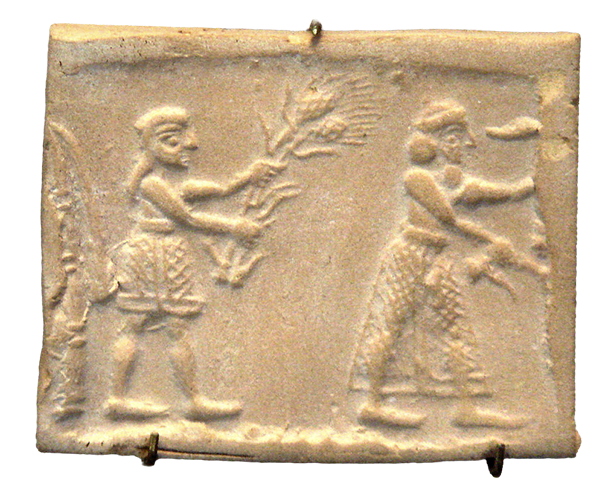
Sumerian cylinder seal impression dating to c. 3200 BC showing an ensi and his acolyte feeding a sacred herd
Before the warrior of the late epic was formed, Ninurta represented the cultivated soil. Ninurta's name could possibly be interpreted as "The Lord of Barley" since barley is thought to have been represented by the word. He had his earliest representation in the plow. Thorkild Jacobsen believes Ninurta was in the pantheon of the gods of the north and the farming communities. According to him, the farming theology of Ninurta lies in him being the son of Enlil of Nippur. He represents the thunderstorm alongside the plow and the rains, representing both as tools used by man to raise crops.1,14
Ninurta's role as a model husbandman can be seen through the Old Babylonian poem entitled the Farmer's Instruction, the Sumerian equivalent of Hesiod's calendar of the working year. Edited by Miguel Civil from over forty exemplars; this poem describes the whole cycle of activities involved in cultivating crops, including flooding and drying, hoeing and leveling, plowing and sowing, and finally winnowing and harvesting.6
At the conclusion of the poem, the author places their counsel at the feet of the god and includes a subscript stating that it is the instruction of Ninurta, son of Enlil, and addresses him as the faithful farmer of Enlil whose praise is good. Ninurta's name encapsulates the ideals of correct cultivation. It seems every careful farmer viewed Ninurta as the model upon which they based their work.42
In mythological terms, Ninurta received authority over these farming duties from a cosmic source. In the Epic Lugal-e, edited by J.J.A. Van Dijk, Ninurta fights against the evil demon Asag on Mounts Zalpa in Upper Mesopotamia, kills Asag, builds a massive wall made out of stones to keep back the water that would otherwise flow unchecked, turns those waters into the river Tigris, thus creating a river that would periodically overflow and moisten the lands where farmers grow grains. This single act of achieving control over all things and establishing irrigation systems is representative of two actions. His help for farmers is also representative of the dual role of the god who destroys chaos and the god who establishes systems that provide nourishment for plants and humanity alike.
Amar Annus identified Ninurta's various aspects, including those of the farmer, monster slayer, and healer. The fact that Ninurta still represented agriculture, as well as his association with the ideology of kingship, indicates that the agrarian aspects of Ninurta continued to remain an active part of his character. Annus stated that, in addition to his other characteristics, Ninurta bore the likeness of the just king who provides for his people through peaceful tending of his land, something inverted in the extra-Biblical smut and slander.2,5
Sources and Bibliography
- Black, Jeremy, and Anthony Green. Gods, Demons and Symbols of Ancient Mesopotamia: An Illustrated Dictionary. London: British Museum Press, 1992, 142, s.v. "Ninurta."
- Annus, Amar. The God Ninurta in the Mythology and Royal Ideology of Ancient Mesopotamia. State Archives of Assyria Studies 14. Helsinki: Neo-Assyrian Text Corpus Project, 2002.
- Streck, Michael P. "Ninurta/Ninĝirsu. A. I. In Mesopotamien." In Reallexikon der Assyriologie und Vorderasiatischen Archäologie, vol. 9, 512–22. Berlin: De Gruyter, 1998–2001.
- Cooper, Jerrold S. The Return of Ninurta to Nippur: an-gim dím-ma. Analecta Orientalia 52. Rome: Pontificium Institutum Biblicum, 1978.
- van Dijk, J. J. A. LUGAL UD ME-LÁM-bi NIR-ĜÁL: Le récit épique et didactique des Travaux de Ninurta, du Déluge et de la Nouvelle Création. 2 vols. Leiden: Brill, 1983.
- Civil, Miguel. The Farmer's Instructions: A Sumerian Agricultural Manual. Aula Orientalis Supplementa 5. Barcelona: Editorial AUSA, 1994.
- Frayne, Douglas R. Presargonic Period (2700–2350 BC). The Royal Inscriptions of Mesopotamia, Early Periods 1. Toronto: University of Toronto Press, 2008.
- Krebernik, Manfred, and Jan J. W. Lisman. The Sumerian Zame Hymns from Tell Abū Ṣalābīḫ. Dubsar 12. Münster: Zaphon, 2020.
- Selz, Gebhard J. Untersuchungen zur Götterwelt des altsumerischen Stadtstaates von Lagaš. Occasional Publications of the Samuel Noah Kramer Fund 13. Philadelphia: University of Pennsylvania Museum, 1995.
- Robson, Eleanor. "Ninurta, God of Victory." In Ancient Mesopotamian Gods and Goddesses. Oracc and the UK Higher Education Academy, 2015.
- Edzard, Dietz Otto. Gudea and His Dynasty. The Royal Inscriptions of Mesopotamia, Early Periods 3/1. Toronto: University of Toronto Press, 1997.
- Grayson, A. Kirk. Assyrian Rulers of the Early First Millennium BC I (1114–859 BC). The Royal Inscriptions of Mesopotamia, Assyrian Periods 2. Toronto: University of Toronto Press, 1991.
- Leick, Gwendolyn. A Dictionary of Ancient Near Eastern Mythology. London and New York: Routledge, 1998, s.v. "Ninurta."
- Jacobsen, Thorkild. The Treasures of Darkness: A History of Mesopotamian Religion. New Haven: Yale University Press, 1976.
- Black, Jeremy, Graham Cunningham, Eleanor Robson, and Gábor Zólyomi. The Literature of Ancient Sumer. Oxford: Oxford University Press, 2004, 163–80 (Ninurta's Exploits).
- Black, Jeremy A., Graham Cunningham, Jarle Ebeling, Esther Flückiger-Hawker, Eleanor Robson, Jon Taylor, and Gábor Zólyomi, eds. The Electronic Text Corpus of Sumerian Literature. Oxford: University of Oxford, 1998–2006. See "Ninurta's Exploits" (c.1.6.2) and "Ninurta's Return to Nibru" (c.1.6.1).
- Vogelzang, Marianna E. Bin šar dadmē: Edition and Analysis of the Akkadian Anzu Poem. Groningen: Egbert Forsten, 1988.
- Saggs, H. W. F. "Additions to Anzu." Archiv für Orientforschung 33 (1986): 1–29.
- Annus, Amar. The Standard Babylonian Epic of Anzu. State Archives of Assyria Cuneiform Texts 3. Helsinki: Neo-Assyrian Text Corpus Project, 2001.
- Foster, Benjamin R. Before the Muses: An Anthology of Akkadian Literature. 3rd ed. Bethesda, MD: CDL Press, 2005, 555–78 (Anzu).
- Lambert, W. G. Babylonian Creation Myths. Mesopotamian Civilizations 16. Winona Lake, IN: Eisenbrauns, 2013.
- Sjöberg, Åke W., and E. Bergmann. The Collection of the Sumerian Temple Hymns. Texts from Cuneiform Sources 3. Locust Valley, NY: J. J. Augustin, 1969.
- George, A. R. House Most High: The Temples of Ancient Mesopotamia. Mesopotamian Civilizations 5. Winona Lake, IN: Eisenbrauns, 1993.
- Suter, Claudia E. Gudea's Temple Building: The Representation of an Early Mesopotamian Ruler in Text and Image. Cuneiform Monographs 17. Groningen: STYX, 2000.
- Maul, Stefan M. "Der assyrische König, Hüter der Weltordnung." In Priests and Officials in the Ancient Near East, edited by Kazuko Watanabe, 201–14. Heidelberg: Winter, 1999.
- Livingstone, Alasdair. Mystical and Mythological Explanatory Works of Assyrian and Babylonian Scholars. Oxford: Clarendon Press, 1986.
- Bottéro, Jean. Religion in Ancient Mesopotamia. Translated by Teresa Lavender Fagan. Chicago: University of Chicago Press, 2001.
- Alster, Bendt. "Ninurta and the Turtle: On Parodia Sacra in Sumerian Literature." In Approaches to Sumerian Literature: Studies in Honour of Stip (H. L. J. Vanstiphout), edited by Piotr Michalowski and Niek Veldhuis, 13–36. Cuneiform Monographs 35. Leiden: Brill, 2006.
- Koch-Westenholz, Ulla. Mesopotamian Astrology: An Introduction to Babylonian and Assyrian Celestial Divination. Copenhagen: Museum Tusculanum Press, 1995.
- Wiggermann, F. A. M. Mesopotamian Protective Spirits: The Ritual Texts. Cuneiform Monographs 1. Groningen: STYX & PP, 1992.
- Horowitz, Wayne. Mesopotamian Cosmic Geography. Mesopotamian Civilizations 8. Winona Lake, IN: Eisenbrauns, 1998.
- Leichty, Erle. The Royal Inscriptions of Esarhaddon, King of Assyria (680–669 BC). The Royal Inscriptions of the Neo-Assyrian Period 4. Winona Lake, IN: Eisenbrauns, 2011.
- 2 Kings 19:36–37 (parallel Isaiah 37:37–38), on the murder of Sennacherib in the house of Nisroch.
- van der Toorn, Karel, Bob Becking, and Pieter W. van der Horst, eds. Dictionary of Deities and Demons in the Bible. 2nd ed. Leiden: Brill; Grand Rapids: Eerdmans, 1999, s.v. "Nisroch."
- Pomponio, Francesco. Nabû: Il culto e la figura di un dio del pantheon babilonese ed assiro. Studi Semitici 51. Rome: Istituto di Studi del Vicino Oriente, 1978.
- Lambert, W. G. "Ninurta Mythology in the Babylonian Epic of Creation." In Keilschriftliche Literaturen, edited by Karl Hecker and Walter Sommerfeld, 55–60. Berliner Beiträge zum Vorderen Orient 6. Berlin: Reimer, 1986.
- Reisman, Daniel. "Ninurta's Journey to Eridu." Journal of Cuneiform Studies 24, no. 1–2 (1971): 3–10.
- Isaiah 46:1–2, on Bel and Nebo bowing as the idols of Babylon are carried away.
- Genesis 10:8–12, on Nimrod, the mighty hunter, and the cities of his kingdom.
- van der Toorn, Karel, and Pieter W. van der Horst. "Nimrod Before and After the Bible." Harvard Theological Review 83, no. 1 (1990): 1–29.
- Levin, Yigal. "Nimrod the Mighty, King of Kish, King of Sumer and Akkad." Vetus Testamentum 52, no. 3 (2002): 350–66.
- Black, J. A., G. Cunningham, J. Ebeling, E. Flückiger-Hawker, E. Robson, J. Taylor, and G. Zólyomi. “The Farmer’s Instructions.” In The Electronic Text Corpus of Sumerian Literature. Oxford, 1998–2006. https://etcsl.orinst.ox.ac.uk/section5/tr563.htm.