





9 min read
Father of Algebra
Muhammad ibn Musa al-Khwarizmi
author: High Priest Zevios Metathronos
Calculation as a Public Art
Dates: c. 780–c. 850 CE
Period: Darkness (800–1000 CE)
Muhammad ibn Musa al-Khwarizmi was a scholar of the House of Wisdom in Baghdad in the 9th century. For the caliph al-Ma'mun he wrote the Hisab al-jabr w'al-muqabala, a short book on calculating by completion and balancing and the first known book on algebra in Arabic. The title gave Europe the word algebra, and the Latin form of his own name gave it the algorithm.1
The book taught its reader to reduce a problem in squares, roots and numbers to 1 of 6 standard forms, solve it by a fixed procedure and then prove the procedure with a drawn figure. He wrote it, he said, for what “men constantly require in cases of inheritance, legacies, partition, law-suits, and trade.”2
Zevism reads the work under Dike, the daughter of Zeus who guards just dealing. A fair share of an estate is a calculated thing, and al-Khwarizmi made the calculation open to anyone who learned the rules.
LIFE AND CONTEXT
He was born about 780. His name points to Khwarizm, though MacTutor notes that his ancestors, and not necessarily he, may have come from there. The historian al-Tabari also called him al-Qutrubbulli, from a district between the Tigris and the Euphrates near Baghdad, and al-Majusi, an epithet that suggests Zoroastrian roots.3
His own faith is plain on the page. The book opens “In the Name of God, gracious and merciful!”, and G. J. Toomer, quoted by MacTutor, concluded that “the pious preface to al-Khwarizmi's ‘Algebra’ shows that he was an orthodox Muslim, so Al-Tabari's epithet could mean no more than that his forebears, and perhaps he in his youth, had been Zoroastrians.”4
Al-Ma'mun ruled from Baghdad between 813 and 833. He continued his father's patronage of learning and founded an academy called the House of Wisdom, and al-Khwarizmi was attached to it with his colleagues the Banu Musa. Their tasks included translating Greek scientific manuscripts, and they wrote on algebra, geometry and astronomy.3
He dedicated 2 books to the caliph, the algebra and a set of astronomical tables. The tables, the Zij al-Sindhind, followed Indian astronomical works, unlike most later Islamic handbooks, which used Greek planetary models.5 Indian astronomy had reached Baghdad some 40 years before al-Ma'mun took power, when an embassy from Sind brought an Indian astronomer to al-Mansur's court in 771 or 773.6
His range went well beyond equations. He wrote a geography giving latitudes and longitudes for 2,402 localities as a basis for a world map, 2 works on the astrolabe, 1 on the sundial and 1 on the Jewish calendar.5 The geography joined large parts of Ptolemy's Geography to many coordinates that aren't in Ptolemy.7
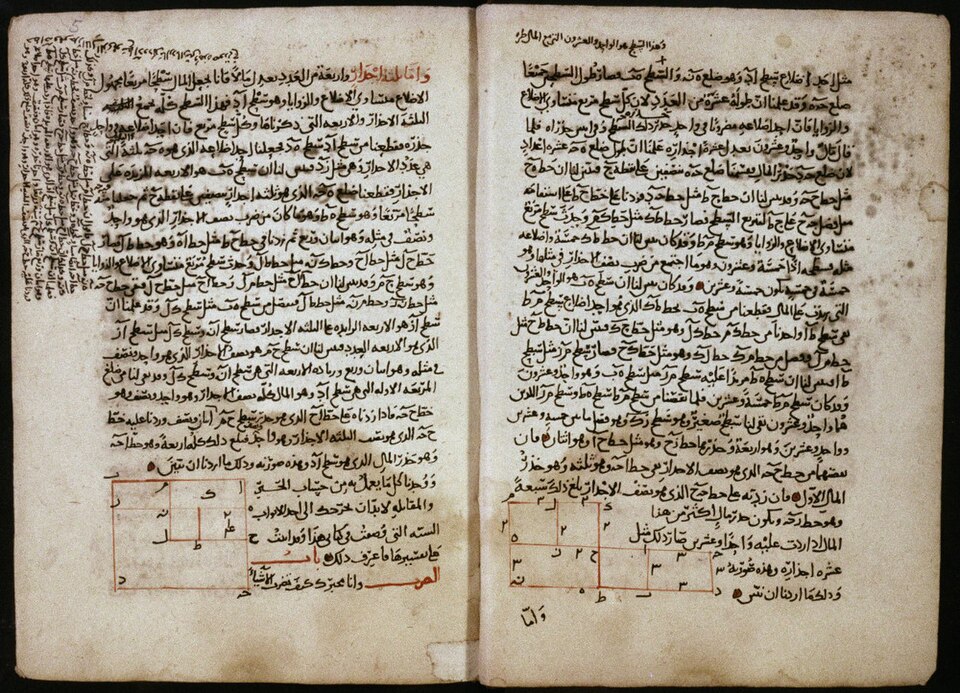
He died about 850. Much of his work wouldn't have survived without copyists and translators. The Arabic arithmetic is lost and lives in Latin, and Frederic Rosen's English algebra of 1831 rests on a single Bodleian manuscript, Hunt. 214, copied in AH 743, or 1342 CE.8
ATTAINMENTS
- He wrote the first known book on algebra in Arabic and dedicated it to al-Ma'mun.9
- He reduced every linear and quadratic equation to 1 of 6 standard forms, running from squares equal to roots to roots and numbers equal to squares, with worked examples such as x² + 10x = 39 and x² + 21 = 10x.5
- He named 2 operations. Al-jabr, completion, removes negative terms from an equation; al-muqabala, balancing, reduces terms of the same power on both sides.5
- He proved his rules by geometry, completing a square with 4 corner pieces of 2½ by 2½ to solve x² + 10x = 39.10
- His arithmetic taught the Indian numerals with zero and place value, and, in MacTutor's words, “first introduced the Hindu numbers to Europe, as the very name algorism signifies.”5
- He drew up the Zij al-Sindhind, astronomical tables on Indian methods, which reached Latin through al-Majriti's revision and Adelard of Bath's translation in the 12th century.3
- He gave coordinates for 2,402 places in his geography, the Kitab surat al-ard.3
KEY STORIES
A Short Work for the Commander of the Faithful
The algebra's preface begins with a short history of learning. “The learned in times which have passed away, and among nations which have ceased to exist, were constantly employed in writing books,” al-Khwarizmi wrote. Some “applied themselves to obtain information which was not known before them, and left it to posterity.” Others explained the hard passages in older works, and others again found mistakes and “corrected the faults of their fellow-labourers, without arrogance towards them.”11
Then he named his patron. He credited “That fondness for science, by which God has distinguished the Imam al Mamun, the Commander of the Faithful,” and said it “has encouraged me to compose a short work on Calculating by (the rules of) Completion and Reduction.” He'd confine it “to what is easiest and most useful in arithmetic.”12
The uses he listed were the daily business of the caliph's subjects: inheritance, legacies, partition, lawsuits and trade, and beyond them “the measuring of lands, the digging of canals, geometrical computation.” The book was written in the capital for the caliph, and its problems came from the fields, canals and markets of his subjects.12
The Square, the 10 Roots and the 39 Dirhems
The most famous problem in the book is put in words. Suppose “one square, and ten roots of the same, amount to thirty-nine dirhems.” The rule follows: halve the roots to get 5, multiply 5 by itself to get 25, add it to 39 to make 64, and take the root, 8. Subtract the 5, and “the remainder is three. This is the root of the square which you sought for; the square itself is nine.”13
A rule alone didn't satisfy him, so he drew it. He set down a square for the unknown and told the reader to “take one-fourth of ten, that is to say, two and a half, and combine it with each of the four sides of the figure.” The new shape was a cross, “in each of the four corners of which a square piece of two and a half multiplied by two and a half is wanting.”14
He filled the corners with “four times the square of two and a half, that is, twenty-five,” and the whole became a single square: “this together makes sixty-four. One side of this great quadrate is its root, that is, eight.” Take the 2 strips of 2½ from that side, “then the remainder of such a side will be three, and that is the root of the square.”14 The equation also has a negative root, −13, which the book didn't consider, since it worked only with positive quantities.
Algorizmi Said
The arithmetic's Arabic original hasn't survived. A Latin version does, among others in a manuscript of the 13th or early 14th century in Cambridge University Library, Ms. Ii.vi.5, and it begins with his name: “Dixit algorizmi,” “Algorizmi said: Let us speak praises to God our guide and defender.”15
The text then shows its Latin readers a new way to write number. The Indians, it says, “made IX symbols,” and “the character that signifies one in the first place, in the second signifies X, in the third C and in the fourth I.” For an empty place “they put one space in front of it and put in it a little circle like the letter o, so that by means of this they might know that the place of the units was empty.”16
MacTutor gives the Latin work as Algoritmi de numero Indorum, “Al-Khwarizmi on the Hindu Art of Reckoning,” and the name in that title gave rise to the word algorithm.5 The algebra followed. Robert of Chester, living in Segovia, put it into Latin in 1183 of the Spanish Era, 1145 CE.17
When Louis Karpinski edited that translation in 1915, he hoped a wider acquaintance with it would “contribute to a more just estimate of the services rendered to science by the Arabs.”18 In Zevist terms each of these copyists and translators kept the source alive; without them the name of a Baghdad scholar wouldn't sit inside the word algorithm.
THE ZEVIST READING
Hesiod tells of “virgin Justice, the daughter of Zeus,” who, “whenever anyone hurts her with lying slander, she sits beside her father, Zeus the son of Cronos, and tells him of men's wicked heart.”19 A miscounted share of an estate or a mismeasured field wounds her. Al-Khwarizmi wrote his rules for inheritance, partition and lawsuits, and wrote them so that each step could be checked by the people whose property depended on it. Zevism reads that as service to the justice of Zeus.
The instrument he used is also a divine gift. Aeschylus gives Prometheus the claim: “numbers, too, chiefest of sciences, I invented for them.”20 It's the Prometheus of the play who gives number to mortals, and al-Khwarizmi's algebra put that gift in a form the clerk, the heir and the surveyor could use. Zevism counts the square completed with 4 corner pieces among the Promethean arts, a procedure anyone can carry out and verify.
He was a Muslim who opened his book with praise of God, and he may have come of Zoroastrian stock. His tables followed Indian astronomy. Zevism, as the chain of all spirituality, reads him as a link that joined Indian astronomy, Greek geography and Arabic scholarship in the service of order, under the name his own faith gave the divine.
His preface names 3 kinds of scholar: the discoverer, the explainer and the corrector who works “without arrogance.” The Temple holds the same honour for those who keep and pass on the source. Knowledge evolves in transmission, and the source keeps priority. Rosen's Bodleian copy, Robert of Chester's Latin and the Cambridge arithmetic all lead back to a short book written for the Commander of the Faithful, and the Temple returns to that book.
NOTES
1 MacTutor, “Al-Khwarizmi”; Brentjes, “Khwārizmī”.
2 Rosen, The Algebra of Mohammed ben Musa, p. 3.
4 MacTutor; Rosen, p. 1.
5 MacTutor.
7 Brentjes.
8 MacTutor; Rosen, preface, p. xiii.
10 Rosen, pp. 13–14.
11 Rosen, pp. 2–3.
12 Rosen, p. 3.
13 Rosen, pp. 8–9.
14 Rosen, p. 14.
15 Crossley and Henry, “Thus spake al-Khwārizmī”.
17 Karpinski, p. 13.
18 Karpinski, Robert of Chester's Latin Translation, p. 13.
19 Hesiod, Works and Days 256–262.
20 Aeschylus, Prometheus Bound 459–460.
BIBLIOGRAPHY
Muhammad ibn Musa al-Khwarizmi, The Algebra of Mohammed ben Musa, edited and translated by Frederic Rosen, London: Oriental Translation Fund, 1831, Internet Archive text (also as a scanned PDF); Rosen's preface p. xiii, author's preface pp. 1–3, example pp. 8–9, geometrical demonstration pp. 13–14.
J. J. O'Connor and E. F. Robertson, “Al-Khwarizmi”, MacTutor History of Mathematics, University of St Andrews; names, House of Wisdom, 6 forms, terms, arithmetic, tables, geography, minor works.
Sonja Brentjes, “Khwārizmī: Muḥammad ibn Mūsā al-Khwārizmī”, The Biographical Encyclopedia of Astronomers, Springer, 2007, via ISMI, Max Planck Institute for the History of Science.
John N. Crossley and Alan S. Henry, “Thus spake al-Khwārizmī: A translation of the text of Cambridge University Library Ms. Ii.vi.5”, Historia Mathematica 17, no. 2 (1990): 103–131.
Louis Charles Karpinski, Robert of Chester's Latin Translation of the Algebra of Al-Khowarizmi, New York: Macmillan, 1915; p. 13.
David Pingree, “Al-Fazārī”, Complete Dictionary of Scientific Biography, via Encyclopedia.com; the embassy from Sind, 771 or 773.
Hesiod, Works and Days 256–262, translated by H. G. Evelyn-White, Theoi Classical Texts Library.
Aeschylus, Prometheus Bound 459–460, translated by Herbert Weir Smyth, Theoi Classical Texts Library.
CREDIT
Picture: A later manuscript of al-Khwarizmi’s algebra, Bodleian MS. Huntington 214, fols. 4v–5r, showing geometrical solutions of quadratic equations.
Al-Khwarizmi (text); unidentified later copyist; Bodleian Libraries (manuscript image); Wikimedia Commons; Public domain; faithful reproduction of a public-domain artwork. Image record, Public domain; faithful reproduction of a public-domain artwork.

The round picture in the lists of the personalities is cropped from it.