




9 min read
Father of Computing
Alan Turing
author: High Priest Zevios Metathronos
The Freedom to Ask a Precise Question
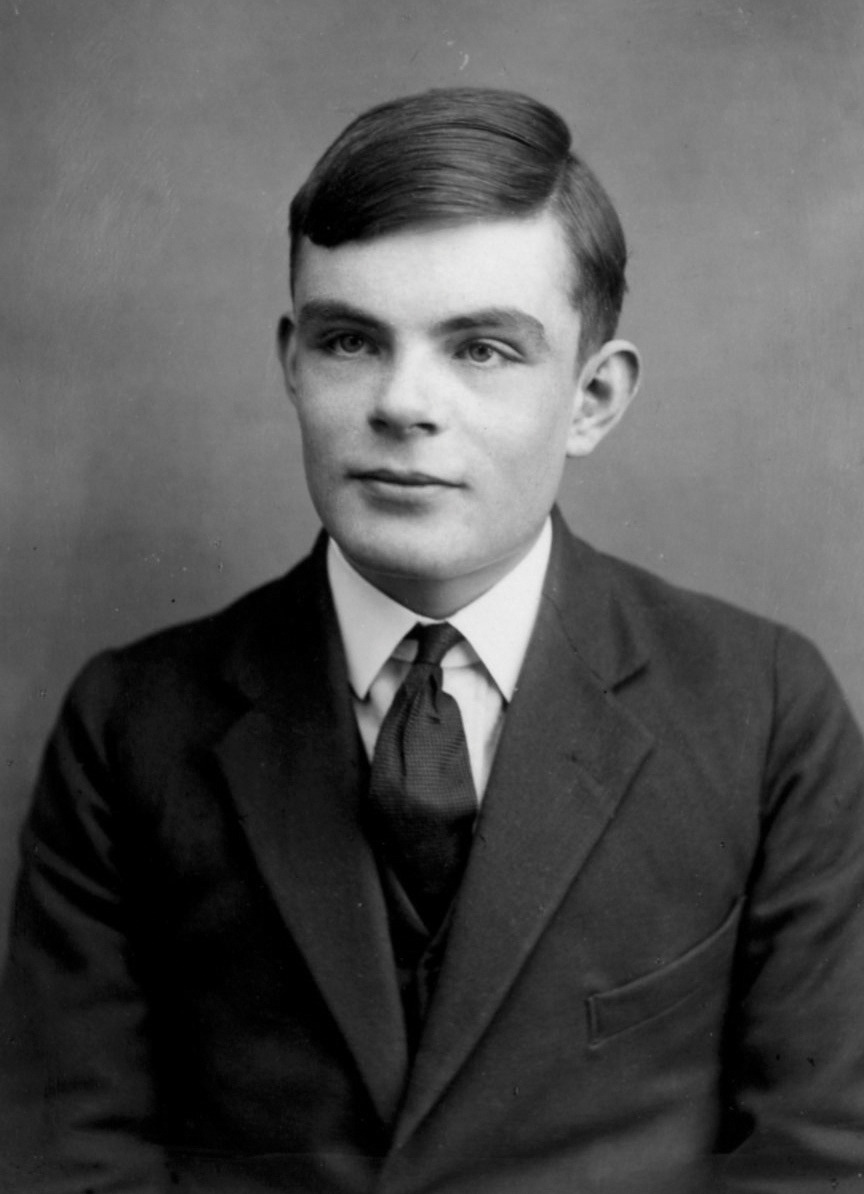
Dates: 1912–1954 CE
Period: Modern period (1900–present)
Alan Turing was the English mathematician who gave calculation an exact definition. In a paper received by the London Mathematical Society on 28 May 1936 he described a machine that follows explicit rules, and then showed that “it is possible to invent a single machine which can be used to compute any computable sequence.”1
The universal machine is his greatest single attainment. It began as an argument in logic, and within 12 years it ran on hardware: in June 1948 Manchester gave what Andrew Hodges calls “the world's first practical demonstration of Turing's computer principle.”2
Zevism reads the work under Theuth, the inventor of number and calculation in Plato's myth, and under the Logos, the rational order of things. Turing wrote down what it means to follow a rule so exactly that a machine could do it.
LIFE AND CONTEXT
He was born on 23 June 1912 in a nursing home in Paddington, London. In 1926, in the middle of the General Strike, he started at Sherborne School in Dorset.3
He went up to King's College, Cambridge, in autumn 1931, took his degree in June 1934 and was elected a Fellow of King's on 16 March 1935. That year a lecture course by Max Newman showed him that a question posed by David Hilbert, the Entscheidungsproblem or decision problem, still lay open.4
In September 1939 he joined the Government Code and Cypher School at Bletchley Park. His section, Hut 8, deciphered German naval and U-boat messages. He crossed the Atlantic in November 1942 for high-level liaison in the United States and came back in March 1943. The work was collective: Gordon Welchman, Joan Clarke and the Polish cryptanalysts belong in the same account.5
After the war he joined the National Physical Laboratory at Teddington and designed the Automatic Computing Engine. In 1948 he moved to Manchester as Deputy Director of the Royal Society Computing Laboratory, under Newman, whose group had its Mark 1 running by March 1949. He also ran long distances, once from London to his mother's home in Guildford. Bletchley Park reckons he might have qualified for the marathon at the 1948 London Olympics if an injury hadn't stopped him.6
Turing was arrested and tried on 31 March 1952, after the police learned of his sexual relationship with a young Manchester man. To stay out of prison he accepted a year of oestrogen injections. He died of cyanide poisoning at his home in Wilmslow on 7 June 1954, and the coroner's verdict was suicide.7 On 24 December 2013 he received a posthumous pardon under the Royal Prerogative of Mercy.8
ATTAINMENTS
- His 1936 paper defined the computable numbers and showed that some problems have no general decision procedure. Alonzo Church reached a related result independently by another method.9
- At Bletchley he developed the concepts behind the bombe, an electro-mechanical machine that found the daily key settings of the Enigma machines used by the German armed forces.6
- He broke the German naval Enigma system at the end of 1939, and his Hut 8 deciphered naval and U-boat messages once captured material made regular reading possible in mid-1941.7
- At Hanslope Park, with a single assistant, Donald Bayley, he built Delilah, his own speech secrecy system.7
- His design for the Automatic Computing Engine won formal approval at the National Physical Laboratory in early 1946.7
- His paper on the chemical basis of morphogenesis, submitted in November 1951 and published in 1952, gave a mathematical account of how biological pattern and form arise.10
- He was appointed OBE for his war work and elected a Fellow of the Royal Society in July 1951. Since 23 June 2021 his portrait has been on the Bank of England £50 note, with a table and formulae from the 1936 paper and drawings of the bombe.11
KEY STORIES
Nature of Spirit
In the science classes at Sherborne, Turing met Christopher Morcom, “another outstanding student and enthusiast for science.” The friendship gave him, in Hodges's words, “a vital period of intellectual companionship.” Then, on 13 February 1930, Morcom suddenly died.12
Turing didn't hide his feelings; he shared them with Christopher's mother. He also wrote out a statement of belief in the survival of the spirit after death, and he brought into it the new science of quantum mechanics. He headed it “Nature of Spirit.”13
The next year he won a scholarship to King's College, Cambridge. The relation of mind to matter came back 20 years later, when he asked in the journal Mind whether a machine could think.13
A Machine Made of Rules
Newman's course of 1935 left Turing with Hilbert's Entscheidungsproblem, the question of the “decidability” of mathematical assertions in general. He answered it by imagining a machine. His paper opens: “The ‘computable’ numbers may be described briefly as the real numbers whose expressions as a decimal are calculable by finite means.” The London Mathematical Society received it on 28 May 1936.14
Then Alonzo Church's paper appeared. Church had reached a related result by another road, and Turing's paper couldn't go out without a reference to it: “In a recent paper Alonzo Church has introduced an idea of ‘effective calculability’, which is equivalent to my ‘computability’, but is very differently defined.” Publication slipped to August 1936.15
He arrived at Princeton University in September 1936 and spent 2 years there as a graduate student. In London, meanwhile, the paper was read to the Society on 12 November 1936.16
From Bomba to Bombe
Turing's bombe began with a Polish machine. The Polish method wasn't enough on its own: Andrew Hodges writes that it “was limited as it depended upon the very particular way the Germans had been using the Enigma.” One of the Polish ideas was built into a machine called the Bomba.7
The way forward, Hodges writes, lay in “Turing's generalisation of the Polish Bombe into a far more powerful device.” Bletchley Park names the men behind it: Alan Turing, Gordon Welchman, Harold “Doc” Keen and others devised the machine.17
From late 1940 the Turing-Welchman Bombe made the reading of Luftwaffe signals routine. Over 200 bombes were built, and with them Bletchley Park read many thousands of German messages until the end of the war.18
The Imitation Game
In October 1950 the philosophy journal Mind printed his paper “Computing Machinery and Intelligence.” Its first line reads: “I propose to consider the question, ‘Can machines think?’” He swapped the question for a game “played with three people, a man (A), a woman (B), and an interrogator (C),” in which the interrogator, in a separate room, tries to tell the man from the woman. Then he asked what happens when a machine takes part.19
He made a forecast that's easy to check, since it carries a date and figures. In about 50 years, he wrote, computers with a storage capacity of about 10⁹ would play so well “that an average interrogator will not have more than 70 per cent. chance of making the right identification after five minutes of questioning.”20
He also met the objection that thinking is “a function of man's immortal soul.” “I am unable to accept any part of this,” he wrote, “but will attempt to reply in theological terms.” Makers of such machines, he answered, wouldn't be usurping God's power of creating souls any more than parents are: “rather we are, in either case, instruments of His will providing mansions for the souls that He creates.” The paper ends: “We can only see a short distance ahead, but we can see plenty there that needs to be done.”20
THE ZEVIST READING
In Plato's myth Theuth invents number and calculation, geometry and astronomy, and then letters.21 Turing's machine joins the 1st gift to the last. It has a tape divided into squares, “each capable of bearing a ‘symbol’,” and by writing and reading those symbols it calculates.22 Zevism reads the universal machine as Theuth's art reduced to its bare rule.
Heraclitus first named the Logos and said that “all things happen according to this Word.”23 Zevism holds itself to be the Logos restored, and Turing's paper gives the Logos a mechanical form. The same paper proves a limit: no single method settles every question. Zevism counts a proven limit as knowledge, since it tells the mind where its instruments reach and where they stop.
The Mind paper touches the aim of the path, ὁμοίωσις θεῷ κατὰ τὸ δυνατόν, becoming like the divine “as far as possible.”24 Turing rejected the objection and answered it in its own language. Zevism reads the question another way: a mind that shapes matter into a new likeness of mind imitates, on a small scale, the intelligence that orders the cosmos. The schoolboy who wrote “Nature of Spirit” and the Fellow of the Royal Society who asked whether machines can think were working on 1 question, the place of mind in the order of things.
Hesiod seats Dike, daughter of Zeus, beside her father.25 In Zevist terms the law must answer to that seat. The law that convicted Turing for his private life was a false measure, and the pardon of 2013 set a small part of the record right.
NOTES
1 Turing, “On Computable Numbers,” 1936, §6.
2 Hodges, “Alan Turing: A Short Biography”.
3 Hodges, Alan Turing Scrapbook, “Early Life”.
4 Bletchley Park, “10 Things to Know about Alan Turing”; Hodges, “Short Biography”.
5 Bletchley Park; Hodges, “Short Biography”; GCHQ, “Alan Turing”.
8 Ministry of Justice, “Royal Pardon for WW2 Code-Breaker Dr Alan Turing”; University of Manchester, “Alan Turing”.
10 Hodges, “Short Biography”; MacTutor.
11 Hodges, “Short Biography”; Bank of England, “£50 note”.
12 Hodges, Scrapbook, “Spirit”; Hodges, “Short Biography”.
13 Hodges, Scrapbook, “Spirit”.
14 Turing, “On Computable Numbers”; Hodges, Scrapbook, “Machine”.
15 Turing, “On Computable Numbers”; Hodges, “Short Biography”.
16 Hodges, “Short Biography”; Turing, “On Computable Numbers”.
17 Bletchley Park, “Hut 11A: The Bombe Breakthrough”; Hodges, “Short Biography”.
18 Hodges, “Short Biography”; Bletchley Park.
19 Turing, “Computing Machinery and Intelligence”.
20 Turing, Mind 59.
22 Turing, “On Computable Numbers,” §1.
23 Graham, “Heraclitus,” §2, fragment B1.
25 Hesiod, Works and Days 256–262.
BIBLIOGRAPHY
A. M. Turing, “On Computable Numbers, with an Application to the Entscheidungsproblem”, Proceedings of the London Mathematical Society, series 2, vol. 42, received 28 May 1936, read 12 November 1936; opening sentence, introduction, §6.
A. M. Turing, “Computing Machinery and Intelligence”, Mind 59, no. 236 (October 1950), 433–460; §1, the theological objection, closing sentence.
Andrew Hodges, “Alan Turing: A Short Biography”, The Alan Turing Internet Scrapbook, based on his 1995 entry for the Oxford Dictionary of Scientific Biography; with the Scrapbook pages “Early Life” and “Spirit”.
J. J. O'Connor and E. F. Robertson, “Alan Turing”, MacTutor History of Mathematics, University of St Andrews; computability, Church and morphogenesis.
Bletchley Park Trust, “10 Things to Know about Alan Turing”; Cambridge dates, Bletchley, the bombe, NPL, Manchester and running.
GCHQ, “Alan Turing”, “Bletchley Park”; wartime collaboration.
Ministry of Justice, “Royal Pardon for WW2 Code-Breaker Dr Alan Turing”, GOV.UK, 24 December 2013.
University of Manchester, “Alan Turing”, heritage biography; prosecution and pardon.
Bank of England, “£50 note”; issue date and design.
Plato, Phaedrus 274c–d, translated by H. N. Fowler, and Theaetetus 176a–b, Greek text, Perseus Digital Library.
Daniel W. Graham, “Heraclitus”, Stanford Encyclopedia of Philosophy, §2, fragment B1.
Hesiod, Works and Days 256–262, translated by H. G. Evelyn-White, Theoi Classical Texts Library.
CREDIT
Image: Alan Turing at approximately sixteen, 1928–1929; photographer possibly Arthur Reginald Chaffin, as qualified in the file record. Commons records public-domain status; verified file record.

Alan Turing at age sixteen, photographer possibly A. R. Chaffin, via Wikimedia Commons; public domain. Image record, Publicdomain asrecordedonCommons;PD-old-70-expired;pre1931publication.
The round picture in the lists of the personalities is cropped from it.