





9 min read
Great Printer
Aldus Manutius
author: High Priest Zevios Metathronos
The Craft That Put Wisdom into Readers' Hands
Dates: c. 1450–1515 CE
Period: Renaissance (1336–1650 CE)
Aldus Manutius was a scholar who became a printer in Venice. In 20 years of work, from 1495 to 1515, he published more than 120 editions, and the Grolier Club counts “no fewer than thirty first editions of Greek literature” among them. With the punchcutter Francesco Griffo he also made the earliest book printed entirely in italic type.1
His greatest attainment can be weighed in paper. The complete Greek Aristotle he printed between 1495 and 1498 took more leaves of Greek type than all the presses before him had printed since Gutenberg, and his Plato of 1513 was the first complete printed edition.2
Aldus was a Christian and said so in his prefaces. Zevism counts printers among the keepers of the source, and it reads his press under Prometheus, whom Aeschylus credits with “the combining of letters, creative mother of the Muses' arts.”3
LIFE AND CONTEXT
He was born at Bassiano, about 40 miles southeast of Rome. The year isn't certain: the Grolier Club gives about 1452, the Morgan Library's authority record 1449 or 1450. One of his teachers was the humanist Battista Guarino, who'd later ask his former pupil for books.4
Around 1490 he moved to Venice to enter the printing trade. His first appearance in print there, the Musarum Panagyris, wasn't from his own press: Baptista de Tortis printed it some time between 1487 and 1491. The Grolier exhibition calls it the “first Aldine” and reads it as an announcement of the programme to come.5
The first dated book of his own press was Constantine Lascaris's Greek grammar, the Erotemata, finished on 8 March 1495, with Aldus's Latin translation printed beside the Greek so that beginners could use it. He stated his aim through Horace: “To the Greeks the Muse gave genius and Well-rounded speech.” He wanted the models of great literature in readers' hands “both day and night.”6
He didn't work alone. Cambridge University Library describes texts “revised by him and eminent scholars such as Chalcondylas and Musurus,” and Griffo cut his italic. Marcus Musurus edited his Aristophanes and shared the work on the Plato.7
In 1499 he printed the Hypnerotomachia Poliphili, a book whose woodcuts and text were laid out together, which Cambridge calls “his most accomplished illustrated book.” A year later the first italic words ever printed appeared in one of his books, a volume of Catherine of Siena, where the words “iesu dolce” and “iesu amore” were cut in the new letter.8
His faith shaped his list. Of the Poetae Christiani Veteres, printed from 1501 to 1504, he wrote that students could “learn Greek while studying sound doctrine” instead of relying on “pagan and lascivious poets.” The same shop printed Hesiod, Aristophanes and Plato.6
He dedicated the Plato of 1513 to Giovanni de' Medici, newly elected as Pope Leo X, and printed Athenaeus in 1514. He died in Venice on 6 February 1515.9
ATTAINMENTS
- He published more than 120 editions between 1495 and 1515, many of them texts revised with scholars such as Chalcondylas and Musurus.10
- He printed the complete works of Aristotle in Greek between November 1495 and June 1498.11
- His Aristophanes of 1498 set Musurus's compendium of ancient scholia in smaller Greek type around the lines of the plays, after Musurus had compared many manuscripts.11
- He and Musurus produced the first complete printed Plato in 1513, 2 volumes of 932 leaves in all.12
- He introduced italic type: a few italic words in a book of 1500, then the complete Virgil of April 1501, cut by Griffo.13
- He launched a series of small octavo classics, starting with the Virgil and the Horace of 1501, which he called his portable library.14
- He printed the Hypnerotomachia Poliphili in 1499, which the Grolier Club calls “a masterpiece of integrated text and design.”15
KEY STORIES
The Greek Aristotle
In November 1495 Aldus began printing Aristotle in the original Greek, and he didn't stop until June 1498. The set gave the complete works. The Grolier Club puts its scale in one comparison: it “represented more leaves of Greek type than had cumulatively been printed since the time of Gutenberg.”11
In the middle of that work his old teacher wrote to him. Battista Guarino needed Hesiod for his students, and in 1496 Aldus sent him a volume with Theocritus and Hesiod and a dedication: “Here, most illustrious master, is the Theogonia of Hesiod, which you ask me to provide for the public instruction of your pupils.” The pupil had become the supplier of his master's classroom.11
In 1498 came the Aristophanes. Musurus claimed to have compared many manuscripts for it, and the ancient commentary was printed in a smaller Greek type that wrapped around the lines of each play, so a reader saw text and scholia on 1 page.11
The Portable Library
In April 1501 Aldus issued a Virgil in octavo, small enough to hold in 1 hand and set entirely in italic. Griffo had cut the type, modelling it on humanist handwriting; Aldus's own petition for legal protection says as much. The Grolier Club dismisses the old story that italic was chosen to save paper: “Arguments that italic type enabled more words to fit on the page, thereby saving paper and lowering costs, have proven unfounded.”15
A Horace followed in May. Cambridge's copy shows how Griffo adapted a formal script for the press. Then came Catullus, Tibullus and Propertius, and Petrarch and Dante.16
Aldus meant the series as a reader's companion. The Grolier exhibition compares it to the small books of hours people carried for prayer. In the dedication of the Catullus to Marino Sanuto, as the exhibition translates it, he hoped that “this small format enables readers to come and go with Catullus constantly and conveniently in hand.”17
The Coin of Titus
The humanist Pietro Bembo once showed Aldus a silver denarius struck under the emperor Titus. On it was a dolphin with an anchor, and Bembo saw that the image “succinctly reflected Aldus's twin objectives.” In June 1502 the dolphin and anchor appeared as Aldus's printer's mark, in the 2nd volume of the Poetae Christiani Veteres.18
The motto that went with it was festina lente, make haste slowly. Erasmus explained the emblem in his Adages of 1508: in the exhibition's summary, the dolphin stood for speed of production and the anchor for stability of purpose.19
The coin itself dated from 80 CE, the year after Vesuvius erupted. The exhibition suggests its sea creature and anchor may belong to Rome's efforts to appease Neptune, whom Romans blamed for the eruption. If so, Aldus's mark began on a coin struck to honour the God of the sea.19
Hercules at the Printer's Door
By 1514 the press had made Aldus famous, and fame brought visitors. In the preface to that year's edition of the Rhetorica ad Herennium he complained about the callers who ate his working day, and he gave them a rule: “State your business briefly, and then immediately go away, unless like Hercules you come to support the arms of weary Atlas.”15
The printer had cast himself as weary Atlas and wished for a Hercules. The image put the whole enterprise into 2 figures: a scholar straining under a load, and the helper each caller might have been.15
He died on 6 February 1515, within a year of that preface, and the news went out to the world in the preface to the press's edition of Lactantius. His father-in-law, Andrea Torresani, carried the press on until his own death in October 1528, and it closed in 1529.20
THE ZEVIST READING
Zevism is the chain of all spirituality from its inception to today, and it holds that one must return to the source. Transmitters are honoured in that chain as keepers of the source, and printers stand among them. An editio princeps fixes a text that had lived only in scattered manuscripts. Aldus did that at least 30 times for Greek literature, and his Aristotle and Plato gave the Hellenic source a printed form that readers could return to anywhere.
Aeschylus has Prometheus claim the gift behind that work: “numbers, too, chiefest of sciences, I invented for them, and the combining of letters, creative mother of the Muses' arts.” A few lines later he sums up: “every art possessed by man comes from Prometheus.”21 That's the combining of letters made mechanical. Zevism reads Griffo's punches and Aldus's press as that Promethean gift worked out in lead.
Aldus himself put the Muse at the head of his programme when he quoted Horace. He printed as a Christian and said he wanted students to learn Greek through sound doctrine. The Temple reads the Greek books he printed as the Muses' gift carried forward. His mark tells the same story in miniature: the dolphin and anchor came from a Roman coin that may have been struck for Neptune, Poseidon to the Greeks, and it first stood on the page of his Christian poets in 1502.
The door notice of 1514 gives the last doctrine. The Creator builds, and creation is open forward and requires work; festina lente is a rule for that work, speed held steady by purpose. Zevism asks the heirs of such a builder for the answer Aldus wanted from his visitors: to come as Hercules, and take a share of the weight.
NOTES
1 Cambridge University Library, Aldus Manutius; Grolier Club, Aldus Manutius: A Legacy More Lasting Than Bronze.
2 Grolier Club, “Saving the Greeks”; BYU Library, “Plato. Works (1513)”.
3 Aeschylus, Prometheus Bound 459–461.
4 Grolier Club; Morgan Library & Museum, PML 1439; “Saving the Greeks”.
5 Grolier Club, “In the Beginning”.
7 Cambridge, Aldus Manutius; BYU Library.
8 Cambridge; “Pressing Business”.
9 “Saving the Greeks”; Cambridge.
10 Cambridge.
12 BYU Library.
13 Grolier Club, “Pressing Business”.
14 Grolier Club, “Libelli Portatiles”.
16 Cambridge University Library, “Horace, Carmina, 1501”; “Libelli Portatiles”.
18 Grolier Club, “The Dolphin and Anchor”.
20 Grolier Club, “The Heirs of Aldus”.
21 Aeschylus, Prometheus Bound 459–461, 505–507.
BIBLIOGRAPHY
Cambridge University Library, Aldus Manutius, online exhibition; life dates, output of more than 120 editions, collaborators. With the object essay “Quintus Horatius Flaccus, Carmina, 1501”, shelfmark Sel.6.47, fol. i7r.
Grolier Club, Aldus Manutius: A Legacy More Lasting Than Bronze, curated by G. Scott Clemons and H. George Fletcher, 2015; introduction and “In the Beginning” (Musarum Panagyris, Lascaris 1495, Poetae Christiani Veteres).
Grolier Club, “Saving the Greeks”, entries for Theocritus and Hesiod (1496), Aristotle (1495–98), Aristophanes (1498) and Plato (1513).
Grolier Club, “Pressing Business”, entries for Virgil (April 1501), Catherine of Siena (1500), Hypnerotomachia Poliphili (1499) and Rhetoricorum ad C. Herennium (1514).
Grolier Club, “Libelli Portatiles”, “The Dolphin and Anchor” and “The Heirs of Aldus”.
Brigham Young University Library, “Plato. Works (1513)”, Aldine exhibition, item 61.
Morgan Library & Museum, Aldus's Rudimenta grammatices latinae linguae, PML 1439, February 1501; author authority gives 1449 or 1450–1515.
Aeschylus, Prometheus Bound 459–461 and 505–507, translated by Herbert Weir Smyth, Theoi Classical Texts Library.
CREDIT
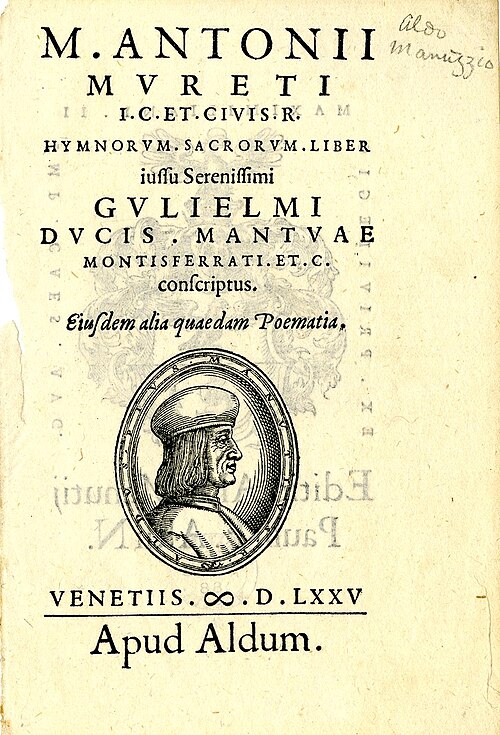
Picture: Posthumous portrait of Aldus on a 1575 title page, anonymous woodcut and letterpress from Marc-Antoine Muret's Hymnorum Sacrorum Liber. British Museum, 1865,0708.88; public domain.
.jpg)
Anonymous woodcut artist / Wikimedia Commons; Public domain (Commons PD-scan). Image record, Public domain (Commons PD-scan).
The round picture in the lists of the personalities is cropped from it.