




9 min read
Discoverer of Penicillin
Alexander Fleming
author: High Priest Zevios Metathronos
Attention in the Service of Healing
Dates: 1881–1955
Period: Modern period
Alexander Fleming was a Scottish bacteriologist who spent his working life at St Mary's Hospital in London. In 1928 he saw that a stray mould on a culture plate had destroyed the bacteria growing near it, and he gave the substance it released a name: penicillin.1
Fleming couldn't purify the substance himself. An Oxford team under Howard Florey and Ernst Chain made it into a drug, and in 1945 the 3 men shared the Nobel Prize in Physiology or Medicine “for the discovery of penicillin and its curative effect in various infectious diseases.”2
Zevism receives this work under Asclepius and Hygieia, the powers of healing and of the body kept whole. It also reads the clear ring around Fleming's mould as light carried into darkness, a small patch of the unseen world made known and then put to the service of the sick.
LIFE AND CONTEXT
Fleming was born on 6 August 1881 at Lochfield Farm near Darvel, in Ayrshire. He was the 7th of 8 surviving children in a farming family, and his father died when the boy was 7. At 13 he followed a stepbrother, already a practising physician, to London.3
In his teens he attended classes at the Regent Street Polytechnic, worked as a shipping clerk and served briefly in the army during the Boer War, though he didn't see combat. In 1901 a scholarship took him to St Mary's Hospital Medical School in Paddington, “which remained his professional home for the rest of his life.”4
In 1906 he joined the Inoculation Department at St Mary's under Sir Almroth Wright. Wright wanted to strengthen the body's own defences with vaccines and distrusted chemotherapy, the treatment of disease with outside chemical agents.4
The First World War sent Fleming to a wound-research laboratory at Boulogne, run by Wright. There he found that “chemical antiseptics like carbolic acid do not sterilize jagged wounds” and that “pus has its own antibacterial powers.”4
In 1921 he found a substance in nasal mucus that made bacteria disintegrate and called it lysozyme. It worked best against harmless airborne bacteria, and his attempts to concentrate it failed. Penicillin would give him the same trouble 7 years later.4
His paper on penicillin appeared in June 1929 and drew little notice through the 1930s. Florey and Chain showed in 1940 that it worked as a medicine, and Fleming shared the Nobel Prize with them 5 years later. He died in London on 11 March 1955, aged 73.5
ATTAINMENTS
- At Boulogne during the First World War he showed that carbolic acid and similar antiseptics couldn't sterilize jagged wounds, and that “in dilutions harmless to bacteria” they “actually damage white blood corpuscles,” the body's own defenders.4
- In 1921 he discovered lysozyme, a bacteria-dissolving substance in nasal mucus, and with a colleague traced it in blood serum, tears, saliva, milk and many other fluids.4
- In 1928 he observed a mould killing staphylococci on a culture plate, established that only certain strains of Penicillium, namely Penicillium notatum, made the active substance, and named it penicillin.4
- He measured the crude product's stability at different temperatures and over different periods, tested it against many microbes and checked its toxicity on a laboratory mouse and a rabbit.4
- He published the discovery in the British Journal of Experimental Pathology in June 1929, his first paper on penicillin, and later told the Nobel audience plainly that his own attempts to concentrate it had failed.6
- In 1945 he shared the Nobel Prize in Physiology or Medicine with Ernst Boris Chain and Howard Walter Florey.7
- In his Nobel lecture of 11 December 1945 he warned that exposing bacteria carelessly to too little penicillin could breed resistance.8
KEY STORIES
The Plate Left on the Bench
In 1928 Fleming was working on staphylococcus, the germ behind boils and behind disastrous infections in patients with weak immune systems. Before he left for a holiday of 2 weeks, a Petri dish of staphylococcus was left on the laboratory bench and never went into the incubator. A spore of Penicillium had got into the medium, perhaps through a window or, more likely, up the stairwell from a laboratory below where moulds were being grown.4
The temperatures of those 2 weeks let both the bacteria and the mould grow. In the incubator only the bacteria could have. When Fleming came back, the colonies near the mould had changed. He photographed the plate, and the photograph shows lysis: the bacteria near the mould weakened and destroyed.9
He kept the mould and spent the following months on experiments, varying the conditions systematically. Not every mould made the substance; only certain strains of Penicillium did. He couldn't isolate the active substance, yet he named it “penicillin,” measured how long it kept and at what heat, and tried it against one microbe after another.4
Fleming never polished the tale. His notebooks are sketchy, and “his subsequent accounts of the discovery are contradictory”: sometimes he spoke of lysis, sometimes of a clear zone where the mould “juice” had stopped growth. In Stockholm in 1945 he called the start a chance observation and refused to invent a plan behind it.9
Bedpans, Biscuit Tins and 700 Vessels
The paper of 1929 lay nearly untouched for a decade. The few scientists who sent for samples “did not or could not capitalize on Fleming's discovery.”4 At Oxford, Florey's team took up the mould again. Their first problem was growing enough of it.
Norman Heatley answered with anything that would spread the culture medium wide. The museum at Oxford records that he used “any convenient vessels that could provide a large surface area for the mould's culture medium,” and that the laboratory “became home to cans of sheep dip, pie dishes, bed pans and biscuit tins.”10
Then he designed a rectangular ceramic vessel that could be stacked. The Staffordshire pottery firm James Macintyre and Co. made 700 of them. Heatley seeded the first batch with spores on Christmas Day 1940, and he built a semi-automatic apparatus that extracted and purified the penicillin continuously; its control panel still survives. The penicillin from those vessels treated the first 6 patients at the Radcliffe Infirmary in Oxford in 1941.11
The Policeman at the Radcliffe
On 12 February 1941 Albert Alexander, a 43-year-old policeman, was given penicillin at the Radcliffe Infirmary. He had a serious infection, and at first he got better. Then, in the words of the University of Oxford's account, “supplies of the penicillin ran out before the cure could be completed.” He died of his infection shortly afterwards.12
The team fought for every trace of the drug. Patients' urine was collected in the hospital and “carried back to the laboratory by bicycle,” and any penicillin left in it was extracted so it could be injected into a patient again. Lady Florey often rode as courier for this “P patrol.”13
A tiny glass vial dated 25 June 1941 survives from that work. In 1941 Florey and Heatley also made a secret crossing of the Atlantic “to mobilise American interest,” and American factories took production to a scale Oxford couldn't reach. One vial from the largest American plant still carries a prescription label showing that it treated a soldier, Private Blanchard.14 Alexander's death showed the gap between a cure that works and a cure that reaches the bed. Zevism counts the closing of that gap as part of the healing art.
THE ZEVIST READING
The Hippocratic Oath opens with the healing powers: “I swear by Apollo the physician, and Asclepius, and Hygieia and Panacea and all the gods.”15 Asclepius cures, Hygieia keeps the body whole, and Panacea's name means the remedy for all. Aeschylus has Prometheus claim that mortals wasted away for lack of medicine until he showed them how to mix healing remedies.16 A drug that turned deadly infections into curable ones belongs to that same domain.
Zevism holds that unexplored darkness isn't evil. It's the part of the world no one has yet walked into with a lamp. The contest between mould and bacterium on Fleming's plate went on whether anyone watched or not. When he noticed the clear zone, kept the mould and worked out what it did, that darkness became knowledge, and knowledge became a remedy.
Infection is a form of Izfet, dissolution working inside a living body. Healing restores Ma'at, “the personification of truth, justice, and the cosmic order,” which Zeus holds as Sovereign of the Cosmos.17 Fleming's warning in Stockholm belongs to the same order. A remedy used without measure hands the disorder back its strength, and measure is Apollo's gift as much as healing is.
Ma'at also governs the record. Fleming's notebooks were thin and his later accounts didn't agree, yet before the Nobel audience he refused to dress a lucky observation as a plan. A true account of how knowledge arrived, chance included, keeps the order of truth that Ma'at names, and a legend improved for effect would have broken it.
The penicillin story also shows how Zevism honours a chain of transmission. Fleming held the source: the plate, the mould and the paper of 1929. Florey, Chain and Heatley carried it forward, and Lady Florey pedalled urine back to the laboratory so that none of it would be lost. Each did what lay within his or her power, κατὰ τὸ δυνατόν. That's the measure Plato set for ὁμοίωσις θεῷ, becoming like the divine as far as possible, and here it was met at a laboratory bench and a hospital bed.18
NOTES
1 Science History Institute, “Alexander Fleming”.
2 Nobel Prize, “The Nobel Prize in Physiology or Medicine 1945”.
3 Britannica, “Alexander Fleming”; Science History Institute.
5 Science History Institute; Britannica.
6 Fleming, Penicillin, Nobel lecture, pp. 83–85, 91–93.
9 Science History Institute; Fleming, Penicillin, pp. 83–85.
10 History of Science Museum, Oxford, “Production”.
11 “Production”.
12 University of Oxford, “Norman Heatley,” 22 February 2024.
13 History of Science Museum, Oxford, “Consumption”.
14 History of Science Museum, “Original penicillin culture and specimen”; “Consumption”.
15 NLM, “Greek Medicine,” Oath tr. Michael North.
16 Aeschylus, Prometheus Bound 477–481.
BIBLIOGRAPHY
Science History Institute, “Alexander Fleming”, Scientific Biographies; early life, St Mary's, Wright, Boulogne, lysozyme, the 1928 plate and the reception of the 1929 paper.
Encyclopaedia Britannica, “Alexander Fleming”; birth and death dates and places.
Alexander Fleming, Penicillin, Nobel lecture, 11 December 1945, printed pp. 83–93; especially pp. 83–85 and 93.
Nobel Prize Outreach, “The Nobel Prize in Physiology or Medicine 1945”; laureates and prize motivation.
History of Science Museum, University of Oxford, “Production”, Back from the Dead exhibition; Heatley's vessels and extraction apparatus.
History of Science Museum, University of Oxford, “Consumption”, Back from the Dead exhibition; the recovery of penicillin from urine and the “P patrol.”
History of Science Museum, University of Oxford, “Original penicillin culture and specimen”, inventory numbers 23034 and 14439; the vial dated 25 June 1941 and the 1941 American visit.
University of Oxford, “The lasting legacy of Norman Heatley, the unassuming penicillin pioneer who changed the course of medicine”, 22 February 2024; Albert Alexander.
US National Library of Medicine, “Greek Medicine”, Hippocratic Oath tr. Michael North, 2002.
Aeschylus, Prometheus Bound 477–481, tr. Herbert Weir Smyth, Theoi Classical Texts Library.
Encyclopaedia Britannica, “Maat”; Plato, Theaetetus 176a–b, Greek text, Perseus Digital Library.
CREDIT
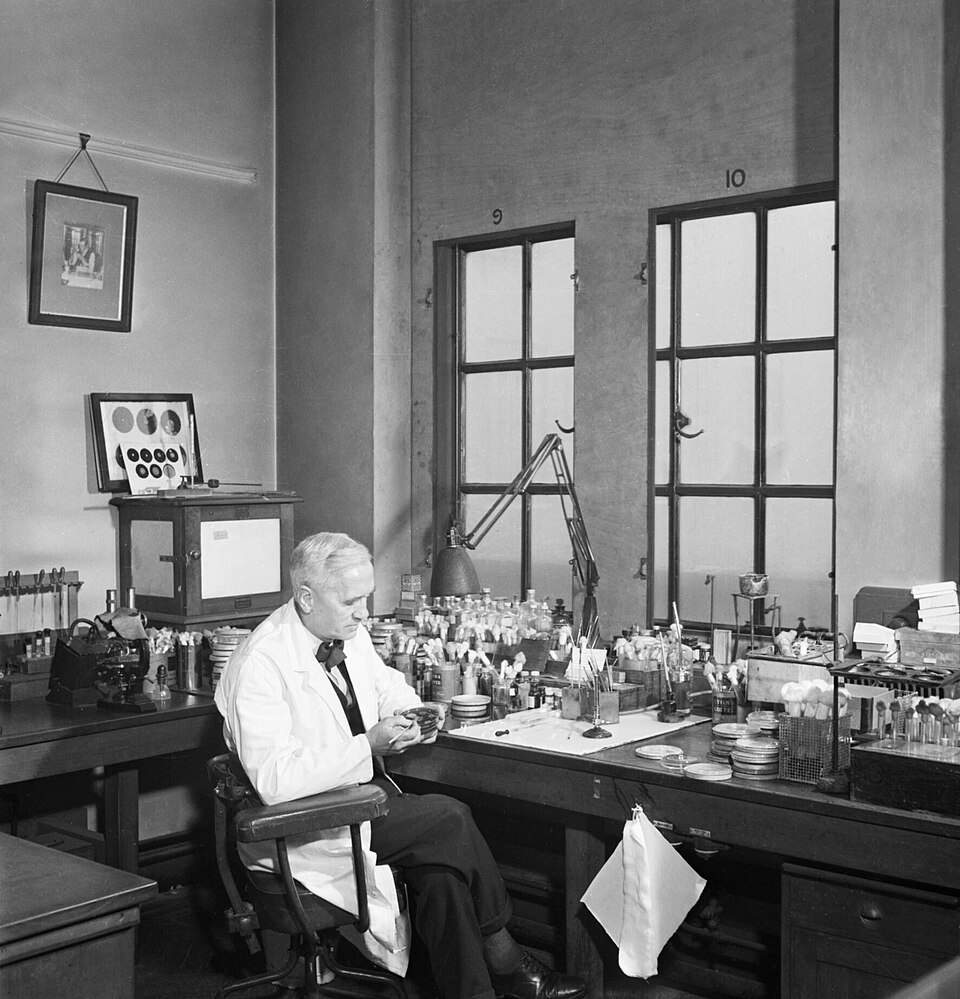
Picture: Alexander Fleming at work in his St Mary's Hospital laboratory during the Second World War.
Imperial War Museums D17801, via Wikimedia Commons; expired Crown copyright. Image record, Public domain (expired Crown copyright; faithful scan).

The round picture in the lists of the personalities is cropped from it.