





9 min read
Poet of Proserpine
Algernon Charles Swinburne
author: High Priest Zevios Metathronos
The Sacred Memory Carried by Song
Dates: 1837–1909 CE
Period: Imperial Era, 1804–1900
Principal work discussed: 1866
Algernon Charles Swinburne was the English poet who wrote a tragedy on the Greek model in English verse before he was 30 and wrote Greek verse well enough to satisfy a bishop who had written a history of Greece. Atalanta in Calydon (1865), “written in the form of classical Greek tragedy,” made his name.1 A year later Poems and Ballads drew such abuse that its publisher pulled it from sale within days.2
Swinburne wasn't a believer. He called his own “Hertha” “another mystic atheistic democratic anthropologic poem.”3 Yet his verse called the old Gods by name, Artemis, Proserpine, Athena and Apollo, and Zevism reads that work as service to the Muses. In “The Last Oracle” he calls on Apollo by name as father, destroyer and healer.
LIFE AND CONTEXT
Swinburne was born in London on 5 April 1837, “the child of an admiral, Captain Charles Henry Swinburne, and Lady Henrietta Swinburne.” He grew up at Capheaton Hall and at Bonchurch on the Isle of Wight.4 He later told Landor that Landor's poems “had first given him inexplicable pleasure and a sort of blind relief when he was a small fellow of twelve.”5
In September 1849 his parents took him to Rydal Mount, “where the aged Wordsworth received them with great civility.”5 He went to Eton from 1849 to 1854 and to Balliol College, Oxford, in January 1856, and he left the university without a degree in 1860. For a time he shared a house in Chelsea with D. G. Rossetti and George Meredith.4
Atalanta in Calydon “was the first poem to come out under his name and was received enthusiastically.”6 Its 1st chorus begins: “When the hounds of spring are on winter's traces, / The mother of months in meadow or plain / Fills the shadows and windy places / With lisp of leaves and ripple of rain.”7
The next book fared worse. Everett writes that “Laus Veneris” and Poems and Ballads, “with their sexually charged passages, were attacked all the more violently.” In 1867 he met Mazzini, the exiled Italian patriot, and the meeting “led to the more political Songs before Sunrise” of 1871.6
He went back to the Greek model in Erechtheus (1876), with Erechtheus, Praxithea and Chthonia among its persons and a chorus of Athenian elders. Near the close Athena herself speaks: “Hear, men that mourn, and woman without mate.”8
Drink nearly killed him. “In 1879, with Swinburne nearly dead from alcoholism and dissolution, his legal advisor Theodore Watts-Dunton took him in.”9 Watts-Dunton took him to The Pines, “near the bottom of Putney Hill,” and Swinburne lived there for the last 30 years of his life. He died on 10 April 1909 and was buried at Bonchurch.10
ATTAINMENTS
- He published Atalanta in Calydon in 1865, a full tragedy on the Greek model about the hunt at Calydon and the fate of Meleager, Atalanta and Althaea. Its first lines address Artemis as “Maiden, and mistress of the months and stars.”11
- He dedicated Atalanta to Landor in 2 pieces of Greek elegiac verse, which Bishop Connop Thirlwall read and praised.12
- Poems and Ballads (1866) printed the “Hymn to Proserpine” on pages 77–84, a monologue set “After the Proclamation in Rome of the Christian Faith.”13
- Songs before Sunrise (1871) carried “Hertha,” the poem he'd choose “if one single and separate poem were perforce to be picked out of my lot.”3
- Erechtheus (1876) gave English a 2nd Greek tragedy of his, with Athena herself in the cast.14
- The 2nd series of Poems and Ballads (1878) opened with “The Last Oracle,” an invocation of Apollo.15
KEY STORIES
The Blessing in Florence
In 1864 Swinburne went to Italy, and “one of his earliest acts was to call on the aged Walter Savage Landor, armed with a letter of introduction from Milnes.” Landor was in his 90th year. The young poet threw himself down, “flinging himself on both knees before the old man,” and “implored his blessing.”16
The meeting went badly. “Landor was so feeble and deprecating, so perplexed and uncomfortable, that Swinburne withdrew ‘in a grievous state of disappointment and depression.’” Swinburne didn't give up, and a later visit went differently. Gosse tells how the aged poet called him his “dear friend” and added: “let me now and ever call you so.”17
Landor died before Atalanta appeared. Swinburne kept the Greek verses he'd written for the living man and added more “evoked by the news of his death.” The English preface dedicates the play “to the memory of Walter Savage Landor” with “equal affection, reverence, and regret,” so that “though losing the pleasure I may not lose the honour of inscribing in front of my work the highest of contemporary names.”18
The Bishop Reads the Greek
Swinburne printed 2 pieces of Greek elegiac verse to Landor at the front of Atalanta, and Gosse says that over these he “had taken very great pains.” Lord Houghton was preparing to review the play for the Edinburgh Review, and Swinburne feared the Greek “might escape attention, as Houghton made no pretence to being an expert.”19
At the poet's suggestion Houghton wrote to Connop Thirlwall, Bishop of St David's and historian of Greece. “The Bishop read Atalanta, and came to dinner with Lord Houghton to talk it over.” His verdict on the elegiacs was that Swinburne's thoughts moved “with scarcely less ease and freedom in the language and measures of Callinus and Mimnermus than in his native speech.” He also flagged 1 idea in the drama that, in his phrase, would “have made Aeschylus stare and Sophocles shudder.”20
The Week the Book Was Withdrawn
The Saturday Review was, in Gosse's words, “by far the most powerful organ of literary opinion in 1866.” On 4 August it ran a long article on Poems and Ballads, and it “had condemned the book before it was obtainable in the shops.” The reviewer called Swinburne “an unclean fiery imp from the pit” and “the libidinous laureate of a pack of satyrs.”21
The publishing house of Moxon had reason to be afraid. In 1841 Edward Moxon had been prosecuted for reprinting Shelley's Queen Mab. His successor, J. Bertram Payne, “had not hesitated, but on the 5th of August had curtly informed Swinburne that Poems and Ballads was withdrawn from sale.”22
Swinburne took everything he'd published away from Moxon. John Camden Hotten agreed to reissue the book, and “for the existing copies of Poems and Ballads Hotten paid Moxon £200.” The volume the reviewers had condemned before it reached the shops came back on sale under Hotten's imprint.23
Adrift off the Normandy Coast
In 1868 Swinburne was staying with his friend George Powell at Étretat on the Normandy coast. He went swimming and was caught by a “tide that was setting from the Porte d'Amont.” He “was never a powerful swimmer, in consequence of the weakness of his arms,” but he kept himself up by floating.24
He later described the moment to Gosse. As he “floated to his death, as he supposed, he reflected with satisfaction that his republican poems were nearly ready for the press.” He'd “nearly reached the limits of his endurance when he was sighted by a fishing-vessel, the Marie Marthe, which was making for Yport, where the poet was ultimately landed, wrapped in a sail.”24
Soon afterwards “an inquisitive and precocious collegian, home for the holidays, offered his services and was received by the English friends.” His name was Guy de Maupassant, and he left a portrait of the Englishman that Gosse calls “highly colored” but “of extreme value.”25
THE ZEVIST READING
“The Last Oracle” gives the Zevist reading its text. Swinburne dated the poem A.D. 361, the year Julian became emperor, and opened it with Delphi silent: “Years have risen and fallen in darkness or in twilight, / Ages waxed and waned that knew not thee nor thine, / While the world sought light by night and sought not thy light.”26 The poem then calls the God back by his healing name: “O father of all of us, Paian, Apollo, / Destroyer and healer, hear!”
Zevism holds that darkness no one has explored isn't evil. It's the ground light enters, and explored darkness becomes knowledge. Swinburne's image fits the doctrine: an age that sought light by night and didn't seek the God's light. His poem carries that light back into the dark.
The “Hymn to Proserpine” shows the other posture. Its speaker opens, “I have lived long enough,” and ends in exhaustion: “For there is no God found stronger than death; and death is a sleep.”13 Zevism names this voice. It's the andrapod's, living among ruins and answering them with lament. The poem is beautiful, and the Temple keeps it, but the Temple's answer comes from “The Last Oracle,” which calls on the God and expects him to hear.
The Greek verses for Landor finish the reading. Swinburne went back to the language of the source and wrote in it for a living master, and Zevism honours that return. His 2 tragedies do the same work in English. Atalanta opens with a huntsman praying to Artemis, “Goddess whom all gods love with threefold heart,” and Erechtheus brings Athena onto the stage to speak to her city.7 Zevism counts both plays as service to the Muses, who keep the arts and the memory of the Gods.
NOTES
1 Poetry Foundation, “Algernon Charles Swinburne”.
2 Gosse, Life of Swinburne, pp. 150–154.
4 RPO, “Algernon Charles Swinburne”.
6 Everett, “Swinburne: A Brief Biography”.
8 Swinburne, Erechtheus, persons of the drama; Victorian Web, “A. C. Swinburne's Works”.
9 Everett.
10 RPO.
11 RPO, Atalanta in Calydon, Argument and lines 1–41; Atalanta in Calydon, 1885 text.
14 Erechtheus.
15 Everett; Poems and Ballads, 2nd and 3rd series.
16 Gosse, Life of Swinburne, pp. 101–104.
18 Swinburne, Atalanta in Calydon, dedication.
19 Gosse, p. 114.
25 Gosse, p. 179.
26 Swinburne, “The Last Oracle”; Britannica, “Julian”.
BIBLIOGRAPHY
Edmund Gosse, The Life of Algernon Charles Swinburne, New York: Macmillan, 1917; pp. 101–106, 114–115, 142, 150–154, 178–179, searched in the Internet Archive full text.
Representative Poetry Online, University of Toronto, “Algernon Charles Swinburne”, biography: birth, parents, Eton, Balliol, The Pines, death and burial.
Glenn Everett, “Swinburne: A Brief Biography”, The Victorian Web.
Poetry Foundation, “Algernon Charles Swinburne”, biography.
Algernon Charles Swinburne, Atalanta in Calydon, London: Chatto & Windus, 1885; dedication and opening lines.
Swinburne, Atalanta in Calydon, 1865; RPO text, Argument and opening lines 1–41.
Swinburne, “Hymn to Proserpine”, Poems and Ballads, London: J. C. Hotten, 1866, pp. 77–84; RPO text and publication record.
Swinburne, “Hertha”, Songs before Sunrise, London: F. S. Ellis, 1871, pp. 82–92; note 1 citing his letters of 26 October 1869 and 15 January 1870.
Swinburne, Erechtheus, new edition, London: Chatto & Windus, 1881; persons of the drama.
Swinburne, “The Last Oracle”, in Poems and Ballads (Second and Third Series), London: Heinemann, 1917.
The Victorian Web, “A. C. Swinburne's Works”: dates of Erechtheus and the second series.
Encyclopaedia Britannica, “Julian”: reign 361 to 363.
CREDIT
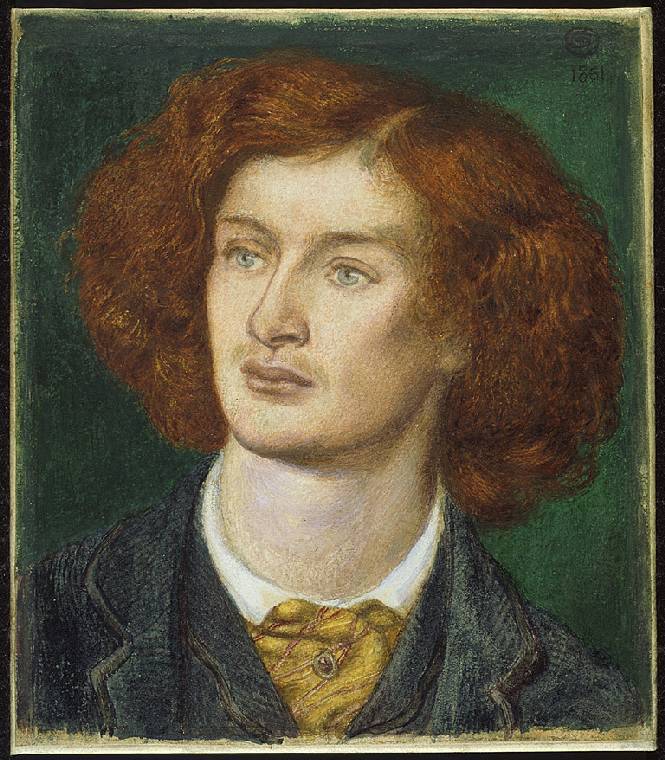
Image: Dante Gabriel Rossetti’s portrait of Swinburne, 1861, Fitzwilliam Museum, accession 682. Public-domain work and reproduction.

Dante Gabriel Rossetti / Wikimedia Commons; Public domain. Image record, Public domain.
The round picture in the lists of the personalities is cropped from it.