




9 min read
Magnificent Pharaoh
Amenhotep III
author: High Priest Zevios Metathronos
Giving Sacred Care a Lasting Form
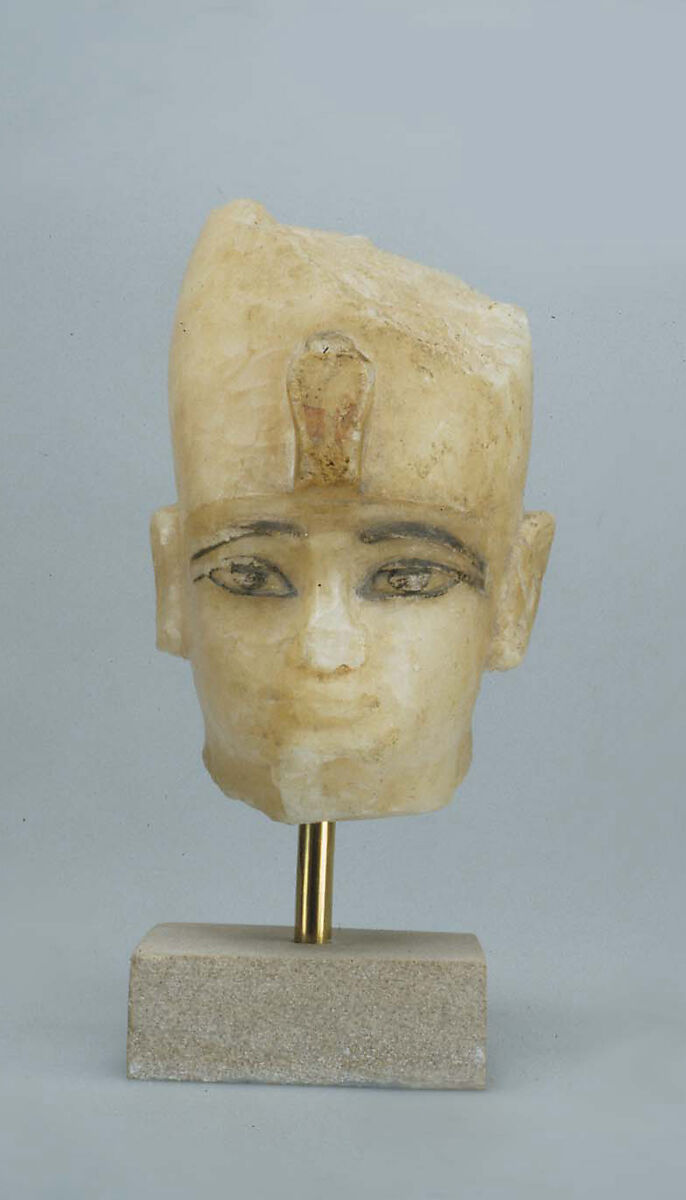
Dates: Reigned in the 14th century BCE; precise regnal chronology varies.
Period: Ancient (6000–500 BCE).
Amenhotep III ruled Egypt for some 39 years, and University College London counts him among “the most important kings of the Eighteenth Dynasty.” He built or rebuilt temples at Luxor, Memphis, Elkab and Armant, and on the west bank at Thebes he raised a vast temple to his own cult, whose 2 seated colossi still stand.1
His most striking commission was a crowd of Goddesses: some 600 stone statues of Sakhmet, made to keep illness and evil away from the king.2
Zevism reads his reign as a link in the chain that passes through Egypt. He built for Amun, whom Herodotus knew as Zeus, and his Sakhmet statues fought Izfet, the disorder of disease, on behalf of Ma'at, the order that Zeus holds as Sovereign of the Cosmos.
LIFE AND CONTEXT
The dates are disputed. UCL gives about 1388–1351 BCE; the Met's essay on the Amarna letters gives about 1390–1353 BCE. The reign was long in either reckoning, and its building ran from Soleb in Nubia north to Memphis.3
His main wife was Tiye. UCL notes that she “seems to have played an important part in the reign” and that she “appears on monuments more often and more prominently than virtually any queen before her.” Inscriptions in the tomb of her steward Kheruef mention the sed festival, the royal jubilee.4
He governed through officials whose monuments survive. The UCL register lists statues from Karnak of the official Amenhotep son of Hapu and further monuments of his, along with inscriptions from the tomb of the vizier Ramose, TT 55.5
Egypt dealt with the great kingdoms of the east as an equal. Letters from his reign turned up among the hundreds of clay tablets found at Amarna, most of them in 1887, uncovered “either by a peasant woman or a group of local farmers.” They're written in Akkadian cuneiform, the shared diplomatic language of the eastern Mediterranean. In them foreign rulers called the Egyptian king “brother” and traded “gold from Egypt and lapis lazuli from modern Afghanistan.”6
His son Akhenaten built a new royal city at Amarna, and letters from his father's reign were “brought to the new royal city from an older archive.”7 Amenhotep's own tomb was cut into the rock of the West Valley at Thebes, WV 22, and his palace complex at Malqata stayed “relatively well preserved” until the 1900s.8
ATTAINMENTS
- He reigned for some 39 years and built or rebuilt temples at Luxor, Memphis, Elkab, Armant and on Elephantine, including the temple of Amun at Luxor.9
- He raised a mortuary temple on the west bank at Kom el-Hitan, and its 2 colossi, “each made of a single stone” in Strabo's words, are the Colossi of Memnon.10
- He commissioned about 600 statues of Sakhmet for his mortuary temple and the Mut precinct at Karnak; the Met's example is granodiorite, 210 cm high.11
- He built a temple at Soleb in Nubia and set red granite lions there; the one catalogued as EA 2 is 216 cm long and weighs 2,580 kg.12
- He built the palace complex of Malqata on the west bank at Thebes, and put up sphinxes at the temple of Mut.9
- He kept up a written diplomacy in Akkadian with the courts of western Asia, and letters of his reign survived in the archive found at Amarna.6
- His sculptors worked at colossal scale: a single red granite head, probably his, stands 290 cm high.13
KEY STORIES
A Goddess for Every Day of the Year
Sakhmet held a dangerous power. She could “bring illness and destruction,” and she “also could offer health and restoration.” Amenhotep III answered her with numbers. His sculptors cut “some six hundred statues of the goddess,” and they've been traced to 2 main places, his mortuary temple at Kom el-Heitan and the temple of Mut at Karnak.11
The statues weren't decoration. The Met describes them as a “litany in stone” that “appeased the goddess and invoked her not to use her negative powers, thereby delivering the king from illness and evil for a year.” Read with that litany, the count may once have reached “730 statues, one seated and one standing for each day of the year.”11
The seated statue in New York shows what the rite asked for. The Goddess sits upright, and “in her outstretched fist, on her lap, she's clutching an ankh, the symbol for life.” Henry Walters gave it to the Met in 1915.11
The Colossus That Sang at Sunrise
Strabo heard that an earthquake had thrown down the upper part of 1 of the 2 colossi; Pausanias later heard that Cambyses had broken it in 2. What stayed on the throne made a sound. Strabo went to hear it with Aelius Gallus and “his crowd of associates, both friends and soldiers.”
“It is believed that once each day a noise, as of a slight blow, emanates from the part of the latter that remains on the throne and its base,” he wrote, and he heard it himself “at about the first hour.” He wouldn't say whether it came from the stone or from “one of the men who were standing all round.”14
In the consulship of Marcus Silanus and Lucius Norbanus, the Roman prince Germanicus “set out for Egypt to view its antiquities.” At Thebes a senior priest read the old inscriptions to him and told him that “once the city contained seven hundred thousand men of military age.” “Other marvels, too, arrested the attention of Germanicus,” Tacitus writes, above all “the stone colossus of Memnon, which emits a vocal sound when touched by the rays of the sun.”15
Pausanias crossed the Nile and saw it too. The crowds called it Memnon, he writes, but “the Thebans, however, say that it is a statue, not of Memnon, but of a native named Phamenoph.” It made its noise every day at sunrise, and he compared it to “a harp or lyre when a string has been broken.”16 The Thebans had it right. The colossus stands at Amenhotep III's temple and shows the king himself.
The Lions of Soleb
The king set a pair of red granite lions at his temple at Soleb in Nubia. They lie at rest, “the forepaws crossed,” one hind paw tucked under the other, the tail curled forward around the body. One of them names Amenhotep III and the temple of Soleb in its original inscription.12
The other lion carries a later hand. A text of Tutankhamun “was inscribed on the base, stating that the king renewed this monument for Amenhotep III.”12
The lions travelled on. They were later moved to Gebel Barkal, where the Kushite ruler Amanislo added his own cartouches to both. The Museum traces their road to London through Lord Prudhoe's travels, and in 1835 Algernon Percy, 4th Duke of Northumberland, gave them to it.12
The Head Belzoni Moved
In 1817, on his 2nd journey in Egypt, Giovanni Belzoni and his companion Beechey found a broken colossus in front of the temple of Khonsupakhered at Karnak. “It took them eight days to move it one mile (1.6 km) to Luxor.”13
The head wears the double crown and stands 290 cm high. Its style belongs to Amenhotep III, and the Museum thinks it may have come from his mortuary temple at Kom el-Hitan. But its face had been reworked: “the lips have been adjusted by drilling in the corners,” and the features that resulted are “thought to be those of Ramesses II, who is known to have ordered earlier statues to be modified to represent himself.” An arm of the same statue is also in London, and its body has been found in the Mut enclosure. The Museum bought the head from Henry Salt.13
THE ZEVIST READING
Herodotus tells how the Egyptians gave Amun a ram's face, and he adds that “the Egyptians call Zeus Amun.”17 Strabo writes that Thebes was “now called Diospolis,” the city of Zeus.14 Zevism reads Amenhotep's temples to Amun as service to the one sovereignty, rendered under its Egyptian name.
The Sakhmet statues answer the question of disease. Zevism counts plague as a form of Izfet, the dissolution of order, and healing as the restoration of Ma'at. The Iliad knows the same double power in Apollo, who strode down from Olympus “and his coming was like the night,” and whose arrows set the pyres burning, until Chryses prayed “ward off now from the Danaans the loathly pestilence” and “Phoebus Apollo heard him.”18
The Temple reads Sakhmet and Apollo as 2 names for 1 truth: the power that sends sickness is the power that lifts it, and an ordered rite turns it toward life. Amenhotep's 600 statues made that rite permanent: a defence of Ma'at cut in stone, 2 Goddesses for every day of the year in the Met's reconstruction.
The lions and the head teach a 2nd lesson. Zevism honours those who keep the source. Tutankhamun renewed his predecessor's lion and wrote that he'd done it for Amenhotep III, so the name stayed with the work. The head in London, by the Museum's reading, had its mouth drilled smaller to give it the face of Ramesses II. Knowledge evolves in transmission, but the source holds priority, and renewal that keeps the maker's name keeps Ma'at in the record.
NOTES
1 UCL, Digital Egypt, “Amenhotep III”.
2 Metropolitan Museum, Statue of the Goddess Sakhmet, 15.8.2.
3 UCL; Elizabeth Knott, “The Amarna Letters,” Met, 2016.
4 UCL, introduction and officials.
6 Knott, “The Amarna Letters”.
7 Knott.
10 UCL; Met, 15.8.2; Strabo 17.1.46.
11 Met, 15.8.2.
14 Strabo 17.1.46.
16 Pausanias 1.42.3.
17 Herodotus 2.42, tr. G. C. Macaulay.
18 Homer, Iliad 1.43–52, 1.456–457.
BIBLIOGRAPHY
University College London, Digital Egypt for Universities, “Amenhotep III”; introduction, main buildings, officials register and tomb. Regnal dates vary among modern chronologies.
The Metropolitan Museum of Art, Statue of the Goddess Sakhmet, 15.8.2; catalogue description and gallery audio transcript. The proposed total of 730 statues is a reconstruction.
British Museum, Granite Lion, EA 2; inscriptions and curatorial comments on Soleb, Tutankhamun's renewal, Amanislo and the gift of 1835.
British Museum, Colossal head of Amenhotep III, EA 15; curatorial comments on Belzoni's discovery of 1817 and the recutting for Ramesses II.
Elizabeth Knott, “The Amarna Letters”, Heilbrunn Timeline of Art History, The Metropolitan Museum of Art, 2016.
Strabo, Geography 17.1.46, tr. H. L. Jones, Loeb Classical Library, 1932; LacusCurtius.
Tacitus, Annals 2.59–61, tr. J. Jackson, Loeb Classical Library, 1931; LacusCurtius.
Pausanias, Description of Greece 1.42.3, tr. W. H. S. Jones, Theoi Classical Texts Library.
Herodotus, Histories 2.42, tr. G. C. Macaulay, Internet Sacred Text Archive.
Homer, Iliad 1.43–52 and 1.456–457, tr. A. T. Murray, Theoi Classical Texts Library.
CREDIT
Picture: Head of Amenhotep III, fourteenth century BCE, travertine with paint; The Metropolitan Museum of Art, 66.99.29.
The Metropolitan Museum of Art, Purchase, Fletcher Fund and The Guide Foundation Inc. Gift, 1966, 66.99.29; public domain. Image record, Public domain (Met Open Access).
The round picture in the lists of the personalities is cropped from it.