




9 min read
Poet of Delphi
Angelos Sikelianos
author: High Priest Zevios Metathronos
The Sacred Inheritance Made Present
Dates: 1884–1951 CE
Period: Modern Era, 1900–present
Delphic Festivals: 1927 and 1930
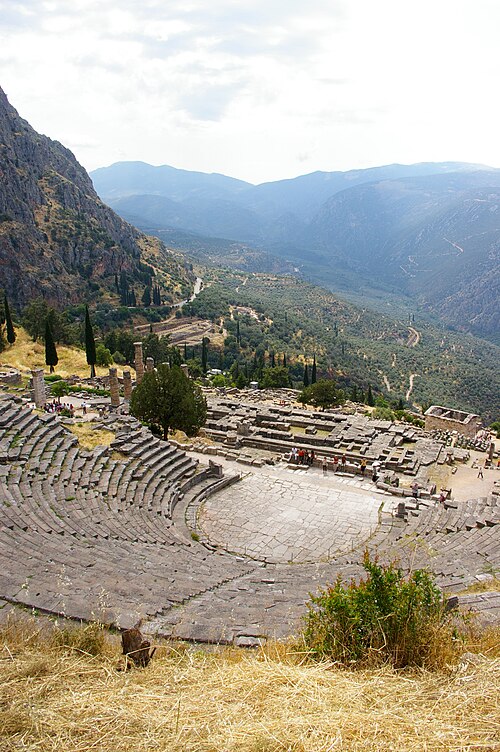
Angelos Sikelianos was a poet from Lefkada who took Aeschylus back to Delphi. On 9 May 1927 he and his American wife, Eva Palmer-Sikelianos, opened the First Delphic Festival, and ancient Greek drama was played again in the ancient theatre of Delphi with Prometheus Bound.1 Britannica counts him “one of the leading 20th-century Greek lyrical poets.”2
His poetry moved between Hellenic and Christian forms; he wrote a Mother of God as well as a Delphic Utterance. In 1929 the Academy of Athens gave him and Eva silver medals as the “Phoebus-inspired couple.”3 Zevism takes the title at its word. The festivals served Apollo in his own sanctuary, and they opened with the Titan who gave mortals their arts.
LIFE AND CONTEXT
Sikelianos was born on Lefkada in March 1884. The day is given as 15 March by the Centre for the Greek Language and as 28 March by Britannica. His first poems appeared in 1902 in the reviews Dionysos and Panathinaia.4
In August 1906 he met Eva Palmer. She'd left New York for Paris, learned to weave with Raymond and Penelope Duncan and followed them to Greece. They sailed for the United States on 26 August 1907 and married at Bar Harbor on 9 September, in an Episcopal ceremony conducted in French.5 That year Sikelianos wrote Alafroiskiotos in the Libyan desert. It came out in 1909 with the Rhapsodies of the Ionian, dedicated to Eva.6
In 1914 he became friends with Nikos Kazantzakis, and the 2 men travelled together to Mount Athos. In 1915 they toured Greece, and Sikelianos housed Kazantzakis at Sykia near Corinth.7 Prologue to Life came out in 1917. In 1921 he travelled with Eva to the Holy Land.8 The long poems Mother of God and The Greek Easter led up to the Delphic Utterance of 1927. Britannica says that in this last work “Greek tradition and the national historic and religious symbols are given a mystic turn and a universal significance.”9
He finished the play Dithyramb of the Rose on 9 June 1932. Eva staged it on 24 April 1933 in a wooden open-air theatre she'd built on the western slope of Philopappos Hill in Athens, and a crowd of “between 15,000 and 100,000 people present ridicule the performance.” The festivals had been paid for with mortgages on Eva's houses, and in August 1933, “distraught by financial and personal strains, Eva leaves for America.”10 Sikelianos stayed in Greece. In 1940 he married Anna Karamani, and in 1941 he joined the Resistance and the artists' group of EAM.11
His late work was tragedy: Sibyl, finished in 1940, Daedalus in Crete (1943), Christ in Rome (1946) and The Death of Digenis (1948). In 1951 the Academy of Athens turned down his candidacy for the 2nd time. He died on 19 June 1951, aged 67, of accidental poisoning.12
ATTAINMENTS
- His first major book, Alafroiskiotos, came out in 1909; Britannica says it “revealed his lyrical powers.”9
- He and Eva staged the First Delphic Festival on 9 and 10 May 1927, reviving ancient drama in the theatre at Delphi with Aeschylus' Prometheus Bound.13
- The Second Delphic Festival of May 1930 gave 3 performances each of Prometheus Bound and the Suppliants, with Pythian athletic games, music by Konstantinos Psachos, and costumes, choreography and direction by Eva.14
- In 1929 the Academy of Athens awarded the couple silver medals as the “Phoebus-inspired couple.”15
- He wrote “Ιερά Οδός” (“Sacred Way”) in 1935, a poem the Greek school anthology calls one of his most important.16
- He gathered his poems in Lyric Life, volumes 1 and 2 in 1946 and volume 3 in 1947.17
- He was nominated for the Nobel Prize in Literature 9 times between 1946 and 1950. The Nobel archive lists him among the nominees of 1947 and 1949.18
KEY STORIES
Prometheus Returns to Delphi
In 1925 Sikelianos stood in the ancient theatre of Delphi and announced the Delphic Effort.19 Between April and December he gave speeches on the Delphic plan. Eva wove the costumes and trained the chorus, and in 1926 her weaving won the gold medal for Decorative Arts at the International Exposition in Paris. That year the couple moved to Delphi.20
The village wasn't ready for visitors. Sikelianos oversaw the building of roads and paths and the laying of water pipes, all at Eva's expense, and she mortgaged the houses at Sykia and Delphi to pay for the guests. On 9 and 10 May 1927 the festival ran: Prometheus Bound in the ancient theatre, athletic games, Byzantine and folk music at the ancient site, and an exhibition of handiwork in the modern village.21
The press abroad praised it; the accounts didn't balance. Leontis records that the festival “receives positive international coverage but is a financial failure.” The play they'd chosen has Prometheus sum up his gift in 1 line: “every art possessed by man comes from Prometheus.”22
The Phoebus-Inspired Couple
The first festival left debts, and the second needed backers. In 1929 Antonis Benakis asked Eva to come back to Greece and organise it “with funding from private donors and a loan from the National Bank of Greece.” On 25 March the Academy of Athens gave her and Angelos their silver medals. On 21 April George Seferis, poet and diplomat, came to see Sikelianos at Delphi with Édouard Herriot, a former Foreign Minister of France.15
The Second Delphic Festival ran on 3 sets of days, 1 to 3, 6 to 8 and 11 to 13 May 1930, with 3 performances each of Prometheus Bound, the Suppliants and the Pythian athletic games, followed by Macedonian war dances and torchlight processions. Konstantinos Psachos wrote the music; Eva made the costumes and the choreography and directed. Leontis adds that after the event “Psachos breaks ties with Eva.”14 The same year Sikelianos published his Delphic Appeal in Greek and French.23
On the Sacred Way
Sikelianos wrote the poem in 1935. It opens with a wound: “Από τη νέα πληγή που μ' άνοιξεν η μοίρα,” from the new wound that fate had opened in him. The speaker walks alone on the road to Eleusis as the sun goes down.24
Out of the dusk come 3 shadows. A Gypsy walks in front, and behind him, dragged on chains, come “δυο αργοβάδιστες αρκούδες,” 2 slow-footed bears, a mother and her cub. The Gypsy puts the mother bear through her dance, and the poet watches a dance of pain and captivity.
In the poet's eyes the suffering mother becomes the Great Mother, and the poem calls up Demeter, Alcmene and the Virgin Mary. At the end the poet's heart asks whether the hour will come when the soul of the bear, the soul of the Gypsy and his own soul will celebrate together.24
Poems Against the Occupation
Kostis Palamas was the elder poet of Sikelianos' Greece. On 8 June 1925 Eva and Angelos went with him to Lefkada for the centenary of Aristotelis Valaoritis, at his grave on the islet of Madouri.25
Palamas died 18 years later, in Athens under German occupation. At the funeral Sikelianos recited his poem «Ηχήστε Σάλπιγγες», “Sound, Trumpets.”26 Leontis records the result: his eulogy “inspires crowds to sing outlawed Greek national anthem.”27
His Akritika, poems of resistance, were meanwhile “circulating illegally in occupied Greece.” On 22 March 1944 Seferis, now a diplomat of the government in exile in Cairo, secretly sent a copy to Eva and asked her to publish it. She moved back to New York to do the work, and the book came out there in June in Paul Nord's translation.28
THE ZEVIST READING
Delphi is Apollo's own ground. The Homeric Hymn to Apollo tells how the God came “to Crisa beneath snowy Parnassus” and there “laid out all the foundations throughout, wide and very long.”29 Sikelianos chose that ground on purpose. The Academy's phrase, “Phoebus-inspired,” names the God the Temple sees at work in the festivals: Apollo of music, measure and poetry. The Sikelianoi didn't bring a new cult to the sanctuary. They brought Greek forms back to a Greek sanctuary: Aeschylean tragedy, the Pythian games, the old church music and the village crafts. That's the Zevist return to the source in practice.
The choice of play carries the 2nd lesson. Aeschylus' Prometheus claims numbers, “chiefest of sciences,” and “the combining of letters, creative mother of the Muses' arts.”30 A festival that joined drama, athletics, Byzantine chant and weaving was a gathering of those arts, and it put the Titan who gave those arts on the stage first. Zevism reads the programme as a single act of worship addressed to the source of craft and letters.
Zevism also sets the Creator against the andrapod, the one who lives among ruins and answers them with complaint and nostalgia. Delphi in 1925 was a field of ruins beside a village that needed roads, paths and water pipes before it could take guests. Sikelianos and Eva answered it with pipes, paths, looms and a trained chorus, and they paid for it with their houses. Creation is open forward and requires work, and the debts don't cancel the work.
“Sacred Way” gives the ethical dimension, Φρόνησις and Justice. The poet walking to Eleusis in his own grief stops for a chained animal and the man who leads it, and he won't celebrate without them. Zevism reads the poem as Demeter's lesson: sacred memory is tested by the suffering on the road beside it.
NOTES
1 European Cultural Centre of Delphi, “Historical Milestones”.
2 Britannica, “Angelos Sikelianós”.
3 Leontis, “Chronology of a Life,” 1929.
4 Centre for the Greek Language, chronology; Britannica.
6 Centre for the Greek Language, 1907, 1909.
7 Centre for the Greek Language, 1914–1915.
8 Centre for the Greek Language, 1921.
9 Britannica.
11 Centre for the Greek Language, 1940–1941.
12 Centre for the Greek Language, 1940–1951; Leontis, 1951.
13 ECCD, 1927.
14 Leontis, 1930.
15 Leontis, 1929.
16 Κείμενα Νεοελληνικής Λογοτεχνίας, Α΄ Λυκείου.
17 Centre for the Greek Language, 1946–1947.
18 Leontis, 1946.
19 Centre for the Greek Language, 1925.
21 Leontis, 1927.
22 Aeschylus, Prometheus Bound 507, tr. Smyth.
23 Centre for the Greek Language, 1930.
25 Leontis, 1925.
26 Centre for the Greek Language, 1943.
27 Leontis, 1943.
28 Leontis, 1944.
29 Homeric Hymn to Pythian Apollo 282, 294–295, tr. Evelyn-White.
30 Aeschylus, Prometheus Bound 459–460, tr. Smyth.
BIBLIOGRAPHY
Centre for the Greek Language, Angelos Sikelianos: chronology, entries for 1884, 1902, 1907, 1909, 1914–1915, 1925, 1940–1943, 1946–1948 and 1951.
Encyclopaedia Britannica, “Angelos Sikelianós”.
European Cultural Centre of Delphi, Historical milestones, entries for 1927 and 1930.
Artemis Leontis, Eva Palmer Sikelianos: chronology of a life, University of Michigan; entries for 1906–1907, 1925–1927, 1929–1930, 1933, 1943, 1946 and 1951.
Angelos Sikelianos, “Ιερά Οδός” (“Sacred Way”), 1935, in the Greek Ministry of Education's Κείμενα Νεοελληνικής Λογοτεχνίας, Α΄ Λυκείου; complete poem and introductory note.
Nobel Prize Outreach, Nomination Archive, Literature, 1947 and 1949.
Homeric Hymn to Pythian Apollo 282 and 294–295, H. G. Evelyn-White translation, Theoi Classical Texts Library.
Aeschylus, Prometheus Bound 459–460 and 507, translated by Herbert Weir Smyth, Theoi Classical Texts Library.
CREDIT
Image: The theatre in Apollo’s sanctuary at Delphi, photographed by Robin Iversen Rönnlund, 29 May 2009, CC BY-SA 3.0. An illustration of the festival setting, not a portrait or a photograph of the 1927 performance.

Robin Iversen Rönnlund / Wikimedia Commons; CC BY-SA 3.0. Image record, CC BY-SA 3.0.
The round picture in the lists of the personalities is cropped from it.