



9 min read
Scholar of Letters
Antonios F. Chalas
author: High Priest Zevios Metathronos
Letters, Symbols, and Hellenic Memory
Greek name: Αντώνιος Φ. Χαλάς
Dates: 1891–1967
Period: Modern, 1900–present
Antonios F. Chalas was a Greek journalist and scholar from the island of Andros whose books turn on the Greek alphabet, the ancient sky and the old texts. He translated Aristotle and Plutarch with commentary. Every edition of his books in the Greek book catalogue appeared after his death.1
The claim at the centre of his work is a claim about Zeus. In Η απόκρυφος διάταξις του ελληνικού αλφαβήτου he held that the understanding of “Οι Ημέρες και οι Νύκτες του Διός,” the Days and Nights of Zeus, is the highest human knowledge, “την Ουσίαν των Όντων,” the Essence of Beings.2
Zevism reads that claim under Zeus as Sovereign of the Cosmos, the God who set the signs in the sky, and reads his work on letters under the powers that gave letters to mortals. Chalas also wrote on the Christian Apocalypse and on Blavatsky; the Zevist reading below is the Temple's own.
LIFE AND CONTEXT
He was born at Batsi on Andros in 1891 and died in Athens in 1967.3 He went first to the Greek schools of Constantinople. After that he studied philology, philosophy and theology in France, Switzerland and England.4
The same biography calls him a master of Ancient Greek who also knew the main European languages. He “δηλώνει ότι έγραφε και μιλούσε δέκα ξένες γλώσσες,” stated that he wrote and spoke 10 foreign languages, and the list given includes Latin, Russian, Spanish and Hebrew.5
He earned his living by the pen. The biography describes him as a distinguished journalist, a man of letters and the author of many works. “Μετέφρασε και σχολίασε έργα του Αριστοτέλη και του Πλούταρχου”: he translated and annotated works of Aristotle and Plutarch. He also made a systematic study of Eastern philosophy, above all that of India.5
His books didn't reach print while he lived. Biblionet lists 7 editions under his name, all posthumous. The first is Η αποκάλυψις του Ιωάννου, from the publisher Dimeli in 1970, 3 years after he died. Between 1996 and 1999 the Athenian publisher Georgiadis brought out 3 more, all edited by Nikolaos Prearis. Ideotheatron printed his correspondence with Kostis Palamas in 1999 and his alphabet treatise in 2005, and Dion published the Apocalypse again in 2024.3
The back-cover note to his book on Blavatsky states his purpose. Chalas aimed at “Αξιοποίησι της αρχαίας Ελληνικής επιστημονικής και πνευματικής κληρονομιάς,” putting the scientific and spiritual inheritance of ancient Greece to use. The same note gives his thesis in capitals: “Οι Έλληνες ανέκαθεν υπήρξαν ΙΔΕΟΛΑΤΡΕΣ και ποτέ ΕΙΔΩΛΟΛΑΤΡΕΣ,” the Greeks always worshipped ideas and never idols.6
He also wrote about his own century. His longest book, at 531 pages with illustrations, carries the title Ο επιμενίδειος ύπνος της διεθνούς πνευματικής, πολιτικής και στρατιωτικής ηγεσίας και τα βαθύτατα αίτια του επερχόμενου τρίτου πυρηνικού πολέμου: the Epimenidean sleep of the world's spiritual, political and military leaders, and the deepest causes of the coming 3rd nuclear war. Biblionet files it under politics.7
The Blavatsky note also names the closing of the schools. It recalls Justinian's decree of 529 CE, which shut the philosophical schools and Plato's Academy, a centre, it says, of the Greek tradition for more than 800 years.6
ATTAINMENTS
- He studied philology, philosophy and theology in France, Switzerland and England, after schooling in the Greek schools of Constantinople.4
- He translated works of Aristotle and Plutarch with his own commentary, and he worked as a journalist.5
- He wrote Το εις το ελληνικόν αλφάβητον και το σύμπαν υπολανθάνον μυστήριον ή περί επιστήμης, on the mystery hidden in the Greek alphabet and the universe, published in Athens in January 1996 in 226 pages.8
- He wrote a 302-page study of Helena Petrovna Blavatsky's claims about ancient Greece, published by Georgiadis in 1998.9
- He wrote a 531-page illustrated work on the Epimenidean sleep of the world's leadership and the causes of a coming 3rd nuclear war, published in 1999.7
- He corresponded with Kostis Palamas, and the letters make a volume of 265 pages, printed in Athens in 1999 with a preface by the poet.10
- He wrote Η απόκρυφος διάταξις του ελληνικού αλφαβήτου, subtitled “Πηγή απάσης της των Ελλήνων φιλοσοφίας,” the source of all the philosophy of the Greeks, published in 2005.11
- He wrote a book on the Apocalypse of John, first published in 1970 and reissued in 2024 in 242 pages.12
KEY STORIES
The Visitor of December 1920
The published description of the alphabet book begins with an event. It announces “Η κοσμοϊστορικής σημασίας αποκάλυψι του κεντρικού γράμματος του Ελληνικού Αλφαβήτου υπό αοράτου επισκέπτου, κατά τον Δεκέμβριον του 1920”: the revelation, of world-historical weight, of the central letter of the Greek alphabet by an invisible visitor, in December 1920. Chalas wasn't yet 30.2
The book then names a science of the sky. “Η ανωτάτη επιστήμη της Αρχαίας Ελλάδος και των αιώνων είναι η ‘Μετεωρολογία’,” the highest science of ancient Greece and of the ages is “Meteorology,” the study of things aloft, and the whole hidden order of the alphabet turns on it.13
From there the book joins worship to astronomy. The religion and poetry of ancient Greece, it says, are bound most closely to that science, “με τους Ουράνιους Χάρτες,” with the maps of the heavens. Its end point is Zeus: the Days and Nights of Zeus, and the understanding of them, make up the highest knowledge a human being can hold. It's a book of 58 pages, and it appeared in 2005, 85 years after the December it describes.13
Letters to Kostis Palamas
Kostis Palamas, born in Patras in 1859, was in Britannica's words “a Greek poet who was important in the evolution of modern Greek literature.” He published Tragoudia tes Patridos mou in 1886 and Dodecalogos tou Gyftou in 1907, and he died in Athens on 27 February 1943.14
Chalas wrote to him, and Palamas wrote back. The exchange had to end by February 1943, when Chalas was in his early 50s. The letters came out under the title Η αλληλογραφία μου με τον ποιητή μας Κωστή Παλαμά, in English “My Correspondence with Our Poet Kostis Palamas.” Ideotheatron printed the book in Athens in January 1999, in 265 pages.15
The volume carries a preface by Palamas himself. In it the poet discusses the publication Chalas proposed and states his own hesitation about its celebratory interpretation.16
Hesiod's Key to the Apocalypse
Chalas read the last book of the Christian Bible through an old Greek poet. The description of his Αποκάλυψις του Ιωάννου states it without hedging: “την δίδει ο Ησίοδος! Τα Πέντε Γένη.” Hesiod gives the key, and the key is the 5 races. Its chapters ask “Τι αποκαλύπτει ο Ησίοδος περί του Πέμπτου Γένους,” what Hesiod reveals about the 5th race, and what Homer reveals of the 4th.17
That's the myth of Works and Days. “First of all the deathless gods who dwell on Olympus made a golden race of mortal men who lived in the time of Cronos when he was reigning in heaven.” Silver followed, then bronze, then the heroes. Then “far-seeing Zeus made yet another generation, the fifth, of men who are upon the bounteous earth.”18
Hesiod wished himself out of it: “would that I were not among the men of the fifth generation, but either had died before or been born afterwards. For now truly is a race of iron.” Men of that race, he says, never rest from labour and sorrow by day or from dying by night. Chalas made Hesiod's account of that 5th race his key to John's Apocalypse.19
The description begins with “Οι δυο πιστοί της Αληθείας Μάρτυρες,” the 2 faithful Witnesses of the Truth, and it doesn't stay with the Bible: one heading promises “Το Μυστήριον του έρωτος εξηγούμενον υπό του Αριστοφάνους,” the mystery of love explained by Aristophanes.17
THE ZEVIST READING
Chalas put the Days and Nights of Zeus at the summit of knowledge. He wasn't the first to tie the days to Zeus. Hesiod told the farmer: “Mark the days which come from Zeus.”20 Aratus opened his poem on the stars, “From Zeus let us begin,” because “himself it was who set the signs in heaven, and marked out the constellations.”21 Zevism reads Zeus as Sovereign of the Cosmos, and the order of day and night, season and star, as his Ma'at written across the sky.
The alphabet belongs to the Gods who gave it. Prometheus in Aeschylus claims “the combining of letters, creative mother of the Muses' arts.”22 A man who looks for the cosmos in the order of the letters works in that domain. Zevism treats his conclusions as his own reading and honours the attention he paid to the letters.
His title for the sleeping leaders of his century came from Crete. Pausanias tells of Epimenides of Cnossus, who “entered a cave in the country and slept. And the sleep did not leave him before the fortieth year, and afterwards he wrote verses and purified Athens and other cities.”23 His title puts the powers of his own century asleep in that cave. Zevism reads the rest of the story as the Creator's answer: Epimenides woke, wrote and purified cities.
Transmitters are keepers of the source. Chalas translated Aristotle and Plutarch. After his death 4 publishers and the editor Nikolaos Prearis brought his books into print, from 1970 to 2024. Zevism honours both links of that chain.
NOTES
1 CaptainBook, author biography; Biblionet, author record.
2 CaptainBook, Η απόκρυφος διάταξις.
4 CaptainBook, author biography.
5 CaptainBook.
6 CaptainBook, Αι εκπληκτικαί αποκαλύψεις.
7 Biblionet.
8 Biblionet.
9 CaptainBook.
11 CaptainBook; Biblionet.
12 Biblionet, author record; CaptainBook.
13 CaptainBook.
14 Britannica, “Kostis Palamas”.
15 Biblionet.
16 Politeia, edition details and Palamas preface excerpt.
17 CaptainBook, Η Αποκάλυψις του Ιωάννου.
18 Hesiod, Works and Days 109–169.
19 Hesiod, Works and Days 170–178.
20 Hesiod, Works and Days 765.
21 Aratus, Phaenomena, opening hymn.
22 Aeschylus, Prometheus Bound 459–461.
23 Pausanias 1.14.4.
BIBLIOGRAPHY
Biblionet, Antonios F. Chalas, author authority, 1891–1967, with list of editions; CaptainBook, author biography.
Chalas, Το εις το ελληνικόν αλφάβητον και το σύμπαν υπολανθάνον μυστήριον ή περί επιστήμης, Georgiadis, Athens, January 1996, edited by Nikolaos Prearis; 226 pages; ISBN 978-960-316-063-2.
Chalas, Αι εκπληκτικαί αποκαλύψεις επί της αρχαίας Ελλάδος της Ελένης Πέτροβνας Μπλαβάτσκη, Georgiadis, 1998, edited by Nikolaos E. Prearis; 302 pages; ISBN 978-960-316-082-3; publisher's note.
Chalas, Ο επιμενίδειος ύπνος της διεθνούς πνευματικής, πολιτικής και στρατιωτικής ηγεσίας και τα βαθύτατα αίτια του επερχόμενου τρίτου πυρηνικού πολέμου, Georgiadis, Athens, January 1999, edited by Nikolaos Prearis; 531 pages; ISBN 978-960-316-097-7.
Chalas, Η αλληλογραφία μου με τον ποιητή μας Κωστή Παλαμά, Ideotheatron, Athens, January 1999; 265 pages; preface by Kostis Palamas. Politeia, edition details and Palamas preface excerpt.
Chalas, Η απόκρυφος διάταξις του ελληνικού αλφαβήτου: Πηγή απάσης της των Ελλήνων φιλοσοφίας, Ideotheatron, Athens, 2005; 58 pages; ISBN 978-960-7921-84-0. Description and edition details, CaptainBook.
Chalas, Η Αποκάλυψις του Ιωάννου, Dion, 2024; 242 pages; ISBN 978-618-5736-50-7; description and chapter headings. First edition Dimeli, 1970.
Encyclopaedia Britannica, “Kostis Palamas”; dates and principal works.
Hesiod, Works and Days 109–178 and 765, translated by H. G. Evelyn-White, Theoi Classical Texts Library.
Aratus, Phaenomena, opening hymn to Zeus, translated by G. R. Mair, Theoi Classical Texts Library.
Aeschylus, Prometheus Bound 459–461, translated by Herbert Weir Smyth, Theoi Classical Texts Library.
Pausanias, Description of Greece 1.14.4, translated by W. H. S. Jones, Theoi Classical Texts Library.
CREDIT
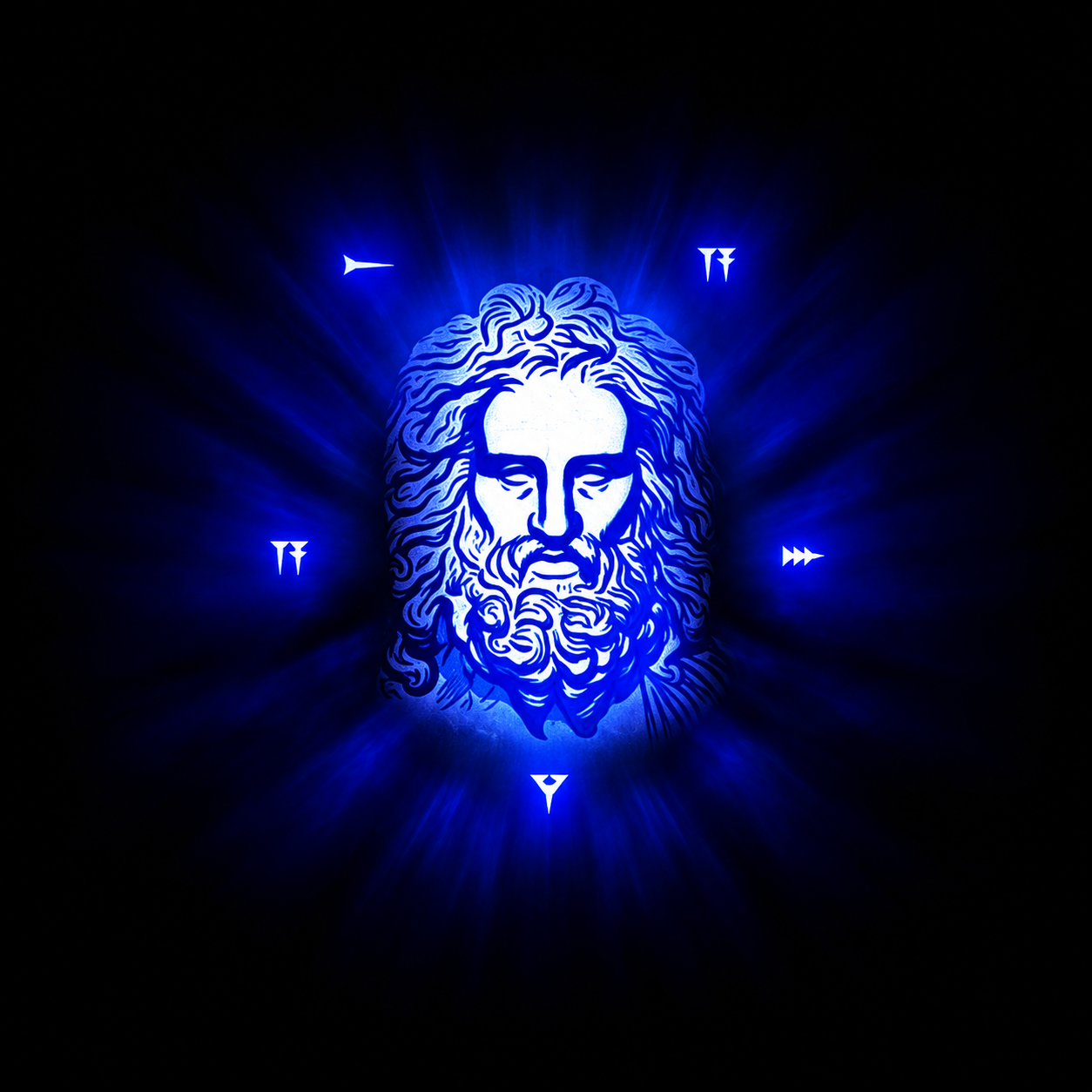
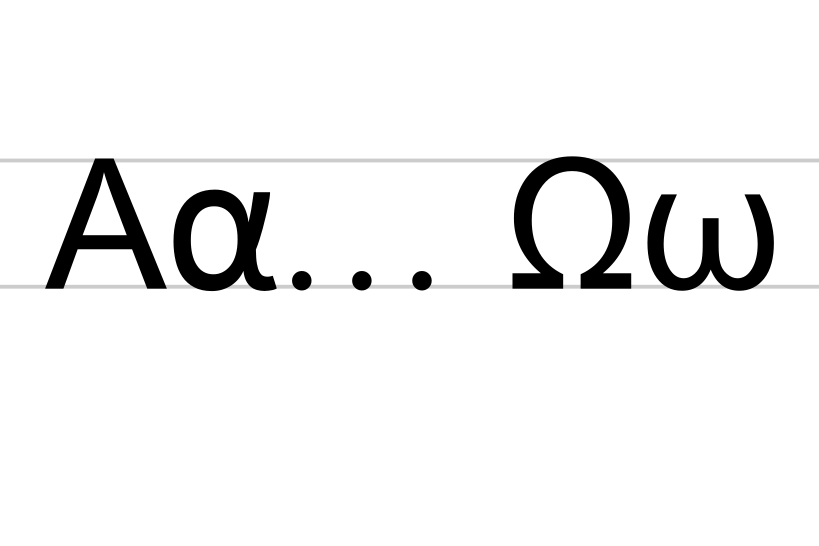
Image: Greek alphabet illustration by Miguel C. Ventura, 2015, CC0. This illustrates Chalas's subject and is not his portrait or a reproduction of his own diagram. Verified image record.

Miguel C. Ventura / Wikimedia Commons; CC0 1.0. Image record, CC0 1.0.
The round picture in the lists of the personalities is cropped from it.