




10 min read
Great Geometer
Archimedes of Syracuse
author: High Priest Zevios Metathronos
Dates: c. 287–212 BCE
Period: Hellenistic (334–30 BCE)
Archimedes of Syracuse trapped the value of π between 2 fractions, weighed a curved area against a triangle and wrote the law of the lever as a chain of propositions. He lived in Syracuse under King Hiero II and died there in 212 BCE, when Roman soldiers took the city in the Second Punic War.1
He picked his own monument. He proved that a sphere fills 2/3 of the cylinder that encloses it, and he “considered his most significant accomplishments were those concerning a cylinder circumscribing a sphere.” He asked for that figure to be set on his tomb.2
Zevism reads his work under Hephaestus and Athena, who in the Homeric Hymn taught men their crafts, and under Theuth, who invented number and geometry.3 Archimedes found his results with the balance and then proved them with the mind, and both acts belong to the order of measure.
LIFE AND CONTEXT
Archimedes was born in Syracuse, the son of the astronomer Phidias. Plutarch calls him “a kinsman and friend of King Hiero,” and as a young man he probably studied in Alexandria with the successors of Euclid.4
He worked at home in Sicily and sent his results abroad as letters. His closest colleague was Conon of Samos. When Conon died, Archimedes sent his proof about the parabola to Dositheus, a friend of Conon's, and wrote that he “grieved for the loss not only of a friend but of an admirable mathematician.”5
Another letter, The Method, went to Eratosthenes of Cyrene and explained that “certain things first became clear to me by a mechanical method, although they had to be demonstrated by geometry afterwards.”6
Hiero wanted machines. Plutarch says the king “persuaded him to turn his art somewhat from abstract notions to material things.” Archimedes built them, yet he “would not consent to leave behind him any treatise on this subject,” since he regarded “the work of an engineer and every art that ministers to the needs of life as ignoble and vulgar.”7
His engines went to war in his old age, when the Roman general Marcellus attacked Syracuse by land and sea. The city fell in 212 BCE, after Marcellus seized a tower while the Syracusans “were celebrating a festival in honour of Artemis.” Archimedes was killed in the sack.8
The books survived by copying. In the 10th century a scribe in Constantinople copied his treatises onto parchment. On 14 April 1229, in Jerusalem, the scribe Johannes Myronas finished a prayer book written over the scraped leaves, and The Method lay under the prayers for 677 years until J. L. Heiberg found it in 1906. The book sold at Christie's on 28 October 1998 for 2 million dollars, and the Walters Art Museum then led 12 years of recovery by over 80 scientists and scholars, using multispectral imaging and synchrotron x-rays.9
ATTAINMENTS
- Measurement of a Circle fixed π between 3 10/71 and 3 1/7. He got both bounds by drawing regular polygons of 96 sides inside and outside the circle and computing their perimeters.2
- On the Sphere and Cylinder, in 2 books, proved that a sphere has 2/3 the volume of the cylinder circumscribed about it.2
- Quadrature of the Parabola proved that “every segment bounded by a straight line and a section of a right-angled cone” is 4/3 of the triangle with the same base and equal height. He found it by mechanics before he proved it.10
- On the Equilibrium of Planes turned the balance into postulates and propositions. Its 1st book reaches the law that magnitudes balance at distances inversely proportional to their weights, so a small weight far from the fulcrum holds a large one near it.11
- On Floating Bodies, in 2 books, worked out the rules of hydrostatics and tested when a body floating in a fluid stays upright.2
- The Sand Reckoner, dedicated to Gelon, son of Hiero, built a system of numbers large enough to count the grains of sand that would fill the universe. He put the figure at 8 followed by 63 zeros.2
- The Method handed on the way he worked. He wrote it down, he said, because “some, either of my contemporaries or of my successors, will, by means of the method when once established, be able to discover other theorems in addition.”12
KEY STORIES
The Crown and the Bath
Vitruvius tells the story in the preface to his 9th book. Hiero, newly king, vowed a crown of gold to a temple “to the immortal gods” and weighed out the gold for the goldsmith. When the crown came back, “the weight appeared to correspond with that of the gold which had been assigned for it.” Then a report went round that the smith had kept some of the gold and made up the weight with silver.13
Hiero couldn't prove the theft, so he gave the problem to Archimedes. Archimedes went to a bath, climbed into the tub and watched the water run over the side as his body went under. Vitruvius says he “leapt out of the vessel in joy” and ran home naked, shouting in Greek, εὑρηκα, “I have found it out.”14
He took 2 masses as heavy as the crown, one of gold and one of silver. He filled a large vessel to the brim, sank the silver and measured the overflow, then did the same with the gold. Last he sank the crown and “discovered that more water ran over then than with the mass of gold that was equal to it in weight.” From that difference he “found, by calculation, the quantity of silver mixed with the gold, and made manifest the fraud of the manufacturer.”15
The Ship on the Beach
Plutarch reports that Archimedes wrote to Hiero “that with any given force it was possible to move any given weight.” He went further: “if there were another world, and he could go to it, he could move this.” The king told him to prove it on something real.16
Archimedes picked “a three-masted merchantman of the royal fleet, which had been dragged ashore by the great labours of many men.” He had her loaded with “many passengers and the customary freight,” sat some distance away and, working “a system of compound pulleys” with his hand, drew the ship to him “smoothly and evenly, as though she were gliding through the water.”17
The king was convinced. He had Archimedes build “offensive and defensive engines,” and then never used them, “because he spent the greater part of his life in freedom from war and amid the festal rites of peace.” The machines waited for Marcellus.18
The Geometrical Briareus
Marcellus came with “a fleet of sixty quinqueremes” and a siege engine on a platform carried by 8 galleys lashed together. Plutarch says “the Syracusans were stricken dumb with terror.” Then “Archimedes began to ply his engines.” Huge beams swung out from the walls and sank ships with weights dropped from above. Iron claws gripped other ships by the prow, hauled them “straight up into the air, and then plunged stern foremost into the depths.”19
Marcellus joked with his engineers: “Let us stop fighting against this geometrical Briareus, who uses our ships like cups to ladle water.” His soldiers had lost their nerve. At the sight of “a bit of rope or a stick of timber projecting a little over the wall,” they cried “Archimedes is training some engine upon us” and ran, and Marcellus settled into a long siege.20
When the city fell, Archimedes was “by himself, working out some problem with the aid of a diagram.” A soldier ordered him to come to Marcellus, and he refused until he'd finished the problem, so the soldier killed him. Plutarch gives 2 other versions, and in the last one soldiers took his box of instruments for gold. Marcellus “turned away from his slayer as from a polluted person” and honoured the dead man's kin.21
Cicero Finds the Tomb
In 75 BCE, 137 years after the sack, Cicero was quaestor in Sicily and went looking for the grave. The Syracusans “knew nothing of it, and even denied that there was any such thing remaining.” Cicero remembered verses said to be carved on the monument, which set “a sphere with a cylinder” on top.22
He walked the crowded cemetery at the Achradina gate with leading men of the city. There he saw “a small column standing out a little above the briars, with the figure of a sphere and a cylinder upon it.” Men went in with scythes and cut a path. On the pedestal he found the inscription, “though the latter parts of all the verses were effaced almost half away.”23
Cicero didn't spare his hosts. One of the noblest cities of Greece, he wrote, “had known nothing of the monument of its greatest genius, if it had not been discovered to them by a native of Arpinum.”24
THE ZEVIST READING
The Homeric Hymn to Hephaestus begins: “Sing, clear-voiced Muses, of Hephaestus famed for inventions. With bright-eyed Athene he taught men glorious gifts throughout the world.” The hymn sets those gifts against life in caves “like wild beasts.”25 The compound pulley and the iron claw belong to these Gods, though Archimedes ranked such work below geometry. Zevism doesn't keep his ranking; the pulley that moved the ship and the proof about the sphere answer to the same order of measure.
Plato's Theuth invented “numbers and arithmetic and geometry and astronomy.”26 Archimedes, an astronomer's son, worked in the first 3 and carried number out to the edge of the cosmos in The Sand Reckoner. Zevism reads such work as the Logos found in things: the ratio of sphere to cylinder was there before him, and he wrote it down.
The crown story is a lesson in Ma'at. Egyptian religion named Ma'at “the personification of truth, justice, and the cosmic order” and set her against isfet.27 A votive gift to the Gods with silver hidden inside its gold is Izfet, a false weight in a sacred place. Archimedes answered it with a vessel of water and a calculation, and the true weight came back into the record.
The Method shows the doctrine of Light and Darkness at work. Archimedes walked into problems nobody had solved with an imagined balance, found the answer, and then proved it so that explored darkness became knowledge others could check. He gave the method away for successors he'd never meet. Zevism honours the scribes who copied his books, the scholar who read them under a prayer book and the teams who brought them back with light, since they're keepers of the source.
NOTES
1 O'Connor and Robertson, “Archimedes of Syracuse”.
3 Homeric Hymn to Hephaestus 1–4; Plato, Phaedrus 274c–d.
4 O'Connor and Robertson; Plutarch, Marcellus 14.7.
5 Archimedes, Quadrature of the Parabola, preface.
6 Archimedes, The Method, introductory letter.
7 Plutarch, Marcellus 14.4, 17.3–4.
8 Plutarch, Marcellus 14.3, 18.3; O'Connor and Robertson.
9 Walters Art Museum, “Lost and Found”; O'Connor and Robertson.
10 Quadrature of the Parabola, preface.
11 Archimedes, On the Equilibrium of Planes, book 1, propositions 1–7.
12 The Method, introductory letter.
13 Vitruvius, On Architecture 9, preface 9–10.
15 Vitruvius 9, preface 11–12.
18 Plutarch, Marcellus 14.8–9.
19 Plutarch, Marcellus 14.3, 15.1–2.
20 Plutarch, Marcellus 17.1–3.
21 Plutarch, Marcellus 19.4–6.
22 Cicero, Tusculan Disputations 5.64; O'Connor and Robertson.
23 Cicero, Tusculan Disputations 5.65–66.
24 Cicero, Tusculan Disputations 5.66.
25 Homeric Hymn to Hephaestus 1–4.
BIBLIOGRAPHY
J. J. O'Connor and E. F. Robertson, “Archimedes of Syracuse”, MacTutor History of Mathematics, University of St Andrews; life, surviving works, π bounds, The Sand Reckoner, tomb and Heiberg's discovery of 1906.
Archimedes, On the Equilibrium of Planes, book 1, extract, MacTutor, “Archimedes on statics”; postulates and propositions 1–7.
Archimedes, The Method, introductory letter to Eratosthenes, MacTutor, “Archimedes on mechanical and geometric methods.”
Archimedes, Quadrature of the Parabola, preface to Dositheus, MacTutor primary-text extract.
Vitruvius, On Architecture, book 9, introduction, translated by Joseph Gwilt (1826), LacusCurtius; sections 9–12.
Plutarch, Life of Marcellus, translated by Bernadotte Perrin, Loeb Classical Library, 1917, LacusCurtius; 14.3–9, 15.1–2, 17.1–4, 18.3, 19.4–6.
Cicero, Tusculan Disputations, book 5, translated by C. D. Yonge (1877), attalus.org; 5.64–66.
Walters Art Museum, “Lost and Found: The Secrets of Archimedes”, exhibition release, 2011; the palimpsest's copying, reuse in 1229, sale in 1998 and recovery.
Homeric Hymn 20 to Hephaestus 1–4, H. G. Evelyn-White translation, Theoi Classical Texts Library.
Plato, Phaedrus 274c–d, translated by H. N. Fowler, Perseus Digital Library.
Encyclopaedia Britannica, “Maat”.
CREDIT
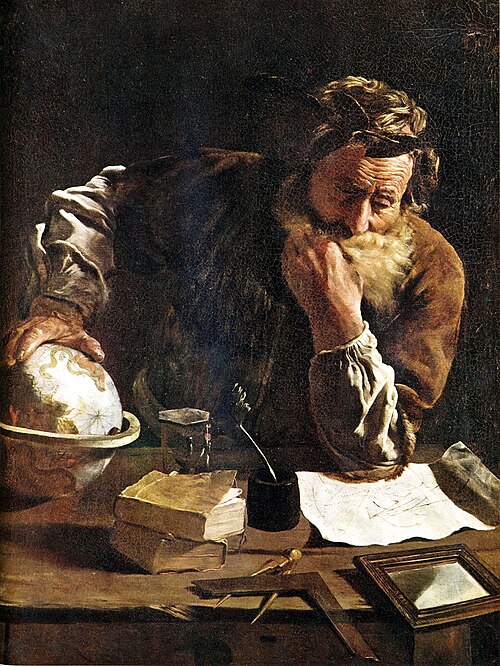
Picture: Portrait of a scholar, traditionally associated with Archimedes, by Domenico Fetti, c. 1620; an imagined likeness whose identification is qualified
Domenico Fetti; Wikimedia Commons; Public domain; faithful reproduction of a public-domain artwork. Image record, Public domain; faithful reproduction of a public-domain artwork.

The round picture in the lists of the personalities is cropped from it.