





9 min read
The Just
Aristides the Just
author: High Priest Zevios Metathronos
Integrity Above Rivalry
Dates: Probably born in the 520s BCE; died about 467 BCE.
Period: Classical (500–334 BCE).
Aristides, son of Lysimachus, fought for Athens at Marathon, Salamis and Plataea. After the Persian Wars he fixed what each Greek ally would pay into the common fund of the Delian League. Plutarch says his justice won him “that most kingly and godlike surname of ‘The Just.’”1
His greatest work was an assessment. The allies asked Athens for Aristides by name, and he went through their lands and revenues and set the tribute at 460 talents. They later praised his tariff the way earlier generations had praised the golden age of Cronus.2
Zevism reads him under Zeus, guardian of oaths, and under Dike, the daughter of Zeus who sits beside her father and tells him of men's wrongs. His career puts the Temple's doctrine of the Good to a hard test: right order and right act, held together while rivals, exile and his own city's interest pulled the other way.
LIFE AND CONTEXT
Aristides belonged to the tribe Antiochis and the deme of Alopece. Plutarch reports that he and Themistocles quarrelled from the time they were boys and fellow pupils, and the rivalry ran through both their public lives. His birth year isn't in any ancient text; Julia Shear places it probably in the 520s BCE.3
At Marathon in 490 BCE he was one of the Athenian generals. Supreme command rotated among them day by day, and when his turn came he handed it to Miltiades. After the battle he stayed on the field with his own tribe to guard the captives and the booty. Silver and gold “lay about in heaps” in the Persian tents, and he didn't touch any of it or let anyone else touch it.4
Plutarch notes that the archon list records an Aristides as chief magistrate “immediately after Phaenippus, in whose year of office the victory at Marathon was won.” The theatre knew him as well. When Aeschylus' lines on the seer Amphiaraus were recited, “He wishes not to seem, but rather just to be,” the whole audience turned to look at Aristides.5
In the late 480s Athens struck silver at Maroneia and cleared 100 talents. Themistocles blocked a handout to the citizens and had the money spent on 100 triremes, the ships that later fought at Salamis. “About this time Aristides the son of Lysimachus was ostracized,” Aristotle's Constitution of the Athenians records. Plutarch says Athens recalled him in the 3rd year, as Xerxes marched through Thessaly and Boeotia.6
After the war Aristotle names 2 leaders of the people: Themistocles for the conduct of war, and Aristides, who “had the reputation of being a clever statesman and the most upright man of his time.”7 He died about 467 BCE.8 Plutarch found conflicting reports of where, and noted that Craterus' charge of bribery and exile came with no written proof.9
The city built his tomb at Phalerum, “since he did not leave even enough to pay for his funeral,” and gave each of his daughters 3,000 drachmas as a dowry.10 The poverty is disputed. Patrice Brun's study of 2023 argues that later writers embellished the portrait and that a man with his political career must have belonged to the richest property class.11
ATTAINMENTS
- He gave up his day of supreme command at Marathon in 490 BCE to Miltiades, then held the captured Persian camp with his tribe and kept its gold and silver untouched.12
- He held the eponymous archonship of Athens in the year after Marathon.13
- At Salamis in 480 BCE he took Athenian hoplites from the shore across to the islet of Psyttaleia, and “these slew all the Persians who were in this islet.”14
- At Plataea in 479 BCE he commanded the Athenians, 8,000 men on the left wing of the Greek line.15
- He made the first assessment of the allies' tribute “two years after the battle of Salamis, in the archonship of Timosthenes,” and swore the alliance with the Ionians for Athens.16 The total was 460 talents a year.17
- His figure became a legal standard. In the peace between Athens and Sparta of 421 BCE, 6 northern cities, among them Stagirus, Acanthus and Olynthus, were to pay “only the tribute of Aristides.”18
- He talked the assembly out of Themistocles' plan to burn the naval station of the allied Greeks, reporting that no plan “could be more advantageous, and none more unjust.” The people ordered Themistocles to drop it.19
KEY STORIES
The Name on the Sherd
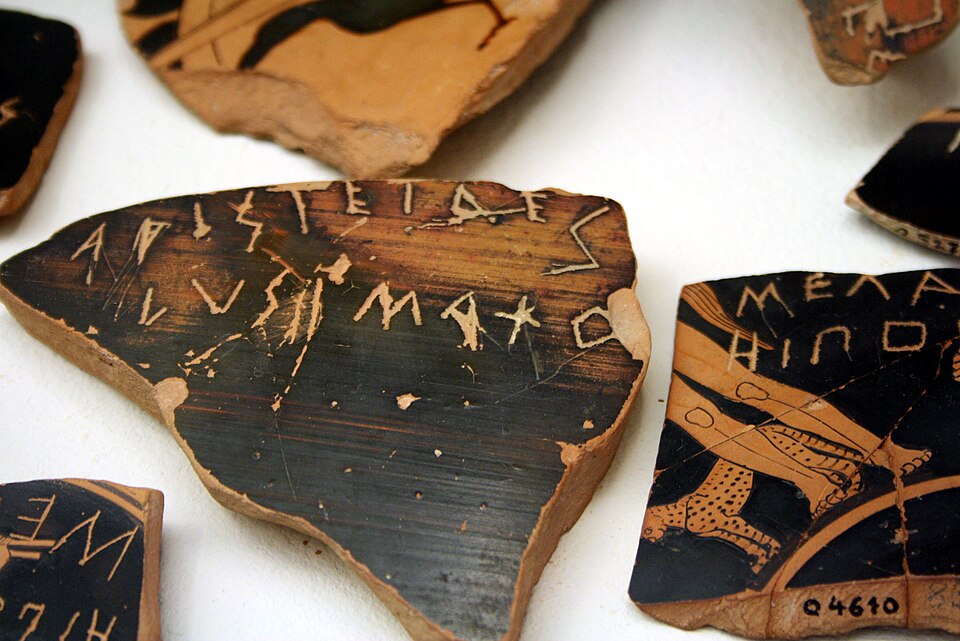
On the day of the ostracism vote each Athenian took a potsherd, wrote on it the name of the man he wanted gone, and carried it into a railed-off space in the agora.20 Plutarch tells how “an unlettered and utterly boorish fellow” handed his sherd to a stranger and asked him to write Aristides on it. The stranger was Aristides. He asked what wrong Aristides had ever done him.21
“None whatever,” the man answered. “I don't even know the fellow, but I am tired of hearing him everywhere called ‘The Just.’” Aristides said nothing. He wrote his own name on the sherd and gave it back.
The vote went against him. As he left the city, Plutarch says, he lifted his hands to heaven and prayed “that no crisis might overtake the Athenians which should compel the people to remember Aristides.” The prayer failed within 3 years. Xerxes came south with his army, and the Athenians “repealed their law of ostracism, and voted that those who had been sent away under it might return.”22
The Crossing from Aegina
In 480 BCE the Greek fleet lay at Salamis while its commanders argued over sailing away to the Isthmus. While they argued, Aristides crossed over from Aegina, still an exile. Herodotus calls him “the best and most upright of all Athenians.” He had slipped through the Persian ships, and he called Themistocles, his old enemy, out of the council.23
His first words set the terms. “At this time,” he said, “we ought to carry on rivalry as to which of us shall do more service to our country.” Then he gave his news: “we are encompassed round by the enemy.” Themistocles admitted the Persian move was “of my suggestion,” because the Greeks wouldn't fight of their own will. He asked Aristides to carry the report in himself, since the commanders would think Themistocles had invented it.24
Aristides went in and told them. Most didn't believe him. Then a trireme of Tenian deserters under Panaitios rowed in and “brought them the whole truth.”25 During the battle Aristides ferried hoplites onto Psyttaleia and cut down the Persian garrison.14
Iron in the Sea
Under Spartan leadership the Greek allies had paid “a sort of contribution for the war.” Now they wanted “to be assessed equably city by city.” They “asked the Athenians for Aristides, and commissioned him to inspect their several territories and revenues,” then to fix each share “according to each member's worth and ability to pay.” He travelled from city to city, fixed the total at 460 talents, and came back, Plutarch says, “poorer still.”2
Then came the oath. Aristides swore for Athens and the allies swore for themselves, and “they cast the masses of iron into the sea.” Plutarch adds that the iron marked the curses the oath called down on anyone who broke it.26
The allies later remembered the assessment as a golden age, since the tribute was afterward doubled and then trebled.27 Zevism takes the sunken iron as the right image for his work: a sum fixed by measure of what each city could bear, then sworn before the Gods.
THE ZEVIST READING
Hesiod gives the pattern. “There is virgin Justice, the daughter of Zeus,” and whenever anyone wrongs her, “she sits beside her father, Zeus the son of Cronos, and tells him of men's wicked heart.”28 The work of Aristides was Dike's kind of work: a hearing, an assessment, an oath. Zevism reads his tribute list as Ma'at in fiscal form, a true record of what each city could bear, set in the open and sworn to.
Plato names the aim of the path as likeness to the divine “as far as possible,” ὁμοίωσις θεῷ κατὰ τὸ δυνατόν, and defines that likeness at once: ὁμοίωσις δὲ δίκαιον καὶ ὅσιον μετὰ φρονήσεως γενέσθαι, to become just and holy with wisdom.29 Plutarch's “godlike surname” points at the same thing. In Zevist terms Aristides walked the ethical dimension of the path, Φρόνησις joined to Justice, and the Athenians saw it well enough to turn in their seats at a line of Aeschylus.
The record is mixed, and the Temple won't trim it. He judged Themistocles' fleet-burning plan by its justice, and the assembly dropped it. Yet Plutarch, citing Theophrastus, reports that he called the removal of the League treasury from Delos to Athens “unjust, but advantageous,” and that he later “bade the Athenians lay the perjury to his own charge.”30 Zevism measures by the Good, right order and right act from a right will together. The speech against the fleet plan meets that measure; the saying on the treasury doesn't.
Hesiod's warning weighs on that 2nd saying. Whoever “forswears himself, and so hurts Justice and sins beyond repair” leaves his descendants in obscurity.31 The rivalry at Salamis shows the better half of the man. Aristides took a feud that dated from his school days and gave it a new prize, the larger service to the city, and that turn of ambition toward a common good is what the Temple asks of anyone who holds power over others.
NOTES
3 Plutarch, Aristides 1.1, 2.1; Shear, “Aristides (‘the Just’)”.
4 Plutarch, Aristides 5.2, 5.5.
5 Plutarch, Aristides 3.4, 5.7.
6 Aristotle, Constitution of the Athenians 22.7; Plutarch, Aristides 8.1.
7 Aristotle, Constitution 23.3.
8 Shear.
11 Merkel, review of Brun, BMCR 2025.02.20.
14 Herodotus 8.95.
15 Herodotus 9.28.
16 Aristotle, Constitution 23.5.
18 Thucydides 5.18.
22 Plutarch, Aristides 7.6, 8.1.
23 Herodotus 8.79.
26 Aristotle, Constitution 23.5; Plutarch, Aristides 25.1.
28 Hesiod, Works and Days 256–262.
30 Plutarch, Aristides 25.1–2.
31 Hesiod, Works and Days 280–285.
BIBLIOGRAPHY
Herodotus, Histories 8.79, 8.80, 8.81, 8.82, 8.95 and 9.28, G. C. Macaulay translation, Lexundria.
Plutarch, Life of Aristides, Bernadotte Perrin translation, Loeb Classical Library, 1914; LacusCurtius transcription; 1.1, 2.1, 3.4, 5.2–7, 6.1, 7.5–6, 8.1, 22.2, 24.1–3, 25.1–2, 26.1–3, 27.1.
Aristotle, The Athenian Constitution, Part 3, Frederic G. Kenyon translation, Avalon Project, Yale Law School; 22.7, 23.3–5.
Thucydides, History of the Peloponnesian War, Book 5, Richard Crawley translation, Internet Classics Archive; 5.18.
Julia L. Shear, “Aristides (‘the Just’),” The Encyclopedia of Ancient History, Wiley-Blackwell, 2012, public abstract; dates and career.
Erich Merkel, review of Patrice Brun, Aristide ‘le Juste’. L'art et la manière de fabriquer un héros dans la cité démocratique, Ausonius, 2023, Bryn Mawr Classical Review 2025.02.20.
Hesiod, Works and Days 256–262 and 280–285, H. G. Evelyn-White translation, Theoi Classical Texts Library.
Plato, Theaetetus 176a–b, Greek text, Perseus Digital Library.
CREDIT
Picture: Ancient ostrakon naming Aristides, son of Lysimachos, in the Kerameikos Archaeological Museum. Photograph by Giovanni Dall’Orto.
Giovanni Dall’Orto; Attribution-only permission: any purpose, including commercial use and derivatives; Wikimedia Commons. Image record, Attribution-only permission: any purpose, including commercial use and derivatives.

The round picture in the lists of the personalities is cropped from it.