





10 min read
Philosopher of Alexandria
Aristobulus of Alexandria
author: High Priest Zevios Metathronos
Greek Wisdom and the Claims Made upon It
Dates: Active in the 2nd century BCE; writing around 155–145 BCE according to Maren R. Niehoff. Birth and death dates unknown.
Period: Hellenistic (334–30 BCE)
Aristobulus was a Jewish philosopher who wrote at Alexandria under the Ptolemies. Maren Niehoff calls him “the first Jewish author who clearly defined himself as a philosopher,” and he dedicated books of commentary on the law of Moses to a Ptolemaic king. Only fragments survive, quoted by Clement of Alexandria and Eusebius of Caesarea.1
The fragments keep his boldest claim best: that Plato and Pythagoras took their doctrines from the laws of Moses. His real achievement lies in the method he used to argue it. He read Scripture with the tools of Greek scholarship, and he called Orpheus and Aratus into court as witnesses.2
Zevism answers him from the Temple's position that the Hellenic source holds priority. His fragments also show how far Greek philosophy reached in Alexandria, and they carried Greek verses, Zeus's name among them, into books that survived.
LIFE AND CONTEXT
Britannica places him in the 2nd century BCE and calls him “a Jewish Hellenistic philosopher who, like his successor, Philo, attempted to fuse ideas in the Hebrew Scriptures with those in Greek thought.” He “lived at Alexandria in Egypt, under the Ptolemies.” Niehoff dates his writing to the years “between 155 and 145 bce” and reads him beside the Letter of Aristeas and the chronographer Demetrius.3
The ancient sources don't agree on his king. Clement quotes “his first book addressed to Philometor,” yet elsewhere says he “lived in the time of Ptolemy Philadelphus.” Anatolius makes him a translator of the Scriptures for Philadelphus and his father. The editor Valesius took him for the man the Maccabees call διδάσκαλος, master, and for “the Peripatetic philosopher who dedicated his Commentaries on the Law of Moses to Ptolemy Philometor.”4
Clement names “Aristobulus the Peripatetic” among the writers who showed that Jewish philosophy “committed to writing has the precedence of philosophy among the Greeks.” Britannica also calls him a Peripatetic who used Platonic and Pythagorean ideas, and it sees the Stoic allegorising of myth as his model. Niehoff disagrees on that last point: his fragments name “the Peripatetic school” and “not even one Stoic thinker,” and he emerges as “an Aristotelian scholar, who offers metaphorical solutions to textual problems.”5
His standpoint was plain. Eusebius introduces him as a Hebrew philosopher, and in the extract Aristobulus calls the Hebrews his fellow countrymen and their legislation his own. Britannica puts his purpose in 1 sentence: “He believed that part of his mission in life was to prove that Greek culture was overshadowed and heavily influenced by Judaism.” Clement says he wrote “abundant books to show that the Peripatetic philosophy was derived from the law of Moses and from the other prophets.”6
Those books are lost. What remains are passages that Christian writers copied into their own arguments. The longest runs through chapter 12 of the 13th book of Eusebius' Preparation for the Gospel, and shorter ones sit in Clement's Stromata and in the Paschal Canon of Anatolius, an Alexandrian who became bishop of Laodicea.7
ATTAINMENTS
- He was, in Niehoff's words, “the first Jewish author who clearly defined himself as a philosopher,” and he wrote at Alexandria between 155 and 145 BCE.8
- He wrote a commentary on the law of Moses in more than 1 book. Clement quotes “his first book addressed to Philometor,” and Anatolius says he “dedicated his exegetical books on the law of Moses to the same kings.”9
- He solved difficulties in the text with the methods of Aristotle's school. Niehoff shows him offering “metaphorical solutions to textual problems” and naming “the Peripatetic school” among the philosophers he cites.10
- He gave a rule for dating the Passover that Anatolius still cited centuries later. Anatolius names him among the writers who, “in solving some questions which are raised with respect to Exodus, say that all alike ought to sacrifice the Passover after the vernal equinox in the middle of the first month.”11
- He built a history of transmission to carry his thesis: an early Greek version of the Exodus, the conquest of the land and “the whole code of laws,” made “previous to the dominion of Alexander and of the Persians,” before the full translation under Ptolemy Philadelphus.12
- He collected Greek poetry as testimony, verses attributed to Orpheus and the opening of Aratus' Phaenomena. He also read the divine speech of Genesis as the order of created works and joined piety to justice and temperance.13
KEY STORIES
A Birthplace Made in Translation
Anatolius, writing on the date of Easter, called on “the eminent Aristobulus, who was one of the Seventy who translated the sacred and holy Scriptures of the Hebrews for Ptolemy Philadelphus and his father, and dedicated his exegetical books on the law of Moses to the same kings.” In Greek, “the eminent Aristobulus” was Ἀριστοβούλου τοῦ πάνυ.11
When Rufinus put the passage into Latin, he read τοῦ πάνυ as a place and wrote “Aristobulum ex Paneade,” Aristobulus of Paneas. Scaliger, the note says, “strangely thinks that the text should be corrected from the version of Rufinus.” Bede followed the Latin in his De Ratione Computi and wrote “Aristobulus et Paniada,” as though Paniada were the name of a 2nd Jewish writer. He'd probably found that reading in his own copy of Rufinus; it also stands in “a very ancient Paris manuscript” and in the Codex Corbeiensis.14
Valesius set the record straight in the note the Ante-Nicene Fathers reprints. Aristobulus wasn't one of the translators, “as Anatolius writes,” and he was the same man as the Peripatetic who dedicated his commentaries to Philometor. The Paneas label stayed in the books anyway, and it's still attached to his name.15
Plato at the School of Moses
Clement quotes the claim in Aristobulus' own words, from “his first book addressed to Philometor”: “And Plato followed the laws given to us, and had manifestly studied all that is said in them.”16
Aristobulus needed Plato to have read Moses, and the Greek translation Alexandria knew had been made, as Clement's chapter reports, “in the reign of Ptolemy the son of Lagos, or, according to others, of Ptolemy surnamed Philadelphus.” So he posited an older one.16
In his words, “And before Demetrius there had been translated by another, previous to the dominion of Alexander and of the Persians, the account of the departure of our countrymen the Hebrews from Egypt,” with the conquest of the land and “the account of the whole code of laws.” From that he drew his conclusion: Plato “derived a great deal from this source,” and so did “Pythagoras, who transferred many things from our books to his own system of doctrines.”16
The same passage opens the long extract in Eusebius, where the older translation is set apart from the complete one made under Philadelphus. Clement took the argument up for his own purposes. The chapters of the Stromata that name Aristobulus carry the English titles “The Greek Philosophy in Great Part Derived from the Barbarians” and “Greek Plagiarism from the Hebrews.”17
The Name Taken Out of Aratus
Aristobulus closed his case with poetry. He brought forward verses attributed to Orpheus, then the opening of the Phaenomena, the star poem of Aratus. Then he said what he'd done to them: he had taken away the name of Zeus that ran through the verses, because he understood their thought as directed to God as he conceived Him. In the text Eusebius hands down, Zeus still stands in the lines from Aratus.13
Aratus had written: “From Zeus let us begin; him do we mortals never leave unnamed; full of Zeus are all the streets and all the market-places of men; full is the sea and the havens thereof; always we all have need of Zeus.” The poem goes on: “For we are also his offspring.” Zeus, in Aratus, “set the signs in heaven, and marked out the constellations.”18
Clement quoted the same opening with the name in place: “With Zeus let us begin; whom let us ne'er, / Being men, leave unexpressed.” In Zevist terms the verse had already answered its editor, since its 1st line promises that mortals never leave the God unnamed.19
THE ZEVIST READING
Zevism holds that one must return to the source, and that knowledge evolves in transmission while the source keeps its priority. Aristobulus reversed the order. His own fragment shows the problem he faced: the Greek Moses that Alexandria read was a Ptolemaic translation, and Plato and Pythagoras were older. He answered with a translation made “by another,” before Alexander and before the Persians, and the surviving fragment doesn't name a translator or cite a copy.16 The Temple reads the chronology as it stands: Orpheus, Pythagoras and Plato belong to the Hellenic source, and later readers found likenesses to it in other books.
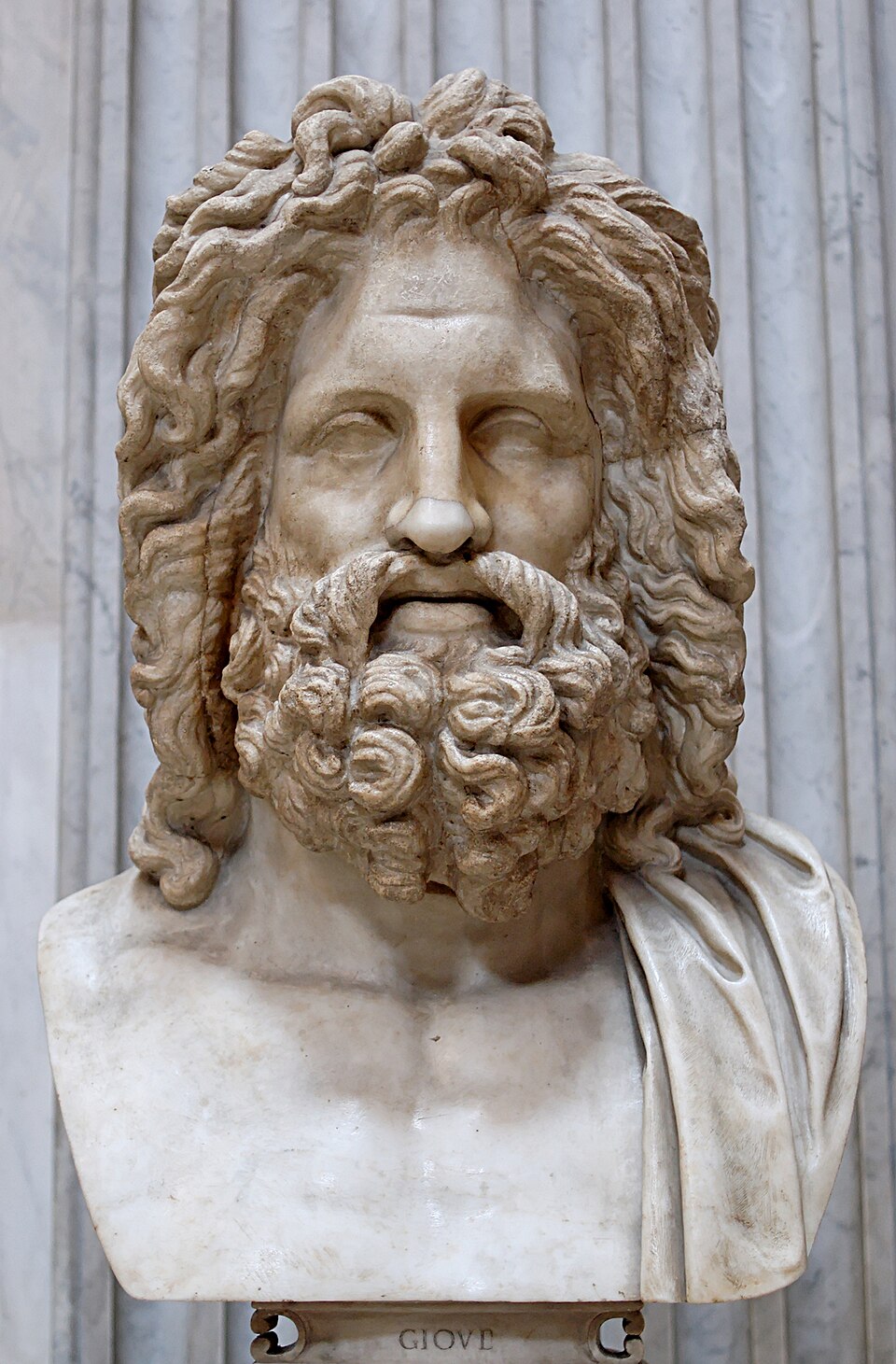
The Aratus episode shows what was at stake. The Phaenomena praises Zeus as the God who fills streets and harbours and sets the constellations to tell the ploughman and the planter their seasons.20 Taking out the name changes the testimony, and the Temple restores it. When Zevism quotes Aratus, it quotes “From Zeus let us begin” as he wrote it.
The same fragments also bear witness for Hellas. A Jewish philosopher of Alexandria answered Scripture's hard passages with Aristotle's tools, argued like a Peripatetic and cited Orpheus, Plato and Pythagoras as authorities worth claiming. Zevism reads that as the reach of Greek wisdom, strong enough that other traditions measured themselves against it.
The Temple also honours transmitters as keepers of the source, and Aristobulus kept more than he meant to. Through his quotations and the Christian books that copied them, lines attributed to Orpheus and the opening of Aratus reached later readers, the name of Zeus among them. The priority belongs to Hellas, and the channel that carried part of it deserves a place in the record.
NOTES
1 Niehoff, “Aristobulus' questions and answers”; Britannica, “Aristobulus of Paneas”.
2 Clement, Stromata 1.22; Eusebius, Preparation for the Gospel 13.12.
4 Clement, Stromata 1.22 and 5.14; Anatolius, Paschal Canon 3, note 1168.
5 Clement, Stromata 1.15; Britannica; Niehoff.
6 Eusebius 13.11–12; Britannica; Clement, Stromata 5.14.
7 Eusebius 13.12; Anatolius, translator's notice.
8 Niehoff, Jewish Exegesis and Homeric Scholarship in Alexandria, ch. 4.
9 Clement, Stromata 1.22; Anatolius, Paschal Canon 3.
10 Niehoff.
11 Anatolius, Paschal Canon 3.
12 Clement, Stromata 1.22; Eusebius 13.12.
13 Eusebius 13.12.
15 Anatolius, note 1168; Britannica, “Aristobulus of Paneas”.
17 Eusebius 13.12; Clement, Stromata 1.15; Stromata 5.14.
18 Aratus, Phaenomena 1–13, tr. G. R. Mair.
BIBLIOGRAPHY
Eusebius of Caesarea, Preparation for the Gospel, book 13, translated by E. H. Gifford, 1903, The Tertullian Project; 13.11, introduction of Aristobulus; 13.12, the transmitted extract, especially its opening priority claims and the paragraph after the Aratus quotation.
Clement of Alexandria, Stromata 1.22, “On the Greek Translation of the Old Testament”, translated by William Wilson, Ante-Nicene Fathers, vol. 2, ed. Philip Schaff, Christian Classics Ethereal Library.
Clement of Alexandria, Stromata 1.15, “The Greek Philosophy in Great Part Derived from the Barbarians”, same translation.
Clement of Alexandria, Stromata 5.14, “Greek Plagiarism from the Hebrews”, same translation; the note on Aristobulus and the quotation of Aratus.
Anatolius of Alexandria, Paschal Canon 3, Ante-Nicene Fathers, vol. 6, Christian Classics Ethereal Library; editorial note 1168 attributed to Valesius, on the “Paneas” designation; with the translator's biographical notice.
Maren R. Niehoff, “Aristobulus' questions and answers as a tool for philosophical instruction”, chapter 4 in Jewish Exegesis and Homeric Scholarship in Alexandria, Cambridge University Press, 2011, pp. 58–74, DOI 10.1017/CBO9780511732324.004; publisher's chapter abstract.
Encyclopaedia Britannica, “Aristobulus of Paneas”.
Aratus, Phaenomena 1–18, translated by G. R. Mair, Loeb Classical Library 129, 1921, Theoi Classical Texts Library.
CREDIT
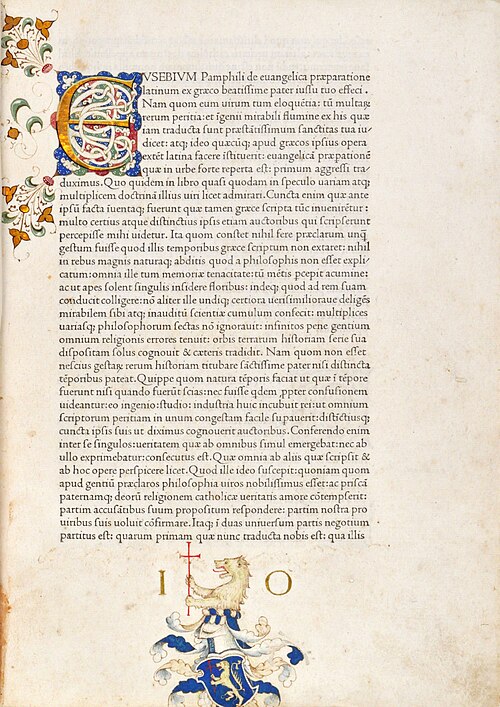
Illustration: Opening page of Eusebius' De evangelica praeparatione, printed by Nicolas Jenson, Venice, 1470, folio 1r, SMU Bridwell Library. A later printed witness to the work preserving Aristobulus' fragments, not a portrait or the page containing this extract. Public domain. Image record and attribution.

Nicolas Jenson, printer; Eusebius, author; SMU Bridwell Library scan via Codex 99 / Wikimedia Commons; Public domain. Image record, Public domain.
The round picture in the lists of the personalities is cropped from it.