





9 min read
Astronomer of India
Aryabhata
author: High Priest Zevios Metathronos
Number, Motion and the Trained Imagination
Dates: 476–c. 550 CE
Period: Roman (30 BCE–800 CE), the collection's chronological label
Aryabhata finished the Aryabhatiya in 499 CE, at the age of 23. In 118 Sanskrit verses it gave rules for arithmetic, algebra and trigonometry, a value of π of 3.1416, a system of planetary astronomy and the claim that the daily turning of the heavens comes from the rotation of the Earth.1
He also explained eclipses by the shadows of the Earth and the Moon, at a time when Indian belief blamed the demon Rahu.2
Aryabhata opened his book with reverence to Brahman, in the forms of his own tradition.3 Zevism reads him as a link in the chain that runs through every people's search for the divine order, and as one who carried light into the oldest darkness of the sky.
LIFE AND CONTEXT
His birth year comes from his own words: he says he was 23 years old when he wrote the Aryabhatiya, which he finished in 499, so he was born in 476. Where he was born is disputed. Historians have argued for Kerala, Tamil Nadu, Andhra Pradesh and Bengal, and some place his birth in the Asmaka region, though he “lived most of his life in Kusumapura.”4
Kusumapura is commonly taken to be Pataliputra, then the capital of the Gupta empire, though MacTutor notes that “no final verdict can be given” on its location. It describes Pataliputra as “the centre of a communications network which allowed learning from other parts of the world to reach it easily.”2
He “composed at least two works, Aryabhatiya and the now lost Aryabhatasiddhanta.” The lost book was “one of the earliest astronomical works to assign the start of each day to midnight.”5
The Aryabhatiya is short and dense. It has an introduction of 10 verses, a section on mathematics of 33, a section on time and planetary models of 25, and a section on the sphere and eclipses of 50.2 Its compressed rules were a starting point for teaching and commentary, and William E. Clark's English translation of 1930 discusses openly the places where the wording is hard to read.6
His death is dated only approximately, to about 550. His teaching lived on in a school of followers. The astronomer Bhaskara I, “certainly a follower of Aryabhata I,” worked in a school in Asmaka a century later.7
ATTAINMENTS
- He gave the rule: “Add four to one hundred, multiply by eight and then add sixty-two thousand. the result is approximately the circumference of a circle of diameter twenty thousand.” That makes π equal to 62,832/20,000, or 3.1416, and the verse itself calls the value approximate.8
- The mathematics section “contains 33 verses giving 66 mathematical rules without proof,” among them rules for summing the first n integers, their squares and their cubes.2
- He gave correct formulae for the areas of a triangle and a circle. His formulae for the volumes of a sphere and a pyramid “are claimed to be wrong by most historians.”2
- He wrote numbers with letters, assigning values to the 33 consonants of the Indian alphabet, a notation that could express numbers up to 10¹⁸.2
- He computed a table of sines at steps of 90°/24, that is 3° 45′.2
- He gave the kuttaka, “to pulverise,” a method for equations in whole numbers that breaks a problem into new ones with ever smaller coefficients.2
- He put the length of the year at 365 days 6 hours 12 minutes 30 seconds. Brahmagupta's later figure of 365 days 6 hours 12 minutes 36 seconds is only 6 seconds longer.9
- He gave the circumference of the Earth as 4,967 yojanas and held that “the Moon and planets shine by reflected sunlight.”2
KEY STORIES
A Book at 23
At Kusumapura, in 499, a young astronomer finished a book of 118 verses. He gave his own age inside the work, 23, and that line is how he's dated today.2
The book began with reverence. Clark's translation opens: “Having paid reverence to Brahman.” Then came the numbers. Aryabhata wrote numbers into verse by making consonants stand for values, so a line of syllables could carry figures up to 10¹⁸. A student who learned the verses by heart learned the numbers with them.10
The mathematics section ran to 33 verses and 66 rules, set down without proof. Some of the rules worked square and cube roots, calculations that Ifrah, whom MacTutor cites, argues were impossible without the place-value system and zero. One verse gave the circle rule with its 62,832 and 20,000, and it named the result approximate. He didn't pretend to more precision than he had.8
The Boat at Lanka
In the section on the sphere, Aryabhata asked his reader to picture a man in a boat. As the boat moves forward, the man sees the objects on the shore slip backward, though they're standing still. So too, he wrote, the fixed stars seem to the people at Lanka, on the equator, to move straight to the west. The simile asks the reader to separate the motion he sees from the motion of the place he's standing on.11
The image carries the claim MacTutor states plainly: “the apparent rotation of the heavens was due to the axial rotation of the Earth.” The next verse speaks of stars and planets driven westward by a wind, and Clark discusses the tension between the 2 verses and the ways later readers resolved it.12
His successors found the idea too much. MacTutor records that later commentators “could not bring themselves to follow” it, and “most changed the text to save Aryabhata from what they thought were stupid errors!”2
The Shadow and the Demon
Indian belief before Aryabhata held that eclipses were caused by a demon, Rahu. Aryabhata set out a different account. The Moon and the planets have no light of their own; they “shine by reflected sunlight.”2
From that premise the eclipses follow. When the Moon passes between the Sun and the Earth, it hides the Sun. When the Moon passes into the Earth's shadow, it goes dark, since it has no light to lose but the Sun's. Aryabhata “correctly explains the causes of eclipses of the Sun and the Moon,” and he did it with geometry and shadows.2
The explanation sits in the last section of the Aryabhatiya, 50 verses on the sphere and eclipses, the same section that holds the boat at Lanka. The demon had nothing left to do: the positions of Sun, Moon and Earth accounted for every eclipse.2
Bhaskara Takes Up the Verses
Aryabhata's rules needed teachers, and they found them. In 628 Brahmagupta finished his Brahmasphutasiddhanta, and a year later, in 629, Bhaskara I wrote the Aryabhatiyabhasya, a commentary on the 33 verses of mathematics in the Aryabhatiya, 130 years after it was finished. The commentary covered only those verses; the remaining 85 verses of the book are mathematical astronomy.13
Bhaskara worked in a school of mathematicians in Asmaka and was “certainly a follower of Aryabhata I.” His commentary took the terse rules one at a time and opened them up, with discussions of indeterminate equations and trigonometric formulae.7
MacTutor quotes Bhaskara's tribute: “Aryabhata is the master who, after reaching the furthest shores and plumbing the inmost depths of the sea of ultimate knowledge of mathematics, kinematics and spherics, handed over the three sciences to the learned world.”2
THE ZEVIST READING
Aryabhata began his book with reverence to Brahman, in the terms of his own faith. Zevism doesn't claim him for the Greek Gods. It reads him as a link in the chain of all spirituality, a man who served the divine order under the names of his own tradition, as the Egyptian, the Babylonian and the Greek astronomers served it under theirs.
His letters that carry numbers recall Plato's Theuth, who invented “numbers and arithmetic and geometry and astronomy, also draughts and dice, and, most important of all, letters.”14 Aryabhata joined the 2 gifts in a single notation, so that a verse could be read as speech and as calculation at once.
The eclipse is the doctrine of Light and Darkness in its plainest form. An eclipse is literal darkness, and fear filled it with a demon. Aryabhata walked into that darkness with geometry and found only shadow and reflected light. Explored darkness becomes Light, and the terror of the sky became a figure that anyone could compute. In Zevist terms that's discovery: the eclipse stayed as dark as before, and its darkness was now understood.
The fate of the rotating Earth teaches the last lesson. Zevism holds that knowledge evolves in transmission, and that the source keeps priority. Commentators altered his verses to fit what they already believed, and the original text held the sounder view. The Temple honours those who kept his words as he wrote them, and it counts the return to his text as a return to the source.
His reckoning of time belongs to the same order. The calendar and the true year are forms of Ma'at, “truth, justice, and the cosmic order,” and Aryabhata fixed the length of the year in days, hours, minutes and seconds.15
NOTES
1 O'Connor and Robertson, “Aryabhata the Elder”.
3 Aryabhata, Aryabhatiya, invocation, tr. Clark, p. 1.
4 O'Connor and Robertson; Britannica, “Aryabhata I”.
6 Aryabhatiya, tr. Clark, introduction.
7 O'Connor and Robertson, “Bhaskara I”.
8 O'Connor and Robertson; Aryabhatiya 2.10, tr. Clark, p. 28.
9 O'Connor and Robertson; O'Connor and Robertson, “Brahmagupta”.
10 Aryabhatiya, tr. Clark, p. 1; O'Connor and Robertson.
11 Aryabhatiya 4.9, tr. Clark, pp. 64–67.
12 O'Connor and Robertson; Aryabhatiya 4.10, tr. Clark.
13 O'Connor and Robertson, “Brahmagupta”; O'Connor and Robertson, “Bhaskara I”.
BIBLIOGRAPHY
J. J. O'Connor and E. F. Robertson, University of St Andrews, “Aryabhata the Elder”, MacTutor History of Mathematics; chronology, birthplace debate, Kusumapura, structure of the Aryabhatiya, π rule, alphabetic numerals, sines, kuttaka, rotation, eclipses, year length, commentators and Bhaskara's tribute.
Aryabhata, The Aryabhatiya of Aryabhata, translated with notes by William E. Clark (University of Chicago Press, 1930), opening invocation, 2.10 and 4.9–10, pp. 1, 28 and 64–67. Repository description; Internet Archive text.
Encyclopaedia Britannica, “Aryabhata I”; birth and works, the lost Aryabhatasiddhanta and the midnight day.
J. J. O'Connor and E. F. Robertson, “Bhaskara I”, MacTutor History of Mathematics; the Aryabhatiyabhasya of 629.
J. J. O'Connor and E. F. Robertson, “Brahmagupta”, MacTutor History of Mathematics; values for the length of the year.
Plato, Phaedrus 274c–d, translated by H. N. Fowler, Perseus Digital Library.
Encyclopaedia Britannica, “Maat”.
CREDIT
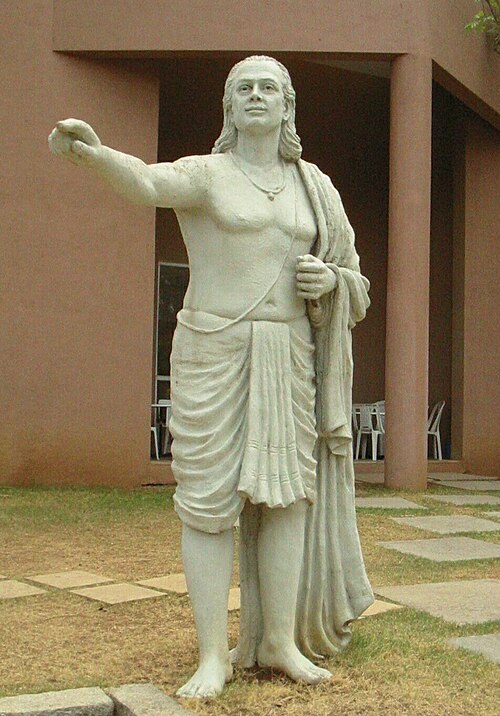
Picture: Modern commemorative statue of Aryabhata at IUCAA, Pune; photographed in May 2006. This is not a contemporary likeness.
Mukerjee (photograph); statue artist not identified on the file page; Wikimedia Commons; Photograph released to public domain by uploader; Commons records Indian freedom of panorama for the public sculpture. Image record, Photograph released to public domain by uploader; Commons records Indian freedom of panorama for the public sculpture.

The round picture in the lists of the personalities is cropped from it.