




9 min read
Keeper of Theurgy
Asclepigeneia of Athens
author: High Priest Zevios Metathronos
Dates: Active in the 5th century CE; exact lifespan unknown
Period: Roman period (30 BCE–800 CE)
Asclepigeneia was the daughter of Plutarch of Athens, head of the Platonic school in the city, and the keeper of its sacred rites. Marinus, the biographer of Proclus, says her father confided to her alone “the mystic rites preserved by Nestorius, and the whole theurgic science,” and that Proclus learned those practices from her.1
No book survives under her name. What survives is a line of transmission: from Nestorius to Plutarch, from Plutarch to his daughter, and from her to the philosopher who led the school for almost 50 years.2
Zevism honours her as a theurgist and a keeper of the source. Her work served the 4th dimension of the path, the joining of human intelligence to the intelligence of the Gods, and it passed through her hands from her father to Proclus.
LIFE AND CONTEXT
Her father, Plutarch, was an Athenian Platonist, distinct from the much earlier Plutarch of Chaeronea. Marinus calls him “the great Plutarch, son of Nestorius.”3 He was already an old man when Proclus came to Athens in 430 or 431, and he died in 432. Syrianus then became head of the school.4
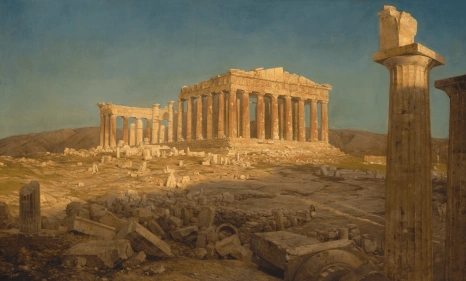
The heads of the school lived in one house. Proclus later lodged, Marinus writes, in the house “where had dwelt both Syrianus, whom he called his father, and Plutarch, whom he called his grandfather.” It stood near the temple of Asclepius “which Sophocles had immortalized,” near the temple of Dionysus by the theatre, and “in sight of the Acropolis.” It housed 3 successive heads of the school: Plutarch, Syrianus and Proclus.5
Her work belonged to that household. Late Platonists, Carlos Steel explains, relied on Plato's Theaetetus 176a–b and “saw the assimilation to god (homoiôsis theôi) as the goal (telos) of philosophy.” Theurgy, the hieratic art, worked toward that goal through “theurgic rites established by the gods themselves,” and Proclus became “an experienced practitioner of theurgy.”6
Her family kept the rites across 3 generations, from Nestorius to Plutarch to her. Plutarch on his deathbed commended Proclus to Syrianus together with his own grandson Archiadas. Archiadas and his wife Plutarche later had a daughter also named Asclepigeneia, whom Marinus keeps distinct from her.7
Her dates aren't recorded. She taught Proclus some time after his arrival in 430 or 431, and the sources don't describe her later life or her death. Crystal Addey's study reads her, with Sosipatra of Pergamon, among the “Neoplatonic female philosophers and theurgists” on whom the figure of Diotima, the teacher of Socrates in Plato's Symposium, left its mark.8
ATTAINMENTS
- She received from her father, “exclusively,” the mystic rites preserved by Nestorius and “the whole theurgic science.”9
- She taught Proclus the Chaldean practices: the prayer meetings and conferences, “the art of moving the divine tops,” unpremeditated responses and other forms of divination. Proclus, Marinus says, “was a believer in these practices.”9
- Marinus names her as the source of that practice in his chapter on theurgic virtue, which he ranks as “a still greater and more perfect virtue” than the life of theory.9
- Her pupil Proclus led the Athenian school from 437 until his death in 485, almost 50 years, and wrote a treatise On Hieratic Art, that is, on theurgy; fragments of it survive.10
- She is 1 of the 3 women, with Clea of Delphi and Sosipatra of Pergamon, whose part in the transmission of Platonic philosophy and ritual expertise “from teacher to pupil” Addey examines in the Routledge Handbook of Women and Ancient Greek Philosophy (2024).11
KEY STORIES
The Earthquake and the Hero
Zosimus, the Greek historian of the empire's decline, records a disaster that followed the death of the emperor Valentinian. “Crete was very much shaken, as was likewise the Peloponnese, and all Greece, many places being destroyed; indeed almost all were overturned, except Athens and the country of Attica.”12
He tells how Athens escaped. “Nestorius, who was then chief sacrist at Athens, saw a vision, by which he was commanded to pay public honours to the hero Achilles, which would be a protection to the city.” The magistrates put it down “to the doting of age” and wouldn't listen.
So Nestorius acted on his own. He set up an image of the hero in a chamber under the statue of Athena, and whenever he offered to the Goddess, he “performed the rites due to the hero.” When the earthquake came, every other place suffered, Zosimus writes, “except the country of Attica, which shared in the favour of the hero.”13
Zosimus names his witness: “the philosopher Syrianus, who has composed a hymn in honour of this hero.” Syrianus was Plutarch's successor at the head of the school.14 Neither author says outright that this sacrist was the Nestorius whose rites came down to Asclepigeneia. The story shows what such rites were for in that city: they guarded it.
The Youth Who Came to Plutarch's House
In 430 or 431 a young man landed at the Piraeus. Syrianus took him in and “presented him to the great Plutarch, son of Nestorius.” The old man saw a youth of barely 20 and was charmed. Plutarch “loved him more and more, continually called Proclus his child, and received him into his house,” and with him Proclus read Aristotle's On the Soul and Plato's Phaedo.15
Plutarch didn't live long after that, only 2 more years, and Syrianus took Proclus into his own home. The rites stayed with Plutarch's daughter, and Proclus learned them from her. Marinus says he practised “the Chaldean prayer-meetings and conferences,” and the rest, “which he had learned from Asklepigenia, daughter of Plutarch.”16
Marinus goes on to what Proclus did with the art. Purified by the Chaldean lustrations, he had “witnessed the apparitions of Hecate under a luminous form,” as he described in a booklet of his own. He could bring rain by performing a rite at the right time, and Marinus says he delivered Attica “from a terrible drought.” He foresaw earthquakes and tested the divining power of the tripod.9 The teacher's name stands in the middle of that chapter as the source of the practice.
A Prayer at the Asclepieion
The younger Asclepigeneia, daughter of Archiadas and Plutarche, fell ill as a small child with a sickness “pronounced incurable by the physicians.” She was “the family's only hope.” Archiadas ran to Proclus “and urgently besought him to come and pray for his daughter.”5
Proclus took the philosopher Pericles of Lydia with him and “ran to the temple of Asklepius.” Athens still had it then; Marinus notes that it “had not yet been sacked.” Proclus prayed “according to the ancient rite,” and while he prayed, “suddenly a change manifested in the little girl's condition.” She recovered, Marinus says, “for the Savior, being a divinity, swiftly gave her back her health.” The child lived to marry Theagenes, whom Marinus calls “our benefactor.”5
He had made his vows “so as to preclude any possibility of malicious slander,” and “the whole household had taken part in this act.” The house where Plutarch and Syrianus had lived stood near that same temple.5
Asclepius was the God the Greek physicians swore by: “I swear by Apollo the physician, and Asclepius, and Hygieia and Panacea and all the gods.”17 In Zevist terms, the child's disease was a form of Izfet, the disorder that Egyptian religion set against Ma'at, “the personification of truth, justice, and the cosmic order,” and the prayer answered it with Ma'at.18
THE ZEVIST READING
Zevism names 4 dimensions of the path, and theurgy is the 4th: Σοφία, the joining of one's intelligence to the intelligence of the Gods. Marinus describes that virtue as “passing beyond the theoretic step.” Proclus, he says, would “direct his thoughts upward to the divine” and also “cared for those things which were lower.”9 Asclepigeneia held that art in her generation, and the chain of the school ran through her.
The aim behind it is Plato's: likeness to the divine “as far as possible,” ὁμοίωσις θεῷ κατὰ τὸ δυνατόν.19 The late Platonists read that passage as the goal of philosophy itself. Zevism reads it as the literal elevation of human nature toward the divine, and a theurgist's rites are one of its roads.
Zevism honours the keepers of the source. A book can wait on a shelf for centuries, but a rite dies with the last person who knows how to perform it. Plutarch didn't divide his rites among his pupils. He gave them to a single person, and she passed them on. Knowledge evolves in transmission; first it has to be transmitted, and Asclepigeneia was the one who did it.
The practice she handed on didn't stop at the borders of Athens. Marinus says Proclus “regularly observed the great festivals of all peoples,” purified himself every month in the rites of the Mother of the Gods, and kept the Egyptian holy days. His favourite phrase was that a philosopher should be “the hierophant of the whole world in common.”20 Zevism, the chain of all spirituality from its inception, reads that phrase as its own.
Hecate stands at the centre of the rite Proclus learned from her. Hesiod says Zeus honoured Hecate “above all,” and that “whenever any one of men on earth offers rich sacrifices and prays for favour according to custom, he calls upon Hecate.”21 Proclus saw her “under a luminous form.” The Temple reads that line through its doctrine of Light and Darkness: the initiate walks into the unexplored dark carrying light, and what is explored becomes Light. Asclepigeneia taught the way in.
NOTES
1 Marinus, Life of Proclus 28.
3 Marinus, Life of Proclus 12.
5 Marinus 29.
6 Steel, “Proclus,” SEP, §3.6.
8 Addey, “The Reception of Diotima”.
9 Marinus 28.
10 Steel, “Proclus,” SEP, §§1, 3.6.
12 Zosimus, New History 4, pp. 102–103.
14 Zosimus 4, p. 103; Marinus 12.
15 Marinus 10, 12; Steel, SEP, §1.
16 Marinus 12, 28.
17 Hippocratic Oath, tr. North, NLM.
20 Marinus 19.
BIBLIOGRAPHY
Marinus of Samaria, The Life of Proclus, or Concerning Happiness, tr. Kenneth Sylvan Guthrie, 1925, pp. 15–55; chapters 10, 12, 19 and 28–29. Chapter 28 is the principal ancient testimony for Asclepigeneia's teaching.
Carlos Steel, “Proclus”, Stanford Encyclopedia of Philosophy, first published 2011, revised 2020; §1 and §3.6.
Crystal Addey, “The Reception of Diotima in Later Platonism: Clea, Sosipatra and Asclepigeneia”, in The Routledge Handbook of Women and Ancient Greek Philosophy, Taylor and Francis, 2024, pp. 461–481; institutional abstract.
Zosimus, New History 4, English translation, London: Green and Chaplin, 1814, pp. 102–103; transcription at tertullian.org.
Hesiod, Theogony 411–418, tr. H. G. Evelyn-White, Theoi Classical Texts Library.
Hippocratic Oath, tr. Michael North, National Library of Medicine, “Greek Medicine”, 2002.
Encyclopaedia Britannica, “Maat”.
Plato, Theaetetus 176a–b, Greek text, Perseus Digital Library.
CREDIT
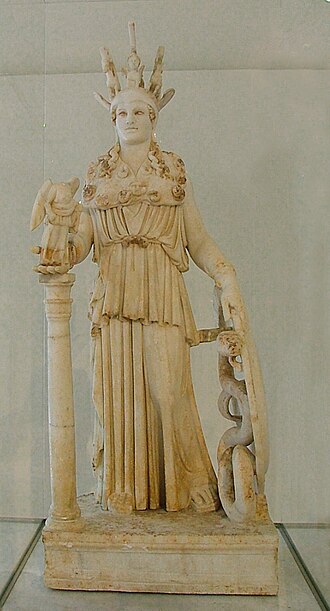
Picture: The Varvakeion Athena, a Roman-period copy of Athena Parthenos in the National Archaeological Museum, Athens. An illustration of the Athenian sacred inheritance, not a portrait of Asclepigeneia.
Jerónimo Roure Pérez (Dorieo), photograph2007; Wikimedia Commons; CC BY-SA 4.0. Image record, CC BY-SA 4.0.

The round picture in the lists of the personalities is cropped from it.