




9 min read
King of Assyria
Ashurbanipal of Assyria
author: High Priest Zevios Metathronos
Learning Entrusted to the Future
Dates: Reigned 668–c. 631 BCE.
Period: Ancient.
Ashurbanipal ruled the Assyrian empire from Nineveh from 668 to about 631 BCE. He was the son of Esarhaddon and the grandson of Sennacherib, and his tablets call him “great king, mighty king, King of the World, King of Assyria.”1
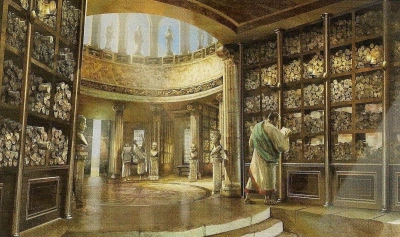
His great work was a royal library. His scholars copied tablets from Assyria and from Babylonia, checked them and labelled them as the king's, and the ruins of Nineveh have given up more than 30,000 clay tablets. The British Museum's research has shown which of them carry his library label and which belong to other collections.2
Zevism reads Ashurbanipal as an Assyrian link in the chain of spirituality. His library served Nabu, “scribe of everything,” whose office the Temple reads beside Thoth and Hermes, and it kept older sources alive by copying them.
LIFE AND CONTEXT
Ashurbanipal was trained as a scribe. In one of his inscriptions he says: “The art (lit., work) of the Master Adapa I learned,” and he calls it “the hidden treasure of all scribal knowledge.”3
He claimed to read the oldest writing of his world. “I have read the artistic script of Sumer (and) the dark (obscure) Akkadian, which is hard to master,” he says on the same page of the translation, and it adds that he took pleasure “in the reading of the stones (i.e., steles) (coming) from before the flood.”4
His brother Shamash-shuma-ukin was king of Babylon. The Akitu Chronicle, a Babylonian record, deals with what followed: “the war between the Babylonian king Šamaš-šuma-ukin and his brother Aššurbanipal, king of Assyria.”5
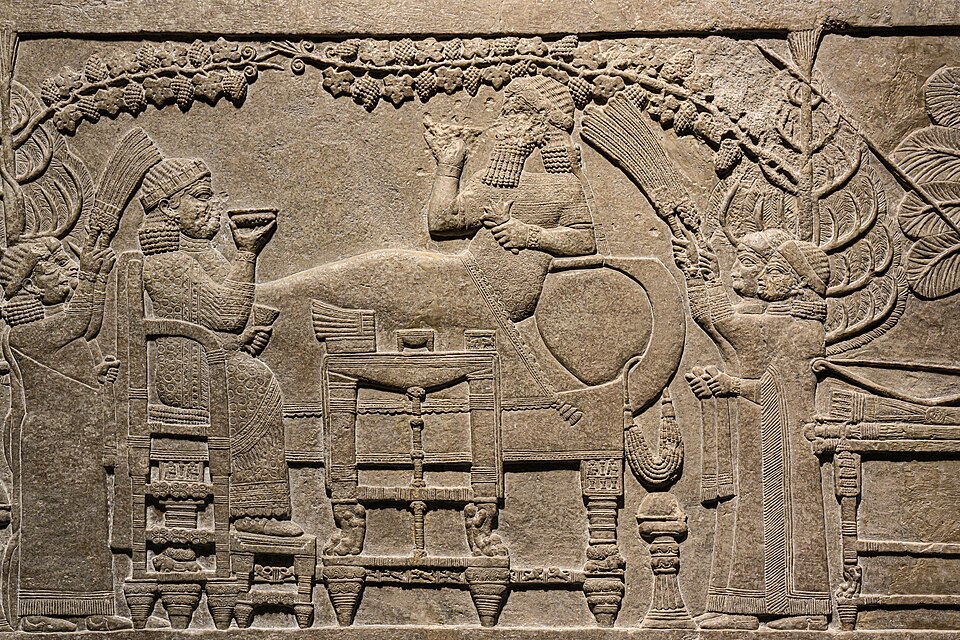
He also fought Elam. On the reliefs of his North Palace at Nineveh, carved between 645 and 635 BCE, the head of Teumman, “king of Elam,” hangs in a tree while the king drinks with his queen. The same palace held reliefs of his lion hunts.6
His reign ended about 631 BCE. Nineveh fell in 612 BCE, and the museum records that the faces of the king and queen on the banquet relief were mutilated that year.7
The library's tablets lay in the ruins until excavators dug them out between 1851 and 1932. They didn't find them in order: the British Museum's project concluded that “excavators did not find a library frozen in time when it fell to the floor during the conquest of Nineveh in 612 BC.” Its researchers counted how many Nineveh tablets bear the library label, the colophon, and so sorted the king's library from other collections.2
ATTAINMENTS
- He assembled a royal library at Nineveh, with tablets labelled by colophons as his, from the more than 30,000 cuneiform tablets recovered there.2
- His scholars copied from 2 traditions at once. A standard colophon names its sources as “tablets and writing boards, copies from Assyria and Sumer and Akkad,” that is, Babylonia.8
- He had texts checked as well as copied: “I have written, checked and collated this tablet in the assembly of scholars.”9
- He kept the checked tablets in his palace “for my royal consultation,” and he protected their attribution with a curse in the name of Nabu.10
- He learned the scribal art himself and claimed to read Sumerian script, difficult Akkadian and inscriptions “from before the flood.”4
- He defeated his brother's Babylonian army at Hiritu in the 16th year of Shamash-shuma-ukin, 652/651 BCE.11
- He decorated the North Palace at Nineveh with carved gypsum reliefs of the hunt and of his victory over Elam, now in the British Museum.12
KEY STORIES
Brothers at War
The Akitu Chronicle counts years by the Babylonian king. In the 16th year of Shamash-shuma-ukin, 652/651 BCE, “the major-domo conscripted troops in Akkad,” and then: “On the nineteenth day of the month Tebêtu hostilities began between Assyria and Akkad. The king withdrew before the enemy into Babylon.”13
The armies met just over 2 months later. “On the twenty-seventh day of Addaru the armies of Assyria and Akkad did battle in Hiritu. The army of Akkad retreated from the battlefield and a major defeat was inflicted upon it.” The chronicle adds at once: “However, there were still hostilities and warfare continued.”14
In the 17th year “there were insurrections in Assyria and Akkad,” and the chronicle records a silence in the temples. For 4 years, the 17th to the 20th, the procession of Bêl in Babylon didn't take place: “Nabû did not come and Bêl did not come out.” The war between the brothers had stopped the God's procession.15
Wine over the Lions
A gypsum panel from Room S of the North Palace shows the king at the hunt in 3 registers, on reliefs that “probably decorated one of the king's own private apartments.” At the top a small boy or eunuch, “himself protected from the lion by a smaller cage,” let a lion out, and the king's arrows hit it but “fail to kill it, and it leaps at the king who continues shooting, guarded by a shield-bearer.” In the middle register the king “grabs the lion by the tail,” and his right hand, the caption says, held a mace to strike it over the head.16
The bottom register shows what came after. The king “is pouring a libation, which the caption tells us is wine, over the bodies of four lions,” beside an altar of offerings, while “a musician with a plectrum plays a triumphant tune on a seven-stringed horizontal harp; there is another man beside him, perhaps a singer.”16
The museum's curators note that “Ashurbanipal records that in his time there was ample rain in Assyria and lions abounded,” and the inscription names Ashur, Ninurta, Nergal, Ninlil and Ishtar. Someone later defaced the lion's tail in the middle register, “probably the action, at once humorous and symbolic, of some enemy soldier busy ransacking the palace in 612 BC.”16
The Head in the Garden
One relief from his palace shows a garden party, with birds and a locust in the trees. The king “reclines on a sofa beneath a vine and his queen sits opposite him; they are drinking.” Women fanned them with fly-whisks and brought dishes, and the hands of a woman drummer and a woman harpist showed among the palms. He'd left his sword, bow and quiver on a table behind him.17
The trees carry the trophies of the Elamite war: “the head and hand holding a wand of Teumman, king of Elam.” The curators put it plainly: “Suspended from a tree behind the queen is the head of Teumman, king of Elam.” The fragment was found where it had fallen into Room S of the North Palace.17
Written, Checked and Collated
A tablet from the library ends with a short statement of how it was made. It names the palace and the king's line, then its sources: “According to tablets and writing boards, copies from Assyria and Sumer and Akkad (=Babylonia).”8
Then the king speaks. “I have written, checked and collated this tablet in the assembly of scholars, and placed it in my palace for my royal consultation.” The last line curses anyone who would put his own name in the king's place: “Whoever erases my name and writes his own, may Nabu, scribe of everything, erase his name!”18
Nineveh's tablets outlived the palace. Among them is K.3375, excavated at Kouyunjik by Hormuzd Rassam, the 11th tablet of the Epic of Gilgamesh, which tells how Ea “instructed” Utu-napishtim “to make a boat.” The British Museum calls it “the single most famous cuneiform text,” one that “caused a sensation when its content was first read in the 19th century.” In Zevist terms the tablets waited in the dark for nearly 25 centuries, and reading them carried light back into it.19
THE ZEVIST READING
Zevism holds that spirituality forms one chain from its inception to the present, and Ashurbanipal's Gods keep their names in it: his lion hunt names Ashur, Ninurta, Nergal, Ninlil and Ishtar, and Nabu guards his tablets. The Temple reads Nabu's office beside that of Theuth, who in Plato's Phaedrus invents number, calculation, geometry, astronomy and letters.20 A king who calls himself a student of Adapa's art and asks Nabu to guard his name stands inside that office.
Zevism also holds that one must return to the source. Knowledge changes as it's handed on, and the source keeps priority. The library's colophon names its sources in the line after the king's titles, and Ashurbanipal's pleasure in stones “from before the flood” is a scholar's wish to read the oldest witness. The Temple honours the copyists of the assembly of scholars as transmitters, keepers of the source whose names this colophon doesn't give.
The Good in Zevism is the conjunction of Ma'at and Right, right order together with a right act from a right will. The library meets that measure. The war with his brother, which stopped the procession of Bêl for 4 years, and an enemy king's severed head hung in the garden during a royal feast don't. The Temple keeps both facts in view and doesn't let the library excuse the garden.
The colophon's curse guards a name against being written over. Nabu's curse protects attribution, and so does every honest citation. In the Temple's reading, a true record of who wrote and who copied is itself a small restoration of Ma'at.
NOTES
1 British Museum, What was Ashurbanipal's library?; Colophon b, line 1, ORACC.
2 British Museum, What was Ashurbanipal's library?.
3 Luckenbill, Ancient Records, vol. 2, p. 386.
5 ABC 16, introduction, Livius.
6 British Museum, 124920; British Museum, 124886.
7 British Museum, What was Ashurbanipal's library?; British Museum, 124920.
12 British Museum, 124886; British Museum, 124920.
14 Lines 13–16.
15 Lines 17–23.
18 Lines 6–10.
BIBLIOGRAPHY
British Museum, What was Ashurbanipal's library?, research-project account, especially its distinction between Ashurbanipal's collection and other Nineveh collections, the count of over 30,000 tablets and the excavation dates.
ORACC, Reading the Library of Ashurbanipal project, Ashurbanipal Library Colophon b, BAK 318, Q009328, edition and translation, lines 1–10.
Daniel David Luckenbill, Ancient Records of Assyria and Babylonia, vol. 2, Historical Records of Assyria from Sargon to the End, University of Chicago Press, 1927, Internet Archive; p. 386.
Akitu Chronicle (ABC 16), lines 9–26, adapted from A. K. Grayson, Assyrian and Babylonian Chronicles (1975) and J.-J. Glassner, Mesopotamian Chronicles (2004), Livius.org.
British Museum, wall panel, royal lion hunt, 124886, North Palace, Nineveh, 645–640 BC; description and curator's comments.
British Museum, The Banquet Scene, 124920, North Palace, Nineveh, 645–635 BC; description and curator's comments.
British Museum, The Flood Tablet, K.3375; description and curator's comments.
Plato, Phaedrus 274c–275b, English translation, Perseus Digital Library.
CREDIT
Picture: Ashurbanipal reclining in the palace banquet relief from Nineveh, c. 645–640 BCE, British Museum. This is an ancient royal representation, not an illustration of the library. Photograph by Allan Gluck; CC BY 4.0.

Photograph by Allan Gluck, via Wikimedia Commons; CC BY 4.0. Image record, CC BY 4.0.
The round picture in the lists of the personalities is cropped from it.