










3 min read
Finder of the Hidden Sun
Atri
author: High Priest Zevios Metathronos
The seer whose sacred work restores the light
Dates: Rigvedic period; individual lifetime undated
Period: Ancient (6000–500 BCE)
Region: Vedic India
Tradition: ṛṣi and priestly lineage
Religion or tradition: Vedic religion: Atri and the Atri priestly lineage.
Heresy status: No designation documented.
Atri and the Atris belong to the sacred inheritance of the fifth book of the Ṛgveda. Hymn 5.40 names their role in the recovery of Sūrya from darkness. The passage gives a direct Vedic foundation for Atri’s religious character: his power is represented through prayer, ritual knowledge and service to the Gods.1
PRESERVING AN IMAGE OF KNOWLEDGE USED CONSTRUCTIVELY
The hymn of Atri and the Atris presents sacred competence through the recovery of Sūrya from obscuring darkness. The beings affected by the darkness are bewildered; the seer’s prepared utterance contributes to the restoration described by the poem. The tradition therefore honours knowledge through its constructive purpose and through its relation to a God whose light matters to the living world.2
The contribution received by later humanity is this powerful religious account of trained understanding brought into action. Its service to the Gods lies in the praise of Sūrya and the ritual work of the seer’s lineage. For Zevist study, the passage offers a memorable standard for personal development: acquired ability should become useful when clarity, restoration and purposeful action are required.
THE RECOVERY OF SŪRYA
The hymn begins with praise of Indra’s strength. It then describes Svarbhānu’s darkness obscuring the Sun and leaving living beings bewildered. Atri discovers the concealed Sūrya through sacred utterance, and the concluding verses celebrate the Atris’ achievement. Ritual preparation and praise are integral to the account.3
The movement from the named seer to the plural Atris is significant for reading his legacy. It connects an exemplary figure with a priestly inheritance. The poem honours a form of knowledge capable of preserving or restoring the conditions of ordered life.
This is sacred poetry. Its imagery can be studied in relation to celestial phenomena, but the hymn alone does not establish an exact astronomical date for Atri’s life. The present profile follows the text’s explicit religious action.
A ZEVIST INTERPRETATION
Atri offers a forceful image of spiritual competence: confusion is met by prepared knowledge and purposeful practice. The sage’s response has form. He knows the utterance, undertakes the rite and directs his work toward restoration.
For a Zevist practitioner, this can serve as an interpretation of the value of repeated training. One studies before a difficult moment arrives, so that understanding can become action when needed. The recovery of light also gives a fitting image for renewed clarity after uncertainty.
The profile’s emphasis is therefore on learned spiritual capability and its constructive use. Atri’s place in the tradition is expressed by the hymn’s own praise of the seer and his lineage as those who recover the Sun.
NOTES
1 Ṛgveda 5.40.
3 5.40.5–9.
PRIMARY SOURCE
Ṛgveda 5.40, especially verses 5–9, trans. R. T. H. Griffith, full hymn. The narrative and its spiritual interpretation are distinguished from independently dated biography.
Indira Gandhi National Centre for the Arts, Vedic Heritage Portal, “Rigveda,” maṇḍala and seer-family table, for traditional family-book attribution.
CREDIT
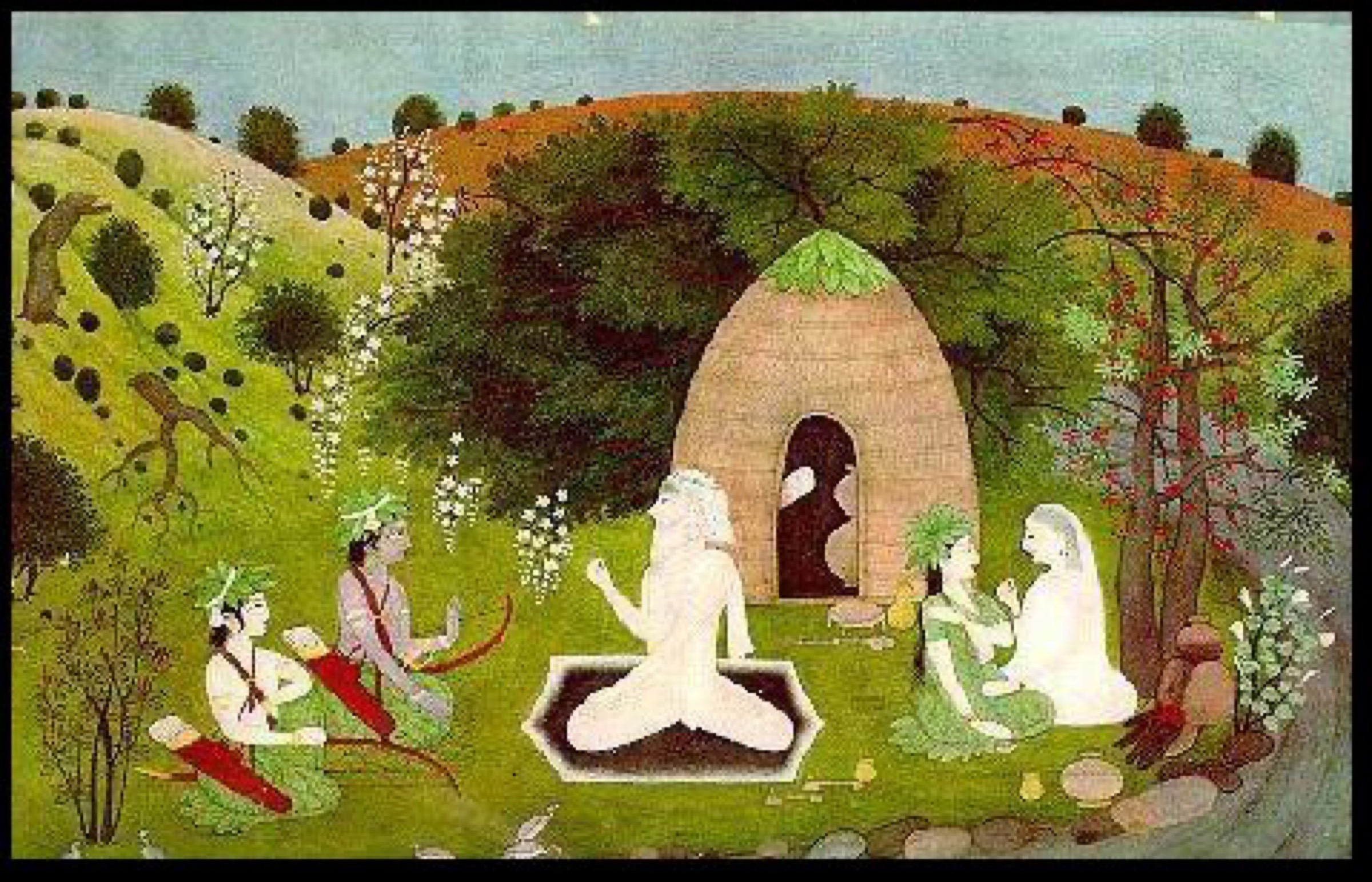
Picture: Traditional narrative painting. Rama, Sita and Lakshmana at the Hermitage of Sage Atri, Pahari painting, 1780–1785, Bhuri Singh Museum. A later traditional scene associated with Atri.
Credit: Unknown artist. Source record, Public domain.

The round picture in the lists of the personalities is cropped from it.