





9 min read
The Chief Master
Avicenna
author: High Priest Zevios Metathronos
The Ordering of Knowledge in the Service of Life
Dates: Born in the 10th century; died 1037
Period: Era of Ignorance in this collection's timeline
Abū ʿAlī al-Ḥusayn ibn ʿAbd Allāh ibn Sīnā, known in Latin as Avicenna, was a physician and philosopher from the country around Bukhara who died at Hamadan in 1037. He wrote the Canon of Medicine, a medical encyclopaedia in 5 books, and The Cure, a philosophical encyclopaedia that fills 22 large volumes in its Cairo edition.1
The Canon had a long life in Europe. Its Latin translation, “often revised, formed the basis of medical instruction in European universities until the 17th century,” and between 1500 and 1674 some 60 editions of it appeared in Europe.2
Avicenna lived and wrote in an Islamic setting and built on the Arabic inheritance of Greek learning. Zevism reads him as a link in the chain of all spirituality and a keeper of the source: he gave Greek medicine and philosophy an order that could cross languages. That work belongs to Athena, Goddess of wisdom, and to Thoth, the Egyptian lord of writing and measurement.3
LIFE AND CONTEXT
He was born in Afshana, a village outside Bukhara, “some time in the 70s of the tenth century, perhaps as early as 964.” Gutas adds that “it has not been possible to determine the year of his birth with greater precision,” though 980 remains the conventional date in many catalogues. His father had come north from Balkh and served the Samanids as governor of the nearby district of Kharmaythan.4
In his autobiography he makes a point of having studied the sciences “all by himself, in this order, at increasing levels of difficulty,” and says he'd reached proficiency by 18. At 21 a neighbour named ʿArūḍī asked him for a “comprehensive work” on all philosophy, and he wrote Philosophy for ʿArūḍī.5
The Samanid state fell when the Qarakhanid Turks entered Bukhara in 999. Avicenna moved from court to court. At Gurganj he joined the service of the Maʾmunid Abu'l-Ḥasan ʿAlī b. Maʾmūn. At Jurjan he met Jūzjānī, later his biographer, and spent little time there before moving to Rayy, where he served the Buyid Majd al-Dawla and his mother Sayyeda. MacTutor sums up those years as a teacher's post in Gurgan and an administrator's in Rayy.6
At Hamadan he became vizier to the amir Shams al-Dawla, “with an occasional conflict with the amir's troops,” until the amir died in 1021. His last 13 years or so were spent at the court of ʿAlāʾ al-Dawla in Isfahan. He finished The Cure there and wrote the Persian Dānishnāma for his patron. He died in 1037 on a journey to Hamadan and was buried there.7
ATTAINMENTS
- He organised the Canon in 5 books: general principles, anatomy and regimen; simple drugs listed alphabetically; diseases of 1 part of the body; diseases covering several parts; and a formulary of compound remedies.8
- He wrote the Canon on the move. It was begun at Gurgan, continued at Rayy and completed at Hamadan.9
- He completed The Cure in Isfahan, an encyclopaedia of the philosophical sciences that runs to 22 large volumes in the Cairo edition of 1952–83.5
- He carried philosophy into Persian with the Dānishnāma written for ʿAlāʾ al-Dawla, alongside his major works in Arabic.3
- He practised medicine at court from about 17, as physician to the Samanid Nūḥ b. Manṣūr, and later held the office of vizier at Hamadan.10
- The Canon taught the keeping of health as well as the cure of disease: a Latin copy of about 1450 at the National Library of Medicine preserves its material on regimen, including diet and exercise.11
- He wrote about 450 works, of which around 240 survive, by MacTutor's count.12
- He observed the sky at Isfahan and at Hamadan, invented an instrument for observing the coordinates of a star, and tried to fix the difference in longitude between Baghdad and Gurgan from a meridian transit of the moon.12
KEY STORIES
The Physician in the Samanid Palace
Avicenna began to study medicine at 13, MacTutor reports, and “had mastered that subject by the age of sixteen when he began to treat patients.” At about 17 he was enrolled as a physician in the service of the Samanid ruler Nūḥ b. Manṣūr.13
The young physician cured the ruler of an illness, and as a reward he was allowed to use the Royal Library of the Samanids, which MacTutor calls important “for ibn Sina's development in the whole range of scholarship.” Gutas places the 3rd and highest stage of his studies “at a research level, in the physicians' library in the palace of the Samanid ruler.”14
He was “perfectly schooled in the Greek sciences by the time he was eighteen.” The palace didn't last much longer. In 999 the Qarakhanid Turks entered Bukhara and overthrew the Samanid state, and the young scholar had to look for new patrons.10
Four Months in the Castle of Fardajan
Shams al-Dawla died in 1021, and Avicenna refused to serve the new amir. He wrote instead to ʿAlāʾ al-Dawla, the ruler of Isfahan. The court at Hamadan took it badly. “The Buyid court in Hamadān, and especially Tāj-al-molk, the Kurdish vizier, suspected Avicenna of treachery because of these moves, and they arrested and imprisoned him in a castle outside of Hamadān called Fardajān.”10
He'd stay there for 4 months. Release came with an army: ʿAlāʾ al-Dawla “marched toward Hamadān and ended Samāʾ-al-dawla's rule there” in 1023.10
MacTutor tells the last act. Avicenna slipped away to Isfahan “disguised as a Sufi” and joined ʿAlāʾ al-Dawla. There he found a patron who valued him, and in Gutas's words “his productivity never flagged, even during these years that were militarily and politically turbulent.”15
The Canon Goes West
In the 12th century Gerard of Cremona put the Canon into Latin, and Europeans read it in his version. Its size and even its name worked for it: Qānūn means “canon” or “codes of law,” and the title helped make the book an authority.9
A copy made in France around 1250, now at Utrecht, shows the book in use. It's a heavy volume of 638 parchment leaves. “The margins show notes of several hands and there are many maniculae,” little pointing hands drawn to mark important passages. It passed through the hands of David of Burgundy, bishop of Utrecht, and of his physicians Anthonius Pottage and Johannes Keyl.16
Then came a return to the Arabic. Andrea Alpago had lived in Damascus for 30 years as physician to the Venetian Republic, and he used his Arabic to make a new Latin version, published in 1527, 5 years after his death, with an Arabic-Latin glossary. Long before Alpago, the physician Ibn al-Nafīs had written a commentary on the anatomical sections of the Canon and stated that the blood of the right ventricle “must reach the left ventricle by way of the lungs.”9
The Last Journey to Hamadan
In Isfahan Avicenna followed his patron to war. He went with ʿAlāʾ al-Dawla “in most of his campaigns and trips,” Gutas writes, “and indeed it was during one such trip to Hamadān that he died, in 428/1037, of colic, after a protracted series of recoveries and relapses.”10
MacTutor adds that he took ill on campaign and died “despite attempting to apply his medical skills to himself.” The physician whose book taught Europe couldn't cure his own colic. MacTutor's source puts the end down to “a mysterious illness, apparently a colic that was badly treated; he may, however, have been poisoned by one of his servants.”12
He was buried at Hamadan, the city where he had held the vizierate and where the Canon was finished. His student Jūzjānī had taken down the autobiography, and most of what's known of the early years comes from it; Jūzjānī wrote the rest of the life himself.17
THE ZEVIST READING
Zevism holds that spirituality is 1 chain from its inception to today and that Ancient Hellenism is its primary lens. Avicenna, who worked in an Islamic setting, stands in that chain as a keeper of the source. The Greek sciences reached him in Arabic, he ordered them, and his order passed on into Latin. The Temple honours every hand on that road: Gerard of Cremona, the Utrecht readers with their pointing hands, and Alpago going back to the Arabic.
Alpago's return is the Zevist rule of transmission at work. Knowledge evolves as it passes from language to language, and the source keeps priority. Ibn al-Nafīs showed the other half of the rule: a commentator working inside the Canon's own tradition corrected its account of the heart and lungs.
The book's title carries a doctrine of its own. Qānūn means law, and a law of the body is Ma'at, “the personification of truth, justice, and the cosmic order,” held by Zeus as Sovereign of the Cosmos.18 Disease is Izfet, the order of the body coming apart, and the Canon sets down the order that healing restores.
Plato gave Theuth the invention of “numbers and arithmetic and geometry and astronomy” and of letters.19 An encyclopaedia completes Theuth's gift by putting what letters store in an order a student can walk through. Avicenna named his philosophical encyclopaedia The Cure. Zevism reads that name literally: knowledge ordered well heals the mind, and a mind so healed moves toward ὁμοίωσις θεῷ κατὰ τὸ δυνατόν, likeness to the divine as far as possible.20
NOTES
1 Gutas, “Ibn Sina [Avicenna],” Stanford Encyclopedia of Philosophy; NLM, “Medical Encyclopedias”.
2 Gutas, SEP; NLM, “Medical Encyclopedias”.
4 Gutas, SEP; Gutas, “Avicenna ii. Biography,” Encyclopaedia Iranica.
5 Gutas, SEP.
8 Utrecht University Library, “Liber canonis medicinae”.
9 NLM, “Medical Encyclopedias”.
10 Gutas, Iranica.
11 NLM, Liber Medicinalis, MS E 1.
12 O'Connor and Robertson, MacTutor.
13 O'Connor and Robertson, MacTutor; Gutas, Iranica.
14 MacTutor; Gutas, Iranica.
15 MacTutor; Gutas, SEP.
16 Utrecht University Library.
17 Gutas, Iranica; NLM, “Medical Encyclopedias”.
BIBLIOGRAPHY
Dimitri Gutas, “Ibn Sina [Avicenna]”, Stanford Encyclopedia of Philosophy, first published 15 September 2016, substantive revision 31 October 2025; §§1–2: birth, father, self-directed study, Philosophy for ʿArūḍī, Isfahan, The Cure, Dānishnāma, the Latin Canon.
Dimitri Gutas, “Avicenna ii. Biography”, Encyclopaedia Iranica; Afshana, Samanid service, the fall of Bukhara, Gurganj, Jurjan, Rayy, Hamadan, Fardajan, Isfahan, death and burial, Jūzjānī.
J. J. O'Connor and E. F. Robertson, “Abu Ali al-Husain ibn Abdallah ibn Sina (Avicenna)”, MacTutor History of Mathematics, November 1999; medical study, the Royal Library, escape to Isfahan, death.
National Library of Medicine, “Catalogue: Medical Encyclopedias,” Kitāb al-Qānūn fī al-ṭibb; composition from Gurgan to Hamadan, Gerard of Cremona, 60 editions 1500–1674, Alpago 1527, Ibn al-Nafīs.
Femke van Hilten, “Liber canonis medicinae by Avicenna”, Utrecht University Library, April 2017; manuscript 681, Hs 4 E 10, France, c. 1250.
National Library of Medicine, Liber Medicinalis, Ibn Sina, c. 1450, MS E 1; regimen in the Latin tradition.
Plato, Phaedrus 274c–275b, tr. Harold N. Fowler, Perseus Digital Library.
Encyclopaedia Britannica, “Maat”.
Plato, Theaetetus 176a–b, Greek text, Perseus Digital Library.
CREDIT
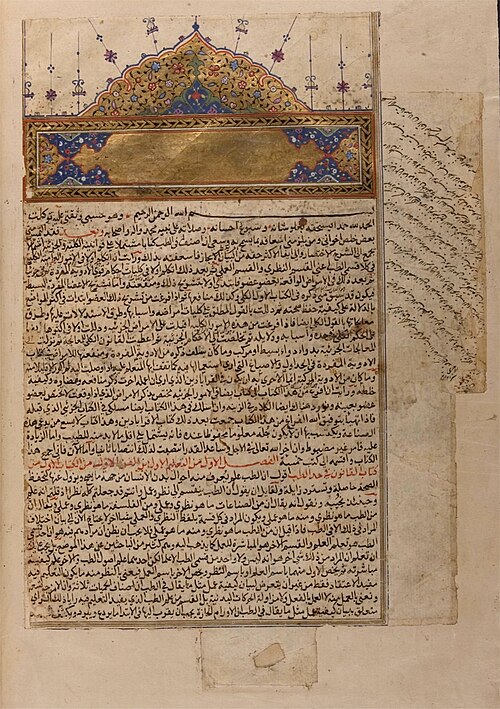
Picture: Illuminated opening of Avicenna’s Canon, copied in 1597–1598. The manuscript preserves an invocation to Allah.
Yale Medical Historical Library, Cushing Arabic MS5; via Wikimedia Commons. Image record, Public domain, faithful reproduction of a two-dimensional public-domain work (PD-Art)..

The round picture in the lists of the personalities is cropped from it.