





9 min read
Guardian of Greek Books
Bessarion
author: High Priest Zevios Metathronos
An Inheritance Entrusted to the Future
Dates: c. 1400–1472 CE
Period: Renaissance (1336–1650 CE)
Bessarion was a Greek monk from Trebizond who became a cardinal of the Roman Church, a translator of Aristotle, a defender of Plato against his critics, and a collector of Greek manuscripts. In 1468 he gave his library to Venice: 482 Greek and 264 Latin manuscripts, with a deed that set out how they were to be kept.1
The gift formed the first nucleus of the Biblioteca Nazionale Marciana, and among its books are the 2 Venetian manuscripts of the Iliad, Venetus A and B.2
Bessarion was a Christian prelate all his adult life. His teacher Plethon wrote a Book of Laws for a renewed Olympian religion, and Zevism honours the pupil as a keeper of the source: after the fall of Constantinople he answered ruin by building, and he placed Homer and Plato where readers would still find them 5 centuries later.
LIFE AND CONTEXT
He was born in Trebizond on the Black Sea and baptised Basil. The year isn't settled: Britannica gives 2 January 1403, the Stanford Encyclopedia a range from 1399 to 1408. As a boy he went to Constantinople and studied with John Chortasmenos, and in 1423 he became a monk and took the name Bessarion.3
From 1430 to 1436 he studied at Mistra under George Gemistos, called Plethon, whom the Marciana calls “the leading Greek philosopher of the time.” Plethon's treatise on the difference between Aristotle and Plato inspired Cosimo de' Medici to found the Platonic Academy of Florence. His Book of Laws went further. The Stanford Encyclopedia describes it as “propagating a philosophically refined form of the old Olympian religion,” and a few years after 1454 the patriarch Gennadios Scholarios ordered all existing copies destroyed.4
In 1437 he was made metropolitan of Nicaea and sailed for Italy with the Greek delegation to the Council of Ferrara-Florence. He argued for union, and in December 1439 the pope created him cardinal. He'd spend the rest of his life in the Roman Curia, and in 1450 Nicholas V sent him to Bologna as legate a latere.5
His house in Rome became a meeting place for Greek emigrés and Latin humanists, among them Theodore Gaza and his own secretary, Niccolò Perotti. Britannica speaks of “a circle of philosophers devoted to the study of Plato.” He translated Greek into Latin himself, and his version of Aristotle's Metaphysics, made between 1446 and 1451, was dedicated to King Alfonso I of Naples.6
The fall of Constantinople in 1453 changed his work. He pressed the Western powers for a crusade to free Greece, carried that case on embassies to Germany and Vienna, went as papal legate to Venice in 1463 and was named Latin patriarch of Constantinople the same year. He came close to the papacy at least twice. The Stanford Encyclopedia reports that his beard, which many took as a sign of his suspect Greek origins, apparently cost him the support he needed.6
He fell ill on the way back from a mission to France and died at Ravenna between 17 and 18 November 1472, a guest of the Venetian podestà Antonio Dandolo.7
ATTAINMENTS
- In July 1439 he read the act of union between the Roman and Greek churches at Florence, after arguing for agreement in his Oratio dogmatica de unione of April.8
- He wrote In calumniatorem Platonis, Against the Slanderer of Plato, over about 10 years; Sweynheym and Pannartz printed it at Rome in 1469.8
- He translated Aristotle's Metaphysics into Latin, a version Nicholas of Cusa praised, and added Latin versions of Xenophon's Memorabilia, Demosthenes' First Olynthiac and a sermon of Saint Basil.8
- He kept Greek emigré scholars such as Theodore Gaza and Latin humanists such as Niccolò Perotti in his household, and his house in Rome drew a circle devoted to the study of Plato.6
- He bought and commissioned copies of Greek texts after 1453 so that Greek and Byzantine learning would survive the loss of its capital.9
- He gave Venice 482 Greek and 264 Latin manuscripts in 1468, with inventories and conditions for their custody; the documents survive as Marciana Lat. XIV, 14 (=4235).1
- His collection includes the Iliad manuscripts Venetus A and B, with works of philosophy, theology and science and volumes made to his order.1
KEY STORIES
The Act of Union at Florence
The Greeks had come to Italy to settle an old quarrel over a single word in the Creed. They held that the Holy Spirit proceeds from the Father alone; the Roman formula added that it proceeds from the Son as well, the Filioque. The debate ran on through Ferrara and then Florence.8
In April 1439 Bessarion delivered his Oratio dogmatica de unione. He argued that the Greek and Latin authorities, read properly, agreed. The Marciana holds that the union proclaimed in Florence on 6 July 1439 came about “largely through his efforts,” and it was Bessarion who read the act of union aloud that month.5
In December the pope made him cardinal of the Basilica of the Santi XII Apostoli in Rome. The monk from Trebizond had become a prince of the Latin Church, and he never went back to live in the East.10
The Answer to the Slanderer of Plato
Around 1458 George of Trebizond published his Comparatio philosophorum Platonis et Aristotelis. “In three books George attacked Plato as ignorant, impious and vicious,” the Stanford Encyclopedia summarises, while praising Aristotle's perfect wisdom, piety and virtue.8
Bessarion spent about a decade on the reply. He didn't answer by running Aristotle down. His In calumniatorem Platonis read the 2 philosophers as working on different subjects, with Aristotle as a natural philosopher and Plato as a theologian, so that most of their apparent disagreement disappeared. Britannica calls it a defence of Plato “against the fervid Aristotelianism of George of Trebizond.”6
He wrote it first in Greek, then saw that a Greek book wouldn't reach the readers who mattered, so he turned it into Latin and had his secretary Perotti polish the style. The work grew to 6 books. The 1st proved Plato's wisdom despite his elusive style; the 2nd set his teaching on creation, soul and matter beside Christian doctrine; the 3rd took apart George's handling of Aristotle; the 4th defended Plato's morals; the 5th listed the errors in George's version of the Laws; the 6th, De natura et arte, expounded Aristotle's Physics.11
In 1469 Sweynheym and Pannartz printed the book at Rome. The pupil of Plethon had put a defence of Plato into type, and Marsilio Ficino was among the readers who took up its Christianised readings of the dialogues.8
The Gift of 1468
After 1453 Bessarion bought Greek manuscripts and paid for copies of the texts he wanted saved. By 1468 he had decided where they should go. Venice, the Marciana writes, appeared to him “as a second Byzantium, heir to the Byzantine tradition,” and he had confidence in the Republic's constitution.9
On 31 May 1468 he wrote to Doge Cristoforo Moro and gave his books to St Mark's and the Republic. The deed, the letter and the inventories survive together. They list 482 Greek and 264 Latin manuscripts and bind the city to protect them, keep them in custody and give books and readers a fit place.1
His reason is on record in his own words, as the Stanford Encyclopedia quotes them: “without books, the tomb would cover the names of men, just as it covers their bodies.”8 The collection didn't stop at 746 volumes. It grew after the deed, which is why the Marciana's present totals differ from the first inventory.1
THE ZEVIST READING
Zevism is the chain of all spirituality from its inception to today, and it honours the transmitters, the translators, copyists, printers and collectors, as keepers of the source. Bessarion was all of these at once. He studied Plato under Plethon, translated Aristotle for Latin readers, put a defence of Plato through a printing press, and delivered Homer's Iliad in the Venetus manuscripts to a city that has kept them since.
Plethon's Book of Laws, inspired by Plato, the Middle Platonists, the Neoplatonists and the Stoics, shows the Olympian worship still being written down in 15th-century Greece. The patriarch's order to destroy it shows how close that link came to breaking.12 His pupil's library kept the Platonic texts on which the Laws had been built.
The year 1453 is the test. Zevism names the andrapod: the one who lives among ruins and answers them with complaint, attack and nostalgia. The Creator restores and builds, because creation is open forward and requires work. Bessarion saw his civilisation's capital fall and gave the Creator's answer: a library, an inventory and a legal deed, left to an heir that could hold them.
The deed itself belongs to Ma'at, “the personification of truth, justice, and the cosmic order,” set against isfet.13 That's order imposed on loss: a list of 746 manuscripts with rules for their custody. Books scattered after a sack are Izfet; books counted, housed and guarded are Ma'at restored.
His defence of Plato as a theologian also points to the aim Zevism sets for the path. Plato wrote that one should flee from here to there, and that the flight is becoming like the divine as far as possible, ὁμοίωσις θεῷ κατὰ τὸ δυνατόν.14 Bessarion was a Christian cardinal and read Plato as one. Zevism reads that aim as the literal elevation of human nature toward the divine, and it counts the Platonic books he saved in Venice among the instruments of that ascent.
NOTES
1 Marciana, “Bessarion bequest”.
2 Del Soldato, “Basil [Cardinal] Bessarion”; Marciana, “Bessarion bequest”.
3 Britannica, “Bessarion”; Del Soldato.
4 Marciana, “Cardinal Bessarion”; Britannica, “George Gemistus Plethon”; Ierodiakonou and Bydén, “Byzantine Philosophy”.
5 Del Soldato; Marciana.
7 Marciana; Del Soldato.
8 Del Soldato.
9 Marciana, “Cardinal Bessarion”.
10 Marciana.
BIBLIOGRAPHY
Biblioteca Nazionale Marciana, “Cardinal Bessarion”, “Education and career” and “His mission.”
Biblioteca Nazionale Marciana, “Bessarion bequest”, biographical overview, donation documentation, inventories and notable manuscripts. Identifies Lat. XIV, 14 (=4235) and the letter dated 31 May 1468. The archive description, rather than a fresh transcription of that manuscript, supports the documentary account above.
Eva Del Soldato, “Basil [Cardinal] Bessarion”, Stanford Encyclopedia of Philosophy, first published 2018; §1 (life) and §2.3 (In calumniatorem Platonis).
Encyclopaedia Britannica, “Bessarion”.
Encyclopaedia Britannica, “George Gemistus Plethon”.
Katerina Ierodiakonou and Börje Bydén, “Byzantine Philosophy”, Stanford Encyclopedia of Philosophy, revised 2018; the passages on Plethon's Book of Laws and its destruction.
Encyclopaedia Britannica, “Maat”.
Plato, Theaetetus 176a–b, Greek text, Perseus Digital Library.
CREDIT
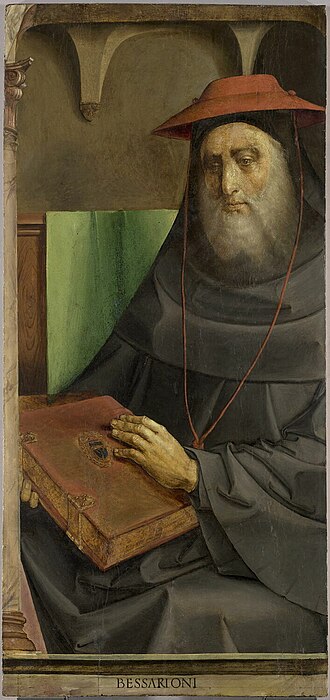
Picture: Cardinal Bessarion, from the Urbino series of illustrious men, attributed on the file record to Justus van Gent and Pedro Berruguete, c. 1473–1475; Louvre, MI 646. Posthumous portrait; public domain.

Attributed to Justus van Gent and Pedro Berruguete / Wikimedia Commons; Public domain. Image record, Public domain.
The round picture in the lists of the personalities is cropped from it.