




9 min read
Great Mathematician
Blaise Pascal
author: High Priest Zevios Metathronos
Thought, Fairness, and the Work of Human Dignity
Dates: 19 June 1623–19 August 1662
Period: Enlightenment (1650–1804), with major earlier work in the Renaissance period
Blaise Pascal designed a calculating machine at 19, published a treatise on conic sections at 16 and, with Pierre de Fermat, solved the problem of dividing the stakes of an unfinished game. The Bibliothèque nationale de France calls that solution of the summer of 1654 the event “vue traditionnellement comme l'acte de naissance de la théorie des probabilités.”1
He was a Catholic Christian drawn to the Jansenists of Port-Royal, and he left unfinished notes for a defence of his faith, published after his death as the Pensées. One of them names what he valued in human beings: “Man is but a reed, the most feeble thing in nature; but he is a thinking reed.”2
Zevism reads his work under Theuth, inventor of number and calculation, and under Dike, the daughter of Zeus. Pascal handed arithmetic to brass wheels and found a measure for fairness where the outcome was still unknown.
LIFE AND CONTEXT
Pascal was born on 19 June 1623 in Clermont, now Clermont-Ferrand, in the Auvergne. His mother died when he was 3. In 1631 his father, Étienne, sold his government post and moved with his children to Paris.3
In Paris the boy took part in the scientific circle of Marin Mersenne, and at 16 he published his Essai pour les coniques. In early January 1640 the family moved to Rouen.4
Next came the vacuum. Pascal published his findings in a short pamphlet, New Experiments concerning the Vacuum, in 1647. He'd returned to Paris that spring on his physicians' advice, and Descartes himself came to see him and, according to reports, suggested “a regimen of bed-rest and bouillon.” A year later Florin Périer, the husband of Pascal's sister Gilberte, assisted in the Puy-de-Dôme experiment, which measured air pressure and proved that a vacuum exists.5
Faith came in through an accident. On an icy day in January 1646 Étienne, sent as a public official to stop a duel outside Rouen, slipped, broke a leg and hurt his hip. The family called in the bonesetters Deschamps, 2 brothers who moved into the house for 3 months and who belonged to the Jansenist community of Port-Royal. “Pascal caught the fire and read with avidity the Jansenist texts that were given to him,” and then converted his family.5
His sister Jacqueline, after long obedience to her father's and brother's wishes, entered Port-Royal as a nun. After his 2nd conversion, in 1654, Pascal wrote 18 public letters in 1656–57 attacking the Jesuits and defending Arnauld and Jansenist doctrine, the Provincial Letters.5
He didn't give up mathematics. In the spring of 1658 he turned to the problem of the cycloid and solved it during a bout of sleeplessness caused by toothache, and he worked out a public omnibus service that went into operation in Paris in 1662. His last 2 years were spent in Paris in the care of Gilberte and Florin. He died at 1 in the morning on 19 August 1662, aged 39.5
ATTAINMENTS
- At 16 he published the Essai pour les coniques of 1640, an essay on conic sections, while he took part in Mersenne's circle.4
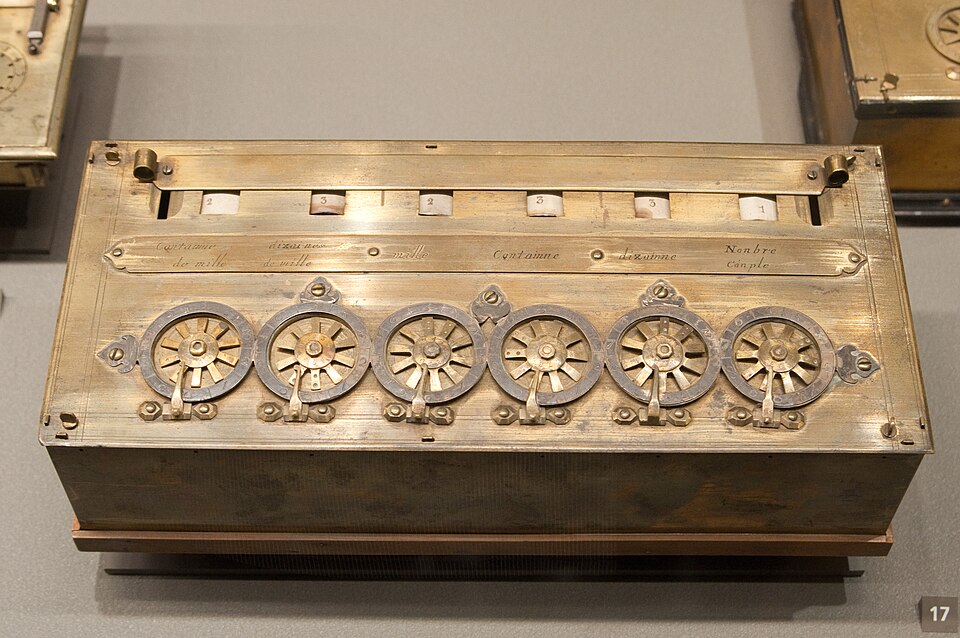
- He began his calculating machine in 1642 and presented it to the public in 1645. He built about 50 of them in brass, and they added and subtracted sums of money, carrying from one wheel to the next.6
- His New Experiments concerning the Vacuum (1647) and the Puy-de-Dôme experiment carried out by Florin Périer measured the pressure of the air and showed that a vacuum exists.5
- In the summer of 1654 he and Fermat solved the “problème des partis” by letter. Pascal planned to build it into a treatise, the Géométrie du hasard.7
- In 1658 he solved the problem of the cycloid, which had “challenged the likes of Galileo, Torricelli, and Descartes.”5
- The 18 Provincial Letters of 1656–57 were public letters against Jesuit casuistry in defence of Arnauld and the Jansenist cause.5
- The omnibus line he planned opened in 1662, and with it Paris had “the first such transit system in the world.”5
KEY STORIES
A Machine for a Tax Assessor
In January 1640 Étienne Pascal took his family to Rouen. The father's work of accounting and tax assessment required a massive number of calculations, and his son wondered whether a mechanical device might relieve that drudgery. He set to work in 1642, at 19.8
The trick lay in the carry, the “retenue” by which a full wheel tips over into the next 10, and the museum puts the machine's ingenuity there. Pascal presented his machine to the public in 1645 and built about 50 of them in brass. He described what it did for its user: “Cette machine délivre celui qui opère par elle de cette vexation ; il suffit qu'il ait le jugement, elle le relève du défaut de la mémoire.”9
The operator kept the judgment and the machine kept the tally. Of those machines, 9 working models survive, and the Musée des Arts et Métiers in Paris holds a 6-digit example dated 1642–1652.8
The Truth at Toulouse and at Paris
The questions came from a gambler. Antoine Gombaud, the Chevalier de Méré, had put a problem about dice to Pascal, and Méré had never found “the just value of the problem of the points”: how 2 players should split the stakes if they stop before anyone has won. Pascal took it up with Fermat in Toulouse, whose answer reached him through M. Carcavi. On Wednesday 29 July 1654, still in bed, he wrote back: “Impatience has seized me as well as it has you.”10
He set out a case. Each player stakes 32 pistoles, the first to win 3 throws takes all 64, and the first player leads by 2 to 1. If he wins the next throw he has 64, and if he loses they're level and each takes back 32. So he can say: “I am sure of 32 pistoles, for even a loss gives them to me. As for the 32 others, perhaps I will have them and perhaps you will have them, the risk is equal.” So “he will then have 48 pistoles and the other will have 16.”11
Fermat had reached the same answer by his own method. “I plainly see that the truth is the same at Toulouse and at Paris,” Pascal wrote. Méré, he added, “has ability but he is not a geometer (which is, as you know, a great defect).”12
The Night of Fire
On 23 November 1654, between 10:30 at night and 12:30 in the morning, Pascal lay in bed at his home in the Marais district of Paris. What happened in those 2 hours his biographers call his “second conversion” or “night of fire.” He wrote it down on a sheet: a cross, the time and date, then the word FEU, fire, in capitals near the top of the page. The text goes on: “Dieu d'Abraham, Dieu d'Isaac, Dieu de Jacob, non des philosophes et des savants.”5
He told no one. He kept the Memorial sewn into the lining of his jacket, and not even Gilberte or Jacqueline knew it existed. It was found only after his death. Within 2 years of that night he was writing the Provincial Letters in defence of Port-Royal.5
The Thorn at Port-Royal
In the same week that Pascal's 5th Provinciale came out, as rumours of royal disfavour toward the Jansenists spread, Port-Royal put a relic on display, a thorn said to come from Christ's crown. His niece Marguerite, Gilberte's 10-year-old daughter, had suffered for over 3 years from a lacrimal fistula, a swelling around her eye that her doctors thought could be treated, if at all, with a red-hot stylus.5
She was pricked with the thorn, and within a few days “Marguerite's eye completely healed.” News of it spread beyond the convent walls and across France. An inquiry confirmed the cure as a miracle, and for a while the attacks on Port-Royal eased. Pascal took it as a sign of divine favour on his letters and on the Jansenist cause.5
THE ZEVIST READING
Plato's Theuth invented number, calculation, geometry and astronomy.13 The Pascaline puts part of that gift into brass. Pascal's own sentence about it draws the line Zevism draws: the machine relieves the memory, and the operator still needs judgment. Measurement serves Ma'at when the person using it stays answerable for the result.
The division of the stakes belongs to Dike. Hesiod makes Justice the daughter of Zeus, who sits beside her father.14 A player ahead by 2 to 1 might claim the whole pot or be pushed to take half, and either claim is a small Izfet, a false account of what each man is owed. Pascal found the true share by counting what each could still win. His line to Fermat, that “the truth is the same at Toulouse and at Paris,” is a plain statement of Ma'at, an order that holds wherever it's measured.
The Pensées hold a fear Zevism reads differently. “The eternal silence of these infinite spaces frightens me,” Pascal wrote.15 Unexplored darkness isn't evil; it's the ground a mind enters with light, and Pascal did enter it, with his experiments on the vacuum, with the cycloid and with a calculus of chance.
His answer to that fear comes close to the aim of the path. “All our dignity consists, then, in thought. By it we must elevate ourselves, and not by space and time which we cannot fill.”16 Pascal wrote as a Christian, and his own hope lay in his faith. Zevism reads the sentence through Plato's formula, ὁμοίωσις θεῷ κατὰ τὸ δυνατόν, becoming like the divine as far as possible, and sees in the thinking reed a nature capable of that elevation.17
NOTES
1 BnF, “Blaise Pascal, géomètre du hasard”; Internet Encyclopedia of Philosophy, “Blaise Pascal”.
3 IEP, “Blaise Pascal”; O'Connor and Robertson, “Blaise Pascal,” MacTutor.
5 IEP.
6 Musée des Arts et Métiers, “Dingue de maths”; IEP.
7 BnF; Pascal to Fermat, 29 July 1654.
8 IEP; Musée des Arts et Métiers.
9 Musée des Arts et Métiers; IEP.
10 IEP; Pascal to Fermat, 29 July 1654, tr. Sanford, pp. 3–5.
11 Pascal to Fermat, pp. 3–4; French text, Œuvres 3.
12 Pascal to Fermat, pp. 3, 5.
14 Hesiod, Works and Days 256–262.
15 Pensées 206.
16 Pensées 347.
BIBLIOGRAPHY
Internet Encyclopedia of Philosophy, “Blaise Pascal”: birth, Paris and Rouen, Mersenne's circle, the Essai pour les coniques, the calculating machine, the vacuum and the Puy-de-Dôme, Descartes' visit, the Memorial, the Holy Thorn, the Provincial Letters, the cycloid, the omnibus and his death.
J. J. O'Connor and E. F. Robertson, “Blaise Pascal”, MacTutor History of Mathematics, University of St Andrews, December 1996: dates, conics in 1640 and Port-Royal.
Musée des Arts et Métiers, “Dingue de maths”, section “Machine arithmétique de Blaise Pascal à 6 chiffres sans sous ni deniers, 1642–1652”: purpose, number built, the carry and Pascal's words on the machine.
Blaise Pascal and Pierre de Fermat, correspondence of 1654, translated by Vera Sanford in D. E. Smith, ed., A Source Book in Mathematics (1929), University of York history of statistics pages; Pascal's letter of 29 July 1654, pp. 3–5.
Blaise Pascal, Letter to Fermat, 29 July 1654, French text in Œuvres, ed. Léon Brunschvicg and Pierre Boutroux, Hachette, 2nd edition, 1923, vol. 3, pp. 381–393.
BnF and Société Mathématique de France, Gregory Miermont, “Blaise Pascal, géomètre du hasard”, lecture of 8 February 2023: the problem of points and the planned Géométrie du hasard.
Blaise Pascal, Pensées, translated by W. F. Trotter, Christian Classics Ethereal Library: section 3, fragment 206; section 6, fragment 347.
Hesiod, Works and Days 256–262, translated by H. G. Evelyn-White, Theoi Classical Texts Library.
Plato, Phaedrus 274c–d, translated by H. N. Fowler, Perseus Digital Library.
Plato, Theaetetus 176a–b, Greek text, Perseus Digital Library.
CREDIT
Picture: Pascaline at the Musée des Arts et Métiers, Paris. Photograph by Tieum512, 17 April 2011.
Tieum512 / Wikimedia Commons; CC BY 3.0. Image record, CC BY 3.0.

The round picture in the lists of the personalities is cropped from it.