




4 min read
Dissenting Priest
Bogomil
author: High Priest Zevios Metathronos
The priest whose movement contested the Church’s authority
Dates: tenth century CE
Period: Darkness (800–1000 CE)
Region: Bulgaria
Tradition: Christian religious dissent
Religion or tradition: Christianity: the Bulgarian dualist movement known as Bogomilism, traditionally founded by a priest named Bogomil.
Heresy status: Christian Heretic: denounced as a heresiarch by medieval Christian opponents.
Bogomil is known primarily through opponents who associated him with the beginnings of a movement condemned by the Bulgarian Church. Cosmas the Priest places his activity in the reign of Tsar Peter, 927–969. That supplies a historical setting, but not a recoverable birth date or a full personal biography.1
WHY HE IS IDENTIFIED AS A CHRISTIAN HERETIC
Bogomil is identified as a Christian Heretic in the sense that medieval Christian opponents denounced him as the originator of a heresy. Cosmas the Priest places him in the reign of Tsar Peter and attacks the movement associated with his name. The dispute concerned Christian dualist teaching, rejection of established Church rites and criticism of clerical authority. A securely documented individual trial is not available.2
Knowledge of the Gods: a Zevist interpretation. The relevant aspiration is the search for divine truth beyond the claims of an established religious hierarchy. In the Temple’s reading, this resistance has value because knowledge of the Gods requires discernment, sustained practice and a willingness to examine inherited authority. Bogomil’s movement pursued its own Christian religious vision. Its significance here lies in that contested pursuit of spiritual understanding, rather than in an established profession of ancient polytheism.
REQUIRING SPIRITUAL AUTHORITY TO ANSWER TO CONDUCT
The movement associated with Bogomil made the behaviour and claims of ecclesiastical leaders a matter of religious dispute. Its criticisms, preserved largely by opponents, challenged the assumption that accepted office and outward religious forms were sufficient evidence of spiritual authority. This left a record of people demanding a more serious account of religious life from the institutions governing them.3
The positive human significance lies in the continued visibility of that challenge. It invites the reader to judge spiritual leadership through teaching, conduct and practice. In a Zevist interpretation, this supports discernment and the refusal to confuse power over a community with wisdom. The critical religious tradition associated with his name keeps that demand for accountable spiritual conduct before later readers.
THE CHALLENGE TO ECCLESIASTICAL MEDIATION
The movement criticized Church rites, material religious institutions and the conduct of clergy. Cosmas’s denunciation preserves these objections through a hostile presentation. Dimo Penkov’s comparison of Cosmas and Euthymius Zigabenus presents these witnesses from an explicitly Orthodox apologetic standpoint. Their testimony must be read with that conflict in view.4
This was a conflict within the world of Christianity. Bogomil’s followers challenged the established Church’s claim to possess authoritative rites and legitimate spiritual leadership. The controversy concerns who could speak for divine truth and whether office, wealth and accepted ceremony were sufficient grounds for obedience.
THE ACCUSATION OF DEVIL WORSHIP
Later hostile descriptions of Bogomils include claims of worshipping Satanael. The scholarly introduction to Christian Dualist Heresies in the Byzantine World treats such allegations critically and distinguishes them from the movement’s ascetic religious character. A polemical charge should therefore not be made into Bogomil’s personal profession of Satanism.5
That distinction brings the nature of the defiance into clearer view. It reveals the process by which religious rivals could be described as servants of the very power they themselves opposed. The historian must ask whose name for a belief is being repeated.
HIS PLACE IN THIS COLLECTION
Bogomil belongs here as a figure of dissent against ecclesiastical control. The Zevist point of interest is the refusal to accept institutional status as a sufficient guarantee of spiritual truth. His movement’s own theology remains distinct from the Temple’s understanding of the Gods and the world.
The reader’s task is to examine the actual dispute. Religious independence demands discernment: identify the claim, consider the evidence, and distinguish sincere practice from an officeholder’s demand for submission. Bogomil’s surviving reputation provides a case in which that contest can still be seen through the language of those who sought to defeat it.
NOTES
1 Scholarly discussion of Cosmas’s testimony.
2 Cosmas’s testimony in Hamilton and Hamilton, pp. 114–134.
3 Hamilton and Hamilton’s historical introduction.
4 Study of Cosmas and Euthymius Zigabenus.
5 Hamilton and Hamilton, historical introduction.
BIBLIOGRAPHY
Bernard Hamilton, “Cathar Links with the Balkans and Byzantium,” in Antonio Sennis, ed., Cathars in Question (Boydell & Brewer, 2016), pp. 131–150, Cambridge chapter record and opening discussion, for Cosmas’s dating of Bogomil.
Dimo Penkov, “Dualistic Principles and Formulations in the Teaching of the Paulicians and Bogomils through the Eyes of Presbyter Cosmas and Euthymius Zigabenus,” Filosofiya 34.2s (2025), pp. 32–43, DOI 10.53656/phil2025-02S-03, open research article.
Janet Hamilton and Bernard Hamilton, with Yuri Stoyanov, Christian Dualist Heresies in the Byzantine World, c. 650–c. 1450 (Manchester University Press, 1998), historical introduction, especially p. 42, text.
CREDIT
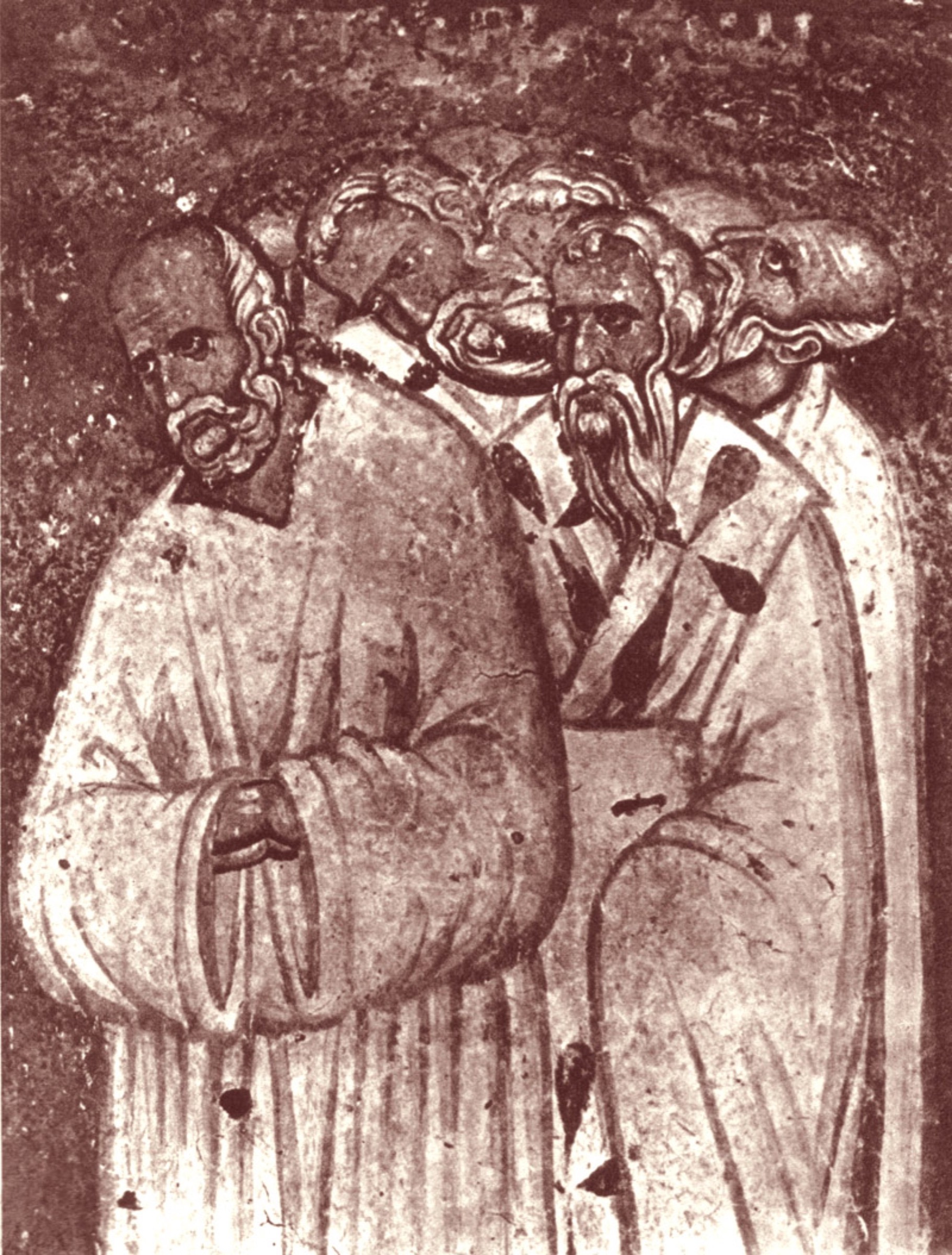
Picture: Later portrayal of the movement. Detail of the council fresco at the Church of Saint Achillius, Arilje, around 1290, showing the condemned dissenters conventionally identified as Bogomils. This is a later ecclesiastical portrayal of the movement, not a portrait of its founder.
Credit: Unknown author. Source record, Public domain.

The round picture in the lists of the personalities is cropped from it.