




3 min read
The Elder Skald
Bragi Boddason
author: High Priest Zevios Metathronos
The poet who gave the Gods a durable voice
Dates: ninth century CE
Period: Darkness (800–1000 CE)
Region: Scandinavia
Tradition: Old Norse sacred poetry
Religion or tradition: Old Norse polytheism; sacred poetry concerning Thor and other Gods.
Heresy status: No designation documented.
Bragi Boddason belongs among the earliest Scandinavian poets whose verse survives under an individual name. His historical outline is slight; his importance rests on the poetry attributed to him. The critical edition places him in the ninth century and treats the surviving material as a fragmentary corpus, rather than the remains of a recoverable modern biography. His principal associations are Ragnarsdrápa, a shield poem, and verses describing Thor’s fishing encounter with the world-serpent.1
WHAT HIS POETRY GAVE TO LATER GENERATIONS
Bragi’s surviving verses preserve names, relationships and episodes that would otherwise be more difficult to recover. His descriptions of Thor’s encounter with the world-serpent join a human artistic achievement to the remembrance of a God: the poet made a demanding religious subject memorable through metre, imagery and allusion. Modern readers still learn from that work because later writers preserved and explained it.2
The benefit to humanity is this continued access to a people’s sacred imagination and skilled language. His service to the Gods, understood within this collection, is the care with which their deeds were given enduring expression. He shows how an accomplished artist can enlarge a community’s religious memory and give its successors something substantial to study.
SACRED KNOWLEDGE CARRIED BY CRAFT
The attribution of poems to Bragi gives an identifiable human point of transmission for narratives about the Gods. In the Thor material, divine identity is conveyed through compact allusions: parentage, remembered struggles and the God’s relation to the world. Such poetry assumes a trained audience capable of recognizing what a few difficult words evoke. The published apparatus records, among other expressions, Thor’s identification through Óðinn and through his defeat of Hrungnir.3
Bragi’s achievement therefore concerns more than the preservation of a plot. The verbal form trains attention. A listener has to remember relationships, distinguish powers and recover an entire sacred episode from a compressed expression. Read within the Temple’s educational framework, this is a demanding model of religious literacy: the Gods become more intelligible as the listener’s knowledge deepens.
A POET, WITH A CAREFULLY BOUNDED BIOGRAPHY
The human poet should not simply be equated with the divine Bragi of later Norse mythology. Nor should later stories about poetic encounters be turned into documented episodes of his life. The critical introduction itself examines the uncertainties surrounding the poet’s identity and the organization of his attributed works. What survives is sufficient to establish his literary stature without manufacturing an uninterrupted personal history.4
HIS PLACE IN A ZEVIST COLLECTION
Bragi represents disciplined service through language. His value here lies in giving the Gods memorable, exacting forms within a living poetic tradition. The relevant example for a student is the union of study and skill: learn the sacred material deeply enough to express it with precision, and develop an art capable of carrying it beyond a single generation.
This is a Zevist interpretation of his preserved work. His historical setting is Norse religious and poetic culture; no modern institutional identity is being assigned to him.
NOTES
3 Edited kennings and references.
BIBLIOGRAPHY
Margaret Clunies Ross, editor, Bragi Boddason corpus and introduction, Skaldic Poetry of the Scandinavian Middle Ages, vol. III, Poetry from Treatises on Poetics (2017), digital critical edition.
Skaldic Poetry of the Scandinavian Middle Ages, Þórr kenning index, with references to the edited verses. The two links are parts of one scholarly edition, not two independent witnesses.
CREDIT
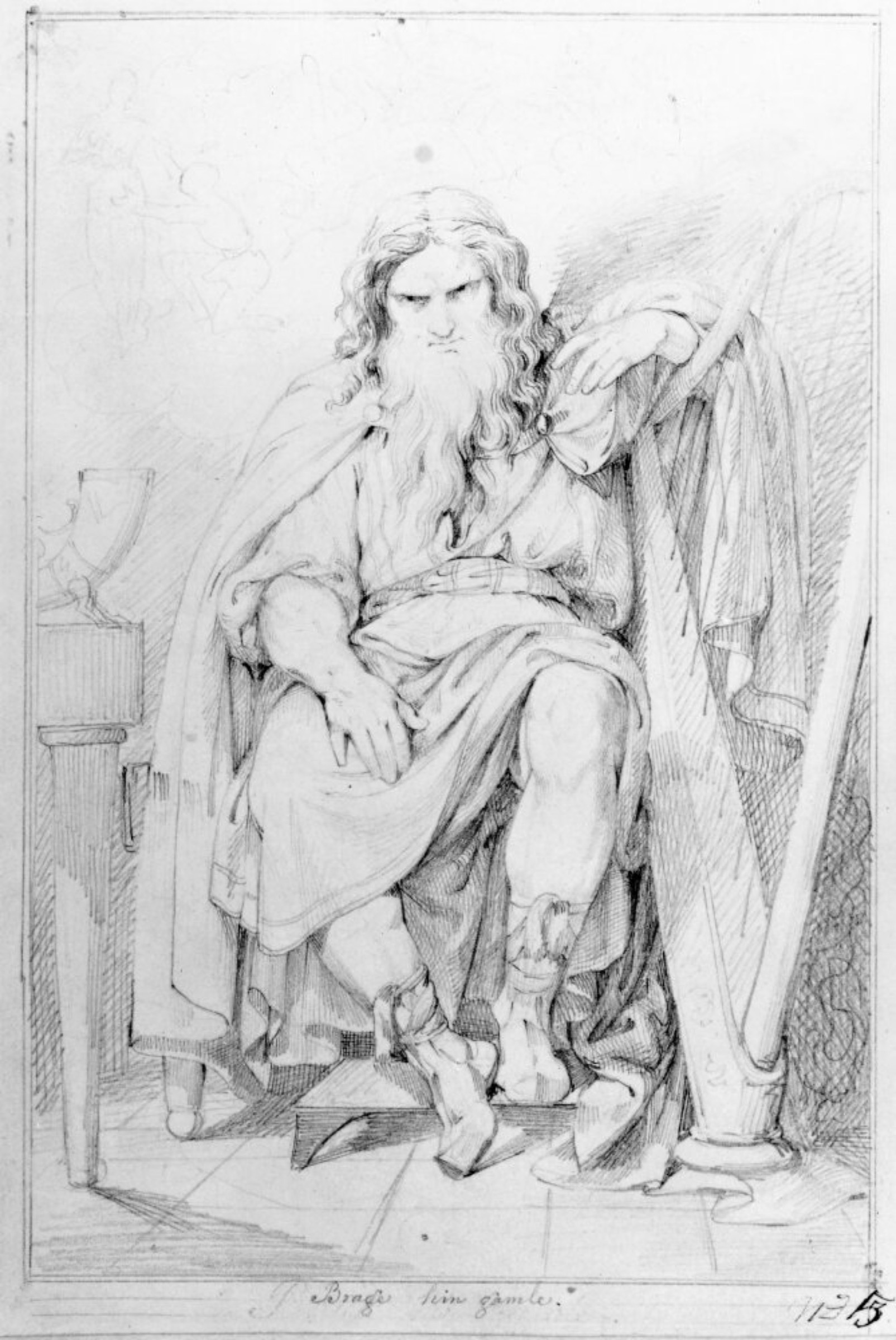
Picture: Later artistic depiction. Carl Wahlbom, Brage, the Elder, 1833–1837, Nationalmuseum. A nineteenth-century representation of the early poet, not a contemporary likeness.
Credit: Carl Wahlbom. Source record, Public domain.

The round picture in the lists of the personalities is cropped from it.