




9 min read
Scholar Poet
Callimachus of Cyrene
author: High Priest Zevios Metathronos
Keeping Sacred Memory Alive
Dates: Born c. 310/305 BCE; active until around 240 BCE
Period: Hellenistic period
Callimachus, son of Battus, came from Cyrene and made his career at the court of the Ptolemies in Alexandria. He was a poet and a scholar at once. The Suda credits him with “more than 800 books,” and among them was the Pinakes, a catalogue of Greek literature in 120 books.1
That catalogue was his greatest single labour. Susan Stephens describes it as “a comprehensive listing of earlier Greek literature by genre that included biographies of each author, citing their works with initial words or first lines.” His poems, above all the Aetia and the Hymns, retold the myths and rites of the Gods in compact, exact verse.2
Zevism honours him twice over. As a cataloguer he kept the source, so that later readers could find their way back to it. As a poet he served Apollo and the Muses, and his hymns carried the worship of Zeus, Apollo and Demeter into new language.
LIFE AND CONTEXT
The Suda names his parents as Battus and Mesatma and calls him a grammarian, “a pupil of Hermocrates of Iasus.” Before he found favour at court, “he taught grammar in Eleusis, a small village in Alexandria.” He lived under Ptolemy Philadelphus and survived into the reign of Ptolemy Euergetes.3
Stephens places his birth around 305 BCE and his death sometime after 240, judging from the subjects of his poems. Few facts about his life can be fixed apart from what the poems suggest.2
Stephens is clear on one point: “Callimachus himself was never head of the Library.” The Pinakes did its work without that office. It gave Greek literature its map: authors grouped by genre, each with a biography and a list of works identified by their opening words.2
His longest poem, the Aetia or Causes, ran to 4 papyrus rolls, an estimated 4,000 to 6,000 lines. It opens with the poet as an old man, recalling a youthful encounter with the Muses in a dream. The 3rd and 4th books are framed by poems for Queen Berenice II, the first of them on her victory in the 4-horse chariot race.4
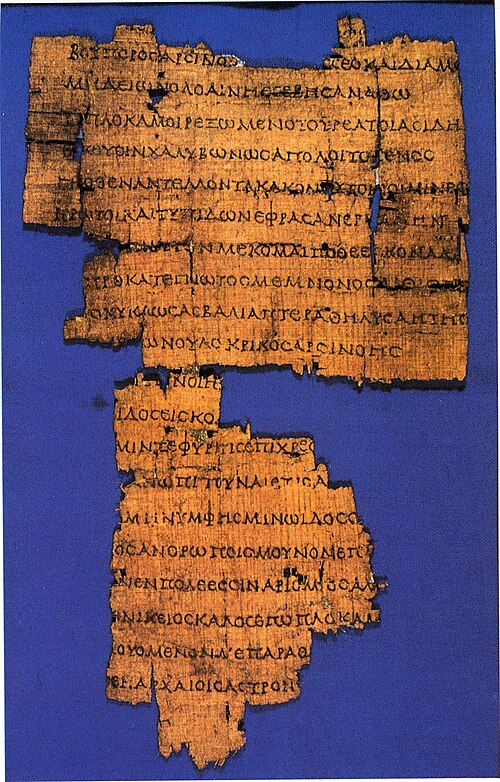
He had enemies and named them. The Suda lists a poem called Ibis, “deliberately made obscure and abusive,” aimed at an enemy it identifies as Apollonius.3 Much of his work is lost; the Aetia survives in papyrus fragments such as PSI 1092, while 6 hymns have come down whole.5
ATTAINMENTS
- He compiled the Pinakes in 120 books, a catalogue of earlier Greek literature arranged by genre, with author biographies and each work cited by its first words.6
- He wrote more than 800 books by the Suda's count, in prose and verse.3
- He composed the Aetia, or Causes, in 4 books running to an estimated 4,000 to 6,000 lines.4
- He wrote 6 hymns that survive complete, including the Hymn to Zeus, the Hymn to Apollo and the Hymn to Demeter.7
- Catullus turned his Lock of Berenice into Latin, and editors now use that Latin version to rebuild the damaged Greek.8
- In the Aetia prologue he set down a rule of craft that, he says, Apollo gave him: “keep your Muse slender.”9
KEY STORIES
The Slender Muse
Callimachus opened the Aetia with an answer to his critics. He called them Telchines, after the mythical sorcerers who, as Stephens notes, “became hateful to the gods, and whom Zeus or Apollo obliterated.” They muttered against him “because I did not complete a single continuous poem in many thousands of lines either on kings ... or on heroes,” and complained that he wrote “like a child.”10
His answer was a memory of the God. “For, when I first placed a writing-tablet on my knees, Lycian Apollo said to me”: “raise your sacrificial victim as fat as possible, but, good man, keep your Muse slender.” The God added a 2nd charge: “walk a path unbeaten by wagons, don't drive your chariot along the common ruts of others.”11
The poet took his side: “we sing among those who love the clear sound of the cicada, and not the din of asses.”12 He staged the quarrel again at the end of his Hymn to Apollo. Envy whispers in Apollo's ear, “I admire not the poet who singeth not things for number as the sea.” Apollo answers that the great Assyrian river carries “much filth of earth and much refuse,” while the Melissae carry to Deo, that is Demeter, only water from “the trickling stream that springs from a holy fountain, pure and undefiled.”13
The Lock Among the Stars
Early in the reign of Ptolemy III, Queen Berenice II cut a lock of her hair. She “dedicated a lock of her hair in the temple of Arsinoe Aphrodite at Cape Zephyrium upon the safe return of her husband, Ptolemy III, from the Third Syrian War.”8
The lock vanished from the temple. Then “the court astronomer, Conon, announced that the lock had disappeared from the temple and had taken up a new place in the heavens as a constellation.” Callimachus made the lock itself the speaker of his poem: “Conon saw me also in the sky, me, Berenice's lock of hair / which she dedicated to all the gods.”14
The lock doesn't celebrate its new place. It mourns the old one: “I am grieved that I will no longer touch that head, / from which, when she was still a young girl, I drank many / simple (oils).”15 The poem closed the 4th book of the Aetia, and PSI 1092 is among the papyri that preserve it.
The Price of Seeing Athena
In the hymn On the Bath of Pallas Callimachus retold how the young Teiresias lost his sight. Athena and his mother Chariclo had gone to bathe at the Fountain of the Horse on Helicon; “it was the noontide hour and a great quiet held that hill.” Teiresias, “on whose cheek the down was just darkening,” was still ranging the place with his hounds. “Athirst beyond telling, he came unto the flowing fountain, wretched man! And unwillingly saw that which is not lawful to be seen.”16
“What god, O son of Everes, led thee on this grievous way?” the Goddess said. “Hence shalt thou never more take back thine eyes!” Then “night seized the eyes of the youth.” Chariclo cried out against her friend, and Athena answered with the law of Cronus: “Whosoever shall behold any of the immortals, when the god himself chooses not, at a heavy price shall he behold.”17
She couldn't give back his eyes, so she gave him another sight. “I will make him a seer to be sung of men hereafter,” she promised; he'd know the birds, carry a great staff and live a long term of life.18
Erysichthon's Hunger
In the Hymn to Demeter Callimachus told the story of Erysichthon, a young lord who wanted timber for a banqueting hall. He “hastened with twenty attendants, all in their prime,” and they took their axes into the sacred grove of Demeter. The first poplar they struck “cried a woeful cry to the others.”19
Demeter came to him in the shape of her priestess Nicippe. “My child, who cutest down the trees which are dedicated to the gods, stay,” she pleaded. Erysichthon threatened her: “lest I fix my great axe in thy flesh!” Then the Goddess showed herself. “Yea, yea, build thy house, dog, dog, that thou art, wherein thou shalt hold festival; for frequent banquets” would be his from now on.20
The banquets were his punishment. A hunger fell on him that nothing could fill. He ate “the heifer that his mother was feeding for Hestia and the racing horse and the war charger,” and his household's wealth went into his mouth. The attendants, who'd cut under orders, were spared.21 In Zevist terms the story is Izfet in its plainest form: a man who fells the Goddess's grove to build a banquet hall and is eaten hollow by his own appetite.
THE ZEVIST READING
Zevism holds that one must return to the source; knowledge evolves in transmission, but the source holds priority. The Temple honours transmitters, copyists and editors as keepers of the source. The Pinakes is the model of that work. Zevism reads its method as a guard on the source: a first line tells a reader which book is in his hands, and a genre and a biography tell him whose it is.
Apollo presides over his poetry. The God of measure appears in person in the Aetia prologue, and his rule, a fat victim and a slender Muse, puts the offering and the craft side by side. The Hymn to Apollo ends on the pure spring whose water the Melissae carry to Deo. Zevism reads that image as the doctrine of the source in poetic form: the offering to the Gods comes from the clean water at the fountain's head.
His Hymn to Zeus affirms what Zevism affirms. The Cretans built a tomb for Zeus, “but thou didst not die, for thou art for ever.” It adds that “from Zeus come kings” and closes with the prayer “Give us goodness and weal.”22 The poem belongs to a Ptolemaic court and carries royal praise, so its lines on kings are read as doctrine about Zeus's sovereignty and not as a warrant for any particular ruler.
Erysichthon gives the negative lesson. Ma'at is the structured order of existence, held by Zeus as Sovereign of the Cosmos; Izfet is dissolution. The grove, the herd and the household's stores are Ma'at in the farmer's world, and Erysichthon's axe turns them into an appetite that eats itself. The hymn ends by letting those who can't walk the whole procession go “so far as their knees are able,” and Demeter still gives to them.23
NOTES
2 Stephens, “Callimachus of Cyrene”.
3 Suda, κ 227.
5 Stephens, “The Lock of Berenice”; Callimachus, Hymns, tr. Mair.
6 Suda, κ 227; Stephens, “Callimachus of Cyrene”.
7 Callimachus, Hymns I–III; Hymns IV–VI.
8 Stephens, “The Lock of Berenice”.
9 Aetia fr. 1.23–24, tr. Stephens.
10 Aetia fr. 1.1–5, tr. Stephens.
14 Aetia fr. 110.7–8, tr. Stephens.
17 Hymn V 78–102.
18 Hymn V 119–130.
20 Hymn VI 44–60.
21 Hymn VI 60–110.
23 Hymn VI 127–129.
BIBLIOGRAPHY
Susan Stephens, “Callimachus of Cyrene”, introduction to Callimachus, Aetia, Dickinson College Commentaries. Biography, literary survival, Pinakes, and Alexandrian context.
Susan Stephens, “The Aetia”, Dickinson College Commentaries; length, structure and the Berenice frame.
Callimachus, Aetia fr. 1, “Prologue against the Telchines”, Greek text with translation and notes by Susan Stephens, Dickinson College Commentaries; lines 1–5, 21–30.
Callimachus, Aetia fr. 110, “The Lock of Berenice”, introduction and translation by Susan Stephens, Dickinson College Commentaries; lines 7–8, 75–77.
Suda, κ 227, “Kallimachos”, translated by Malcolm Heath, Suda On Line, 2002; vetted 2019.
Callimachus, Hymns I–III, A. W. Mair translation, in Callimachus, Hymns and Epigrams; Lycophron; Aratus, Loeb Classical Library 129, 1921; Theoi transcription. Hymn I 8–9, 79–96; Hymn II 105–113.
Callimachus, Hymns IV–VI, same edition. Hymn VI, especially 31–60, 107–108 and 127–129.
CREDIT
Picture: Papyrus fragment of Callimachus’s Coma Berenices, PSI 1092, Biblioteca Medicea Laurenziana, Florence; a textual witness, not a portrait.
Ancient scribe unknown; work by Callimachus; faithful two-dimensional reproduction; Wikimedia Commons; Public domain; faithful reproduction of a public-domain artwork. Image record, Public domain; faithful reproduction of a public-domain artwork.

The round picture in the lists of the personalities is cropped from it.