




9 min read
Author of the Red Chamber
Cao Xueqin
author: High Priest Zevios Metathronos
The Dignity of a Passing World
Dates: 18th century; exact birth and death years remain disputed
Period: Enlightenment (1650–1804), within the collection’s timeline
Cao Xueqin wrote Honglou meng, known in English as Dream of the Red Chamber and The Story of the Stone. Britannica calls it “a partly autobiographical work” in the vernacular that “describes in lingering detail the decline of the powerful Jia family and the ill-fated love between Baoyu and his cousin Lin Daiyu.”1
He finished at least 80 chapters before he died in Beijing, and he left the book unfinished. In 1791 Cheng Weiyuan and Gao E published it in 120 chapters.2
Zevism reads Cao as a link in the chain of spirituality that runs through China under its own Gods' names. His novel opens with the goddess Nüwa mending the sky, which is Ma'at restored, and it's an act of memory for the women of a vanished household, which is the work of the Muses.
LIFE AND CONTEXT
Cao Zhan, better known as Cao Xueqin, was born in Jiangning, now Nanjing, perhaps in 1715; the Library of Congress gives about 1717. He was the grandson of Cao Yin, “one of the most eminent and wealthy men of his time.” The family held the hereditary office of commissioner of imperial textiles in Jiangning.3
The fall came while he was a boy. “In 1727, however, his family, which held the hereditary office of commissioner of imperial textiles in Jiangning, suffered the first of a series of setbacks and moved to Beijing.”4
The decline went on. “By 1742 Cao's contemporaries were reporting him to be living in reduced circumstances and engaged on a work that could hardly be anything other than the Dream.” He died in Beijing on 12 February 1763, by Britannica's date; his birth year remains uncertain.4
The book lived on in manuscript. “When Cao died, only 80 chapters of this book of 120 chapters existed,” the Library of Congress record says. In 1791 Cheng Weiyuan and Gao E printed a 120-chapter version at the Cuiwen Shuwu in Suzhou, “printed with wooden movable type,” and they later issued a 2nd version.5
Who wrote the last 40 chapters is still argued. Eileen Yiran Zhao's thesis notes that their authorship, and how far they follow Cao's intentions, remain in dispute, so the Temple honours Cao as the author of the book's core without assigning him every word of the finished version.6
The opening chapter also says why the book was written. The narrator, “wearied with the drudgery experienced of late in the world,” thinks back: “I suddenly bethought myself of the womankind of past ages. Passing one by one under a minute scrutiny, I felt that in action and in lore, one and all were far above me.”7
Religion in the novel is Buddhist and Daoist. At the start a Buddhist monk picks up the stone, puts it in his sleeve and sets off with a Daoist priest, and their journey gives the whole story its frame.8
ATTAINMENTS
- He wrote at least 80 chapters of Honglou meng, in the vernacular, on the decline of the Jia household.4
- The novel's 1st chapter credits him by name with the editorial labour: 10 years of “perusal and revision” in his study, additions and changes “five times,” an index and the division into chapters.7
- He framed the story with the stone left over when the goddess Nüwa repaired the heavens with 36,500 blocks.9
- He wrote the scene in chapter 27 where Daiyu buries the fallen petals and her lament turns from the flowers to her own frailty and to who will care for her when she's gone.10
- In chapter 37 he gave the household's young women a poetry society: Tanchun proposes it, Daiyu has the members take poets' names, and the chapter ends with plans for poems on chrysanthemums.11
- His 80 chapters reached print in 1791 in the 120-chapter edition of Cheng Weiyuan and Gao E, set in wooden movable type.5
KEY STORIES
The Stone Left Over
The novel begins before the world of men. In H. Bencraft Joly's translation, the goddess Nüwa, “in fashioning blocks of stones, for the repair of the heavens,” prepared “36,501 blocks of rough stone, each twelve chang in height, and twenty-four chang square.”7
She used 36,500 of them, “so that one single block remained over and above, without being turned to any account. This was cast down the Ch'ing Keng peak.” The stone had been worked by a goddess, and it knew it had been passed over.9
When it saw that every other block had gone into the sky and that it alone “had been unfit to attain selection, it forthwith felt within itself vexation and shame, and day and night, it gave way to anguish and sorrow.”9
Then a Buddhist monk and a Daoist priest came by. “The Buddhist priest picked it up, and laid it in the palm of his hand,” put it in his sleeve and went on his way with his companion. Later another Daoist, K'ung K'ung, found “a large block of stone, on the surface of which the traces of characters” told “the various incidents of its fate.” The novel is that record.9
The Debt of Tears
The priest tells a 2nd story in the same chapter. “On the bank of the Ling (spiritual) river, by the side of the San Sheng (thrice-born) stone,” grew a blade of purple pearl grass. The stone liked to walk along the river, and “having at the sight of the blade of spiritual grass been filled with admiration, it, day by day, moistened its roots with sweet dew.”7
Fed on that dew, the grass shed its form and took “a human nature, which gradually became perfected into the person of a girl.” She had nothing to repay the gift with. “I possess no such water as was lavished upon me to repay it!” So she made a vow: if her benefactor went down into the world as a human being, she'd follow, “and if I can only have the means of making restitution to it, with the tears of a whole lifetime, I may be able to make adequate return.”9
The myth stands at the head of what Britannica calls “the ill-fated love between Baoyu and his cousin Lin Daiyu,” and the novel pays out Daiyu's tears one scene at a time. In chapter 27 she weeps over the grave she has made for fallen petals and asks who'll mourn her when she is gone herself.12
10 Years in the Mourning-Red Studio
The author wrote himself into the book's 1st chapter. Joly's translation records “the devotion by Tsao Hsueeh-ch'in in the Tao Hung study, of ten years to the perusal and revision of the work, the additions and modifications effected by him five times, the affix of an index and the division into periods and chapters.” The study's name, Daohong, means mourning the red.7
He wrote as a poor man, in Beijing, 15 years and more after his family's first fall; by 1742 his contemporaries knew him to be living in reduced circumstances and at work on the novel.4
He expected to be misread and said so in a quatrain: “Pages full of silly litter, / Tears a handful sour and bitter; / All a fool the author hold, / But their zest who can unfold?” The same chapter sets out a couplet: “When falsehood stands for truth, truth likewise becomes false.” He died in 1763 with 80 chapters written, 28 years before Cheng Weiyuan and Gao E printed the book.13
THE ZEVIST READING
Zevism is the chain of all spirituality from its inception, and China holds its own links in that chain. Nüwa mending the heavens is a picture of Ma'at restored. Egyptian religion named Ma'at “the personification of truth, justice, and the cosmic order” and set her against isfet.14 A broken sky is Izfet at the scale of the cosmos, and the goddess answers it with measured blocks, each of a set size. Cao opened his novel with that act of order and then turned to a household that couldn't hold its own.
The novel is also an act of memory. Hesiod says the Muses were born of Memory and Zeus as “a forgetting of ills and a rest from sorrow.”15 Cao's book works the other way round: it remembers the ills so that the women who suffered them aren't lost, the women he judged “far above” himself.9 Zevism reads that faithful remembering as service to Mnemosyne and her daughters, and as a true record kept against the falsehood that forgetting would allow.
The doctrine of the Creator fits the man. Zevism names the andrapod, who lives among ruins and answers them with complaint and nostalgia. Cao lived among real ruins, a great family brought down and his own reduced circumstances in Beijing, and his book is full of nostalgia and tears. Yet he spent 10 years revising it, 5 times over, and built 80 chapters out of the wreck. Zevism counts that labour as the Creator's answer to ruin.
The stone left over is the book's own emblem. Passed over for the repair of the heavens, it becomes the surface on which the story is written. In the same way the memory of a ruined household, which could have died with the family, became through Cao's labour a record that others still read.
NOTES
2 Britannica; Library of Congress, 1791 edition record.
3 Britannica; Library of Congress.
4 Britannica.
6 Zhao, Time in the Literary Constructions of Self, Love, and Fate in Honglou meng, p. 27.
7 Hung Lou Meng, chapter 1, tr. Joly.
8 Hung Lou Meng, Book I, chapter 1, tr. Joly.
10 Hung Lou Meng, Book II, chapter 27, tr. Joly.
11 Hung Lou Meng, Book II, chapter 37.
12 Britannica; Hung Lou Meng, Book II, chapter 27.
13 Hung Lou Meng, chapter 1; Library of Congress.
BIBLIOGRAPHY
Encyclopaedia Britannica, “Cao Zhan”: birth, family, the setback of 1727, reduced circumstances by 1742, death on 12 February 1763, the 80 chapters and the novel's subject.
Library of Congress, World Digital Library, with the National Library of China, Hong lou meng yi bai er shi hui, Suzhou: Cuiwen Shuwu, 1791; the 80-chapter manuscript text, the 120-chapter edition of Cheng Weiyuan and Gao E in wooden movable type and the later Cheng-B version.
Cao Xueqin, Hung Lou Meng, or the Dream of the Red Chamber, Book I, translated by H. Bencraft Joly, Project Gutenberg; chapter 1.
Cao Xueqin, Hung Lou Meng, Book II, translated by H. Bencraft Joly, Project Gutenberg; chapters 27 and 37. The article uses modern pinyin names; the translation uses older romanizations (Nue Wo for Nüwa, Tai-yü for Daiyu).
Eileen Yiran Zhao, Time in the Literary Constructions of Self, Love, and Fate in Honglou meng, PhD thesis, University of Edinburgh, 2022; printed p. 27 on the disputed final 40 chapters.
Encyclopaedia Britannica, “Maat”.
Hesiod, Theogony 53–55, translated by H. G. Evelyn-White, Theoi Classical Texts Library.
CREDIT
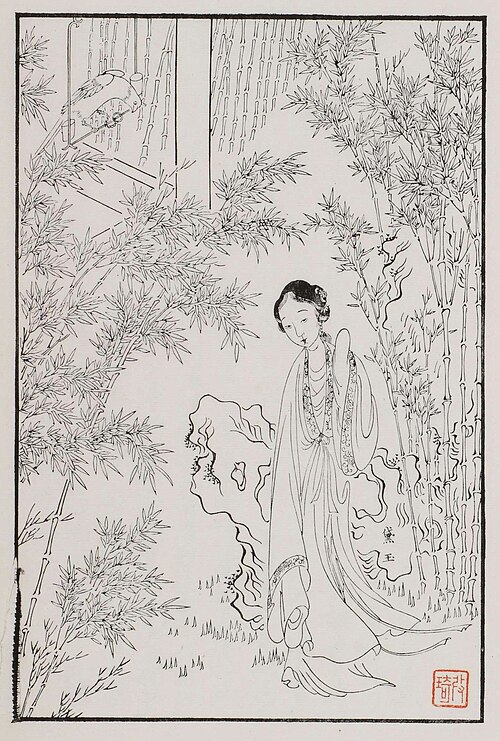
Picture: Lin Daiyu, a character in Cao Xueqin’s novel, in an 1879 edition of illustrations after Gai Qi (1774–1829).
Gai Qi (1774–1829); 1879 printed edition / Wikimedia Commons; Public domain. Image record, Public domain.

The round picture in the lists of the personalities is cropped from it.