




9 min read
Explorer of the Psyche
Carl Gustav Jung
author: High Priest Zevios Metathronos
The Responsibility of Becoming Oneself
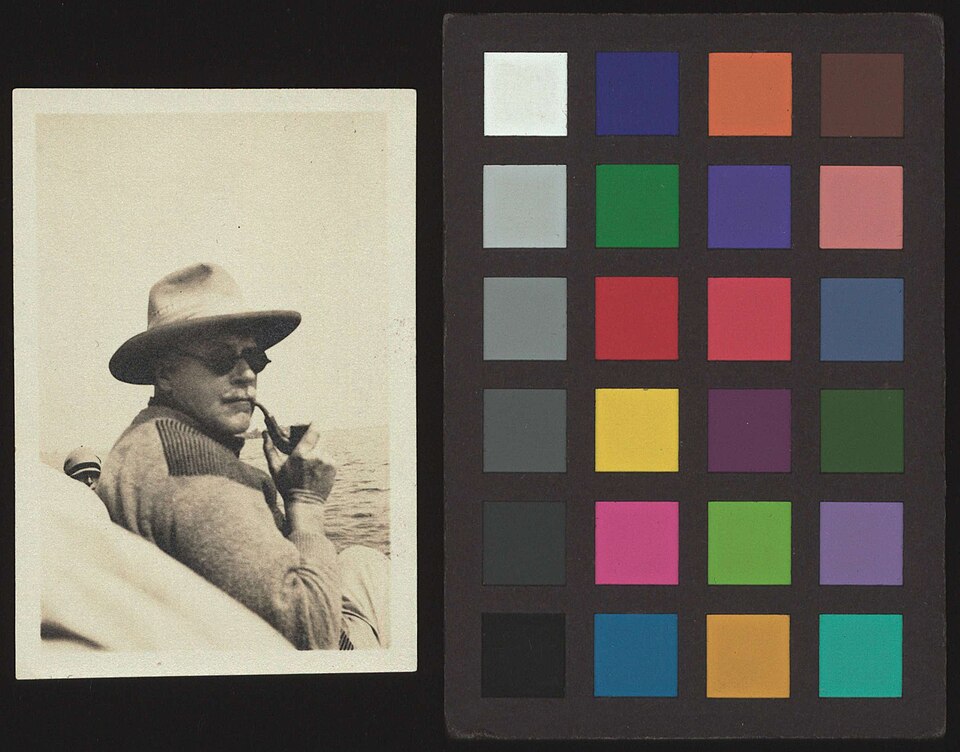
Dates: 1875–1961
Period: Modern era, 1900–present
Carl Gustav Jung was a Swiss psychiatrist who founded analytical psychology. He gave modern thought the ideas of the collective unconscious, the archetype, the shadow and individuation, and his Psychological Types of 1921 was one of the first systematic theories of personality.1
Much of that theory came out of an experiment on himself. From 1913 he recorded the images that rose from his own unconscious, almost daily, and until 1930 he worked them into the Red Book, a volume of calligraphy and paintings that stayed unpublished until 2009.2
Zevism reads his life's work under Apollo, in whose temple at Delphi the Greeks wrote “Know thyself.” It also reads it through the doctrine of Light and Darkness: the shadow Jung described is the darkness of the soul, which a person must walk into with a light before it can become knowledge.3
LIFE AND CONTEXT
Jung was born on 26 July 1875 at Kesswil, a village near Lake Constance. His father was a Swiss Reformed pastor, and his mother came from a family of pastors around Basel.4 He said that all his thoughts “circle around God like the planets around the sun.”5
He studied medicine at Basel and graduated in 1900. That year he joined the Burghölzli, the psychiatric hospital of the University of Zurich, under Eugen Bleuler. His doctoral dissertation, on somnambulistic, or mediumistic, phenomena, earned him his medical degree from Zurich in 1902.6
In 1908 he and his wife, Emma Rauschenbach, built a house at Küsnacht outside Zurich with the help of his cousin, the architect Ernst Fiechter, and the family moved in the following year. He saw patients in his private practice at home, “in those days a complete novelty,” and he lived there for the rest of his life.7
After his break with Freud in 1913 came 3 years of inner work, then the book on types in 1921 and, through the 1920s, travels in North America, Africa and Asia. His late collaboration with the physicist Wolfgang Pauli led to the theory of synchronicity, and Psychology and Alchemy brought the alchemy of the late Middle Ages and early modern period into dialogue with psychology.8
The record has a dark chapter. The IAAP states that “between 1933 and roughly 1936 Jung made a number of statements and public presentations in Germany that had a distinctly anti-Semitic thrust to them.” At the same time he worked to keep an institutional base for psychologists, “particularly Jewish psychologists,” who were being expelled from the German associations.8
By the time he appeared on the cover of Time in 1955, the Library of Congress notes, Jung “was an icon in his profession and in popular culture.” Americans in depth psychology, the arts and comparative religion took up his ideas in the 1940s and 1950s, among them the choreographer Martha Graham, the mythologist Joseph Campbell and abstract expressionists such as Jackson Pollock, who drew on myth and primal symbols.9
He died at his home in Küsnacht on 6 June 1961, aged 85.10
ATTAINMENTS
- At the Burghölzli he ran word association experiments and devised new ways to measure the body's reactions to single stimulus words, the work that shaped his idea of emotionally charged complexes.8
- In 1921 he published Psychological Types, one of the first systematic theories of personality and the inspiration for the Myers-Briggs personality test.8
- He defined individuation as “the process by which a person becomes a psychological in-dividual,” and in the German text of Psychological Types he insisted that the process widens a person's ties to others.11
- He described a collective unconscious whose contents “have never been in consciousness,” and the archetypes that it holds. Patricia Berry reads the archetype best “as metaphor,” “a possibility or potential.”12
- He named the shadow, “everything that the ego-consciousness does not know about itself,” and described how people project it onto others.13
- From his own experiments of 1913 to 1916 he drew the principles of his later clinical approach, built on what he called active imagination.8
- He wrote and painted the Red Book, a volume of more than 600 pages bound in red leather, with Liber Novus on its spine.14
KEY STORIES
13 Hours in Vienna
In 1906, after reading Freud's Interpretation of Dreams, Jung wrote to its author. Letters and papers went back and forth, and on 3 March 1907 Jung came to Vienna. “As soon as Jung reached Freud's home, the two retired to Freud's study for a thirteen-hour conversation.”6
Freud was almost 20 years older, and the bond was immediate. He came to call Jung his heir, the “crown prince” of psychoanalysis. Yet the 2 men differed from the start on the nature of the unconscious, on extraordinary phenomena and on how research should be done. By 1911 Jung was proposing revisions that Freud couldn't accept.8
On 18 December 1912 Jung sent a letter of “hard-hitting criticism,” in the words of the Library of Congress, “including an accusation that he mistreated both his patients and his pupils.” Freud answered on 3 January 1913, and that letter “effectively severed the relationship between the two men.” The manuscript now lies in the Library's Sigmund Freud Collection.15
The IAAP sums up the end: the friendship “that had begun with such intensity broke apart with equal intensity, each man going his own way.”8
An Incessant Stream of Fantasies
After the break Jung turned inward. He later recalled: “An incessant stream of fantasies had been released . . . . I stood helpless before an alien world; everything in it seemed difficult and incomprehensible.” He called what followed “my most difficult experiment” and set himself to “find the meaning in what I was experiencing in these fantasies.”16
From 1913 to about 1916 he worked through deep meditative practice, and wrote the images and narratives down almost daily.8 The notebooks, the “Black Books,” became a handwritten draft, which he had typed and edited. He then copied the text into the Red Book “in the style of a medieval manuscript with paintings, decorative initials, and ornamental borders,” composing the images from pencil drawings.14
He stopped in 1930. In 1959 he tried to finish, but the epilogue “breaks off in mid sentence on page 190.” After his death his heirs locked the book in a safe deposit box. W. W. Norton published it in 2009, edited by Sonu Shamdasani.14 Jung later traced all his work to those years: “All my works, all my creative activity, has come from those initial fantasies and dreams which began in 1912.”16
The House and the Tower
Over the door of the house at Küsnacht is a Latin sentence: VOCATUS ATQUE NON VOCATUS DEUS ADERIT. The museum that now keeps the house renders it “Called and not called God will be present.” Inside, the library took precedence over the other rooms.17
In 1923 he began a 2nd building, his “Tower,” a retreat on the shore of Lake Zurich at Bollingen. He kept it simple: “I have done without electricity, and tend the fireplace and stove myself.”16
He called the Tower “a representation in stone of my innermost thoughts and of the knowledge I had acquired and a concretization of the individuation process.” There, he wrote, “I am in the midst of my true life, I am most deeply myself.”16 The Temple reads the pair as one lesson in 2 buildings: the divine named over the door, and the self built in stone by the water.
THE ZEVIST READING
Pausanias reports that the sages came to Delphi “and dedicated to Apollo the celebrated maxims, ‘Know thyself,’ and ‘Nothing in excess.’”18 Jung was a pastor's son and spoke of God in his own terms. Zevism reads his method as a modern road to Apollo's first command, and it holds its own theology: the Gods aren't images produced by the psyche, and Jung's archetypes describe the human side of an encounter whose other side is divine.
The sentence over his door is one Zevism can hold without change: “Called and not called God will be present.” The divine order doesn't wait to be invoked before it's there, and invocation is the worshipper's way of turning toward a presence that was there all along.
The shadow fits the Temple's doctrine of Light and Darkness closely. Unexplored darkness isn't evil; it's what one walks into with a light, and once explored it becomes Light, knowledge and wisdom. Jung did that on himself between 1913 and 1916, and he turned what he found into a method others could use.
That work belongs to the 1st dimension of the Zevist path, Meditation, the growth of τὸ δυνατόν, the capacity of power. The aim beyond it is ὁμοίωσις θεῷ κατὰ τὸ δυνατόν, likeness to the divine as far as possible.19 Individuation as Jung defined it widens a person's bonds with others, and Zevism counts it a step on that road when it makes a person more truthful and more capable.
The doctrine of the Good judges the record of 1933 to 1936. The Good is Ma'at and Right together, the right act from a right will. Statements with “a distinctly anti-Semitic thrust” fail that test whatever their author intended, and the help he gave to expelled Jewish colleagues doesn't cancel them. The IAAP's own verdict uses his terms: he “fell briefly into an aspect of his own theory,” the shadow.8
NOTES
1 International Association for Analytical Psychology, “Carl Gustav Jung”.
2 IAAP; Library of Congress, “Creation and Publication of the Red Book”.
3 Pausanias 10.24.1, tr. W. H. S. Jones.
4 Britannica, “Carl Jung,” by Michael S. M. Fordham; IAAP.
5 Library of Congress, “Before the Red Book”.
6 IAAP; LOC, “Before the Red Book”.
7 Museum Haus C.G. Jung, “The House and the Garden”.
8 IAAP.
9 LOC, “Jung's Cultural Legacy”.
10 IAAP; Britannica.
11 LOC, “The Red Book and Beyond”; Jung, Psychologische Typen, chapter 11, definition 31.
12 LOC; Berry, “Archetype,” IAAP.
13 Serebrennikova, “The Shadow,” IAAP.
14 LOC, “Creation and Publication”.
15 LOC, “Before the Red Book”.
16 LOC, “The Red Book and Beyond”.
BIBLIOGRAPHY
International Association for Analytical Psychology, “Carl Gustav Jung”, institutional biography; family, Basel, Burghölzli, word association, Freud, 1913–1916, Psychological Types, travels, 1933–1936, Pauli and death.
Library of Congress, The Red Book of Carl Jung exhibition: “Before the Red Book”, the meeting of 3 March 1907 and the letters of 18 December 1912 and 3 January 1913.
Library of Congress, “Creation and Publication of the Red Book”; the Black Books, the red volume, 1930, 1959 and the 2009 edition.
Library of Congress, “The Red Book and Beyond”; Jung's recollections from Memories, Dreams, Reflections, the Bollingen Tower and the definition of individuation.
Encyclopaedia Britannica, “Carl Jung”, by Michael S. M. Fordham; dates and places of birth and death.
Library of Congress, “Jung's Cultural Legacy”; the Time cover of 1955 and Jung's American influence.
Museum Haus C.G. Jung, Küsnacht, “The House and the Garden”; the house of 1908, the practice at home and the door inscription.
C. G. Jung, Psychologische Typen, Zurich, 1921, chapter 11, definition 31, “Individuation,” pp. 637–639; Project Gutenberg.
Natalia Serebrennikova, “The Shadow”, IAAP.
Patricia Berry, “Archetype”, IAAP.
Pausanias, Description of Greece 10.24.1, tr. W. H. S. Jones, Loeb Classical Library, Theoi Classical Texts Library.
Plato, Theaetetus 176a–b, Greek text, Perseus Digital Library.
CREDIT
Picture: Carl Gustav Jung, circa 1921. Basel University Library, UBH Portr BS Jung CG 1875, 6.
Unknown photographer; Basel University Library, UBH Portr BS Jung CG 1875, 6 / Wikimedia Commons; Public domain. Image record, Public domain.

The round picture in the lists of the personalities is cropped from it.