




9 min read
Hunter of Comets
Caroline Herschel
author: High Priest Zevios Metathronos
A Faithful Watch upon the Heavens
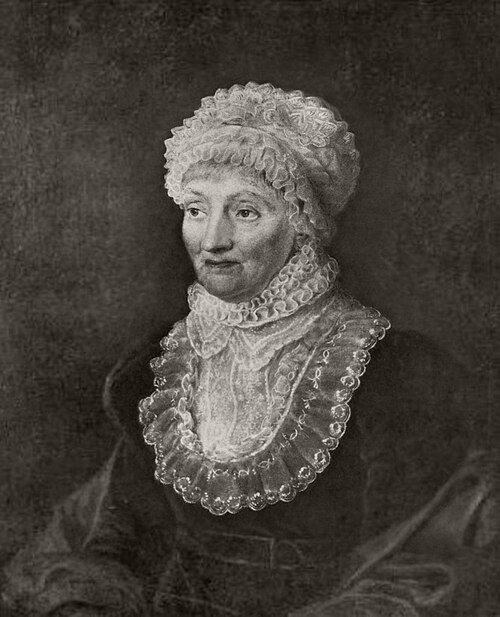
Dates: 1750–1848
Period: Enlightenment.
Caroline Herschel was a singer from Hanover who became an astronomer in England. She found 8 comets between 1786 and 1797, and in 1787 King George III gave her a salary of £50 a year as assistant to her brother William.1 Royal Museums Greenwich calls her “the first female in Britain to earn an income for the pursuit of science.”2
Her largest works were catalogues. She indexed Flamsteed's observations and found 560 stars he had left out, and in old age she compiled a catalogue of 2,500 nebulae for her nephew John, which won the Royal Astronomical Society's gold medal in 1828.3
Zevism honours her under the Muses of heaven and song, and as a keeper of the source. She swept the dark sky for what no one had seen, and she copied, checked and indexed what others had seen so that none of it would be lost.
LIFE AND CONTEXT
Caroline Lucretia Herschel was born in Hanover on 16 March 1750. Her father played the hautboy, the oboe, in the band of the Guards.4 Her mother “strongly opposed her daughters doing anything other than the household chores,” and Caroline “essentially lived the life of a servant” until her father died in 1767.3
Her brother William had gone to England and directed the musical life of Bath. In 1772 she joined him there. He trained her voice and taught her English and mathematics, and she didn't waste the chance.3 “As first treble in the Messiah, Judas Macabaeus, etc., she sang at Bath or Bristol sometimes five nights in the week.”3
William's telescopes changed both their lives. After his discovery of Uranus the Herschels moved to Datchet in August 1782 and to Slough in 1785. She kept his records, and by 1783 she had found 3 new nebulae of her own.5
When she spotted her last comet, in 1797, she “rode nearly 30 miles to the Royal Observatory in Greenwich to tell the Astronomer Royal, Nevil Maskelyne.”2 The next year she sent the Royal Society an index to Flamsteed's observations of the fixed stars.3
William died in 1822, and she went back to Hanover. MacTutor judges it “a bad decision, made too quickly, which she soon regretted.” She lived there another 25 years, still working for astronomy, and died on 9 January 1848, aged 97.5
ATTAINMENTS
- She discovered 8 comets between 1786 and 1797; the first, found on 1 August 1786, is now catalogued as C/1786 P1 (Herschel).5
- By 1783 she had detected 3 new nebulae with a small sweeping telescope William made for her.2
- Her letter on the first comet was read to the Royal Society on 9 November 1786 and printed in the Philosophical Transactions in 1787.6
- In 1787 King George III granted her £50 a year as William's assistant, the first income paid to a woman in Britain for science.5
- In 1798 she gave the Royal Society an Index to Flamsteed's Observations of the Fixed Stars “together with a list of 560 stars which had been omitted.”3
- She completed a catalogue of 2,500 nebulae for John Herschel, and the Royal Astronomical Society gave her its gold medal for it in 1828.3
- In 1835 she and Mary Somerville became the Royal Astronomical Society's first women honorary members; the Royal Irish Academy elected her in 1838.3
KEY STORIES
A Comet over a Hanover Street
Caroline's memory of the heavens began with her father. He “was a great admirer of astronomy,” she wrote, and she remembered him “taking me, on a clear frosty night, into the street, to make me acquainted with several of the most beautiful constellations, after we had been gazing at a comet which was then visible.”4
In the summer of 1761, when she was 11, “a severe attack of typhus fever” nearly killed her. It left her so weak that “for several months after I was obliged to mount the stairs on my hands and feet like an infant.” She added, writing in 1821, that she couldn't remember ever since spending a whole day in bed.4
Her schooling ended early. “My father wished to give me something like a polished education, but my mother was particularly determined that it should be a rough but at the same time a useful one.” That meant 2 or 3 months with a seamstress “to be taught to make household linen.”4 The girl who'd learned the constellations in the street was kept at home to sew.
English and Arithmetic at Breakfast
Caroline reached Bath in 1772 after nights on the post-wagon across Holland. Her own recollection records the start of her training: “On the second morning, on meeting my brother at breakfast, he began immediately to give me a lesson in English and arithmetic.” He also taught her to keep the household accounts. “By way of relaxation we talked of astronomy and the bright constellations with which I had made acquaintance during the fine nights we spent on the Postwagen travelling through Holland.”7
Soon the house turned into a telescope works. “Every leisure moment was eagerly snatched at for resuming some work which was in progress, without taking time or changing dress,” she wrote, and “many a lace ruffle” was “torn or bespattered by molten pitch.”3
Mirrors had to be polished by hand without a pause. Once, finishing a 7-foot mirror, William “had not left his hands from it for 16 hours,” and Caroline fed him as he worked: “I was even obliged to feed him by putting the vitals by bits into his mouth.”3
A Star out of Focus
In 1782 William gave her a small telescope “adapted for ‘sweeping,’ consisting of a tube with two glasses.” She began her record on 22 August 1782, but it was months before she “felt the least encouragement to spend the star-light nights on a grass-plot covered with dew or hoar frost, without a human being near enough to be within call.”8
In the summer of 1786 William was away in Germany. At Slough on 1 August, at 9 h 50 m, she noted an object “like a star out of focus, while the rest are perfectly distinct, and I suspect it to be a comet.” It resembled “in colour and brightness the 27th nebula of the Connoissance des Temps, with the difference however of being round.” Haze stopped her from proving it that night. On 2 August she looked again and wrote: “the motion since last night is evident.”9
She wrote straight to Charles Blagden, Secretary of the Royal Society: “In consequence of the friendship which I know to exist between you and my Brother, I venture to trouble you in his absence with the following imperfect account of a comet.” Her usual work, she explained, was “writing down the observations, when my Brother uses the 20-feet reflector,” which “does not often allow me time to look at the heavens.” She enclosed drawings of the star field and gave her instrument: “a Newtonian sweeper of 27 inches focal length, and a power of about 20.”10
The Catalogue for John
Back in Hanover after 1822, she set to work for William's son, compiling a catalogue of nebulae to help John Herschel in his astronomical work. It grew to 2,500 entries. She was past 70, and she'd spent 40 years copying and reducing the Herschel observations.3
The Royal Astronomical Society gave her its gold medal for it in 1828. In 1835 it made her and Mary Somerville its first women honorary members.3
On her 96th birthday, in March 1846, a letter told her that “His Majesty the King of Prussia, in recognition of the valuable service rendered to astronomy by you, as the fellow worker of your immortal brother,” wished to give her “the Large Gold Medal for science.” She died less than 2 years later. For her gravestone she wrote her own line: “The eyes of her who is glorified here below turned to the starry heavens.”5
THE ZEVIST READING
Plato's Socrates tells how the cicadas carry news of mortals to the Muses. To Calliope and to Urania “they make report of those who pass their lives in philosophy and who worship these Muses who are most concerned with heaven and with thought divine and human and whose music is the sweetest.”11 Caroline Herschel served both halves of that sentence in 1 life: as many as 5 nights a week as a soprano in Bath and Bristol, then decades under the sky.
Her sweeps are the Zevist teaching on darkness made plain. Unexplored darkness isn't evil; it's the ground one enters carrying a light, and explored darkness becomes Light. She stood alone on frosted grass with a sweeping telescope and brought back 8 comets and a record of nebulae that others could find again.
Zevism holds that knowledge must return to its source and honours those who keep the source whole: copyists, editors, indexers. Caroline did that work for 40 years. Her index of Flamsteed restored 560 stars to the record, and her catalogue of nebulae put the family's work into John's hands in a form he could use. A true record is Ma'at; a lost or garbled one lets the work of a lifetime fall back into the dark.
Her epitaph names the direction of the path. The aim of Zevism is ὁμοίωσις θεῷ κατὰ τὸ δυνατόν, likeness to the divine “as far as possible.”12 A girl who was taught only to sew household linen turned her eyes to the starry heavens and kept them there for the rest of a very long life. In Zevist terms that's the path walked to the full measure of the capacity she was given.
NOTES
1 MacTutor, “Caroline Lucretia Herschel”.
2 RMG.
3 MacTutor.
4 Memoir and Correspondence, ch. 1.
7 Memoir and Correspondence of Caroline Herschel, ch. 2.
9 C. Herschel, “An Account of a New Comet”.
10 Philosophical Transactions 77.
11 Plato, Phaedrus 259d, tr. Fowler.
BIBLIOGRAPHY
Caroline Herschel, “An Account of a New Comet. In a Letter from Miss Caroline Herschel to Charles Blagden, M. D. Sec. R. S.”, Philosophical Transactions 77 (1787), pp. 1–3, letter dated Slough, 2 August 1786; Internet Archive scan. Also transcribed at Wikisource. Spelling modernised from the long s.
Royal Society, “Paper, ‘Account of a new comet’, by Caroline Herschel,” L&P/9/8, Science in the Making; manuscript read 9 November 1786.
Mrs John Herschel, ed., Memoir and Correspondence of Caroline Herschel, 2nd edition (London: John Murray, 1879), Project Gutenberg; chapters 1 and 2, Caroline's own recollections of Bath and of sweeping.
J. J. O'Connor and E. F. Robertson, “Caroline Lucretia Herschel”, MacTutor History of Mathematics, University of St Andrews, July 1999; childhood, music, the workshop, comets, salary, the Flamsteed index, Hanover, the catalogue and her honours.
Royal Museums Greenwich, “Caroline Herschel: the first paid female astronomer”; nebulae of 1783, her sweeper, the ride to Greenwich in 1797, the salary and her epitaph. The article does not repeat this page's claim that she was the first woman ever to discover a comet.
Plato, Phaedrus 259d, translated by Harold N. Fowler, Perseus Digital Library.
Plato, Theaetetus 176a–b, Greek text, Perseus Digital Library.
CREDIT
Picture: Caroline Herschel, after M. Tieleman’s portrait of 1829; reproduced in Agnes Clerke’s The Herschels and Modern Astronomy (1895).
M. Tieleman / Agnes Clerke (1895) / Wikimedia Commons. Image record, Public domain; nineteenth-century painting and 1895 reproduction.

The round picture in the lists of the personalities is cropped from it.