





3 min read
Teacher of the Divine Names
Chaitanya
author: High Priest Zevios Metathronos
The teacher who made Divine remembrance a shared practice
Dates: 1486–1533/1534 CE
Period: Renaissance (1336–1650 CE)
Region: Bengal and Odisha, India
Tradition: Krishna devotion
Religion or tradition: Hinduism: Gauḍīya / Caitanya Vaiṣṇavism, centred on Krishna devotion and collective divine-name singing.
Heresy status: No designation documented.
Chaitanya’s religious work centred on devotion to Krishna expressed through repeated remembrance, singing and communal practice. Born in Bengal, he became an ascetic in 1510, travelled through India and spent his later life in Puri. Accounts of his life combine biographical material with the theology of a tradition that understands him as Divine. Modern reference works differ between 1533 and 1534 for his death.1
TURNING DIVINE REMEMBRANCE INTO COMMUNAL ACTION
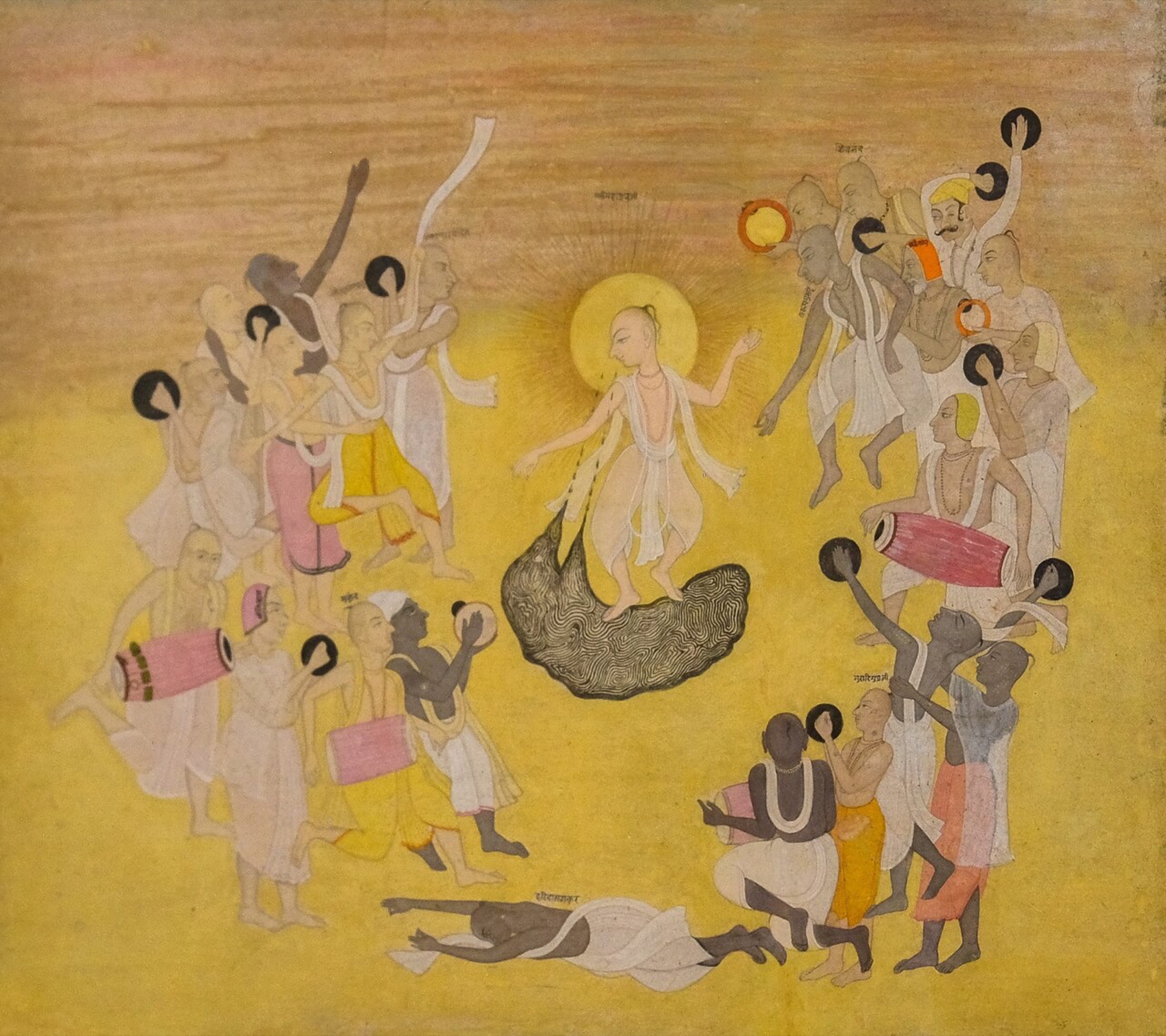
Chaitanya made collective singing of the Divine names a defining practice of the religious movement associated with him. This gave devotion a shared activity in which participants could direct voice, attention and movement towards Krishna. The practice also became the centre of a tradition whose later teachers developed substantial works of philosophy and religious instruction.2
His human contribution lies in the formation of a durable community of practice and a continuing intellectual inheritance. His service to Krishna is expressed through the prominence he gave to remembrance and praise. The constructive lesson is the provision of an action people can undertake together: a teaching becomes part of communal life when its meaning has a repeatable form through which participants can return to it.
FROM TEACHING TO REPEATED ACTION
His distinctive contribution was the prominence given to collective singing of the Divine names, or saṅkīrtana. Devotional attention was joined to voice and movement. The tradition’s later systematic theology was developed by teachers including the six Gosvamins of Vrindavan.3
The early biographies are essential witnesses to how his followers understood that work. They must be read as religious texts with their own purposes. A claim made within them about Chaitanya’s Divine identity describes the tradition’s faith; it is different in kind from a dated journey or the identification of a disciple.4
A ZEVIST INTERPRETATION
Chaitanya’s example is useful for understanding how religion becomes a daily discipline. A teaching needs an action through which the student can return to it. In communal recitation, participation is immediate: the worshipper must attend, remember and give voice to the sacred name.
For a Zevist reader, the corresponding lesson concerns application. Study supplies understanding; practice gives that understanding a place in the life of the practitioner. The cycle becomes deeper when experience leads to renewed study and more attentive practice.
Chaitanya’s own devotional destination remains Krishna. Respecting that specificity makes comparison stronger. His contribution demonstrates how a particular religious commitment can shape a community’s shared activity and sustain an extensive intellectual tradition around it.
NOTES
1 Akshay Gupta, “Caitanya Vaiṣṇavism”; “Caitanya,” Encyclopedia of Religion.
2 St Andrews account of Caitanya Vaiṣṇavism.
3 Gupta.
4 “Caitanya”.
BIBLIOGRAPHY
Akshay Gupta, “Caitanya Vaiṣṇavism,” St Andrews Encyclopaedia of Theology (2024), especially §1.1, open article.
“Caitanya,” Encyclopedia of Religion, reference entry.
CREDIT
Picture: Later devotional painting. Chaitanya dancing with followers, Kishangarh, Rajasthan, around 1750; unidentified artist, Kronos Collections. A later devotional scene, not a contemporary portrait.
Credit: Unknown author. Source record, Public domain.

The round picture in the lists of the personalities is cropped from it.