




9 min read
Father of the Computer
Charles Babbage
author: High Priest Zevios Metathronos
Dates: 1791–1871
Period: Imperial period
Charles Babbage was an English mathematician who designed machines to calculate and print mathematical tables without human error. His Difference Engine worked by repeated addition; his Analytical Engine, conceived in 1834, was designed as a general-purpose programmable engine run by punched cards, with a store for numbers and a separate mill for arithmetic.1
He didn't finish a full engine in his lifetime. In 1991 the Science Museum in London completed the calculating section of his Difference Engine No. 2 from his drawings of 1847–1849, and it “works as Babbage intended.”2
Zevism reads his engines under Hephaestus and Athena, who taught mortals their crafts, and under Ma'at, since a machine built to jam when a value is in doubt keeps the printed record true.
LIFE AND CONTEXT
Babbage was born on 26 December 1791, at Walworth in Surrey according to the Computer History Museum, the son of the banker Benjamin Babbage. He entered Trinity College, Cambridge, in October 1810. In 1812 Cambridge undergraduates set up the Analytical Society, and its most prominent members besides Babbage were John Herschel and George Peacock.3
He married in 1814. In 1816, at the age of 24, he was elected a fellow of the Royal Society, and in 1820 he was a major influence in founding the Royal Astronomical Society. The year 1827 brought disaster: his father, his wife and 2 of his children died. That same year he became Lucasian Professor of Mathematics at Cambridge, a chair he held for 12 years.4
The government backed the engine from the start. His first grant was £1,500; by February 1830 the government had paid or promised £9,000. In the end it had put £17,000 into the project, and in 1842 Robert Peel's government decided not to go on.4
His mind ran in every direction. The Computer History Museum credits him with lighthouse signalling, an ophthalmoscope, a cow-catcher for locomotives, an altimeter, a seismic detector and a tic-tac-toe machine for the public, and between 1813 and 1868 he published 6 full-length works and nearly 90 papers. He didn't suffer institutions gladly. Of the Royal Society he wrote that its council was “a collection of men who elect each other to office and then dine together at the expense of this society to praise each other over wine and give each other medals.”5
He died in London on 18 October 1871. A small experimental piece of the Analytical Engine was being built at the time, and none of his designs had been finished in his lifetime. The museum sums up his reputation: “The twin characteristics of irascibility and genius remain the defining signatures of his historical portrait.”6
ATTAINMENTS
- He announced the Difference Engine in a paper, Note on the application of machinery to the computation of astronomical and mathematical tables, read to the Royal Astronomical Society on 14 June 1822. The Society gave him a gold medal for it on 13 July 1824.4
- Difference Engine No. 1 called for some 25,000 parts and would have weighed about 4 tons and stood about 8 feet high. The finished section, about 2,000 parts and 1/7 of the whole, was assembled by Joseph Clement in 1832 and is in the Science Museum as object 1862-89.7
- He built error detection into the mechanism. If a wheel came to rest between 2 whole numbers, “the value is regarded as indeterminate and the engine is designed to jam to indicate that the integrity of the calculation has been compromised.”1
- In 1834 he conceived the Analytical Engine, with a “Store” for numbers and intermediate results and a separate “Mill” for arithmetic, programmed by punched cards.1
- Between 1847 and 1849 he designed Difference Engine No. 2, which calculates with numbers of 31 digits and needs about a third of the parts of the first design.1
- The Science Museum's reconstruction of Difference Engine No. 2 has 8,000 parts, weighs 5 tons and is 7 feet high and 11 feet long. Its calculating section was finished in 1991 and its printing and stereotyping apparatus in 2002.2
KEY STORIES
Dreaming over the Logarithms
Babbage told the story of the idea himself, in Passages from the Life of a Philosopher. The scene was Cambridge, where he was an undergraduate. “I was sitting in the rooms of the Analytical Society, at Cambridge, my head leaning forward on the table,” he recalled, “with a table of logarithms lying open before me.”4
Another member called out to him, “Well, Babbage, what are you dreaming about?” Babbage answered: “I am thinking that all these tables might be calculated by machinery.”4
The computation of logarithms, MacTutor notes, had made him aware of the inaccuracy of human calculation around 1812. A decade later, on 14 June 1822, he read his note on calculating astronomical and mathematical tables by machinery to the Royal Astronomical Society, and in 1824 the Society gave him its gold medal.4
Clement's Workshop
To build the engine Babbage needed a craftsman, and in the mid-1820s he hired Joseph Clement, “a toolmaker as well as a first-rate draftsman,” in the museum's words, “a rare combination.” The full design called for some 25,000 parts.8
By 1832 Clement had assembled a section of about 2,000 parts, 1/7 of the engine, in steel, brass and bronze. Babbage demonstrated this “finished portion of the unfinished engine” to some acclaim. In 1833 the 17-year-old Ada Byron met him at a party and “was entranced when Babbage demonstrated the small working section of the Engine to her.”9
Then the partnership broke. The plan to move Clement's workshops to a site close to Babbage's house ended in a dispute over compensation. Clement quit in 1833, and construction never resumed. Of the 12,000 parts already made, most were later melted down for scrap.10
The Engine Finished in 1991
Babbage completed the drawings for Difference Engine No. 2 in 1849 and never built it. In 1985 the Science Museum in London set out to do so, led by its then Curator of Computing, Doron Swade. The drawings were detailed, but they weren't enough to build from: they were “insufficiently detailed to serve as manufacturing drawings,” so the team worked out specifications for all 8,000 parts.2
They held themselves to one rule. “Modern manufacturing methods were used but uncompromising care was taken to ensure that the precision achievable by Babbage was nowhere exceeded.” The calculating section was finished in 1991, “in time for the bicentenary of Babbage's birth,” and the printer followed in 2002.11
The machine ran. “The completed machine works as Babbage intended,” the museum reports, and the project answered an old question: “We can say with some confidence that had Babbage built his engine, it would have worked.” The failure of the 19th century, it concludes, “had as much to do with politics, economics, and personalities, as with technology.” Zevism reads the result as a verdict for the craft of Hephaestus: the metal did what the drawings promised.11
Cards for the Analytical Engine
With the first engine stalled, Babbage turned in 1834 to a larger machine. He gave it a “Store” and a “Mill” and planned to control it with a device of the Jacquard loom type; MacTutor notes that “the punched cards contained the program for the particular task.”12
In 1843 Ada Lovelace published her translation of Luigi Menabrea's article on the engine “to which Ada added extensive notes of her own.” She wrote that the engine “might compose elaborate and scientific pieces of music of any degree of complexity or extent.” Ada “is often referred to as ‘the first programmer’,” the museum notes, while “biographers debate the extent and originality of Ada's contribution.”13
The Analytical Engine was never built. When Babbage died in 1871, a small experimental piece of it was still under construction.1
THE ZEVIST READING
The Homeric Hymn to Hephaestus begins: “Sing, clear-voiced Muses, of Hephaestus famed for inventions. With bright-eyed Athene he taught men glorious gifts throughout the world.”14 Babbage worked in their domain. His engines are number set in steel, brass and bronze, and the Temple reads them as gifts of the smith God and the Goddess of craft, carried into the age of machines.
Plato's Theuth gave mortals number and calculation along with letters.15 Babbage's step was to hand calculation to a machine and let a craftsman's gears carry out work that people had done with pen and paper. Zevism reads that as the gift of Theuth given a body by the craft of Hephaestus.
Ma'at is “the personification of truth, justice, and the cosmic order,” and isfet her opposite.16 A printed table with a wrong figure is Izfet in a small, stubborn form, and it's copied into every calculation that trusts it. Babbage's answer was a machine that computes by fixed rule and jams when a wheel stops between numbers. Such a machine can't hand on a false value, and in Zevist terms that's Ma'at built into a mechanism.
Zevism honours keepers of the source, and here the source was a set of drawings. Between the last of them in 1849 and the start of construction in 1985 lay 136 years, and the finished machine proved the design sound. Creation is open forward and requires work; Babbage's work stood ready for the hands that came later.
NOTES
1 Computer History Museum, “The Engines”.
2 Computer History Museum, “A Modern Sequel”.
3 O'Connor and Robertson, “Charles Babbage,” MacTutor; Computer History Museum, “Charles Babbage”.
4 MacTutor.
5 Computer History Museum, “Charles Babbage”; MacTutor.
6 MacTutor; Computer History Museum, “The Engines”; “Charles Babbage”.
7 Computer History Museum, “The Engines”; Science Museum Group, Difference Engine No. 1.
8 Computer History Museum, “Joseph Clement”; “The Engines”.
9 Science Museum Group, object 1862-89; Computer History Museum, “Ada Lovelace”.
10 “Joseph Clement”; Science Museum Group.
12 Computer History Museum, “The Engines”; MacTutor.
13 Computer History Museum, “Ada Lovelace”.
14 Homeric Hymn 20 to Hephaestus, tr. H. G. Evelyn-White.
BIBLIOGRAPHY
J. J. O'Connor and E. F. Robertson, “Charles Babbage”, MacTutor History of Mathematics, University of St Andrews; with Babbage's recollection from Passages from the Life of a Philosopher (1864).
Computer History Museum, “Charles Babbage”, The Babbage Engine exhibition; birth, inventions, publications and reputation.
Computer History Museum, “The Engines”, The Babbage Engine exhibition; Difference Engine No. 1, error detection, the Analytical Engine, Difference Engine No. 2 and physical legacy.
Computer History Museum, “Joseph Clement”, The Babbage Engine exhibition; the engineering collaboration and its breakdown.
Science Museum Group, Difference Engine No. 1, object 1862-89, surviving portion made by Joseph Clement in 1832.
Computer History Museum, “Ada Lovelace”, The Babbage Engine exhibition; the 1833 meeting, 1843 translation and notes.
Computer History Museum, “A Modern Sequel”, The Babbage Engine exhibition; construction of Difference Engine No. 2, 1985–2002.
Homeric Hymn 20 to Hephaestus, H. G. Evelyn-White translation, Theoi Classical Texts Library.
Plato, Phaedrus 274c–d, translated by H. N. Fowler, Perseus Digital Library.
Encyclopaedia Britannica, “Maat”.
CREDIT
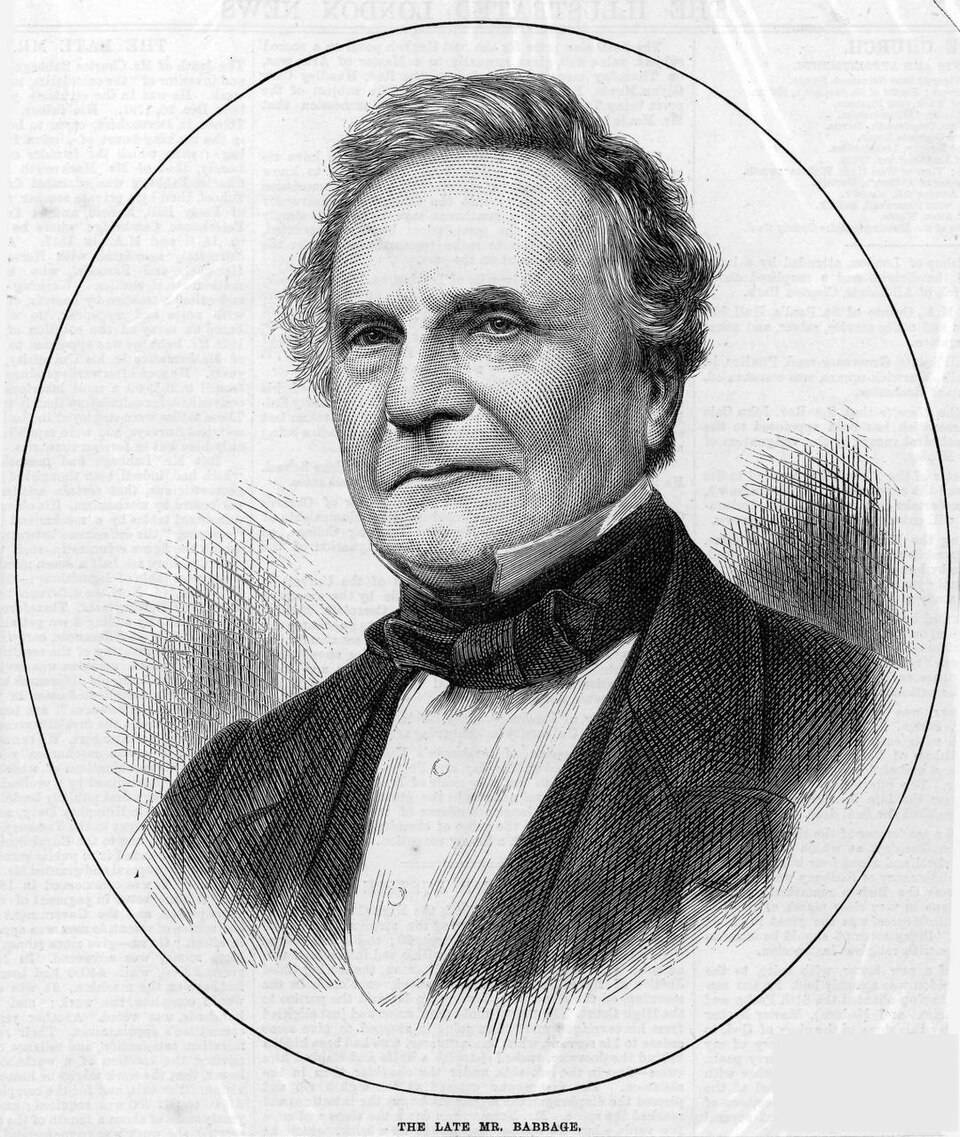
Picture: Charles Babbage; obituary print published 4 November 1871, based on an 1860 photograph
The Illustrated London News, 4 November 1871; attributed to Thomas Dewell Scott, via Wikimedia Commons; public domain. Image record, Public domain.

The round picture in the lists of the personalities is cropped from it.