



10 min read
Great Naturalist
Charles Darwin
author: High Priest Zevios Metathronos
Learning to See the History of Life
Dates: 1809–1882
Period: Imperial
Charles Darwin sailed round the world for nearly 5 years as an unpaid naturalist, opened his first notebook on the change of species in July 1837, and published On the Origin of Species 22 years later, in November 1859.1
The Origin argued that species change and that natural selection drives the change. The mechanism is plain to state and was hard to prove. Organisms vary, more are born than survive, and a heritable difference that helps its bearer under given conditions tends to be passed to more descendants. Over many generations the population changes. Darwin spent 2 decades gathering the evidence, and Alfred Russel Wallace reached the same idea on his own.2
Zevism reads this work as light carried into one of the oldest darknesses of natural history, the first appearance of new kinds of living things. Darwin found order where others saw only a fixed catalogue, and the Temple places that finding under Ma'at, the order of cosmic existence held by Zeus.
LIFE AND CONTEXT
Darwin was born in Shrewsbury on 12 February 1809, the son of Robert Waring Darwin and Susannah Wedgwood. His mother died in 1817. He studied medicine at Edinburgh from 1825 to 1827, then theology and natural science at Christ's College, Cambridge, where he took his BA in 1831 and came under the botanist John Stevens Henslow.3
HMS Beagle left on 27 December 1831 and brought him home in October 1836, aged 27. Looking back, he wrote that the voyage “has been by far the most important event in my life, and has determined my whole career.”4
In London he opened his first notebook on species in July 1837. In October 1838 he “happened to read for amusement 'Malthus on Population,'” and “it at once struck me that under these circumstances favourable variations would tend to be preserved, and unfavourable ones to be destroyed.” As he put it, “Here then I had at last got a theory by which to work.” He married his cousin Emma Wedgwood in 1839; they had 10 children and in 1842 moved to the village of Downe in Kent, where he'd spend the rest of his life.5
He wrote the theory out in 1842 and again in 1844, but he didn't publish it. Instead he spent 8 years, from 1846 to 1854, dissecting barnacles. His daughter Annie died in 1851.6
After the Origin he wrote on variation, human heredity and the evolution of the emotions. He died in April 1882 and was buried in Westminster Abbey.3
ATTAINMENTS
- He spent 5 weeks in the Galápagos Islands, from 15 September to 20 October 1835, with about 19 days ashore on 4 islands: Chatham, Charles, Albemarle and James.7
- His account of the voyage first came out in 1839 as volume 3 of FitzRoy's Narrative, and it was reissued alone that year because demand outran the other 2 volumes. By 1842 it had sold 1,337 copies; the revised 2nd edition of 1845 was translated into 6 languages in his lifetime.8
- Between 1846 and 1854 he dissected and classified barnacles, publishing 2 volumes on the living Cirripedia in 1851 and 1854. He found minute males living on the hermaphrodites of certain genera and won the Royal Society's Royal Medal in 1853.9
- On 1 July 1858 the Linnean Society heard his early sketch of natural selection read beside Wallace's paper on the same theory.10
- On the Origin of Species appeared from John Murray in November 1859. “The first small edition of 1250 copies was sold on the day of publication, and a second edition of 3000 copies soon afterwards.”11
- He gave Chapter 6 of the Origin to the difficulties facing his own theory, among them missing transitional forms and the evolution of complex organs.12
- The Royal Society awarded him the Copley Medal at the end of November 1864. Darwin noted that “the Copley being open to all sciences & all the world is reckoned a great honour.”13
KEY STORIES
A Place on the Beagle
In August 1831 Darwin came home to Shrewsbury from a geological tour of North Wales and found a letter from Henslow. Captain Robert FitzRoy, it said, “was willing to give up part of his own cabin to any young man who would volunteer to go with him without pay as naturalist.”11
His father refused, and then left a door open: “If you can find any man of common sense who advises you to go I will give my consent.” Darwin gave up. “So I wrote that evening and refused the offer.” The next morning he went to Maer for the shooting, and there his uncle, Josiah Wedgwood, sent for him and offered to drive him back to Shrewsbury to talk to his father. “My father always maintained that he was one of the most sensible men in the world, and he at once consented in the kindest manner.”11
The last obstacle was the captain. FitzRoy, Darwin learned years later, was “an ardent disciple of Lavater, and was convinced that he could judge of a man's character by the outline of his features.” By that test “he doubted whether any one with my nose could possess sufficient energy and determination for the voyage.” The nose passed. Darwin later judged, “I have always felt that I owe to the voyage the first real training or education of my mind.”11
The Vice-Governor's Tortoises
On 15 September 1835 the Beagle reached the Galápagos. There the Vice-Governor, Mr. Lawson, told Darwin something he didn't take in at first: “the tortoises differed from the different islands, and that he could with certainty tell from which island any one was brought.”14
Darwin later admitted the lapse. “I did not for some time pay sufficient attention to this statement, and I had already partially mingled together the collections from two of the islands.” His mocking-thrushes told the same story: 1 species on Charles Island, another on Albemarle, a 3rd on James and Chatham.15
Homeward bound in the summer of 1836, sorting his notes, he wrote that when he saw these islands “in sight of each other,” holding birds “but slightly differing in structure & filling the same place in nature,” he “must suspect they are only varieties.” If there was the slightest foundation for it, “such facts would undermine the stability of Species.”16
Like Confessing a Murder
On 11 January 1844, from Down in Kent, Darwin wrote to the botanist Joseph Dalton Hooker. He confessed that he was “almost convinced (quite contrary to the opinion I started with)” that “species are not (it is like confessing a murder) immutable.” The letter is now in Cambridge University Library as MS DAR 114: 3.17
That summer he enlarged his sketch into the essay of 230 pages. On 5 July 1844 he wrote to Emma with instructions for his death: she was to see the essay published, and he set aside £400, with his library and his species notes, for whoever would edit it. He lived another 38 years, and the essay stayed in manuscript while he turned to barnacles.18
A Letter from the East Indies
By 18 June 1858 Darwin had in his hands an essay from Alfred Russel Wallace, who was writing from the East Indies. It set out Darwin's own theory. That day he sent it on to Charles Lyell: “Your words have come true with a vengeance that I shd. be forestalled.” He added, “I never saw a more striking coincidence. if Wallace had my M.S. sketch written out in 1842 he could not have made a better short abstract!”10
The house was sick. Henrietta had diphtheria, and the baby, Charles Waring, caught scarlet fever and died on 28 June. Lyell and Hooker arranged for part of Darwin's early sketch to be read with Wallace's paper at the Linnean Society on 1 July. Darwin didn't attend. The family fled the epidemic to the Isle of Wight, and at Sandown he began the “abstract” that he finished in March 1859 and published that November as the Origin.10
THE ZEVIST READING
Zevism holds that unexplored darkness is ground to be walked into with a light, and that explored darkness becomes Light. The origin of species was such a darkness. Darwin's Galápagos chapter calls it “that mystery of mysteries,” the “first appearance of new beings on this earth.”15 He walked into it with bird skins, barnacles and 22 years of notes.
The Logos gives the 2nd measure. Heraclitus held that “all things happen according to this Word,” and set himself to “distinguish each thing according to its nature and show how it is.”19 Darwin did that work for living forms. The closing page of the Origin sets plants, birds, insects and worms on a single bank, each dependent on the others in complex ways and all the product of a long history.20
That's Ma'at in the living world. Egyptian religion named Ma'at “the personification of truth, justice, and the cosmic order.”21 An order that produces new kinds by law is still order, and it's held by the Sovereign of the Cosmos. The Temple reads the history of life as the working of that order through time.
Darwin's own belief shifted over his life. In 1879 he wrote that he'd never been an atheist “in the sense of denying the existence of a God,” and that generally, “but not always,” an agnostic “would be the most correct description of my state of mind.”22 The Zevist reading is the Temple's claim about the work, and it rests on how he did that work: he printed the objections to his own theory in Chapter 6 and shared the first announcement with Wallace.
NOTES
1 Darwin Correspondence Project, “About Darwin”; Darwin, Autobiography, ed. Francis Darwin.
2 Darwin, On the Origin of Species, 1st ed., ch. 4; Darwin Correspondence Project, “Darwin in letters, 1858–1859”.
3 Darwin Correspondence Project, “About Darwin”.
4 Darwin Correspondence Project, “Darwin in letters, 1821–1836”; Darwin, Autobiography.
5 Darwin, Autobiography; Darwin Correspondence Project, “About Darwin”.
6 Darwin, Autobiography; Darwin Correspondence Project, “Darwin's study of the Cirripedia”.
7 Chancellor and Keynes, “Darwin's field notes on the Galapagos,” Darwin Online, 2006.
8 R. B. Freeman, introduction to Journal of Researches, Darwin Online.
9 Darwin Correspondence Project, “Darwin's study of the Cirripedia”.
10 Darwin Correspondence Project, “Darwin in letters, 1858–1859”.
12 Darwin, Origin, 1st ed., ch. 6.
13 Darwin Correspondence Project, “Darwin in letters, 1864”.
14 Darwin, Journal of Researches, 2nd ed., 1845, ch. 17; Chancellor and Keynes, Darwin Online.
15 Darwin, Journal of Researches, ch. 17.
16 Darwin Correspondence Project, “Darwin in letters, 1821–1836”.
17 Cambridge University Library, Lines of Thought, “Like confessing a murder”; Darwin Correspondence Project, “Darwin in letters, 1844–1846”.
18 Darwin Correspondence Project, “Darwin in letters, 1844–1846”.
19 Graham, “Heraclitus,” Stanford Encyclopedia of Philosophy, §2.
20 Darwin, Origin, 1st ed., pp. 489–490.
22 Darwin Correspondence Project, “What did Darwin believe?”.
BIBLIOGRAPHY
Charles Darwin, On the Origin of Species, London: John Murray, 1859, 1st edition, Darwin Online F373; ch. 4, pp. 80–82; ch. 6, pp. 171–172; conclusion, pp. 489–490.
Charles Darwin, Journal of Researches, 2nd edition, London: John Murray, 1845, Darwin Online F14; ch. 17, Galápagos Archipelago.
Charles Darwin, The Autobiography of Charles Darwin, edited by Francis Darwin, Project Gutenberg; the Beagle offer, the voyage, Malthus, the 1842 and 1844 sketches, sales of the Origin.
Darwin Correspondence Project, University of Cambridge, “About Darwin”.
Darwin Correspondence Project, “Darwin in letters, 1821–1836: Childhood to the Beagle voyage”, with the ornithological notes of 1836 (DAR 29.2: 73–4).
Darwin Correspondence Project, “Darwin in letters, 1844–1846”, “Darwin in letters, 1858–1859: Origin” and “Darwin in letters, 1864”.
Darwin Correspondence Project, “Darwin's study of the Cirripedia” and “What did Darwin believe?”, with the letter to John Fordyce of 7 May 1879.
Cambridge University Library, Lines of Thought, “Like confessing a murder”, Darwin to J. D. Hooker, 11 January 1844, MS DAR 114: 3.
Gordon Chancellor and Randal Keynes, “Darwin's field notes on the Galapagos: 'A little world within itself'”, Darwin Online, October 2006.
R. B. Freeman, introduction to Journal of Researches, Darwin Online.
Daniel W. Graham, “Heraclitus”, Stanford Encyclopedia of Philosophy, §2, fragment B1; Encyclopaedia Britannica, “Maat”.
CREDIT
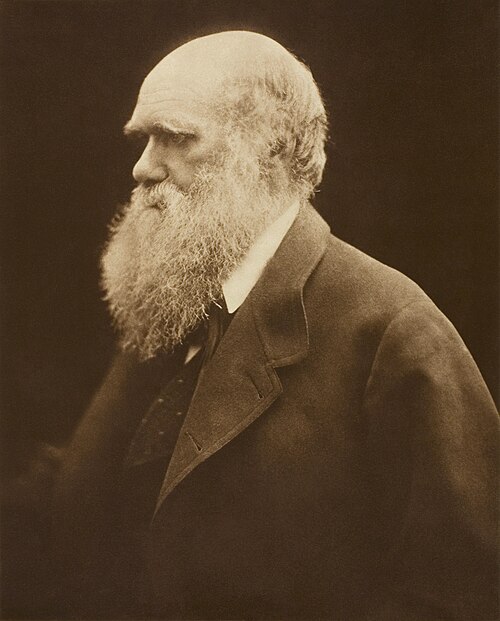
Picture: Charles Darwin, photographed by Julia Margaret Cameron c. 1868; carbon print of 1875, Art Institute of Chicago 1949.881. Digital restoration by Adam Cuerden.
Julia Margaret Cameron / Art Institute of Chicago; restoration Adam Cuerden / Wikimedia Commons. Image record, Public domain original; restoration released for unrestricted use.

The round picture in the lists of the personalities is cropped from it.