




9 min read
First Lady of Physics
Chien-Shiung Wu
author: High Priest Zevios Metathronos
The Courage to Let Nature Answer
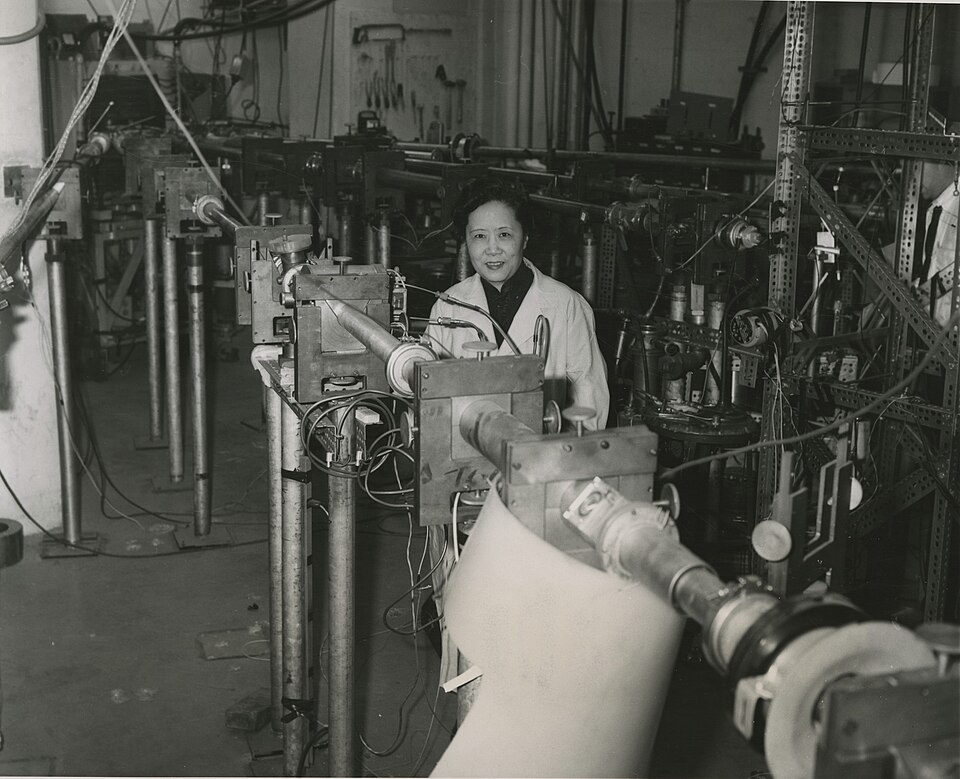
Dates: 1912–1997
Period: Modern
Chien-Shiung Wu was a Chinese-born physicist who spent most of her career at Columbia University and became the leading experimenter of her time on beta decay, “the emission of electrons from radioactive nuclei.” Her colleague Tsung-Dao Lee put it simply: “C.S. Wu was one of the giants of physics. In the field of beta decay, she had no equal.”1
Her greatest single result came at the turn of 1957. Working with 4 physicists at the National Bureau of Standards in Washington, she cooled cobalt-60 to about 0.003 K, lined up the spins of its nuclei and found that more electrons came out on the side opposite the spin. A nucleus and its mirror image didn't behave alike. With a meson-decay experiment at Columbia, the result overturned a law of physics accepted for 30 years.2
Zevism reads the experiment by its doctrine of Light and Darkness and by Ma'at, the order of true measure. Wu asked nature a precise question and let the answer overturn what physicists had assumed.
LIFE AND CONTEXT
She was born in Shanghai in 1912 and grew up in Liuhe, in Jiangsu province north of the city. She went to a school her father had started; he believed in educating girls when few people did. She took a bachelor's degree at National Central University in Nanking in 1934.3
In 1936 she landed in San Francisco, helped by money from an uncle. At the University of California, Berkeley, she studied with E. O. Lawrence, inventor of the cyclotron, and took her doctorate in physics in 1940. There she met Luke Chia-Liu Yuan, and they married in 1942. She taught at Smith and at Princeton from 1942 to 1944.4
In 1944 she joined Columbia's research staff as a senior scientist and went to work for the Manhattan Project at the Substitute Alloy Materials Laboratory. She worked on radiation detectors and helped develop the gaseous diffusion process that separated uranium-235 from uranium-238.5
Columbia made her an associate professor in 1952, a full professor in 1958 and its first Pupin Professor of Physics in 1973. That year she was chosen as the first woman to head the American Physical Society. She retired in 1980.6
Her later work went into the X-ray spectra of muonic atoms and then into biology, where her Mössbauer studies of haemoglobin shed light on its structure. She'd had a stroke about 2 years earlier, and she died in Manhattan after another on 16 February 1997, at 84.7
ATTAINMENTS
- When the Hanford B Reactor shut down soon after it started operating, Wu helped identify the cause as poisoning by xenon-135.8
- She showed that the 2 quanta from the annihilation of an electron and a positron are polarised at right angles to each other, as Dirac's theory required, which proved that electron and positron have opposite parity.9
- With Ernest Ambler, Raymond W. Hayward, Dale D. Hoppes and Ralph P. Hudson she published “Experimental Test of Parity Conservation in Beta Decay,” Physical Review 105, 1413–1415 (1957), the first experimental proof that parity isn't conserved in the weak interaction.10
- The Wolf Foundation credits her with “outstanding experimental work on the mechanism of beta disintegration, and thereby, of weak interactions generally,” and with showing “that the direction of emission of beta rays is strongly correlated with the direction of the spin of the emitting nucleus.”9
- She wrote Beta Decay, which Columbia called at her death “the standard reference on low-energy emission of electrons by decaying atoms.”11
- She won the Research Corporation Award in 1958, the National Medal of Science in 1975 and the first Wolf Prize in Physics in 1978. Princeton gave her the first honorary doctorate it awarded to a woman.5
KEY STORIES
The Question Lee and Yang Brought
In 1956 physics had a puzzle. The K meson seemed to come in 2 versions, one decaying into 2 pions and the other into 3, alike in every other way. Tsung-Dao Lee of Columbia and Chen Ning Yang went through the evidence for parity, the rule that a process and its mirror image behave alike, and found that for the weak interactions it “neither supported nor refuted parity conservation.”12
Their paper, “Question of Parity Conservation in Weak Interactions,” appeared in Physical Review 104 in 1956 and proposed tests. The one that looked best to them was to measure “the directional intensity of beta radiation from oriented ⁶⁰Co nuclei.” To find out how, they went to their Columbia colleague, and Ralph Hudson later described her as a “beta-spectroscopist and Columbia University friend and colleague.”13
Wu knew beta decay. The low temperatures the test required were in Washington. “At the suggestion of Professor Wu of Columbia,” the Bureau records, “arrangements were made to carry out this experiment in the Bureau's low temperature laboratory.”12
Cobalt Near Absolute Zero
Columbia later summed up her method in a sentence: place the cobalt “in a strong magnetic field to line up the north-south magnetic poles of its nuclei, supercool it to minimize the atoms' random thermal motions, and then watch where the electrons it emitted went.”11
Doing it took 6 months of preparation. The cobalt-60 sat in a surface layer 50 micrometres thick on a single crystal of cerous magnesium nitrate. The team cooled it by adiabatic demagnetisation in a field of about 2.3 tesla, and a thin anthracene crystal inside the chamber counted the electrons.13
Halfway through, the apparatus failed them. Gas kept leaking out inside its most sensitive chambers, and the team decided the problem “would never be surmounted.” They redesigned the whole assembly from stainless steel to glass and built a new one fast.13
The first results came between Christmas 1956 and New Year's Day, and page 90 of Ernest Ambler's notebook for the experiment is dated 27 December 1956. At about 0.003 K the nuclei lined up. The team measured the electrons, reversed the field to flip the nuclei, and measured again. The count was higher opposite the spin. “Thus,” the Bureau's account says, “a spinning cobalt-60 nucleus has a beta emission distribution that is not the same as that of its mirror image.”14
The paper went to Physical Review under 5 names, Wu's first. Columbia's obituary later put its meaning in a line: “The discovery stunned scientists, for it showed that the laws of nature are not always symmetrical with respect to right and left.”15
A Prize for the Theorists
The Nobel Prize in Physics for 1957 went to Lee and Yang “for their penetrating investigation of the so-called parity laws which has led to important discoveries regarding the elementary particles.” Wu wasn't among the laureates.16
In Stockholm, O. B. Klein of the Nobel Committee for Physics named her in his presentation speech: “The first of these experiments was carried out by the Chinese physicist, Mrs. C.S. Wu and her collaborators.” He described the cobalt nuclei lined up “just like compass needles,” and electrons “preferentially thrown downwards towards the floor.”17
The Bureau gave its own members of the team the Commerce Department's Gold Medal that year. In 1978, 21 years after Stockholm, the Wolf Foundation gave its first Prize in Physics to Wu, “for her persistent and successful exploration of the weak interaction which helped establish the precise form and the non conservation of parity for this new natural force.”18
At Columbia, Polykarp Kusch, one of the university's Nobel laureates in physics, judged her work in a sentence: “Her experiments have been designed with great elegance and have, by virtue of their elegance, a high esthetic quality.”11
THE ZEVIST READING
Zevism teaches that unexplored darkness isn't evil. It's the ground one walks into with a light, and explored darkness becomes Light. Parity in the weak interaction was such a darkness, though it didn't look like one: the rule had been “universally accepted for the previous 30 years,” and no one had tested it where it mattered.12 Wu carried a detector into that ground at 0.003 K and came back with knowledge.
Ma'at is “the personification of truth, justice, and the cosmic order,” set against isfet, disorder.19 The order Ma'at names is the order that actually holds. A law assumed and never checked is a false entry in the record of the cosmos, however elegant it looks. Wu's experiment struck that entry out. The cosmos Zevism reveres under Zeus turned out to tell left from right in the weak interaction, and knowing it as it is serves Ma'at better than any beautiful assumption.
Zevism also holds that the source keeps priority over what's handed down. In physics the source is nature itself, questioned by experiment. Lee and Yang asked the right question; Wu went back to the source and made it answer, with an apparatus rebuilt in glass when the steel one failed. The collaborators belong in that act: Ambler, Hayward, Hoppes and Hudson supplied the cold, and the result belongs to all 5.
The aim of the path is ὁμοίωσις θεῷ κατὰ τὸ δυνατόν, becoming like the divine “as far as possible.”20 A mind that yields its expectations to what is measured walks that path. Wu reversed the field, counted again and accepted the count.
NOTES
1 Columbia University, obituary, 17 February 1997.
2 Hudson, NIST SP 958, pp. 111–115; NIST, “The Reversal of Parity Law in Nuclear Physics”.
3 Columbia; Atomic Heritage Foundation, “Chien-Shiung Wu”.
4 Atomic Heritage Foundation; Columbia.
5 Columbia; Atomic Heritage Foundation.
6 Columbia; NIST, “Fall of Parity Photo Gallery”.
7 Wolf Foundation, “Chien-Shiung Wu”; Columbia.
10 NIST, “The Reversal of Parity Law in Nuclear Physics”; Nobel Prize, presentation speech, 1957.
11 Columbia.
12 NIST, “The Reversal of Parity Law”.
14 NIST, “Fall of Parity”; NIST, “The Reversal of Parity Law”.
15 Columbia; Hudson, NIST SP 958.
16 Nobel Prize, “The Nobel Prize in Physics 1957”.
17 Klein, presentation speech, 1957.
18 Hudson, NIST SP 958; Wolf Foundation.
BIBLIOGRAPHY
Ralph P. Hudson, “Reversal of the Parity Conservation Law in Nuclear Physics”, in A Century of Excellence in Measurements, Standards, and Technology, NIST Special Publication 958, pp. 111–115; apparatus, redesign, temperature, result and the original paper: C. S. Wu, E. Ambler, R. W. Hayward, D. D. Hoppes and R. P. Hudson, Physical Review 105, 1413–1415 (1957).
National Institute of Standards and Technology, “The Reversal of Parity Law in Nuclear Physics”, with T. D. Lee and C. N. Yang, Physical Review 104, 254 (1956); and “The Fall of Parity” and its photo gallery with short biographies.
Columbia University, “Chien-Shiung Wu, Renowned Columbia Physicist, 84”, 17 February 1997.
National Museum of Nuclear Science & History, Atomic Heritage Foundation, “Chien-Shiung Wu”; early life, Manhattan Project, Hanford.
Wolf Foundation, “Chien-Shiung Wu”, Wolf Prize in Physics 1978, citation and laudation.
The Nobel Prize, “The Nobel Prize in Physics 1957”, and Oskar Klein, presentation speech, 1957.
Encyclopaedia Britannica, “Maat”.
Plato, Theaetetus 176a–b, Greek text, Perseus Digital Library.
CREDIT
Picture: Chien-Shiung Wu in 1963, from the Science Service records.
Smithsonian Institution Archives, Science Service records, SIA2010-1507; via Wikimedia Commons. No known copyright restrictions. Image record, No known copyright restrictions, Smithsonian Flickr Commons.
_in_1963.jpg)
The round picture in the lists of the personalities is cropped from it.