




9 min read
Father of Information
Claude Elwood Shannon
author: High Priest Zevios Metathronos
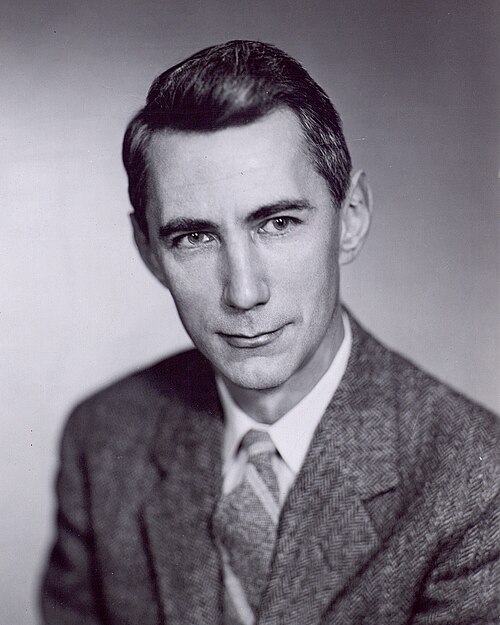
Dates: 1916–2001
Period: Modern period
Claude Shannon was an American mathematician and engineer who put communication on a mathematical footing. In 1948, at Bell Telephone Laboratories, he published A Mathematical Theory of Communication, which measured information in bits and proved how much of it a noisy channel can carry with as few errors as one likes. The Kyoto Prize cited him in 1985 for the “Establishment of Mathematical Foundation of Information Theory.”1
Before that, his master's thesis at MIT had shown how Boolean algebra describes relay and switching circuits. He also built a maze-solving mouse and co-signed the 1955 proposal for a summer study of “artificial intelligence” at Dartmouth.2
Zevism reads his work under Hermes, the messenger of Zeus and God of language, and under Theuth, who invented number and letters. Shannon counted the letters of English and proved how a message can cross a noisy line intact, and in Zevist terms that's Ma'at kept in the channel.
LIFE AND CONTEXT
Shannon was born in Petoskey, Michigan, on 30 April 1916 and grew up in Gaylord. He took bachelor's degrees in mathematics and electrical engineering at the University of Michigan in 1936.3
He went on to MIT, where he worked part-time on Vannevar Bush's differential analyzer. His master's thesis, A Symbolic Analysis of Relay and Switching Circuits, supervised by Frank L. Hitchcock, used Boolean algebra to analyse relay and switching circuits. Howard Gardner of Harvard later called it “possibly the most important, and also the most famous, master's thesis of the century.” Shannon received the SM in electrical engineering and the PhD in mathematics in 1940, then became a research fellow at the Institute for Advanced Study in Princeton.4
In 1941 he joined Bell Telephone Laboratories as a research mathematician, and he stayed affiliated with Bell until 1972. During the Second World War he worked on secrecy systems there as a cryptographer. The 1948 paper came out of those years, in 2 parts in the Bell System Technical Journal.5
By 1955 the Dartmouth proposal could list his fields as “the statistical theory of information, the application of propositional calculus to switching circuits,” and work on “the design of machines that learn, cryptography, and the theory of Turing machines.” He returned to MIT as a visiting professor in 1956, held a named professorship of science from 1958 to 1978 and then became professor emeritus. The honours came in a run: the National Medal of Science and the IEEE Medal of Honor in 1966, the Kyoto Prize in 1985.6
He died on 24 February 2001 at a nursing home in Medford, Massachusetts, after a long illness with Alzheimer's disease. He was 84. His wife, Mary Elizabeth “Betty” Moore, survived him, with their son Andrew and daughter Margarita.7
ATTAINMENTS
- His master's thesis applied Boolean algebra to relays and switches and, in MIT's words, established “the theoretical underpinnings of digital circuits. This work was the beginning of modern switching theory.”7
- He posed the central problem in 1 sentence: “The fundamental problem of communication is that of reproducing at one point either exactly or approximately a message selected at another point.” He divided a communication system into 5 parts: information source, transmitter, channel, receiver and destination.8
- He fixed the unit. With logarithms to base 2, “the resulting units may be called binary digits, or more briefly bits, a word suggested by J. W. Tukey.”9
- He proved the limit of a noisy channel. Theorem 11 states that if the source's rate H doesn't exceed the capacity C, “there exists a coding system such that the output of the source can be transmitted over the channel with an arbitrarily small frequency of errors.”10
- He measured the English language and found that its redundancy, counting statistical structure over up to about 8 letters, “is roughly 50%.”9
- In 1950 he built Theseus, which the MIT Museum describes as “the first learning device of its kind,” and published Programming a Computer for Playing Chess.11
- On 31 August 1955 he signed, with John McCarthy, Marvin Minsky and Nathaniel Rochester, the proposal for a summer study of artificial intelligence at Dartmouth in 1956, budgeted at $13,500.12
KEY STORIES
A Book Opened at Random
In the 3rd section of his 1948 paper Shannon showed how statistics could make something that looked like English. He began with letters chosen blindly, all equally likely, and got strings such as “XFOML RXKHRJFFJUJ ZLPWCFWKCYJ.” Then he let the frequencies of real English guide each choice.13
He didn't need a computer for it. “One opens a book at random and selects a letter at random on the page. This letter is recorded. The book is then opened to another page and one reads until this letter is encountered.” The letter after it went down next, and the search began again on a new page.13
Working with whole words, he produced this: “THE HEAD AND IN FRONTAL ATTACK ON AN ENGLISH WRITER THAT THE CHARACTER OF THIS POINT IS THEREFORE ANOTHER METHOD FOR THE LETTERS THAT THE TIME OF WHO EVER TOLD THE PROBLEM FOR AN UNEXPECTED.” He noted drily that “the resemblance to ordinary English text increases quite noticeably at each of the above steps,” and that the run “attack on an English writer that the character of this” was “not at all unreasonable.” The same statistics gave him his figure of 50% redundancy for English.13
Theseus in the Maze
In 1950 Shannon built a mouse and gave it a hero's name. The MIT Museum describes it: “Mouse and maze, dubbed ‘Theseus’ for the legendary king of Athens, was the first learning device of its kind.” The life-sized magnetic mouse was driven by a relay circuit hidden under a metal table-top maze, the mouse's “brain.” It searched the maze's movable corridors until it found its target.14
That same year he published Programming a Computer for Playing Chess, and a chess machine called Endgame followed. It couldn't play a whole game, only the last few moves, since the computing power of the day allowed no more.15
Zevism reads the name as apt: Shannon gave an Athenian hero's name to a machine that learned its way through a maze.15
The Summer Proposal of 1955
On 31 August 1955 John McCarthy of Dartmouth College, Marvin Minsky of Harvard, Nathaniel Rochester of IBM and Shannon of Bell Telephone Laboratories signed a proposal. They asked for “a 2 month, 10 man study of artificial intelligence” at Dartmouth, in Hanover, New Hampshire, the next summer, and put the cost at $13,500.12
The study rested on a conjecture: “every aspect of learning or any other feature of intelligence can in principle be so precisely described that a machine can be made to simulate it.” Its topics ran from “Automatic Computers” and “How Can a Computer be Programmed to Use a Language” to “Neuron Nets,” “Self-Improvement” and “Randomness and Creativity.” The authors wrote: “We think that a significant advance can be made in one or more of these problems if a carefully selected group of scientists work on it together for a summer.”12
Shannon's section started where he'd left off in 1948. “A basic problem in information theory is that of transmitting information reliably over a noisy channel. An analogous problem in computing machines is that of reliable computing using unreliable elements.” He proposed to build up “a series of matched (theoretical) environments and corresponding brain models,” beginning with simple environments. The proposal's note on him listed “the design of machines that learn” among his results.12
The Juggler in the Halls
At Bell Labs, MIT's obituary recalls, Shannon was remembered “for riding the halls on a unicycle while juggling three balls.” He built a juggling machine, rocket-powered Frisbees, motorized pogo sticks and a mind-reading machine.7
The juggling went into his machines. The MIT Museum now holds the Little Juggling Clowns, a black-lit diorama of 3 figures 5 inches tall: Ignatov tossing 11 rings, Rastelli circling 10 balls and Virgoaga spinning 7 clubs. A mechanical W. C. Fields, a tribute to the actor's “days as a vaudeville juggler,” juggled balls by bouncing them off a drum. When Kyoto honoured him in 1985, he titled his lecture “Development of Communication and Computing, and My Hobby.”16
THE ZEVIST READING
Hermes was “the herald and personal messenger of Zeus,” God of roads and trade and of “language and writing.”17 The Hymn has him “born with the dawning,” playing the lyre by midday, the God “who first made the tortoise a singer.”18 Shannon's paper is the mathematics of the messenger's office: a message chosen at one point, carried across a channel and reproduced at another. Zevism reads it as a work under Hermes, and his juggling and toys as the playful side of the same God.
Plato's Theuth invented number and letters together.19 Shannon joined those 2 gifts. He counted the letters of English, measured how much of a sentence the language already decides, and put a number on what a message carries.
Ma'at is “the personification of truth, justice, and the cosmic order,” and isfet is her opposite.20 Noise in a line is Izfet in small form, since it scrambles the record between sender and receiver. Theorem 11 proved that below the channel's capacity a code can drive the errors as low as anyone wants. In Zevist terms Shannon proved that Ma'at can be kept in the channel.
He set meaning aside on purpose: “The semantic aspects of communication are irrelevant to the engineering problem.”9 Zevism accepts the division. A code keeps the message true to what was sent, but it can't make a false message true, and the sender still answers for that.
NOTES
1 Kyoto Prize, “Claude Elwood Shannon”; Shannon, 1948.
2 MIT News, “Professor Emeritus Claude Shannon,” 2001; McCarthy, Minsky, Rochester and Shannon, 1955.
3 MIT News, 2001; Britannica, “Claude Shannon”.
4 MIT News, 2001; MIT DSpace, thesis record.
5 Kyoto Prize; MIT News, 2001; Shannon, 1948.
6 Dartmouth proposal; MIT News, 2001; Kyoto Prize.
8 Shannon, 1948, introduction.
14 Halber, “Shannon collection shows wit and whimsy,” MIT News, 2007.
15 Halber, 2007.
16 Halber, MIT News, 2007; Kyoto Prize.
17 Theoi, “Hermes”.
18 Homeric Hymn to Hermes 17–19, 24–25.
BIBLIOGRAPHY
Claude E. Shannon, A Mathematical Theory of Communication, Bell System Technical Journal 27 (1948), 379–423 and 623–656; corrected reprint; introduction, §3, §7 and Theorem 11.
MIT News Office, “Professor Emeritus Claude Shannon, founder of digital communications, dies at 84”, 27 February 2001.
MIT DSpace, Shannon, A Symbolic Analysis of Relay and Switching Circuits, SM thesis, Department of Electrical Engineering; advisor Frank L. Hitchcock.
Deborah Halber, MIT News, “Shannon collection shows wit and whimsy”, 30 May 2007; museum descriptions of Theseus, the chess machine and the juggling dioramas.
John McCarthy, Marvin L. Minsky, Nathaniel Rochester, and Claude E. Shannon, A Proposal for the Dartmouth Summer Research Project on Artificial Intelligence, 31 August 1955; opening statement, Shannon's proposed research and budget.
Kyoto Prize, laureate page, “Claude Elwood Shannon”, 1985 prize in Mathematical Sciences; citation, career and lecture title.
Encyclopaedia Britannica, “Claude Shannon”, summary and facts.
Theoi Greek Mythology, “Hermes”; Homeric Hymn to Hermes 17–19 and 24–25, H. G. Evelyn-White translation, Theoi Classical Texts Library.
Plato, Phaedrus 274c–d, translated by H. N. Fowler, Perseus Digital Library.
Encyclopaedia Britannica, “Maat”.
CREDIT
Picture: Claude Elwood Shannon; photograph of unknown date
Tekniska museet, item 43069, via Wikimedia Commons; CC BY 2.0. Image record, CC BY 2.0.

The round picture in the lists of the personalities is cropped from it.