




9 min read
Great Designer
Gabrielle “Coco” Chanel
author: High Priest Zevios Metathronos
Form in the Service of Movement
Dates: 19 August 1883–10 January 1971
Period: Modern (1900–present)
Gabrielle Chanel was a girl from the Loire, raised in an orphanage, who learned to sew from nuns and built her own fashion house in Paris. She opened a hat atelier on the rue Cambon in 1910, dressed women in jersey when it was a fabric for men's underwear, and in 1921 commissioned the perfume that became Chanel No. 5.1
Her greatest attainment was a kind of dress women could move in. Her clothes, the Metropolitan Museum's essay says, “allowed women to leave their corsets behind and freed them for the practical activities made necessary by the war.”2
Zevism reads that work under Athena, who in the Homeric Hymn puts “knowledge of goodly arts” into the minds of those she teaches. Chanel's craft of cloth, cut and seam belongs to the Goddess of weaving and skilled hands.
LIFE AND CONTEXT
She was born on 19 August 1883 in Saumur on the Loire. After her mother died, “her father gave her to a Catholic orphanage at the age of 12.” There “she learned to sew with the nuns so that she could later make a living as a seamstress.”3
Paris came through a patron. In 1910 “a loan from a rich lover enabled her to open a hat atelier in Paris on Rue Cambon.” The boutique Chanel Modes followed at Deauville 3 years later, and a branch at Biarritz after that.4
The house grew fast. By 1919, the Metropolitan Museum's essay says, she “enjoyed huge success, with clients around the world.” She moved her couture house to 31 rue Cambon, which is still the centre of the house of Chanel, and in the 1920s she added a perfume, No. 5, and the little black dress to its name.2
War broke the house. She closed the doors of her salon in 1939, when France declared war on Germany. Her lover in those years was Baron Hans Günther von Dincklage, “who works first as a German spy, then for the Nazi occupation forces in France.”5
The Patent Office's history reports 2 allegations: that she was filed as agent “F-7124” with the code name “Westminster,” and that she took part in a failed operation of 1943, “Modellhut,” meant to open secret talks between Churchill, whom she knew well, and the SS on a separate peace. These actions later brought her “accusations of collaboration or even spying for the Nazis.”4
After the war she lived with Dincklage in Switzerland for years. “It is not until 1954 that she returns to Paris,” and that year she reopened her house. She died in Paris on 10 January 1971, aged 87. Her assistants carried the lines on, and in 1983 Karl Lagerfeld took over the haute couture.6
ATTAINMENTS
- She opened a hat atelier on the rue Cambon in Paris in 1910, the boutique Chanel Modes in Deauville in 1913, and a branch in Biarritz soon after.4
- She made jersey a women's fabric. She chose it at first “primarily for its low cost,” when it “was more commonly used for men's underwear,” and cut it into clothes with “boxy lines and shortened skirts.”2
- A wool dress of about 1924, now in the Metropolitan Museum (1975.7), uses its braided trim as the button loops at front and cuffs and slips over the head like a sweater.7
- In 1921 she commissioned Ernest Beaux to create a new fragrance. He presented several proposals, and “she decides on the fifth bottle.”4
- In 1926 Vogue compared her little black dress to the Ford, and she filed the patent application FR619721A for making artificial flowers.5
- With William Linton of Carlisle she developed “unique soft, lightweight versions of his signature material,” and in 1932 she showed over 130 ensembles in British fabrics in London.8
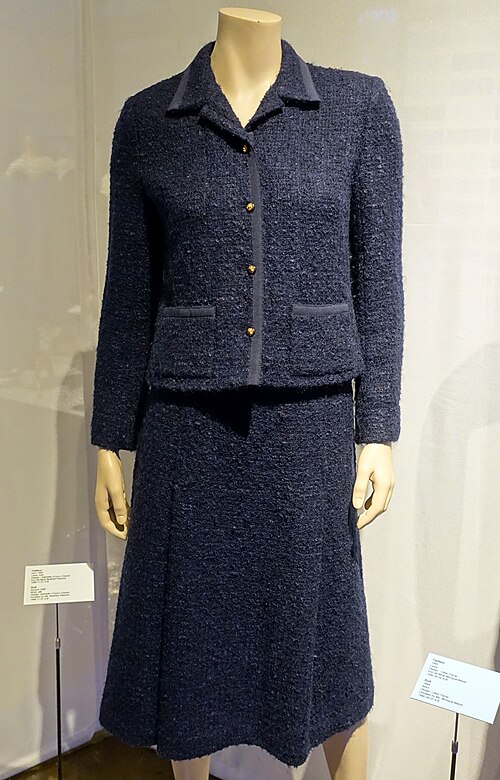
- Her later suit had “its slim skirt and collarless jacket trimmed in braid, gold buttons, patch pockets,” with a chain sewn into the hem, “a gold-colored chain ensuring it hung properly.”2
KEY STORIES
The Nuns' Needle and the Rue Cambon
The Metropolitan Museum's essay sums up her beginning in 1 line: she “survived an impoverished childhood and strict convent education.” The girl who became Coco Chanel entered a Catholic orphanage at 12, after her mother's death, and learned to sew there from the nuns. It was a trade, a way to earn a living as a seamstress.5
She also sang. The Patent Office's history says she “is said to have preferred performing the songs ‘Ko-Ko-Ri-Ko’ and ‘Qui qu'a vu Coco’, to which she owes her nickname.” The name stuck for the rest of her life.4
In 1910 a rich lover lent her the money for a hat atelier on the rue Cambon in Paris. In 1913 she opened Chanel Modes at Deauville, the seaside resort, and then a branch at Biarritz. Her designs, the Metropolitan Museum's essay says, were “simple, practical, and often inspired by menswear.”9
She picked her fabric for its price. She chose jersey “primarily for its low cost,” though it “was more commonly used for men's underwear.” In her hands the cheap knit became dresses with “boxy lines and shortened skirts,” and women left their corsets behind for the work the war demanded.2
The Fifth Bottle
In 1921 Chanel commissioned the perfumer Ernest Beaux to develop a new fragrance for her. He came back with several proposals, and “she decides on the fifth bottle.” The perfume took its number for its name: Chanel No. 5.4
Her own look became part of the house. The Metropolitan Museum's essay describes it: “Her own slim boyish figure and cropped hair became an ideal, as did her tanned skin, active lifestyle, and financial independence.” She kept her apartment and her clothes to the same few colours, beige, black and white.2
Black won. In 1926 American Vogue “likened Chanel's ‘little black dress’ to the Ford, alluding to its almost universal popularity as a fashion basic.” That same year, though she's known for plain clothes with little ornament, she applied for a patent for making artificial flowers.5
British Cloth at Grosvenor Square
Her relationship with the Duke of Westminster took Chanel to his properties in Cheshire, Scotland and London, where she was “often partaking in sporting activities such as hunting, fishing and horse riding.” There she met tweed. She was introduced to William Linton of Carlisle and worked with him on “unique soft, lightweight versions of his signature material.” She also designed rainwear made by David Mosely and Sons and knitwear for Lyle and Scott.8
In 1932 she turned the connection into a public campaign for British textiles. “Inviting a roster of over 40 companies to participate, she launched the initiative with an exhibition and fashion show.” The show ran for 2 weeks at the Duke's house, 30 Grosvenor Square.10
“Over 130 ensembles made from British fabrics were modelled by British Society women, with ticket proceeds going to the War Service Legion.” The Legion trained injured former soldiers “in the arts of tapestry, embroidery and needlework.”10
The Comeback of 1954
Chanel came back to Paris in 1954 after years in Switzerland and reopened her house. The first collection didn't win the critics. The Metropolitan Museum's essay puts it briefly: it “was not a critical success, the designer persevered. Within three seasons, Chanel was enjoying newfound respect.”9
The suit carried the return: slim skirt, collarless jacket trimmed in braid, gold buttons, patch pockets, and a chain in the hem so the jacket hung straight.2
The V&A stresses how close to the material she stayed. “When she returned to fashion in 1954,” it writes, she “was still very much engaged with the creative and material side of her work.” She went on working with Linton's mill in Carlisle, took experimental tweeds from Bernat Klein and used Ascher Ltd. for manufacture.10
THE ZEVIST READING
The Homeric Hymn to Aphrodite says that Athena “first taught earthly craftsmen to make chariots of war and cars variously wrought with bronze,” and that she “teaches tender maidens in the house and puts knowledge of goodly arts in each one's mind.”11 Chanel got that knowledge in an orphanage, from nuns with needles, and built a house of fashion on it. Zevism reads her work under Athena of the skilled hands. The 1932 show in London handed the gift on: its ticket money paid for wounded soldiers to learn needlework.
The dress of about 1924 shows the order in her craft. Its trim is also its fastening, and a garment that slips on like a sweater asks nothing of the body that wears it. Egyptian religion named Ma'at “the personification of truth, justice, and the cosmic order.”12 In a garment, Ma'at is proportion: each part doing its work and nothing added for show.
The doctrine of the Good sets Ma'at beside Right, a right act from a right will. Chanel's craft built order, but a lover in German intelligence and the missions the record ascribes to her stand outside Right, and Zevism doesn't let the one cancel the other.
The comeback shows the Creator. At 70, after a first collection that didn't please the critics, she answered with the next one and the one after that, and within 3 seasons she'd won new respect. Zevism calls that the Creator's answer: the andrapod meets a ruin with complaint, and the Creator goes back to work.
NOTES
1 German Patent and Trade Mark Office, “Coco Chanel”; Krick, “Gabrielle ‘Coco’ Chanel,” Metropolitan Museum.
4 DPMA.
5 Krick, Metropolitan Museum; DPMA.
6 DPMA; Victoria and Albert Museum, “Gabrielle Chanel in Britain”; Britannica, “Coco Chanel”; Krick, Metropolitan Museum.
7 Metropolitan Museum, Dress, ca. 1924.
8 V&A, “Gabrielle Chanel in Britain”.
9 DPMA; Krick, Metropolitan Museum.
10 V&A.
11 Homeric Hymn to Aphrodite 8–15, tr. Evelyn-White.
BIBLIOGRAPHY
German Patent and Trade Mark Office, “Coco Chanel”, Ingenious Women, updated 3 March 2026; birth, orphanage, nickname, the ateliers, Ernest Beaux, patent FR619721A, the wartime account and death.
Jessa Krick, “Gabrielle ‘Coco’ Chanel (1883–1971) and the House of Chanel”, Heilbrunn Timeline of Art History, Metropolitan Museum of Art, October 2004; jersey, the Vogue comparison of 1926, the comeback and the suit.
Metropolitan Museum of Art, Dress, House of Chanel, ca. 1924, wool, object 1975.7, Purchase, Irene Lewisohn Bequest, 1975.
Victoria and Albert Museum, “Gabrielle Chanel in Britain”, updated 17 April 2024; the Duke of Westminster, Linton tweeds, the 1932 exhibition and her later suppliers.
Encyclopaedia Britannica, “Coco Chanel”, quick facts; birth and death.
Homeric Hymn 5 to Aphrodite 8–15, H. G. Evelyn-White translation, Theoi Classical Texts Library.
Encyclopaedia Britannica, “Maat”.
CREDIT
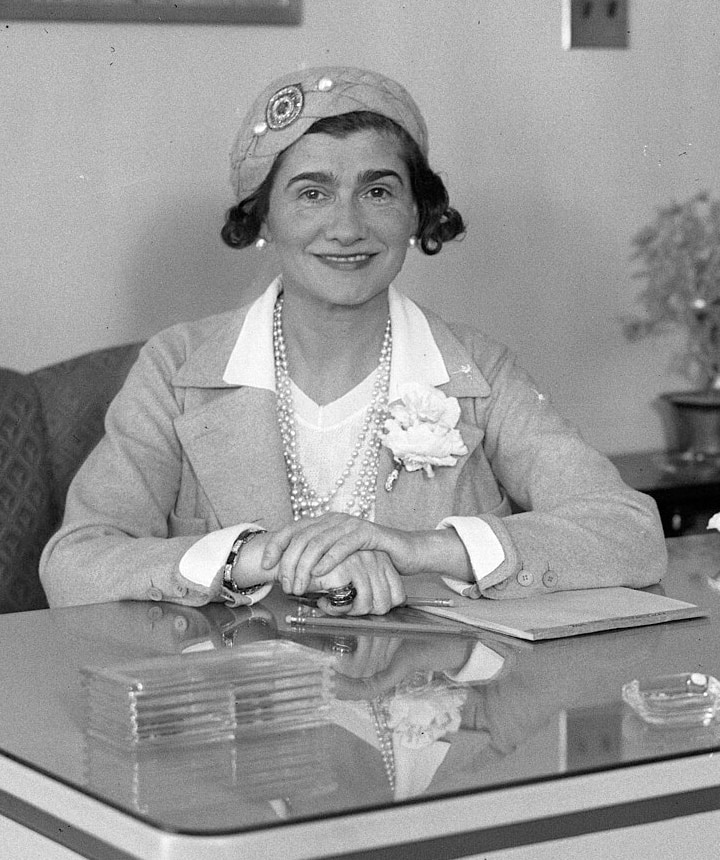
Portrait: Coco Chanel at a desk during her visit to Los Angeles, 18 March 1931. Photograph by the Los Angeles Times, Los Angeles Times Photographic Collection, UCLA Library Special Collections. Image record, holder's record, CC BY 4.0; cropped to the sitter (left 290, top 190, 720 by 860 pixels of the 1920-pixel copy).

Illustration: Chanel wool-and-silk suit, about 1955, exhibited at the Musée de la mode, Montreal. Photograph by Daderot, 25 September 2016, CC0. This illustrates her design work. Image record and attribution.

Daderot / Wikimedia Commons; CC0 1.0. Image record, CC0 1.0.
The round picture in the lists of the personalities is cropped from the portrait.