





3 min read
Priest of the Padmasana
Dang Hyang Nirartha
author: High Priest Zevios Metathronos
The priest remembered in Bali’s sacred architecture
Dates: sixteenth-century tradition
Period: Renaissance (1336–1650 CE)
Region: Bali
Tradition: Śaiva priesthood and temple design
Religion or tradition: Balinese Hinduism, especially Śaiva priestly tradition.
Heresy status: No designation documented.
Dang Hyang Nirartha, also remembered as Dwijendra, occupies an enduring place in Balinese accounts of religious renewal. Traditions associate his arrival and work with the age of Dalem Waturenggong. They credit him with teaching, temple foundations and the development of forms through which the Divine could be honoured in sacred space. These are transmitted religious and architectural traditions; they do not provide a surviving set of signed plans for every sanctuary attributed to him.1
GIVING RELIGIOUS TEACHING A VISIBLE PLACE
Balinese tradition credits Nirartha with teaching and with the development of sacred architectural forms, especially the padmasana. The importance of this association is that a theological understanding acquired a recognizable setting within temple life. The raised sacred seat directed worship towards Hyang Widhi and Śiva Āditya through a form that a community could encounter and use repeatedly.2
His positive legacy, as preserved in that tradition, is the joining of religious instruction to enduring places of practice. The human community received a sacred geography through which teachings could be remembered; divine worship received an intelligible architectural expression. For Zevist readers, his example gives substance to the work of a teacher whose influence continues through the places, forms and observances associated with his mission.
THE DIVINE SEAT
The padmasana, a raised sacred throne within Balinese temple architecture, supplies the clearest focus for his profile. Architectural scholarship connects its development with Nirartha’s religious mission and interprets it through worship of Hyang Widhi and Śiva Āditya. Its significance concerns the way a constructed form can mark and honour Divine presence.3
Studies of Balinese religious architecture also discuss the network of temples associated with his journeys. Such accounts belong to a living sacred geography. They preserve relationships among teacher, place and worship, while the chronology and individual building attributions require separate historical assessment.4
A ZEVIST INTERPRETATION
Nirartha represents priestly work that gives a community enduring places for practice. A teaching becomes more accessible when it has a setting in which people can return to it: a sanctuary, a route of pilgrimage, a recognizable sacred form.
His inclusion therefore concerns the union of instruction and construction. The religious imagination has practical demands. A community needs people who can explain the meaning of a place, sustain its use and help others recognize what their actions there signify.
For a Zevist reader, this is a model of cultural continuity through intelligent religious work. The strength of the example lies in the tradition’s continuing association of Nirartha with those tasks. Describing him as a priest traditionally credited with temple design preserves that significance while keeping architectural authorship precise.
NOTES
1 Putra and Wardani, study of the padmasana.
2 Study of padmasana form and religious meaning.
4 Martana, “Defense discourse in Balinese Pura architecture”.
BIBLIOGRAPHY
Cokorda Putra and A. A. A. Cahaya Wardani, “Tipologi dan Bentuk Bangunan Pelinggih Padmasana,” Widya Teknik, DOI.
S. P. Martana, “Defense discourse in Balinese Pura architecture,” IOP Conference Series: Earth and Environmental Science 738 (2021), 012047, DOI.
CREDIT
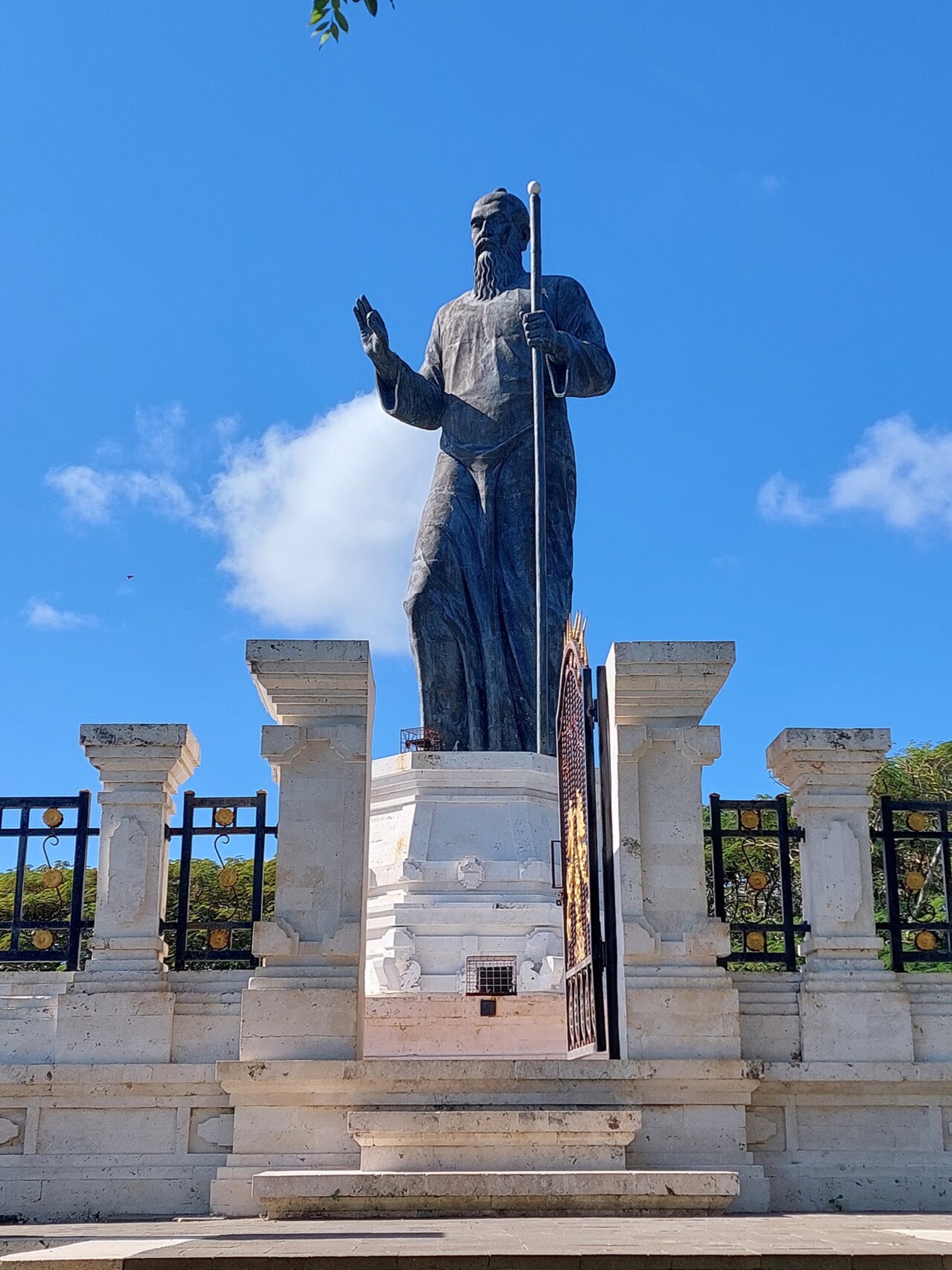
Picture: Commemorative statue. Statue of Dang Hyang Nirartha at Uluwatu, Bali, photographed by Schweigeblick in 2021. A commemorative religious representation, not a contemporary likeness.
Credit: Schweigeblick. Source record, CC BY-SA 4.0.

The round picture in the lists of the personalities is cropped from it.