




9 min read
Skald of Thor
Eilífr Goðrúnarson
author: High Priest Zevios Metathronos
Sacred Courage in Demanding Verse
Dates: Flourished in the late 10th century CE; birth and death dates unknown.
Period: Darkness (800–1000 CE).
Eilífr Goðrúnarson was a skald of the late 10th century, named in the medieval list Skáldatal as one of the poets of Hákon Sigurðarson, earl of Lade. Nobody knows when he was born or died, and it isn't settled whether he was Icelandic or Norwegian.1
His attainment is a single poem, and it's a hard one to read. Þórsdrápa, the praise of Thor, tells in 20 surviving stanzas how the God crossed a flooding river and broke the giant Geirrøðr in his own hall. Mundal describes its style as loaded with circumlocutions and its word order as deliberately unnatural.2
Thor, in Encyclopaedia Britannica's words, was “an implacable foe to the harmful race of giants but benevolent toward humankind,” and he was sometimes equated with Jupiter.3 Zevism reads his war on the giants as the defence of the order that Zeus holds as sovereign of the cosmos, and it reads Eilífr's poem as service to that order.
LIFE AND CONTEXT
Mundal places Eilífr at the end of the 900s and notes that there may be as much evidence that he was Norwegian as Icelandic. Skáldatal names him among the skalds of Hákon Sigurðarson, the earl of Lade.4
That puts him at a heathen court. Snorri's Heimskringla says that in Hákon's first winter as ruler “the herrings set in everywhere through the fjords to the land,” and it quotes the earl's poet Einarr skálaglamm on the temples Hákon raised again: “Hakon the earl, so good and wise, / Let all the ancient temples rise.” Snorri also tells how Hákon, forced into baptism by the Danish king, “put all the learned men on shore again” and made a great blood-offering in Gautland.5
A poem in praise of Thor fitted that court, and it fitted the North. Encyclopaedia Britannica notes that in Iceland, “and perhaps among all northern peoples except the royal families,” Thor “was apparently worshiped more than any other god.”3
He also knew the new faith. In Skáldskaparmál 65, where Snorri gives kennings for Christ, he quotes a half-stanza in which Eilífr calls Christ “Romas sterke konge,” Rome's mighty king. The lines have been taken as proof that the skald converted at some point, but they don't establish that by themselves.6
Þórsdrápa survives in Snorri's Edda. After the prose account of Thor's visit to Geirrøðr in Skáldskaparmál, the text reads, “Eilífr Gudrúnarson has wrought verses on this story, in Thórsdrápa,” and 3 manuscripts of the Edda add 20 stanzas of the poem there. Snorri quotes 2 more half-stanzas, thought to belong to it, elsewhere in Skáldskaparmál.7
The poem doesn't match Snorri's prose in every detail. In Eilífr's verse, Thor's companion on the road is his servant Þjálfi; in Snorri's retelling it's Loki. Mundal hears a comic tone running through the whole poem, and the poem has also been called “infam parodi,” a scandalous parody. Yet in the end Thor takes control and kills the whole band of giants with his hammer. Richard North's edition sets out the overlapping kennings and records where their meaning is uncertain.8
ATTAINMENTS
- He composed Þórsdrápa, a praise poem for Thor: 3 manuscripts of Snorri's Edda preserve 20 stanzas of it, and 2 more half-stanzas are quoted elsewhere in Skáldskaparmál.6
- He gave the Edda a 2nd witness to the Geirrøðr myth. Snorri told the story in prose and named Þórsdrápa as a verse telling of the same tale.9
- He kept a form of the myth that Snorri's prose lost: Þjálfi, not Loki, goes with Thor to the giant's hall and crosses the river with him.10
- His stanzas became models in Snorri's handbook. Skáldskaparmál quotes him in its chapter on names for Thor, where Thor is “Magni's Sire” and Þjálfi “Röskva's Brother,” and again among the names for poetry. Snorri's own list of Thor's names includes “Master of Thjalfi and Roskva, Foe of the Midgard Serpent.”11
- He composed a half-stanza that names Christ “Rome's mighty king,” which Snorri quotes among his kennings for Christ.6
KEY STORIES
How Thor Took His Servants
Eilífr's poem calls Thor's companion “Röskva's Brother,” and Snorri's Gylfaginning tells how the 2 children joined the God. Thor stopped for the night at a farmer's house, slaughtered his own goats for supper and told the household to throw the bones onto the hides. But “Thjalfi, the husbandman's son, was holding a thigh-bone of the goat, and split it with his knife and broke it for the marrow.”12
Before dawn Thor “took the hammer Mjollnir, swung it up, and hallowed the goat-hides; straightway the he-goats rose up, and then one of them was lame in a hind leg.” The farmer paid for the damage with his children. The son was called Thjalfi and the daughter Roskva, and as the God's “bond-servants” Snorri says “they follow him ever since.” That's the servant who stood in the Vimur beside his master.13
Loki in Geirrøðr's Chest
Snorri begins with Loki's folly. The giant Geirrøðr caught him, shut him “into a chest and starved him there three months,” and then took him out and made him speak. Loki bought his life with an oath: “he swore to Geirrödr with oaths that he would get Thor to come into Geirrödr's dwelling in such a fashion that he should have neither hammer nor Girdle of Might with him.”14
Thor went without his hammer. On the way he lodged with a giantess, Gríðr. She “lent him the Girdle of Might and iron gloves which she possessed, and her staff also, which was called Grídr's Rod.” So the God came to the giant's country armed with borrowed strength.9
The Crossing of the Vimur
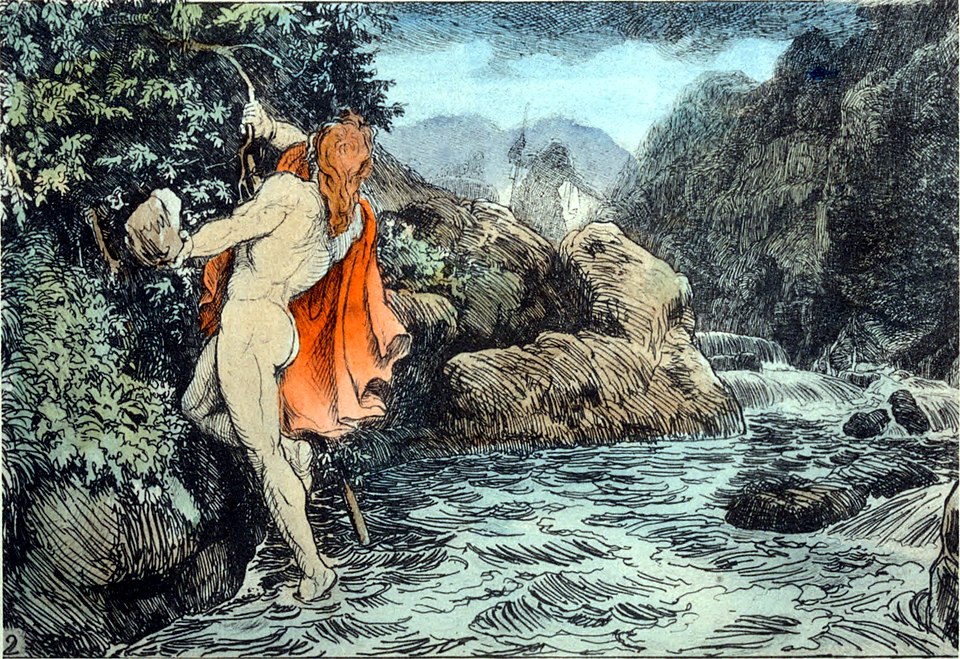
The road led to the river Vimur. Eilífr sets the scene: “And the war-wonted journeyed / Till the hill-women's Waster / Came to Gangr's blood, the Vimur.” Thor waded in, and the river rose until, in Brodeur's translation of the poem, “The Weaver of the Girdle / Beheld the washing slope-stream / Fall on his hard-grown shoulders.”14
Snorri names the cause. “Then Thor saw Gjálp, daughter of Geirrödr, standing in certain ravines, one leg in each, spanning the river, and she was causing the spate.” Thor threw a stone at her, saying, “At its source should a river be stemmed.” Then “he took hold of a rowan-clump, and so climbed out of the river, whence comes the saying that rowan is Thor's deliverance.”9
Eilífr puts the servant in the flood beside his master, carried along “Till Thjálfi came uplifted / On his lord Thor's wide shield-strap,” and neither of them gave way: “Wroth stood Röskva's Brother, / And Magni's Sire wrought bravely: / With terror Thor's staunch heart-stone / Trembled not, nor Thjálfi's.” Another of his lines says the same of both travellers: “Nor did their hearts of rancor / Droop in the men unblemished.”15
The Glowing Iron in Geirrøðr's Hall
At Geirrøðr's house Thor sat down on a chair. “Then he became aware that the chair moved under him up toward the roof.” The giant's daughters, Gjálp and Greip, were lifting it from beneath. Thor forced it down again, and “he had broken both their backs.”9
In the hall Geirrøðr threw a glowing bar of iron at the God. “Thor caught it with his iron gloves and raised the bar in the air,” and hurled it back, and “it passed through the pillar and through Geirrödr and through the wall.” Eilífr gives the catch in his own words: “The Merciless Destroyer / Of the people of the Giants / Grasped with ready fore-arms / At the heavy red-hot iron.”16
THE ZEVIST READING
Britannica records that Thor was equated with Jupiter, so that dies Jovis became “Thor's day,” Thursday.3 Zevism takes that equation seriously. Thor's thunder and Zeus's thunder serve the same order, and Zevism holds that the Gods of the North served the divine order under their own names, as links in the single chain of spirituality from its inception to today.
The giants of Eilífr's poem are powers of Izfet. Egyptian religion named Ma'at “the personification of truth, justice, and the cosmic order” and set her against isfet.17 Gjálp swells the river to drown the traveller, and Geirrøðr turns hospitality into an ambush, a lifting chair and a thrown bar of hot iron. Zevism reads that as an offence against Zeus, who guards guests and hosts. Thor answers each wrong with measured force and leaves the hall in order behind him.
Thor's saying at the river carries a rule the Temple also keeps: “At its source should a river be stemmed.” Zevism holds that one must return to the source. A flood is stopped where it starts, and a tradition is restored where it began. Eilífr's stanzas, preserved beside Snorri's prose, give the reader a 2nd source for the myth and a check on the later telling.
His craft belongs to Odin. Snorri quotes Eilífr among the skalds who named poetry as mead: “Grant shall ye gifts of friendship, / Since grows of Són the Seedling.”9 Són was one of the vats of the mead of poetry. The effort that his twisted syntax demands from a reader is the effort the God's gift has always demanded from those who receive it.
Þjálfi gives the poem its human measure. He's a farmer's son who broke a bone he'd been told to leave whole, and he ends up in the flood beside the God with a heart that doesn't tremble. Plato set the aim of human life as likeness to the divine “as far as possible,” ὁμοίωσις θεῷ κατὰ τὸ δυνατόν.18 Zevism reads that likeness in the servant who holds on to his master's strap and crosses the river.
NOTES
1 Else Mundal, “Eiliv Gudrunsson,” Store norske leksikon.
5 Snorri, King Olaf Trygvason's Saga 16, 27–28, Laing tr..
6 Mundal.
7 Snorri, Skáldskaparmál, Brodeur tr.; Mundal.
8 Mundal; North, Þórsdrápa, text and commentary.
10 Mundal; North, stanzas 5–10.
11 Skáldskaparmál; Brodeur tr., p. 107.
12 Snorri, Gylfaginning, Brodeur tr., p. 57.
14 Skáldskaparmál, Brodeur tr..
15 Skáldskaparmál; North, stanza 10.
16 Skáldskaparmál; North, stanzas 15–18.
BIBLIOGRAPHY
Else Mundal, University of Bergen, “Eiliv Gudrunsson,” Store norske leksikon, updated 21 July 2026; “Bakgrunn” and “Skaldediktning.”
Richard North, edition and translation of Þórsdrápa, especially stanzas 5–10 and 15–18, with commentary. World-Tree Project catalogue entry identifies the source anthology edited by Richard North, Joe Allard and Patricia Gillies (2010).
Snorri Sturluson, Skáldskaparmál, in The Prose Edda, translated by Arthur Gilchrist Brodeur, American-Scandinavian Foundation, 1916; Internet Sacred Text Archive; Thor's journey to Geirrøðr with the Þórsdrápa stanzas, the names of Thor and the names of poetry.
Snorri Sturluson, Gylfaginning, in The Prose Edda, translated by Arthur Gilchrist Brodeur, New York: American-Scandinavian Foundation, 1916; Internet Archive scan; pp. 57–58, Thor's goats and the children Thjalfi and Roskva, and p. 107, the names of Thor.
Snorri Sturluson, King Olaf Trygvason's Saga, in Heimskringla, translated by Samuel Laing, Internet Sacred Text Archive; chapters 16, 27 and 28.
Encyclopaedia Britannica, “Thor”.
Encyclopaedia Britannica, “Maat”.
Plato, Theaetetus 176a–b, Greek text, Perseus Digital Library.
CREDIT
Picture: Thor’s journey towards Geirrøðr, illustrated by Lorenz Frølich and published in 1906. A later interpretation of the mythic tradition, not a portrait of Eilífr or an exact illustration of every detail in his poem.
Lorenz Frølich; Public domain (author died1908; published1906); Wikimedia Commons. Image record, Public domain (author died1908; published1906).

The round picture in the lists of the personalities is cropped from it.