




9 min read
Court Skald
Einarr skálaglamm Helgason
author: High Priest Zevios Metathronos
The Sanctuary and the Flourishing Land
Dates: Born around 950 CE or somewhat earlier; died in the first half of the 990s.
Period: Darkness (800–1000 CE).
Einarr skálaglamm Helgason was an Icelandic skald at the court of Hákon, the earl of Lade who ruled Norway after the sons of Gunnhildr. His principal surviving work is Vellekla, “Gold-Lack,” a long praise poem for the earl.1
The poem's greatest claim is concrete. It says that Hákon raised the ruined temples of the Gods, that worship returned to them, and that the earth bore again as it had in the old days. Snorri Sturluson quoted those stanzas when he wrote Hákon's history, so the account of a heathen restoration in Norway survives in Einarr's own words.2
Zevism reads Einarr under 2 powers. Odin gave the mead of poetry to the Gods and to the men who compose, and Einarr opened his poem by calling it “the Gore of Kvasir.” Ma'at is the order that joins right worship to a fruitful land, and that order is the subject of his best-known stanzas.
LIFE AND CONTEXT
Einarr was born around 950 in western Iceland, the son of Helgi Óttarsson and Niðbjǫrg. Mundal traces his mother's line to a Scottish king, Bjólan, and to Kaðlín, a daughter of Gǫngu-Hrólfr. His brother's daughter was Guðrún Ósvífrsdóttir.3
He spent years abroad. Egils saga, as Mundal quotes it, says that “Einar var lenge utanlands hos høgborne menn,” that Einarr spent a long time abroad with men of high birth. He became one of the skalds of Hákon, the earl of Lade, and he may have fought for him in the sea battle at Hjǫrungavágr.4
Hákon took power after the sons of Gunnhildr left Norway, and he ruled as a heathen. Snorri's saga of Olaf Tryggvason quotes Vellekla for his conquests, his battles and his great sacrifice in Gautland, in chapters 16, 18, 26 and 28.5
The poem followed the earl to war. When Hákon's fleet sailed south to Denmark, Einarr's lines went with it: “Over the foaming salt sea spray / The Norse sea-horses took their way, / Racing across the ocean-plain / Southwards to Denmark's green domain.” Of the fighting there he wrote, “Thick the storm of arrows flew, / Loud was the din.” Snorri didn't need another witness for the campaign; he quoted Einarr 3 times in a single chapter.6
Nobody has the poem whole. It survives in scattered quotations in the kings' sagas and in Snorri's Edda, and its modern order is an editor's reconstruction. The date is disputed: Richard North places it in the early 980s, and Mundal notes that if the Hjǫrungavágr stanzas belonged to it, the poem must date from about 986 or later.7
The title hasn't been explained with certainty. Mundal suggests that “Gold-Lack” may have been a hint to the earl that the skald wanted gold for his work. Einarr came home to Iceland in the end, and he drowned in Breiðafjörður in the first half of the 990s.4
ATTAINMENTS
- He composed Vellekla, a drápa or formal praise poem for Hákon, the earl of Lade, in dróttkvætt.8
- His stanzas record the restoration of Norway's temples under Hákon: in North's numbering, stanzas 15–16 say the earl made ravaged temple lands and sanctuaries holy again and that the earth grew as before, and stanza 18 compares his peace with that of Fróði.9
- He supplied Snorri with a running witness to Hákon's reign: the Heimskringla quotes Vellekla for the earl's conquest of the north, his battles against Ragnfred and in Denmark, and his sacrifice in Gautland.10
- Snorri held him up as a model skald. Mundal notes that Snorri often cites him as an example of how kennings should be made, and Skáldskaparmál opens its list of names for poetry with passages of his.11
- He won 2 gifts that entered saga tradition: a costly shield from Hákon, which Egils saga describes, and a pair of silver scales that, according to Jómsvíkinga saga, gave him his byname.12
KEY STORIES
Hear, Earl, the Gore of Kvasir
Vellekla began with a demand for silence. Snorri preserved the opening in his handbook, among the skalds' names for poetry: “Kvasir's Gore,” “Dwarves' Mead,” “Booty and Find and Gift of Odin.” Then he quoted Einarr: “I pray the high-souled Warder / Of earth to hear the Ocean / Of the Cliff of Dwarves, my verses: / Hear, Earl, the Gore of Kvasir.”13
The next lines turned to the hall. “Now that which Bodn's Billow / Bodes forth will straight be uttered: / Let the War-King's host make silence / In the hall, and hear the Dwarves' Ship.” Both names for the poem point to the same mead. Bodn was one of the vats that held the mead the dwarves brewed from Kvasir's blood. Einarr told the earl's warriors that what they were about to hear came from Odin's store.14
The Temples Rise Again
Snorri tells the story of Hákon's first winter as ruler of Norway. “The first winter that Hakon ruled over Norway the herrings set in everywhere through the fjords to the land.” The harvest came back too. “The people, therefore, laid in seed for the next year, and got their lands sowed, and had hope of good times.”15
Then Snorri gives Einarr's stanzas, as Laing rendered them: “Hakon the earl, so good and wise, / Let all the ancient temples rise.” The fallen champions “To Thor, the thunder-god, may tell / How for the gods all turns out well.” “The shield-bearer in Loke's game / Invokes once more great Odin's name,” and the land answers: “The green earth gladly yields her store, / As she was wont in days of yore, / Since the brave breaker of the spears / The holy shrines again uprears.”15
Mundal reads the poem's ideology plainly: the Gods have returned to worship, the sanctuaries have become true sanctuaries again, and “Det er gudane som styrer landet gjennom Håkon jarl,” it's the Gods who rule the land through Earl Hákon.4
The Ravens Over Gautland
The Danish king Harald Gormsson summoned Hákon and “forced the earl to allow himself also to be baptized.” He sent priests and learned men home with him and ordered the earl to have all of Norway baptized. Hákon didn't argue. He waited for a wind. “When a wind came with which he thought he could get clear out to sea, he put all the learned men on shore again, and set off to the ocean.”16
He plundered his way east along Skåne and landed at the skerries of East Gautland. There he made a great blood-offering. “There came two ravens flying which croaked loudly; and now, thought the earl, the blood-offering has been accepted by Odin.” He burned his ships and marched inland.17
Einarr put the omen into Vellekla: “Two ravens, flying from the east, / Come croaking to the bloody feast.” The next lines read the sign as the earl had: “The warrior knows what they foreshow,” and what they foretold was “The days when Gautland blood will flow.” In Laing's translation the chapter is headed “HAKON RENOUNCES CHRISTIANITY.”17
The Shield Left at Borg
Egils saga tells how Einarr got the earl's shield. He'd composed a poem for Hákon “which is called 'Dearth of Gold',” Green's rendering of Vellekla, and he wanted to leave the earl's service. “The earl did not wish Einar to go away; so he granted a hearing to the poem, and thereafter gave Einar a shield, which was a most costly work.” According to Jómsvíkinga saga, Hákon's gift was a pair of silver scales whose weights rang with a sound that could be read as an omen, and so Einarr became skálaglamm, “scale-clink.”18
Back in Iceland, Einarr came to Borg while Egill was away and left the shield there as a gift for him. When Egill came in, “he saw the shield, and asked whose was that costly work.” He was told that Einarr had brought it. Egill understood that he was expected to compose a poem “about his shield,” and he was furious: “Now, bring my horse. I must ride after him and slay him.” But Einarr “had ridden away early in the morning.” Egill paid the debt in verse instead, with a stanza that begins, “Surely hath Skala-glam.”19
THE ZEVIST READING
Einarr's opening names poetry as Odin's mead and asks a hall of warriors to fall silent before it. Snorri's myth gives the reason: Odin gave the mead “to the Æsir and to those men who possess the ability to compose.”14 Zevism reads the skald's art under Odin, and it holds that the Gods of the North served the divine order under their own names, as links in the single chain of spirituality that runs from its inception to today.
Vellekla states the doctrine of Ma'at in northern terms. Egyptian religion named her “the personification of truth, justice, and the cosmic order” and set her against isfet.20 Hesiod seats Dike, the daughter of Zeus, beside her father.21 Einarr's stanzas make the same claim: when the sanctuaries stand and the Gods are worshipped, the earth yields as it did in the old days. Ruined temples are Izfet, and their rebuilding is the work of a Creator who restores what others left in ruins.
The temple stanza also names the Gods it served. The fallen report to Thor “How for the gods all turns out well,” and the living warrior calls on Odin. Zevism reads the thunder-god of the North beside Zeus, who holds the thunder and the order of the cosmos, and it reads Odin as the giver of the poet's gift. Einarr didn't use the Greek names, and Zevism reads the order he praised as the same order under other names.
The poem also shows the limit of court praise. Hákon, by Snorri's account, plundered Skåne and harried Gautland. The Good in Zevism is the conjunction of Ma'at and Right, right order joined to right act from right will, and a restorer of temples who also lays waste a neighbour's country meets only half of it. Einarr's stanzas praise the half that served the Gods.
NOTES
1 Else Mundal, “Einar Helgason Skålaglam,” Store norske leksikon.
2 Snorri, King Olaf Trygvason's Saga 16, Laing tr..
3 Mundal, “Einar Helgason Skålaglam”.
4 Mundal.
5 King Olaf Trygvason's Saga 16, 18, 26, 28.
6 King Olaf Trygvason's Saga 26.
7 North, Vellekla, introduction; Mundal.
8 Mundal; North, introduction.
10 King Olaf Trygvason's Saga 16–28.
11 Mundal; Snorri, Skáldskaparmál, Brodeur tr..
12 W. C. Green, The Story of Egil Skallagrimsson, p. 179; Mundal.
13 Skáldskaparmál, Brodeur tr..
14 Skáldskaparmál.
15 King Olaf Trygvason's Saga 16.
16 King Olaf Trygvason's Saga 27–28.
17 King Olaf Trygvason's Saga 28.
18 Green, p. 179; Mundal.
21 Hesiod, Works and Days 256–262.
BIBLIOGRAPHY
Else Mundal, University of Bergen, “Einar Helgason Skålaglam,” Store norske leksikon, updated 22 July 2026; sections on background, Vellekla, religious ideology, poetic style and the byname.
Richard North, edition and translation of Vellekla, introduction, opening sequence and stanzas 15–18. World-Tree Project record identifies the 2010 anthology source; the posted PDF carries the revision date 25 September 2016.
Snorri Sturluson, King Olaf Trygvason's Saga, in Heimskringla, translated by Samuel Laing, Internet Sacred Text Archive; chapters 16, 18, 26, 27 and 28.
Snorri Sturluson, Skáldskaparmál, in The Prose Edda, translated by Arthur Gilchrist Brodeur, American-Scandinavian Foundation, 1916; Internet Sacred Text Archive; names for poetry and the verses of “Einarr Tinkling-Scale.”
The Story of Egil Skallagrimsson, translated by W. C. Green, London: Elliot Stock, 1893; Internet Archive; pp. 179–180.
Encyclopaedia Britannica, “Maat”.
Hesiod, Works and Days 256–262, translated by H. G. Evelyn-White, Theoi Classical Texts Library.
CREDIT
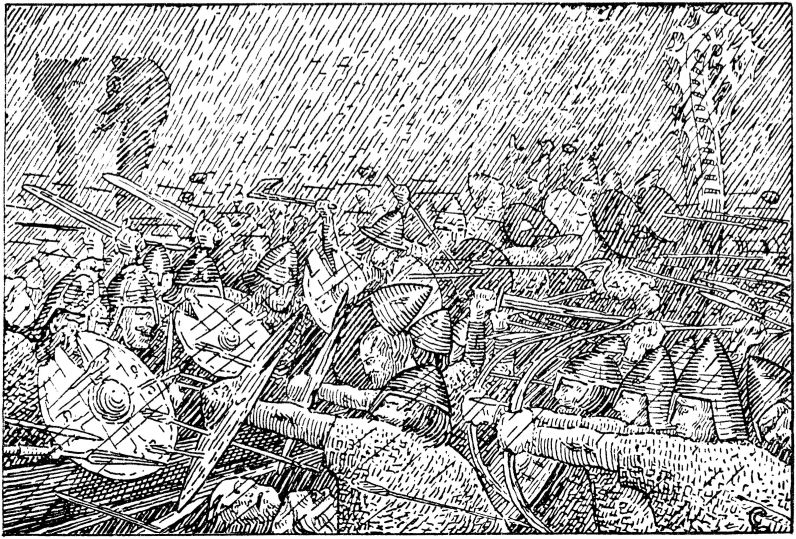
Picture: Halfdan Egedius’s 1897 illustration of the storm at Hjǫrungavágr, published in the 1899 Heimskringla. A later depiction of Hákon’s saga setting, not a likeness of Einarr.
Halfdan Egedius; Public domain (PD-Art; author died1899, published1899); Wikimedia Commons. Image record, Public domain (PD-Art; author died1899, published1899).

The round picture in the lists of the personalities is cropped from it.