





9 min read
Master of Symmetry
Emmy Noether
author: High Priest Zevios Metathronos
The Intelligence That Recognizes Structure
Dates: 1882–1935
Period: Modern
Emmy Noether was a German mathematician who proved in 1918 that, in a physical theory built on an action principle, each continuous symmetry carries a conservation law with it. If the laws don't change with time, energy is conserved; if they don't change from place to place, momentum is. Physicists call it Noether's theorem.1
She then rebuilt algebra. Her paper of 1921 on ideals in rings “was of fundamental importance in the development of modern algebra,” and Einstein called her “the most significant creative mathematical genius thus far produced since the higher education of women began.”2
Zevism reads her work as the Logos found in the order of things and as service to Ma'at, the cosmic order held by Zeus. Her theorem shows why the measures of the world hold.
LIFE AND CONTEXT
Amalie Emmy Noether was born in Erlangen, Bavaria, on 23 March 1882, the eldest of 4 children. Her father, Max Noether, was a distinguished mathematician. German universities let women attend lectures only unofficially when she began, and she took her doctorate at Erlangen in 1907 under Paul Gordan with a thesis that listed systems of 331 covariant forms.3
The next step for a German scholar was the habilitation, the licence to teach, and it wasn't open to women. She stayed on at Erlangen without a post. There she advised 2 doctoral students who were officially her father's, Hans Falckenberg (doctorate 1911) and Fritz Seidelmann (1916). Her papers made her name: in 1908 she was elected to the Circolo Matematico di Palermo, and in 1909 she addressed the annual meeting of the Deutsche Mathematiker-Vereinigung at Salzburg. In 1915 David Hilbert and Felix Klein brought her to Göttingen, because Hilbert needed an expert in invariant theory for his work on relativity.3
She won the right to teach in 1919. In 1922 she was named “unofficial associate professor,” which Edna Kramer calls “a purely honorary position”; a modest salary came later through a teaching appointment in algebra. Her students included Max Deuring, Hans Fitting, W. Krull, Chiungtze Tsen and Olga Taussky Todd.4
In the 1920s she turned from invariants to abstract algebra. B. L. van der Waerden studied with her in 1924 and put her theory into the 2nd volume of his Moderne Algebra. In 1932 she gave a plenary address to the International Congress of Mathematicians in Zurich and shared the Ackermann-Teubner prize with Emil Artin.3
In April 1933 the Nazi government dismissed her from Göttingen because she was Jewish. She sailed for the United States that October, to Bryn Mawr College, and lectured weekly at the Institute for Advanced Study in Princeton. She died at Bryn Mawr on 14 April 1935, aged 53, after surgery.5
ATTAINMENTS
- In 1918 she proved 2 theorems on invariant variation problems. By the 1st, when the action integral is invariant under a continuous group with ρ parameters, “ρ linearly independent combinations of the Lagrange expressions become divergences,” that is, conservation laws.6
- Her 2nd theorem covers symmetries that depend on arbitrary functions, which yield identities among the field equations. She applied it to general relativity and used it to explain Hilbert's observation about energy there.7
- Her 1921 paper Idealtheorie in Ringbereichen proved the decomposition of ideals into intersections of primary ideals “in any commutative ring with ascending chain condition.”3
- She supervised doctoral students at Göttingen, among them Max Deuring, Hans Fitting and Chiungtze Tsen, and van der Waerden built “the major part of the second volume” of Moderne Algebra from her work.5
- From 1927 she worked with Helmut Hasse and Richard Brauer on non-commutative algebras.3
- She gave a plenary address at the International Congress of Mathematicians in Zurich in 1932, on hypercomplex systems and their relation to commutative algebra and number theory.3
- She won the Ackermann-Teubner prize in 1932, jointly with Emil Artin.3
KEY STORIES
With the Assistance of Dr E Noether
Göttingen wanted her mathematics and wouldn't give her a title. Hilbert and Klein fought the faculty to have her admitted as a lecturer, and for 4 years they couldn't win. She taught anyway, under Hilbert's name, while Hilbert used her knowledge of invariants in his own work on relativity.3
The university catalogue for the winter semester of 1916–1917 shows how it was done. It lists: “Mathematical Physics Seminar: Professor Hilbert, with the assistance of Dr E Noether, Mondays from 4-6, no tuition.” The course was hers; the catalogue printed her as the assistant.3
Permission came in 1919, and she became a Privatdozent. The title of 1922 didn't carry a salary. Einstein later wrote that she “never reached the academic standing due her in her own country,” in spite of Hilbert's efforts.8
The Energy Problem of 1918
Einstein's general relativity had a difficulty at its centre. Energy didn't seem to be conserved in the usual way, and Hilbert, as Noether wrote, held “that the failure of proper laws of conservation of energy is a characteristic feature of the ‘general theory of relativity.’”9
Van der Waerden recalled what happened when she reached Göttingen: “She came and at once solved two important problems.” One concerned the covariants of fields in Riemannian space. For the other, “She proved: To every infinitesimal transformation of the Lorentz group there corresponds a Conservation Theorem.”3
The paper, Invariante Variationsprobleme, appeared in the proceedings of the Göttingen Society of Sciences in 1918, pages 235–257. It proved that invariance under displacement gives the “energy relationships,” and it showed why general relativity's symmetries, which depend on arbitrary functions, give identities in place of ordinary conservation laws. Einstein wrote to Hilbert in praise of her “penetrating mathematical thinking.”10
Seminars in the Apartment
In 1932 a neighbour denounced her as a “Marxist Jewess,” and she had to leave her apartment. In April 1933 the new government threw her out of the university. Einstein later put it bluntly: her “unselfish, significant work over a period of many years was rewarded by the new rulers of Germany with a dismissal, which cost her the means of maintaining her simple life.” She didn't stop teaching.11
Hermann Weyl told the story at her funeral. “When you were not allowed to use the institute's lecture halls you gathered your students in your own home. Even those in their brown shirts were welcome.”12
In October 1933 she sailed for America on the Bremen to a post at Bryn Mawr College. From February 1934, at Oswald Veblen's invitation, she lectured every week at the Institute for Advanced Study as a Visitor. She was glad to be at the Institute, and not at Princeton's “men's university, where nothing female is admitted,” as she once put it.13
On 6 March 1934 she wrote to Helmut Hasse about her Princeton hearers: “My audience consists mostly of research fellows, besides Albert and Vandiver, but I'm beginning to realise that I must be careful; after all, they are essentially used to explicit computation and I have already driven a few of them away with my approach.”3
Weyl's Farewell
In April 1935 doctors found a tumour. They operated 2 days later, and the operation seemed to go well. On the 4th day she collapsed with a very high fever and died that day, 14 April 1935.3
Weyl spoke on 18 April. “You were not of clay, harmoniously shaped by God's artistic hand, but a piece of primordial human rock into which he breathed creative genius.” Of her students he said, “They gathered round you like chicks under the wings of a mother hen.” He ended: “Farewell then, Emmy Noether, great mathematician and great woman.”14
On 1 May Einstein wrote to the New York Times. Friends of science, he said, had made a place for her at Bryn Mawr and at Princeton, and there she found “grateful pupils whose enthusiasm made her last years the happiest and perhaps the most fruitful of her entire career.”15
THE ZEVIST READING
Heraclitus set the Logos at the head of his book: “Of this Word's being forever do men prove to be uncomprehending.” He described the world-order as “everliving fire, kindling in measures and being quenched in measures.”16 Zevism is the Logos restored, and Noether's theorem reads as a proof about those measures. Where a law keeps its form through time, something is conserved, and she showed exactly what.
Ma'at is the structured order of existence, held by Zeus as Sovereign of the Cosmos. Egyptian religion named her “the personification of truth, justice, and the cosmic order.”17 A conservation law is Ma'at in the equations of physics: whatever changes, the account balances. Noether's theorem says which quantity balances for which symmetry.
The 4th dimension of the Zevist path is theurgy, Σοφία, the joining of one's own intelligence to the intelligence of the Gods. Noether's way of working fits it. She left the explicit computation her American hearers expected and went looking for the structure that makes the computations come out, and in algebra, Einstein wrote, she “discovered methods which have proved of enormous importance.” He called pure mathematics “the poetry of logical ideas.”18
Her dismissal was Izfet of another kind, the collapse of justice inside a university that had lived on her work for 18 years. She answered it by teaching in her own rooms and then on another continent. Weyl said her heart “knew no malice.”14 Zevism counts that answer as part of the work: order kept in the one place a dismissed teacher still controlled, her own seminar.
NOTES
1 Institute for Advanced Study, “Emmy Noether's Paradise”; Noether, “Invariant Variation Problems,” tr. Tavel.
2 O'Connor and Robertson, “Emmy Amalie Noether”; Einstein, New York Times, 4 May 1935.
4 Kramer, “Noether, Amalie Emmy,” Dictionary of Scientific Biography.
5 O'Connor and Robertson; Kramer, DSB.
8 Kramer, DSB; Einstein, New York Times.
10 Noether, tr. Tavel; O'Connor and Robertson.
11 IAS, “Emmy Noether's Paradise”; O'Connor and Robertson; Einstein, New York Times.
12 Weyl, funeral address, MacTutor.
13 O'Connor and Robertson; IAS.
15 Einstein, New York Times, 4 May 1935.
16 Graham, “Heraclitus,” Stanford Encyclopedia of Philosophy, B1, B30.
BIBLIOGRAPHY
J. J. O'Connor and E. F. Robertson, “Emmy Amalie Noether”, MacTutor History of Mathematics, University of St Andrews, updated November 2014; education, Göttingen, the seminar notice of 1916–1917, van der Waerden's account, algebra, dismissal, emigration and death.
Emmy Noether, “Invariant Variation Problems”, translated by M. A. Tavel, Transport Theory and Statistical Physics 1(3), 183–207 (1971); original in Nachrichten der Königlichen Gesellschaft der Wissenschaften zu Göttingen, Math.-phys. Klasse (1918), 235–257; §§1 and 6.
Institute for Advanced Study, History Working Group, “Emmy Noether's Paradise”, 2017; the theorem, denunciation, Bryn Mawr and the Princeton lectures.
Edna E. Kramer, “Noether, Amalie Emmy”, Complete Dictionary of Scientific Biography, Charles Scribner's Sons, 2008; position of 1922, students, dismissal and death.
Albert Einstein, letter on Emmy Noether to the New York Times, dated 1 May, printed 4 May 1935, MacTutor.
Hermann Weyl, address at Emmy Noether's funeral, 18 April 1935, English text, MacTutor.
Daniel W. Graham, “Heraclitus”, Stanford Encyclopedia of Philosophy; fragments B1 and B30.
Encyclopaedia Britannica, “Maat”.
CREDIT
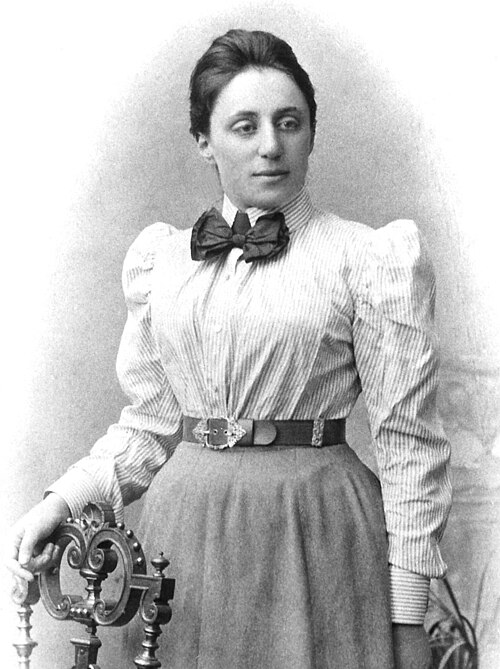
Picture: Emmy Noether, photographed around 1900; later crop.
Unknown photographer, via Wikimedia Commons; crop by Wabbuh. Public domain. Image record, Public domain: anonymous historical photograph.
.jpg)
The round picture in the lists of the personalities is cropped from it.