




9 min read
Poet-Philosopher
Empedocles of Acragas
author: High Priest Zevios Metathronos
Kindred Life and the Discipline of Purification
Dates: Active in the middle of the 5th century BCE; exact life dates uncertain.
Period: Classical (500–334 BCE).
Empedocles of Acragas, the Sicilian city now called Agrigento, was a philosopher who wrote in verse, a physician, a statesman and, by his own account, a man who'd become a God. Aristotle credited him with a first: “he was the first to speak of four material elements.”1
That is his largest single attainment. Fire, air, earth and water, in his system, are eternal; 2 powers, Love and Strife, mix them into living things and pull them apart again. “These roots and forces are eternal and equally balanced, although the influence of Love and of Strife waxes and wanes.”2
Zevism reads the system as theology in the language of nature. Empedocles gave his 4 roots the names of Gods, Zeus first among them, and he taught that purified souls rise to share the hearth of the Gods.
LIFE AND CONTEXT
He was born into an aristocratic family of Acragas in the early 5th century BCE; the Internet Encyclopedia of Philosophy gives about 492–432.3 Diogenes Laertius names his father as Meton and says Meton's father won the horse race at Olympia in the 71st Olympiad, that is, 496 BCE.4
In the politics of Acragas, Empedocles took the people's side. Aristotle, as Diogenes reports him, called Empedocles “a champion of freedom,” and he wouldn't be king: he “declined the kingship” when it was offered. He broke up the oligarchic assembly of the Thousand “three years after it had been set up.”5
He practised medicine as well as philosophy. The Stanford entry calls him “a founder of the Sicilian school of medicine,” and the Hippocratic treatise On Ancient Medicine argued with his way of joining the study of nature to the healer's art.6 Heraclides of Pontus called him “not merely a physician but a diviner as well.”7
His poems were long. “His poems On Nature and Purifications run to 5000 lines, his Discourse on Medicine to 600,” Diogenes records, and Aristotle's Sophist called him “the inventor of rhetoric.”8 He “boasts the largest number of preserved Presocratic fragments,” and a papyrus found at Strasbourg added lines no one had read since antiquity.9
The Purifications taught that souls pass through many bodies. “For I have been ere now a boy and a girl, a bush and a bird and a dumb fish in the sea,” the poet says of himself. From that belief came his ban on killing: “Will ye not cease from this ill-sounding slaughter? See ye not that ye are devouring one another in the thoughtlessness of your hearts?” He looked back to an age when Kypris, the Queen of Love, ruled and “the altar did not reek with pure bull's blood.”10
Lucretius, the Roman poet of nature, read him with awe. He wrote that Sicily, “that three-cornered isle,” had held nothing “more holy, wonderful, and dear” than Empedocles: “Scarce he seems of human stock create.”11 Aristotle reported that he died at 60. The place and manner of his death gathered legends; the Stanford entry thinks he possibly died in the Peloponnese.6
ATTAINMENTS
- He was the first to name 4 material elements, fire, air, earth and water, as the unchanging roots of all bodies.12
- He split the cause of motion into 2 opposed powers. Aristotle says he was “the first to introduce the dividing of this cause, not positing one source of movement, but different and contrary sources,” Love uniting and Strife dividing.12
- He described the physics of trapped air with a brass water-clock: dipped with its top closed, it takes in no water, because “the air inside, pressing upon the close-packed perforations, keeps it out till she uncovers the compressed stream.”13
- He wrote about 5,600 lines of verse: 5,000 in On Nature and Purifications together, and 600 on medicine.14
- He dissolved the oligarchic Thousand at Acragas and refused a crown.15
- He stopped an epidemic at Selinus by bringing 2 rivers into a foul stream at his own expense.16
- He's counted a founder of the Sicilian school of medicine.6
KEY STORIES
The Wind-Stayer
One summer the Etesian winds blew so hard over Acragas that they began to ruin the crops. Diogenes tells what Empedocles did next. “He ordered asses to be flayed and bags to be made of their skin. These he stretched out here and there on the hills and headlands to catch the wind and, because this checked the wind, he was called the ‘wind-stayer.’”17
He'd promised such powers in his poem to his pupil Pausanias. “Thou shalt arrest the violence of the weariless winds that arise to sweep the earth; and again, when thou so desirest, thou shalt bring back their blasts with a rush.” The same lines promise a “seasonable drought after the dark rains,” and, last of all, a dead man's life brought back from Hades.18
The Woman Who Did Not Breathe
Heraclides of Pontus wrote a whole account of a woman in a trance. Empedocles, he said, “kept her body without pulsation though she never breathed” for 30 days, and then sent her home alive.19
Afterward Empedocles offered a sacrifice “close to the field of Peisianax.” Friends came, Pausanias among them. After the feast they lay down to sleep, “some under the trees in the adjoining field, others wherever they chose.” At daybreak Empedocles was the only one missing. The servants said they didn't know where he was. Then someone spoke up: “in the middle of the night he heard an exceedingly loud voice calling Empedocles. Then he got up and beheld a light in the heavens and a glitter of lamps, but nothing else.”20
In Heraclides' telling that was the end: a voice, a light and no body. The next day Pausanias told them to search no further, since “things beyond expectation had happened to him, and it was their duty to sacrifice to him since he was now a god.”20
Sweet Water for Selinus
At the Sicilian city of Selinus, people were dying. Diogenes says “the people of Selinus suffered from pestilence owing to the noisome smells from the river hard by.” Empedocles planned the cure himself: he brought “two neighbouring rivers to the place at his own expense,” and the mixture “sweetened the waters.”16
The sickness stopped. The Selinuntines held a feast on the riverbank to celebrate, and Empedocles walked into it. “The company rose up and worshipped and prayed to him as to a god.”
His own poem describes such scenes. It greets the citizens of Acragas and says: “I go about among you an immortal god, no mortal now.” Crowds followed him, “some desiring oracles, while some, who for many a weary day have been pierced by the grievous pangs of all manner of sickness, beg to hear from me the word of healing.”21
The Bronze Sandal on Etna
Hippobotus told the most famous ending. When Empedocles got up from the feast, he said, he set out for Etna, and when he reached it “he plunged into the fiery craters and disappeared,” wishing “to confirm the report that he had become a god.”22
The mountain didn't keep his secret. “One of his slippers was thrown up in the flames; it had been his custom to wear slippers of bronze.”22 Other writers, the Internet Encyclopedia of Philosophy notes, had him drown after falling from a ship, die after a fall from his carriage, or hang himself. The Etna story outlasted them all.23
THE ZEVIST READING
Empedocles built his physics out of divine names. “Hear first the four roots of all things: shining Zeus, life-bringing Hera, Aidoneus, and Nestis whose tear-drops are a well-spring to mortals.”24
A simile shows how the roots make a world. Painters take pigments of many colours and “mix them in due proportion, more of some and less of others, and from them produce shapes like unto all things,” trees, beasts and fishes, “yea, and gods.”25 Zevism reads the roots' divine names as a return to the source: the stuff of the world is the work of the Gods, and knowing matter is one way of knowing them.
Love and Strife give the Temple's doctrine of Ma'at and Izfet a Sicilian form. Things come together “at one time all uniting in one through Love” and scatter “at another each borne in different directions by the repulsion of Strife.”26 Aristotle judged that Empedocles was, in a sense, the first to mention “the bad and the good as principles.”27 His cures, his sweetened river and his broken oligarchy were works of Love, order won back from dissolution.
The poems also state the goal of the path plainly. Purified souls appear at last “as prophets, song-writers, physicians, and princes; and thence they rise up as gods highest ranking in honour, sharing the hearth of the other gods and the same table.”28 Plato later named that aim ὁμοίωσις θεῷ, likeness to God “as far as possible.”29
Empedocles claimed the whole of it in his lifetime, and antiquity answered with a volcano and a bronze sandal. The Temple keeps both halves: the claim that a human being can rise, and Plato's measure, κατὰ τὸ δυνατόν. In Zevist terms his promise to stay the winds belongs to the theurgic dimension, Σοφία joined to the intelligence of the Gods, and his healing to Apollo's art.
NOTES
1 Aristotle, Metaphysics 1.4, tr. Ross.
2 Parry, “Empedocles,” Stanford Encyclopedia of Philosophy, §2.1.
3 Parry, SEP, §1; Campbell, “Empedocles,” IEP.
4 Diogenes Laertius 8.51, tr. Hicks.
5 Diogenes Laertius 8.63, 8.66; Parry, SEP, §1.
8 Diogenes Laertius 8.57, 8.77.
9 Parry, SEP.
10 Empedocles, frs. 117, 128, 136, tr. Burnet.
11 Lucretius, On the Nature of Things 1.716–733, tr. Leonard.
12 Aristotle, Metaphysics 1.4.
13 Empedocles, fr. 100, tr. Burnet.
15 Diogenes Laertius 8.63, 8.66.
18 Empedocles, fr. 111, tr. Burnet.
19 Diogenes Laertius 8.61, 8.67.
21 Empedocles, fr. 112, tr. Burnet.
23 Campbell, IEP.
24 Empedocles, fr. 6, tr. Burnet.
25 fr. 23.
26 fr. 17.
27 Metaphysics 1.4.
28 frs. 146–147.
BIBLIOGRAPHY
Richard Parry, “Empedocles”, Stanford Encyclopedia of Philosophy, substantive revision 25 September 2024; §§1 and 2.1.
Gordon Campbell, “Empedocles”, Internet Encyclopedia of Philosophy; dates and the ancient accounts of his death.
Diogenes Laertius, Lives of Eminent Philosophers 8.51–77, tr. R. D. Hicks, Loeb Classical Library, Perseus Digital Library; 8.51, 8.57, 8.60–61, 8.63, 8.66–70, 8.77.
Empedocles, Fragments 6, 17, 23, 100, 111, 112, 117, 128, 136, 146–147, tr. John Burnet, Early Greek Philosophy, 2nd edition, 1908; Internet Ancient History Sourcebook, Fordham University.
Aristotle, Metaphysics 1.4, 985a, tr. W. D. Ross, Internet Classics Archive, MIT.
Lucretius, On the Nature of Things 1.716–733, tr. William Ellery Leonard, Internet Classics Archive, MIT.
Plato, Theaetetus 176a–b, Greek text, Perseus Digital Library.
CREDIT
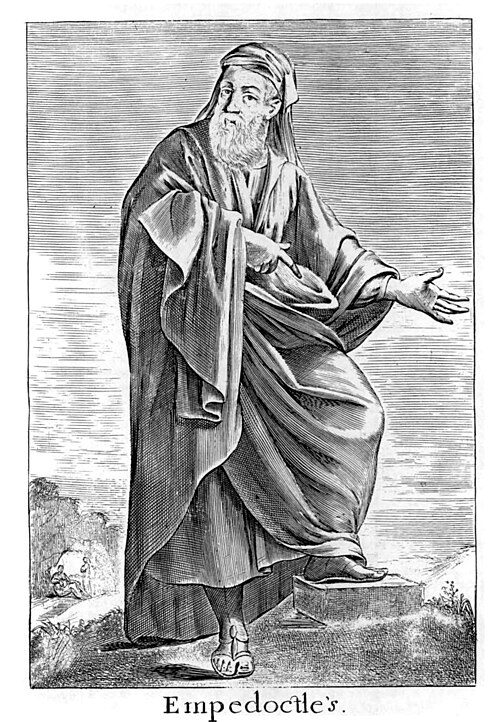
Picture: Later imagined representation of Empedocles, from Thomas Stanley’s History of Philosophy, traditionally dated about 1655.
Unknown engraver; Thomas Stanley volume; Public domain (PD-old-100-expired; PD-Art); Wikimedia Commons. Image record, Public domain (PD-old-100-expired; PD-Art).

The round picture in the lists of the personalities is cropped from it.