





9 min read
Ruler of Lagash
Entemena of Lagash
author: High Priest Zevios Metathronos
The Work of Sacred Concord
Dates: Flourished c. 2400 BCE.
Period: Ancient.
Entemena, whose name modern editors also read as Enmetena, ruled the Sumerian city-state of Lagash about 2400 BCE. He was the son of Enanatum and the nephew of Eannatum, and he inherited from them a border war with the neighbouring city of Umma.1
He ended that war on the field, and then he had its whole history written down. Cone A, a clay cone 27 cm high now in the Louvre, tells the story in 223 lines of Sumerian, from the day Enlil fixed the boundary to Entemena's own levee on the Tigris, and it closes with a curse on anyone who crosses the line again.2
Zevism reads Entemena as a Sumerian link in the chain of spirituality, a ruler who fought and built for Ningirsu and Nanshe under the Gods' own names. His levees and stelae guarded a boundary, and in the Hellenic lens boundaries belong to Zeus, witness of every landmark between neighbours.
LIFE AND CONTEXT
Lagash lay in the far south of Mesopotamia, and its temple city was Girsu, today's Tello, where Cone A was found. The cone belongs to the Early Dynastic IIIb period, which CDLI dates to about 2500–2340 BCE; the Louvre narrows the object to 2420–2400 BCE.3
The quarrel with Umma was over land. The cone begins with the divine title to it: Enlil, “king of all the lands, father of all the gods,” had “demarcated the (border) ground” between Ningirsu, the warrior God of Lagash, and Shara, the God of Umma. The rest of the cone measures every later act against that decision.4
Entemena's family had fought over it for 2 generations. His uncle Eannatum beat Umma and fixed the line again with its governor Enakale. Britannica names the monument of that victory, the Stele of the Vultures, “erected to celebrate the victory of King Eannatum over the neighbouring state of Umma.” His father Enanatum then fought Urlumma of Umma in the field of Ugiga and didn't finish the war.5
The cone gives Entemena his titles. He was “given the scepter by Enlil, given wisdom by Enki, chosen by the heart of Nanše, big-governor of Ningirsu, the man who kept to the words of the gods,” and it asks his personal God, Shul-MUŠ×PA, to stand before Ningirsu and Nanshe for his life “unto distant days.”6
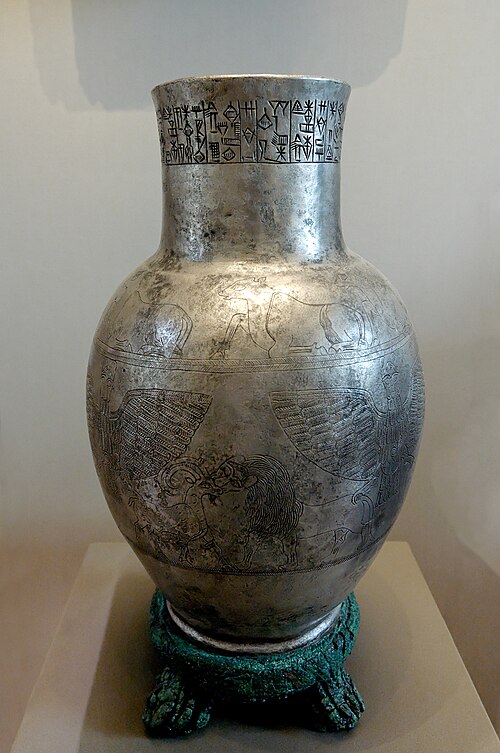
He built as well as fought. A cone at Brown University, likely from Tell al-Madain, records his building of the E-mush temple for Inanna, and its last lines name a “brotherhood, or peace, alliance” with another ruler, Lugal-kinishe-dudu. He also gave Ningirsu a silver vase for the God's table, and the dedication names Dudu, the priest who served there.7
The inscriptions don't say how he died. Cone A came out of the ground at Tello and is now in the Louvre. The cone in Brown's library came from the collector Henry Augustus Greene (1861–1950).8
ATTAINMENTS
- He defeated Urlumma of Umma after his father had fought him to no end at Ugiga, and the cone counts the result: 60 teams of donkeys abandoned on the canal bank and burial mounds heaped up in 5 places.9
- He built the boundary levee “from the Tigris River to Princely Canal” and set the base of the Namnunda-kigara, the boundary mound of Ningirsu, in stone for Ningirsu and Nanshe.10
- He had the history of the frontier written on Cone A, 27 cm high and 12.7 cm across, in 6 columns and 223 lines, the Louvre's “account of a frontier settlement between Lagash and Umma.”2
- He built the E-mush temple for Inanna about 2400 BCE, a work recorded on the foundation cone at Brown University's John Hay Library, an exemplar of the text RIME 1.9.5.3.11
- He made a brotherhood, or peace alliance, with Lugal-kinishe-dudu and had it written into the same building record as the temple.11
- He dedicated an engraved silver vase to Ningirsu's table service, decorated with lion-headed eagles and animals and naming the priest Dudu, now Louvre AO 2674.12
KEY STORIES
The Stele of Mesalim
Cone A tells the old part of the story first. After Enlil fixed the border, Mesalim, king of Kish, “by the command of Ištaran, struck the measuring line upon it, and on that place he erected a stele.” It's the first settlement the cone records, and an outside king made it.13
It didn't hold. Ush, governor of Umma, did what the cone calls “something greatly beyond words (?).” He tore the stele out and marched “into the plain of Lagaš.” The cone makes the answer divine: Ningirsu, “the hero of Enlil,” gave battle to Umma, cast Enlil's “big battle-net upon it,” and heaped its dead into tumuli on the plain.14
Eannatum then drew the line again with Enakale of Umma. He left 215 ninda of Ningirsu's own field under Umma's control as “a field with no owner,” inscribed stelae on the levee and put Mesalim's stele back “to its (former) place.” He didn't cross into Umma's plain. On the boundary mound he built daises for Enlil, Ninhursag, Ningirsu and Utu.15
The settlement carried a debt. The Man of Umma had eaten a grain heap of the barley of Nanshe and Ningirsu “as an interest-bearing loan.” Then “the ‛cut' was imposed,” and 144,000 gur of barley “were to be brought in.” The cone ends this part with a sentence that starts the next war: “Because he was unable to repay that barley.”16
Urlumma Burns the Stelae
The man who couldn't pay was Urlumma, governor of Umma. He turned water on the levees of Ningirsu and Nanshe and washed them away. He set fire to the stelae and tore them out, and he demolished the daises of the Gods on the Namnunda-kigara. Then “foreign countries he hired,” and with them he crossed Ningirsu's levee.17
Enanatum of Lagash met him in the field of Ugiga, “the field of Ningirsu,” and couldn't decide the war. His son did. “Enmetena, the beloved son of Enanatum, defeated him.”18
The cone records the rout without ornament. Urlumma “fled into the middle of Umma and was killed.” His donkeys, “sixty teams,” were left behind on the bank of the Lumma-girnunta canal, and the bones of his men “were all left out on the plain.” Entemena heaped up their burial mounds “in five places.”19
Il, the Field-Thief
At that time Il, temple administrator of Zabala, went from Girsu to Umma and seized the governorship. He washed the levees away again, along with the Namnunda-kigara of Enlil, Enki and Ninhursag on the bank of the Tigris, and he paid back only 3,600 gur of Lagash's barley.20
Entemena sent envoys about the levees. Il, whom the cone calls “the field-thief,” answered with hostility: “The levee of the boundary territory of Ningirsu and the levees of the boundary territory of Nanše are mine!” He added a threat: “From the Antasura (temple) to the temple of Dimgalabzu the earth I shall remove from them!”21
“But Enlil and Ninḫursag did not give it to him.” Entemena built the levee from the Tigris to the Princely Canal and laid the base of the boundary mound in stone for Ningirsu and Nanshe.22
Then he set a curse in clay against any future man of Umma, or of a foreign land, who crossed the levee “in order by violence to carry off fields.” Enlil was to annihilate him, and his own townsmen were to raise their hands against him: “in the middle of his city may they slaughter him!” In Zevist terms the cone is a boundary oath with the Gods as its witnesses.23
THE ZEVIST READING
Zevism holds that spirituality forms one chain from its inception to the present, and the Gods of Lagash keep their own names in that chain. Enlil fixes the border, Ningirsu fights for it, Nanshe owns a levee of her own, and Enki gives the ruler wisdom. The Temple reads their order through the Hellenic lens, where boundaries fall under Zeus. Plato's Laws makes moving a boundary “to move the immovable” and names the divine witnesses: “Zeus, the god of kindred, is the witness of the citizen, and Zeus, the god of strangers, of the stranger, and when aroused, terrible are the wars which they stir up.”24
Cone A reads like a commentary on that sentence written 2 millennia before it. Egyptian religion named the right order Maat, “the personification of truth, justice, and the cosmic order,” and set it against isfet.25 A measured line, a stele returned to its place and a debt recorded in exact gur are Ma'at. A drained levee, a burned stele and a field taken by force are Izfet, and the cone shows how quickly Izfet turns into dead men on a plain.
Zevism judges a victory by the Good, the conjunction of Ma'at and Right: right order together with a right act from a right will. By his own record, Entemena's war defended a line that Lagash's Gods had fixed and that his uncle had already conceded 215 ninda to keep, and the Temple counts that defence as Right. The heaped bones at Lumma-girnunta stand in the same record, and the Temple reads them as the cost of Izfet, stated plainly.
His peace belongs in the same reading. Hesiod seats Dike, the daughter of Zeus, beside her father, and Zevism places a kept agreement between cities under her.26 Entemena wrote a brotherhood into the same record as a temple for Inanna and gave Ningirsu a silver vessel for his table. In the Temple's reading the levee, the alliance and the vase belong to 1 work, the keeping of order at the border, between rulers and at the altar of Ningirsu.
NOTES
1 Louvre, Cone A d'Enmetena, AO 3004; Enmetena, Cone A, lines 32–36, 101–103, CDLI.
2 Louvre, AO 3004; CDLI, P222532.
3 CDLI, P222532; Louvre, AO 3004.
5 Cone A, lines 32–45, 95–100; Britannica, “Lagash”.
7 Mohr and Thompson, §2.2.1–2; Louvre, Vase d'Enmetena, AO 2674.
8 Louvre, AO 3004; Mohr and Thompson, §2.2.1.
12 Louvre, AO 2674; Britannica, “Lagash”.
14 Lines 13–31.
15 Lines 32–66.
16 Lines 67–75.
18 Lines 95–104.
19 Lines 105–117.
21 Lines 141–161.
22 Lines 162–182.
23 Lines 203–223.
26 Hesiod, Works and Days 256–262.
BIBLIOGRAPHY
Enmetena, Cone A (RIME 1.9.5.1 composite, P431117), Sumerian text with English translation, Cuneiform Digital Library Initiative, after D. R. Frayne, Presargonic Period, RIME 1, University of Toronto Press, 2008, ATF by D. A. Foxvog, G. Zólyomi and others; lines 1–223.
Cuneiform Digital Library Initiative, RIME 1.9.5.1, ex. 1, P222532: Louvre AO 3004, Girsu, Early Dynastic IIIb, 6 columns.
Musée du Louvre, Cone A d'Enmetena, AO 3004; date, dimensions, provenance and description.
Musée du Louvre, Vase d'Enmetena, AO 2674; Description, Inscriptions, and Places and dates.
Sara Mohr and Shane M. Thompson, A Selection of Tablets and Cones from Brown University, Cuneiform Digital Library Bulletin 2021:2, published online 26 January 2022, §2.2, M8 = RIME 1.9.5.3.
Encyclopaedia Britannica, “Lagash”; the Stele of the Vultures and the silver vase of Entemena.
Plato, Laws, Book 8, tr. Benjamin Jowett, MIT Internet Classics Archive; the law of boundaries.
Hesiod, Works and Days 256–262, tr. H. G. Evelyn-White, Theoi Classical Texts Library.
Encyclopaedia Britannica, “Maat”.
CREDIT
Picture: Vase of Entemena, Louvre AO 2674. A dedicated sacred vessel, not a portrait. Photograph by Jastrow, 2006; public domain by the creator's release. The caption follows the museum's identification of the vase with Ningirsu's service.

Jastrow, via Wikimedia Commons; Public domain, creator release. Image record, Public domain, creator release.
The round picture in the lists of the personalities is cropped from it.