




9 min read
Stoic Teacher
Epictetus
author: High Priest Zevios Metathronos
Freedom as a Task of the Soul
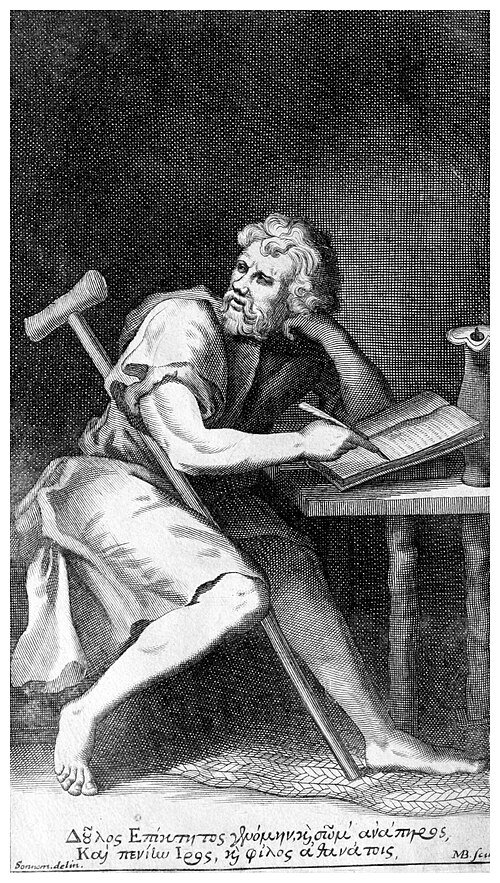
Dates: Born in the 50s–c. 135 CE
Period: Roman period
Epictetus was born in the 50s CE at Hierapolis in Asia Minor and spent part of his life as a slave in Rome. He died around 135 as a free man and the head of his own school at Nicopolis in Epirus. His lectures, written up by Arrian of Nicomedia, survive as 4 books of Discourses and the short Encheiridion, or Handbook.1
The Handbook opens with 1 division: τῶν ὄντων τὰ μέν ἐστιν ἐφ᾽ ἡμῖν, τὰ δὲ οὐκ ἐφ᾽ ἡμῖν, of the things that exist, some lie in a person's power and some don't. Judgement, impulse, desire and aversion lie in that power; body, property, reputation and office don't. The chapter then trains the reader to test each disturbing impression against that division.2
Zevism reads him as the philosopher of kinship with Zeus. He taught that “God is the father both of men and of gods,” and that whoever would please the Gods “must try with all his power to be like them.” That's ὁμοίωσις θεῷ in the words of a former slave.3
LIFE AND CONTEXT
Hierapolis was a Greek city of Asia Minor. Epictetus spent part of his life in Rome as the slave of Epaphroditus, “an important administrator in the court of Nero.” He walked with a limp, “attributed variously to arthritis or to physical abuse during his time of slavery.”4
While he still had a master, he studied with the Stoic Musonius Rufus. Epictetus later recalled how Musonius tested him: “This and this will befall you from your master.” The pupil answered that such things happen “in the ordinary course of human affairs,” and Musonius replied, “Why, then, should I ask him for anything when I can obtain it from you?”5
He gained his freedom and began to lecture in Rome. Then he “was forced to leave the city, presumably by the edict of Domitian (in 89) banning philosophers from the Italian peninsula.” He crossed to Nicopolis, “an important communications hub and administrative center in Epirus,” opened a school, and taught there for the rest of his life.4
The Discourses record his later teaching, from around the year 108. According to their preface, they aren't the writing of Epictetus: they were written up by “the essayist and historiographer Arrian of Nicomedia” to convey the impact of his instruction. The original work ran to 8 or more books, and 4 survive. The Encheiridion is “a brief abridgment” of them. Epictetus never married, but late in life he adopted a child whose parents couldn't feed it.4
His name reached the throne. The Historia Augusta says Hadrian “treated with the greatest friendship the philosophers Epictetus and Heliodorus.”6 A generation later Marcus Aurelius thanked his teacher Rusticus for “being acquainted with the discourses of Epictetus, which he communicated to me out of his own collection.”7
ATTAINMENTS
- He rose from slavery to run his own school. Freed in Rome and exiled under Domitian, he founded the school at Nicopolis and taught there until his death around 135.4
- His teaching fills 4 surviving books of Discourses, from an original of 8 or more, and the Encheiridion that abridges them.4
- He set out a working test for every impression: sort it into what lies in a person's power (judgement, impulse, desire, aversion) and what doesn't (body, property, reputation, office).8
- He gave piety a rule. Its chief part, he wrote, is to hold right opinions about the Gods, ὀρθὰς ὑπολήψεις περὶ αὐτῶν ἔχειν, and to pour libations and make offerings by ancestral custom, cleanly, without carelessness or stinginess, and never beyond one's means.9
- He taught a master to see his slave as “your own brother, who has Zeus for his progenitor.”10
- He shaped the thinking of Rome's rulers. Hadrian treated him with friendship, and Marcus Aurelius read his discourses from Rusticus's own copy.11
KEY STORIES
The Leg That Broke
The best-known story of his slavery survives through an argument between 2 other men. Celsus, a Greek critic of Christianity, held Epictetus up as a model of calm, and the Christian writer Origen quoted his words in reply.12
Celsus tells how Epictetus's master once took hold of his leg and began to twist it. The slave spoke, “smiling and unmoved”: “You will break my leg.” The leg broke. Epictetus said only, “Did I not tell you that you would break it?”12
The Discourses give the principle behind the story in his own voice. A tyrant threatens chains, and the answer comes back: “You may fetter my leg, but my will not even Zeus himself can overpower.”13 In Zevist terms, that's the freedom Zeus gives and keeps: the will is the part of a person that belongs to the Gods and to no master.
The Purple in the Toga
Epictetus taught with examples from recent Roman history. He told his students how Vespasian sent word to the senator Helvidius Priscus “and commanded him not to go into the senate.” Helvidius answered: “It is in your power not to allow me to be a member of the senate, but so long as I am, I must go in.”14
“Well, go in then,” said the emperor, “but say nothing.”
“Do not ask my opinion, and I will be silent.”
“But I must ask your opinion.”
“And I must say what I think right.”
“But if you do, I shall put you to death.”
“When then did I tell you that I am immortal? You will do your part, and I will do mine: it is your part to kill; it is mine to die, but not in fear: yours to banish me; mine to depart without sorrow.”
Then Epictetus asked what good Helvidius had done, a single man. His answer was the purple stripe on a toga, which is “conspicuous in the toga as purple, and is displayed also as a fine example to all other things.”14
Dinner at Aricia
The Discourses open with another Roman under trial. “What, then, did Agrippinus say? He said, ‘I am not a hindrance to myself.’” Epictetus then told how the man behaved on the day the senate judged him.13
A messenger reported that his case was being heard. Agrippinus answered that he hoped it would turn out well, but it was the 5th hour of the day, his usual time for exercise and a cold bath, so he went to take his exercise. When he'd finished, someone came to tell him, “You have been condemned.”
“To banishment,” he asked, “or to death?”
“To banishment.”
“What about my property?”
“It is not taken from you.”
“Let us go to Aricia then,” he said, “and dine.”13 Epictetus gave the story as the model of a man whose desire and aversion had been trained until nothing outside him could hinder them.
The Book Read at Cephisia
Aulus Gellius, a Roman student in Greece, stayed with friends at Cephisia, the villa of Herodes Atticus near Athens, “both in the heat of summer and under the burning autumnal sun.” Among the guests was “a young student of philosophy, of the Stoic school according to his own account, but intolerably loquacious and presuming.” Beside himself, he said, all the Greek authorities, “all wearers of the toga, and the Latin race in general were ignorant boors.”15
Herodes, “a man of consular rank,” didn't argue with him. He “bade them bring the first volume of the Discourses of Epictetus, arranged by Arrian,” and had a passage read aloud in which Epictetus lashed young men who called themselves Stoics but “showed neither virtue nor honest industry, but merely babbled of trifling propositions.”16
The effect was immediate. “On hearing these words, that most arrogant of youths was mute, just as if the whole diatribe had been pronounced, not by Epictetus against others, but against himself by Herodes.”16
THE ZEVIST READING
Epictetus put Zeus at the head of his ethics. The 3rd discourse of Book 1 begins from the claim “that we are all sprung from God in an especial manner, and that God is the father both of men and of gods.” From that kinship he drew duties: a master who rages at a slave is raging at a brother “who has Zeus for his progenitor.”17 Zevism reads the same kinship as the ground of human dignity.
The aim of the path is ὁμοίωσις θεῷ κατὰ τὸ δυνατόν, likeness to the divine “as far as possible.”18 Epictetus spelled it out as a list of duties: “If the divine is faithful, man also must be faithful; if it is free, man also must be free; if beneficent, man also must be beneficent,” and so “an imitator of God” must act and speak accordingly.19
His worship kept its ancestral form. The Handbook asks for right belief about the Gods and for offerings made cleanly and within one's means, and its last chapter opens with the prayer of Cleanthes, ἄγου δέ μ᾽, ὦ Ζεῦ, “lead me, Zeus.” The book then closes with the words of Socrates, ἐμὲ δὲ Ἄνυτος καὶ Μέλητος ἀποκτεῖναι μὲν δύνανται, βλάψαι δὲ οὔ: his accusers can kill him, he says, but can't harm him.20 The Temple keeps the same pairing of right belief with measured, ancestral worship.
Zevism also honours the keepers of the source. The Discourses aren't Epictetus's own writing; Arrian wrote down the teaching, Rusticus shared his copy with a future emperor, and Herodes had the text read aloud at Cephisia. Each of them carried the teacher's words forward without replacing them. Of Arrian's 8 or more books, 4 survive.4
NOTES
1 Margaret Graver, “Epictetus,” SEP, §1.
3 Epictetus, Discourses 1.3; Discourses 2.14.
4 Graver, §1.
6 Historia Augusta, Hadrian 16.10.
7 Marcus Aurelius, Meditations 1.7.
10 Discourses 1.13.
11 Historia Augusta, Hadrian 16.10; Meditations 1.7.
12 Origen, Against Celsus 7.53.
13 Discourses 1.1.
14 Discourses 1.2.
15 Aulus Gellius, Attic Nights 1.2.
19 Discourses 2.14.
20 Encheiridion 31, 53.
BIBLIOGRAPHY
Margaret Graver, “Epictetus”, Stanford Encyclopedia of Philosophy, revised 16 July 2025; §1, life, limp, exile, Nicopolis, Arrian and the transmission of the works.
Epictetus, Encheiridion 1, 31 and 53, Greek text, ed. Albert Watanabe, Dickinson College Commentaries, 2020.
Epictetus, Discourses 1.1–3, 1.9, 1.13 and 2.14, tr. George Long; Internet Classics Archive.
Origen, Against Celsus 7.53, tr. Frederick Crombie, Ante-Nicene Fathers vol. 4, ed. Philip Schaff; Christian Classics Ethereal Library.
Aulus Gellius, Attic Nights 1.2, tr. J. C. Rolfe, Loeb Classical Library, 1927; LacusCurtius.
Historia Augusta, Life of Hadrian 16.10, tr. David Magie, Loeb Classical Library, 1921; LacusCurtius.
Marcus Aurelius, Meditations 1.7, tr. George Long; Internet Classics Archive.
Plato, Theaetetus 176a–b, Greek text, Perseus Digital Library.
CREDIT
Picture: Imagined portrait of Epictetus, frontispiece to Edward Ivie’s Latin verse Encheiridion, Oxford, 1715.
Michael Burghers, after a design attributed to William Sonmans; Boston Public Library scan; cropped and converted to greyscale by Pasicles; Wikimedia Commons; Public domain; faithful reproduction of a public-domain artwork. Image record, Public domain; faithful reproduction of a public-domain artwork.
_frontispiece_-_greyscale.jpg)
The round picture in the lists of the personalities is cropped from it.