




9 min read
Measurer of the Earth
Eratosthenes of Cyrene
author: High Priest Zevios Metathronos
Dates: c. 276–c. 194 BCE
Period: Hellenistic (334–30 BCE)
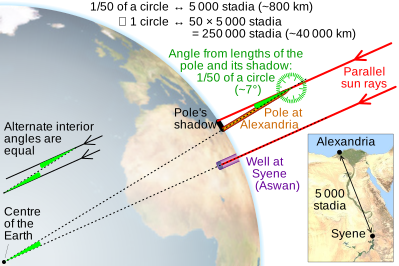
Eratosthenes of Cyrene measured the Earth without leaving Egypt. He took the angle of a noon shadow at Alexandria, set it against the distance to Syene, and put the circumference of the globe at 250,000 stadia, 50 times the 5,000 stadia between the 2 cities.1
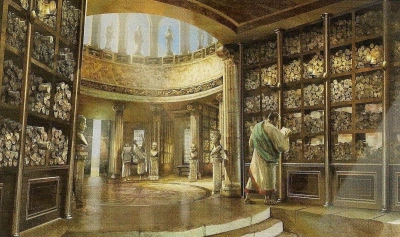
He was the 3rd librarian of Alexandria, in “a temple of the Muses called the Mouseion,” and he worked across geography, chronology, number theory and poetry.2
Zevism reads his career under Zeus and the Muses. His own epigram for King Ptolemy calls on “Zeus, god of heaven,” and his books stood in the Muses' temple.3 The measurement of the Earth carried light into a darkness no traveller could cross on foot.
LIFE AND CONTEXT
The Suda, a Byzantine lexicon, names him “Son of Aglaus (others say Ambrosius); of Cyrene.” He studied under the philosopher Ariston of Chios, the grammarian Lysanias of Cyrene and the poet Callimachus, and he spent some years in Athens.4
Ptolemy III Euergetes called him from Athens to Alexandria to tutor his son, the future Ptolemy IV Philopator. When Callimachus died in about 240 BCE, Eratosthenes took charge of the library. He lived on into the reign of Ptolemy V.5
His range earned him nicknames. The Suda says that “because he came second in every branch of learning to those who had reached the highest level,” he got a nickname, which MacTutor gives as Beta, the 2nd letter of the alphabet. “Others called him a second or new Plato, or the ‘pentathlete.’”6
The same entry lists “philosophical works, poems and histories; Astronomy, or Catasterisms; On the Philosophical Sects; On Freedom from Pain; many dialogues; and numerous grammatical works.” MacTutor adds a poem, Hermes, “inspired by astronomy.” His pupil Aristophanes of Byzantium went on to teach Aristarchus. Almost all of his writing is lost, so later authors carry most of what's known.6
He lost his sight in old age. The Suda says he “died aged 80, giving up food because of his declining eye-sight.” MacTutor places his death at Alexandria in 194 BCE.6
ATTAINMENTS
- He measured the Earth at 250,000 stadia, then “later extended the value to 252,000 so as to make it divisible by sixty.” That gave 4,200 stadia to each 60th part of the circle.7
- He measured the tilt of the Earth's axis at 11/83 of 180°, about 23° 51′. Ptolemy reports the value.8
- His Geographica, in 3 books, drew a map of the inhabited world on a central meridian through Rhodes and a west to east parallel, cut into sections called sphragides, “seals.” He gave the inhabited world a length of 78,000 stades, more than double its breadth.9
- He built a chronology of the Greek world, dating “literary and political events from the time of the siege of Troy.”8
- He devised the sieve that still bears his name, a method for picking out the prime numbers by striking out the multiples of each prime in turn. A later Introduction to Arithmetic preserves it.8
- He solved the old problem of doubling the cube with a mechanical instrument and set the solution on a column at Alexandria.3
- He put the distance to the Sun at 804,000,000 stadia and to the Moon at 780,000 stadia, and he's said to have compiled a catalogue of 675 stars.8
KEY STORIES
The Shadow in the Bowl
Eratosthenes' own book on the measurement is lost. The later astronomer Cleomedes kept the argument in his book On the Heavens. Syene, he wrote, “lies under the circle of the summer tropic,” so at noon on the summer solstice “the gnomons of sundials are necessarily shadowless” there.10
Alexandria lay to the north. “But, in Alexandria, at the same hour, the gnomons of sundials cast shadows.” Eratosthenes read the shadow in a bowl sundial with its gnomon at the centre, and the arc it marked in the bowl came to “a fiftieth proper part” of the full circle. NASA gives the modern figure: 7.2 degrees.11
The Sun's rays reach both cities along parallel lines, so the angle in the bowl equals the angle between the 2 cities at the centre of the Earth. The road between them, Cleomedes wrote, must then be “a fiftieth proper part of the great circle of the earth,” and “the distance between the cities is 5000 stades.” Multiply by 50, and “the whole circle comes to 25 myriads,” 250,000 stadia.12
The result rested on assumptions the Greeks couldn't test: that Syene sat exactly on the tropic and on Alexandria's meridian, and that 5,000 stadia was right. The length of his stadion is still disputed, so any modern percentage of accuracy claims more than the evidence holds.13
The Altar of Delos
Theon of Smyrna quotes the story from Eratosthenes' Platonicus. Plague struck Delos, and “the god proclaimed to the Delians through the oracle” that they should build an altar double the old one. Their craftsmen fell into “great perplexity” over how to double a solid, so the Delians went to Plato. He told them the god didn't want a bigger altar; he wished “to shame the Greeks for their neglect of mathematics and their contempt of geometry.”3
A letter to King Ptolemy under Eratosthenes' name, preserved by Eutocius, gives the problem an older stage. MacTutor judges the letter a forgery whose writer “does quote some genuine writings of Eratosthenes.” In it a tragic poet's Minos inspects the tomb built for Glaucus, 100 feet on every side, and orders: “Let it be twice as large. Without spoiling the form, quickly double each side of the tomb.” The letter answers, “This was clearly a mistake,” since doubling each side makes the tomb 8 times as large.3
Hippocrates of Chios had already reduced the task to a cleaner form: “Given two lines, find two mean proportionals between them.” Ruler and compass alone could never find them, as Pierre Wantzel proved in 1837.3
The Column for Ptolemy
Eratosthenes answered with a machine. He set 3 triangles between 2 parallel rulers, fixed the first and let the other 2 slide, then turned a straight edge until its line passed through the right points. Where the sides crossed, the 2 means appeared, and with them the side of the doubled cube.3
He made the solution a public gift. He raised a column at Alexandria, dedicated to King Ptolemy, with an epigram cut into it. It begins, “If, good friend, thou mindest to obtain from any small cube a cube the double of it,” and promises that the same method will measure “a fold, a pit, or the broad basin of a hollow well,” if the reader will “catch between two rulers two means.”14
The poem then turns to the royal house. It praises Ptolemy for giving his son “all that is dear to muses and Kings” and prays, “O Zeus, god of heaven,” that the boy will one day receive the sceptre. The last line names the giver: “This is the gift of Eratosthenes of Cyrene.”3
A Letter from Syracuse
Eratosthenes' most demanding correspondent lived in Sicily. Archimedes had already tested him: “I sent you on a former occasion some of the theorems discovered by me, merely writing out the enunciations and inviting you to discover the proofs, which at the moment I did not give.”15
The Method went further and showed how he'd found such results. He chose Eratosthenes, he wrote, “seeing moreover in you, as I say, an earnest student, a man of considerable eminence in philosophy, and an admirer [of mathematical inquiry].” The letter set out his mechanical method of weighing figures against each other. “It is of course easier,” Archimedes told him, “when we have previously acquired, by the method, some knowledge of the questions, to supply the proof than it is to find it without any previous knowledge.” He hoped later mathematicians would use it to find theorems he hadn't reached.16
The letter nearly vanished. Its text survives in a 10th-century manuscript that J. L. Heiberg found in 1906.17
THE ZEVIST READING
The epigram on the Alexandrian column is the clearest religious document in this life. Eratosthenes set a working solution in stone, dedicated it to his king and prayed to “Zeus, god of heaven” for the prince's succession.3 Zevism reads this as the right placing of knowledge: a proof offered in public, under the sovereign of the sky, for anyone who can use it.
Plato's answer to the Delians carries the same doctrine. The god asked for a doubled altar, and the true demand was geometry. In Plato's own myth, Theuth invented “numbers and arithmetic and geometry and astronomy.”18 Geometry means earth measurement, and Eratosthenes did it in the literal sense.
The circumference of the Earth was darkness in the Zevist sense: unexplored, and never evil. Nobody could walk around the globe to measure it. Eratosthenes entered that darkness with a shadow, a bowl and a ratio of 1 to 50, and he came back with a number. Explored darkness becomes Light, and the Temple counts that act of discovery as service to the Gods.
The library completes the reading. Eratosthenes kept books in a temple of the Muses, taught Aristophanes of Byzantium and answered Archimedes. Zevism honours such keepers of the source. Knowledge changes as it passes from hand to hand, and the source holds priority; a librarian who guards it serves the same order as the scholar who adds to it.
NOTES
1 Sidoli, “Mathematical Discourse,” translating Cleomedes 1.7.
2 O'Connor and Robertson, “Eratosthenes of Cyrene”.
3 MacTutor, “Doubling the cube”.
4 Suda ε 2898, tr. Malcolm Heath; O'Connor and Robertson.
5 O'Connor and Robertson; Suda ε 2898.
6 Suda ε 2898; O'Connor and Robertson.
7 Aujac, History of Cartography 1, p. 155.
10 Cleomedes 1.7, tr. Sidoli, p. 220.
11 Cleomedes 1.7, tr. Sidoli, p. 220; NASA Goddard, “The Earth”.
12 Cleomedes 1.7, tr. Sidoli, pp. 218–220.
13 Aujac, p. 155; O'Connor and Robertson.
14 O'Connor and Robertson; MacTutor, “Doubling the cube”.
15 Archimedes, The Method, introductory letter.
16 The Method, introductory letter.
17 O'Connor and Robertson, “Archimedes of Syracuse”.
BIBLIOGRAPHY
J. J. O'Connor and E. F. Robertson, “Eratosthenes of Cyrene”, MacTutor History of Mathematics, University of St Andrews, January 1999; life, library, sieve, obliquity, chronology, distances, star catalogue, disputed stadion.
Suda ε 2898, “Eratosthenes”, translated by Malcolm Heath, Suda On Line, 2001.
Nathan Sidoli, “Mathematical Discourse in Philosophical Authors: Examples from Theon of Smyrna and Cleomedes on Mathematical Astronomy”, in Alexander Jones and Christián Carman (eds.), Instruments, Observations, Theories: Studies in the History of Astronomy in Honor of James Evans, 2020, pp. 213–228; translation of Cleomedes 1.7, pp. 218–220.
NASA Goddard Space Flight Center, “The Earth,” Imagine the Universe!, “How Do We Calculate Distances of This Magnitude?”; the 7.2 degree angle, not its accuracy claim.
Editors, from materials supplied by Germaine Aujac, “The Growth of an Empirical Cartography in Hellenistic Greece,” The History of Cartography, volume 1, chapter 9, University of Chicago Press, pp. 154–156.
J. J. O'Connor and E. F. Robertson, “Doubling the cube”, MacTutor; Theon of Smyrna on the Delian oracle and Eratosthenes' epigram, in T. L. Heath's translations.
Archimedes, The Method, introductory letter to Eratosthenes, primary-text extract, MacTutor.
J. J. O'Connor and E. F. Robertson, “Archimedes of Syracuse”, MacTutor; Heiberg's discovery of The Method in 1906.
Plato, Phaedrus 274c–d, translated by H. N. Fowler, Perseus Digital Library.
CREDIT
Picture: Modern diagram explaining the geometry of Eratosthenes’s Earth measurement; not a portrait or surviving ancient diagram
CMG Lee, with source graphics by David Monniaux and jimht at shaw dot ca; Wikimedia Commons; CC BY-SA 4.0. Image record, CC BY-SA 4.0.

The round picture in the lists of the personalities is cropped from it.