




9 min read
Great Biochemist
Erwin Chargaff
author: High Priest Zevios Metathronos
Measure and Intellectual Justice
Dates: 1905–2002 CE
Period: Modern period (1900–present)
Erwin Chargaff was an Austrian-born biochemist at Columbia University who measured the 4 bases of DNA and found 2 rules in them. In every DNA his laboratory tested, adenine and thymine came in nearly equal amounts, and so did guanine and cytosine; and the overall mix differed from one species to another.1
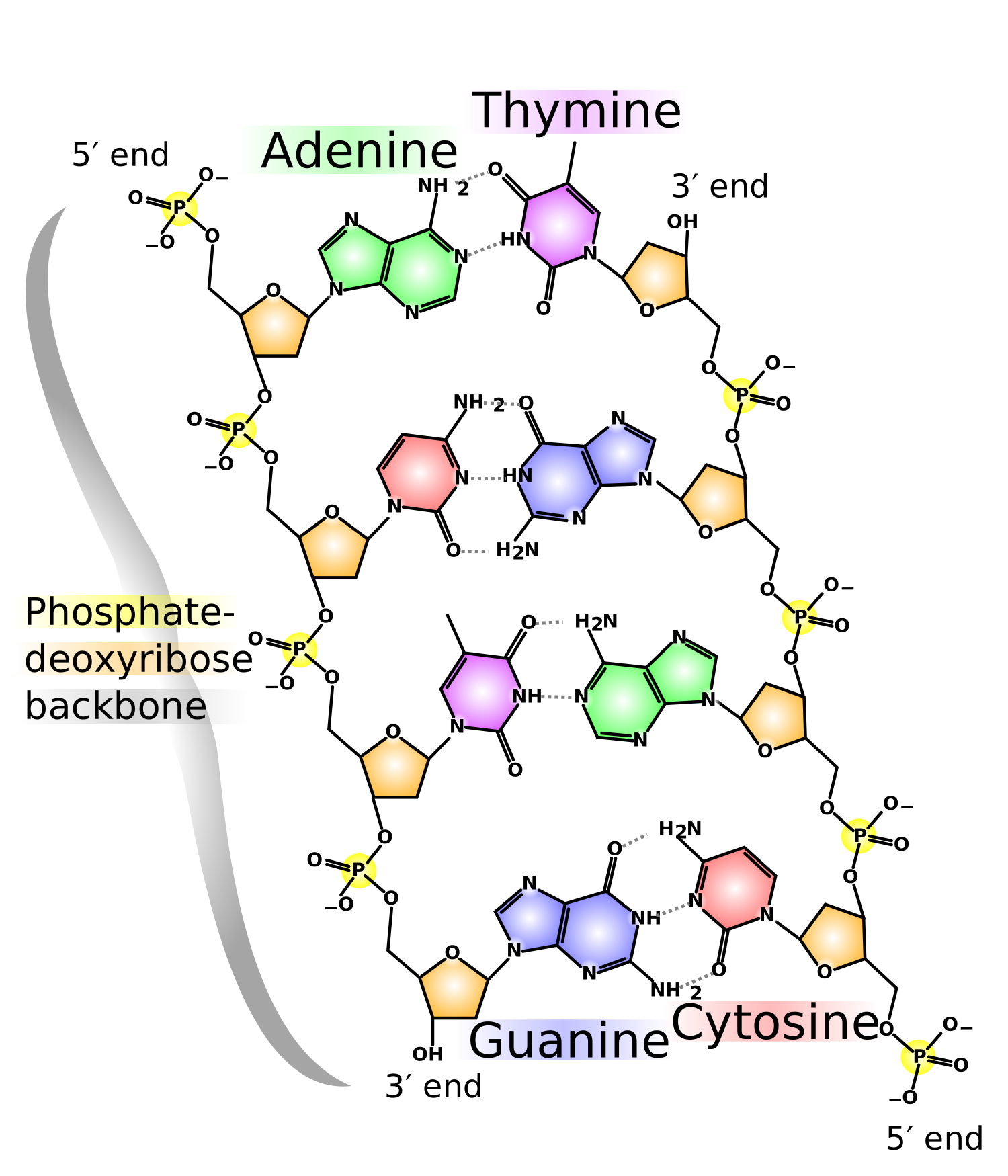
Those ratios, known as Chargaff's rules, were in print before Watson and Crick built their model, and the model had to explain them. It did: A pairs with T and C with G between the 2 backbones of the double helix.2
Zevism reads his work under Theuth, inventor of letters, and under Ma'at, the order of true measure and just credit. Chargaff counted the letters of the hereditary text before anyone could read it.
LIFE AND CONTEXT
Chargaff was born on 11 August 1905 in Czernowitz, in the Austro-Hungarian Empire, and took his doctorate at the University of Vienna in 1928 for work with Fritz Feigl. “Floating from one thing to the next,” in his phrase, he took a fellowship in chemistry at Yale from 1928 to 1930 and worked with R. J. Anderson on the lipids of acid-fast bacteria. Anderson taught him, Chargaff said, “the respect for matter, the care for quantity, even in essentially qualitative investigations, the reverence for accuracy in observation and description.”3
In the summer of 1929 he went back to Vienna for his fiancée, Vera Broida, and married her in New York that September. Their son Thomas was born in 1938. In the late 1930s Chargaff tried and failed to bring his mother out of Austria to the United States.4
Phoebus Levene had proposed a tetranucleotide structure for nucleic acid, “in which the nucleotides were always linked in the same order.” A molecule built that way would repeat itself without variety.5
The paper of Avery, MacLeod and McCarty in 1944 changed his course. Chargaff accepted it and concluded that genetic differences among DNAs had to show up as chemical differences among them. Cohen calls him “the first biochemist to reorganize his laboratory to test this hypothesis, which he went on to prove by 1949.”6
Columbia kept him on its faculty from 1935 to 1982. He won the National Medal of Science in 1974, and the same year the college's “impatient administrators” moved his office and laboratory, an episode that hardened his view of “the deteriorated nature of a transformed science.” He called himself “the Outsider on the Inside.”7
In 1978 he published Heraclitean Fire, a collection of autobiographical essays. In the 1970s he'd begun to write again in German, and his essays, in the manner of the Viennese satirists of his youth, found readers in Austria and Germany. He died in a New York hospital on 20 June 2002, aged 96.8
ATTAINMENTS
- He was the first biochemist to turn a laboratory to the chemistry of DNA as the stuff of heredity after the Avery paper of 1944.9
- His laboratory used partition chromatography and ultraviolet spectrophotometry to measure the bases, and it routinely recovered 96–98% of them to make sure no unknown base was hiding.10
- By 1949 he could state that in all DNAs tested the molar ratios of purines to pyrimidines, of adenine to thymine and of guanine to cytosine approached 1.0.10
- He showed that DNA isn't the same everywhere: the ratio of adenine plus thymine to guanine plus cytosine differed significantly from one organism to another.11
- With S. Zamenhof and C. Green he published the base composition of human DNA in Nature on 13 May 1950, the year the National Library of Medicine's DNA timeline gives for “Chargaff's Rule.”12
- His results broke the tetranucleotide hypothesis and showed that the order of nucleotides in DNA “is, in fact, highly variable.”13
- Watson and Crick's paper of 25 April 1953 cited his work in its references.14
KEY STORIES
Marching Boots in Berlin
In 1930 Chargaff and his young wife tried their luck in Germany. His work on bacteria won him a post as chemical assistant at the Institute of Hygiene of the University of Berlin, and he enjoyed the city's “most brilliant cultural life” after a “nagging, malevolent and immobile” Vienna and a “caste-conscious” Yale.15
It didn't last. In Cohen's words, “the tramp of marching boots in the Berlin of January 1933 drove the Chargaffs to accept an invitation from A. Calmette of the Institut Pasteur to come to Paris to help clarify some problems with the BCG vaccine.”15
In 1935 he moved on to New York and joined a Columbia department begun in 1928 under the organic chemist Hans Thacher Clarke. He worked first on lipids and on the possible role of phospholipids in blood clotting, and by the early 1940s his ultracentrifuge was pulling out cell particles that held phospholipid and RNA together.16
The First Text of a New Language
Chargaff read the 1944 paper from the Rockefeller Institute. Avery and his colleagues had found that the transforming principle of the pneumococcus was DNA, a result Pray sums up as showing “that hereditary units, or genes, are composed of DNA.”13
Years later, in Science, he described the effect. The discovery, he wrote, “almost abruptly, appeared to foreshadow a chemistry of heredity and, moreover, made probable the nucleic acid character of the gene.” Then: “Avery gave us the first text of a new language, or rather he showed us where to look for it. I resolved to search for this text.”17
He acted on it. If genes were DNA, then 2 organisms with different genes should have chemically different DNA. Testing that meant new ways of separating and measuring the bases, and he reorganized his laboratory around the question.6
Counting the Bases
The work needed a way to separate tiny amounts of 4 similar compounds and measure each one. His group split the bases apart by partition chromatography on paper and measured them by the ultraviolet light they absorbed.11
They didn't trust a result until the totals closed. Each analysis had to recover 96 to 98% of the bases, so that an unknown base couldn't slip through unseen.10
Sample after sample gave the same 2 answers. The DNAs of different species differed in composition, which killed the idea of a fixed repeating unit. And inside every DNA, adenine matched thymine and guanine matched cytosine, their ratios close to 1. The human DNA came out in Nature in May 1950 under 3 names, Chargaff's, Zamenhof's and Green's.18
He'd found the pattern and couldn't say why it held. Pray puts it plainly: “Chargaff himself could not imagine the explanation of these relationships.”13
The Rules Inside the Helix
In Cambridge the model builders came at DNA from the other end. The “Chargaff rules,” Cohen notes, “had been demonstrated before the crystallographers Watson and Crick had begun to examine any DNA samples.” Chargaff believed they had known little of the chemical structures of the bases before May 1952.19
The form of the molecule came from Rosalind Franklin's X-ray analyses and from the double-stranded model Watson and Crick published on 25 April 1953. Its bases paired inside the helix, A with T and C with G, and its list of references cited Chargaff.20
That pairing settled the numbers. As the National Library of Medicine explains, if A always paired with T and C with G, “not only were Chargaff's rules (that in DNA, the amount of A equals that of T, and C that of G) accounted for, but the pairs could be neatly fitted between the two helical sugar-phosphate backbones of DNA.”21
THE ZEVIST READING
Plato's Theuth invented “numbers and arithmetic and geometry and astronomy, also draughts and dice, and, most important of all, letters.”22 Chargaff spoke of Avery's result as “the first text of a new language,” and his own work was the first census of its alphabet. He counted 4 letters and found that they came in matched pairs. Zevism reads that as number and letter joined in living matter, the gifts of Theuth found already at work in the cell.
Ma'at joins truth to justice. Egyptian religion named her “the personification of truth, justice, and the cosmic order.”23 Chargaff served her first as a measurer. At Yale he'd learned “the respect for matter, the care for quantity,” and at Columbia his totals had to close at 96 to 98% before a ratio counted.24 A false measure is a small Izfet, disorder let into the record, and a closed account keeps it out.
Justice asks the same care of the historian. The rules carry his name, the 1950 paper carries 3, and the structure belongs to Franklin's X-rays and to Watson and Crick. Chargaff never claimed the helix: the structural meaning of his pairings, Cohen notes, “was not stated explicitly by Chargaff.”25 Zevism gives each contribution its own place.
Chargaff chose his own frame when he called his memoir Heraclitean Fire. Heraclitus described the world-order as “everliving fire, kindling in measures and being quenched in measures,” and opened his book with the Logos, the account that men fail to grasp.26 Zevism is the Logos restored. A pair of ratios that hold in every living thing tested is a measure of that fire, found by a man who wouldn't accept a result until the account balanced.
NOTES
1 Cohen, Erwin Chargaff, 1905–2002, p. 8.
2 NLM, “The Discovery of the Double Helix, 1951–1953”.
5 Pray, “Discovery of DNA Structure and Function”.
9 Cohen, p. 1.
10 Cohen, p. 8.
11 Cohen, p. 8; Pray.
12 Chargaff, Zamenhof and Green, Nature 165, 756–757; NLM, “Chargaff's Rule”.
13 Pray.
14 Watson and Crick, Nature 171, 737–738, reference 3.
15 Cohen, p. 3.
16 Cohen, pp. 3, 5.
17 Chargaff, “Preface to a Grammar of Biology,” 1971, quoted in Pray.
18 Cohen, p. 8; Chargaff, Zamenhof and Green.
19 Cohen, pp. 8–9.
20 Cohen, p. 9; Watson and Crick, reference 3; NLM.
21 NLM, “The Discovery of the Double Helix”.
24 Cohen, pp. 2, 8.
25 Cohen, p. 9.
26 Graham, “Heraclitus,” Stanford Encyclopedia of Philosophy, B1, B30.
BIBLIOGRAPHY
Seymour S. Cohen, with bibliography by Robert Lehman, Erwin Chargaff, 1905–2002, National Academy of Sciences, Biographical Memoirs (2010), pp. 1, 3–4, 7–10.
E. Chargaff, S. Zamenhof and C. Green, “Composition of human desoxypentose nucleic acid”, Nature 165 (1950), 756–757, doi:10.1038/165756b0; bibliographic record for authorship and date.
Leslie A. Pray, “Discovery of DNA Structure and Function: Watson and Crick”, Nature Education 1(1) (2008), Scitable; Levene's hypothesis, Chargaff's methods and results, and his words from “Preface to a Grammar of Biology,” Science 171 (1971), 637–642.
U.S. National Library of Medicine, Profiles in Science, The Francis Crick Papers, “The Discovery of the Double Helix, 1951–1953”.
J. D. Watson and F. H. C. Crick, “Molecular Structure of Nucleic Acids”, Nature 171 (25 April 1953), 737–738; reference 3.
National Library of Medicine, “Chargaff's Rule”, Visible Proofs, DNA timeline, 1950 entry.
Plato, Phaedrus 274c–d, translated by H. N. Fowler, Perseus Digital Library.
Encyclopaedia Britannica, “Maat”.
Daniel W. Graham, “Heraclitus”, Stanford Encyclopedia of Philosophy; fragments B1 and B30.
CREDIT
Image: modern chemical diagram of DNA by Madeleine Price Ball, illustrating complementary bases. This is an explanatory illustration, not Chargaff's own drawing or a portrait. CC0; verified Commons file record.

Madeleine Price Ball, DNA chemical structure, via Wikimedia Commons, CC0. Image record, CC0 1.0.
The round picture in the lists of the personalities is cropped from it.