



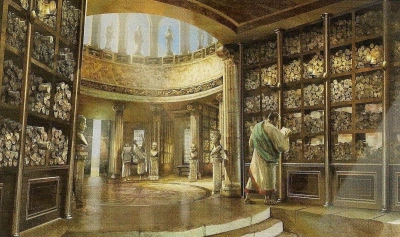
9 min read
Father of Geometry
Euclid of Alexandria
author: High Priest Zevios Metathronos
Dates: Active c. 300 BCE; birth and death dates uncertain
Period: Hellenistic (334–30 BCE)
Euclid taught mathematics at Alexandria in the reign of the first Ptolemy and wrote the Elements, 13 books that build plane geometry, the theory of numbers, the irrationals and solid geometry from a handful of definitions, postulates and common notions.1 More than 1,000 editions have appeared since the first printing in 1482, and the work was studied for 24 centuries in Greek, Arabic, Latin and the modern languages.2
The book's method is its gift. Every result rests on earlier results, and the reader can check each step. Plato credits the Egyptian God Theuth with number and geometry.3 Zevism reads the Elements, written in the Egyptian city of Alexandria, as Theuth's gift carried out in full, and as Ma'at in its purest form: order that anyone can verify.
LIFE AND CONTEXT
Almost nothing is known of Euclid's life. The firm points are Alexandria and a date near 300 BCE; later stories of his birthplace and character are less secure. He is a different man from the earlier philosopher Euclid of Megara.4
The chief ancient witness is Proclus, writing some 750 years later. “Not much younger than these [pupils of Plato] is Euclid, who put together the 'Elements', arranging in order many of Eudoxus's theorems, perfecting many of Theaetetus's, and also bringing to irrefutable demonstration the things which had been only loosely proved by his predecessors.” Proclus adds: “This man lived in the time of the first Ptolemy.”5
Proclus reached that date by a chain of reasoning. “Archimedes, who followed closely upon the first Ptolemy makes mention of Euclid,” so Euclid had to come between Plato's pupils and Archimedes. Hjelmslev has questioned the link, arguing that the reference to Euclid was inserted into Archimedes' book at a later stage. The Arabic biographies, which make Euclid the son of Naucrates and a native of Tyre, are judged by historians of mathematics to be “entirely fictitious.”4
The Elements didn't invent every proposition it contains. It collected the mathematics of Eudoxus, Theaetetus and others and set it in a single order of proof. Book 5 “lays out the work of Eudoxus on proportion applied to commensurable and incommensurable magnitudes,” and Book 10, on irrationals, “is mainly the work of Theaetetus.”4
He taught, and MacTutor supposes that “he would have had some able pupils who may have helped out in writing the books.” Pappus, centuries later, remembered him as “most fair and well disposed towards all who were able in any measure to advance mathematics, careful in no way to give offence.”6
The Elements wasn't his only book. The Data survives with 94 propositions, together with On Divisions, the Optics and the Phaenomena. His Conics in 4 books, the Porisms in 3, the Surface Loci in 2 and a Book of Fallacies are lost.4
ATTAINMENTS
- Book 1 of the Elements opens with 23 definitions, 5 postulates and 5 common notions and derives 48 propositions from them.7
- The 13 books cover plane geometry (Books 1–6), number theory (7–9), irrational magnitudes (10) and solid geometry (11–13).4
- Proposition 1.47 proves that “the square on the side opposite the right angle equals the sum of the squares on the sides containing the right angle.” According to Proclus, the proof given in the Elements is Euclid's own.8
- Proposition 9.20 proves that the primes are more than any assigned finite collection of them, by taking a common multiple of the listed primes and adding 1.9
- The last of Book 13's 18 propositions, and so of the whole work, compares the 5 regular solids and closes with a limit: “No other figure, besides the said five figures, can be constructed which is contained by equilateral and equiangular figures equal to one another.”10
- He stated the 5th postulate, on parallel lines, as an assumption. Later mathematics showed that consistent geometries can be built without it.11
- His Optics is “the first Greek work on perspective.”4
- The Elements has gone through more than 1,000 printed editions since 1482.4
KEY STORIES
A King and a Student
Proclus tells the best-known story about Euclid, and it concerns Ptolemy I, king of Egypt. Ptolemy once asked him whether there was a shorter way to study geometry than the Elements, and Euclid “replied that there was no royal road to geometry.”5 The answer fitted the book. The Elements offers a king no shortcut, because each proposition rests on earlier ones and the only way to a result runs through them.
Stobaeus preserves a sharper story from the classroom. “Someone who had begun to learn geometry with Euclid, when he had learnt the first theorem, asked Euclid, 'What shall I get by learning these things?'” The student had seen something certain and wanted to know its price.12
Euclid didn't argue with him. “Euclid called his slave and said, 'Give him threepence since he must make gain out of what he learns.'” The coin answered the question in the student's own terms.12
The 2 Circles on the First Page
The Elements begins with a construction any child can draw. Given a straight line, Euclid draws a circle about each end with the line as radius. Where the circles cross, he marks a 3rd point and joins it to both ends. Each new side is a radius, so each equals the original line, and “things which equal the same thing also equal one another.” The triangle is equilateral. From there Book 1 climbs, proposition by proposition, to the theorem of the right triangle at 1.47.13
Modern foundational analysis found a gap in it. David Joyce points out that no postulate guarantees that the 2 circles actually meet.14
That discovery didn't dethrone Euclid. It came from reading him the way he'd taught readers to read, asking of every step which assumption supports it. The same question, asked of his 5th postulate, led in time to non-Euclidean geometry.15
Primes Without End
Book 9 of the Elements contains a proof that can be read in a minute. Proposition 20 states: “Prime numbers are more than any assigned multitude of prime numbers.”16
Euclid begins, “Let A, B, and C be the assigned prime numbers.” He takes the least number they all measure and adds a unit to it. If the new number is prime, then 4 primes have been found where only 3 were given. If it isn't prime, some prime measures it, and Euclid shows that this prime “is not the same with any of the numbers A, B, and C,” because each of those leaves a remainder of 1. Either way the list was incomplete.16
Joyce notes that Euclid uses 3 primes to illustrate the general case. The 3 letters stand for any list anyone could ever write. No count of examples could have settled the question; a few lines of argument did.17
From Alexandria to Venice
The Greek text itself changed in transmission. Theon of Alexandria re-edited it, “altering the language here and there, mostly with a view to greater clearness and consistency.”18
The Elements reached medieval Europe by way of Arabic. Adelard of Bath, who travelled to Sicily, then under Norman rule, and on to Syria, made Latin versions, and for his first one he “took as his source one of al-Hajjaj's Arabic translations from Greek.” His versions “were for centuries the chief geometry textbooks in the West.”19
Around 1260 Campanus of Novara produced a new Latin text that “relied to some extent on Adelard of Bath's Latin translations.” His Euclid “was almost the canonical version until the sixteenth century,” and it was the one that went to press in Venice.20
In 1505 came “the first Latin translation directly from the Greek.”18 Zevism reads that year as a return to the source: after the long passage through Arabic and Latin, readers went back to Euclid's own words.
THE ZEVIST READING
In the Phaedrus Socrates tells of Theuth, the Egyptian God who invented number and calculation, geometry and astronomy, and letters.21 Euclid wrote in Egypt, in a Greek city on the Egyptian shore, and he gave geometry the form in which the world learned it. Zevism reads his work as Theuth's gift set in order.
Ma'at is the structured order of existence, held by Zeus as Sovereign of the Cosmos. The Elements is Ma'at made visible in thought. Nothing enters without a stated ground, and a claim that isn't grounded stays out. A false proof is a small Izfet, and the method is built to catch it. The last proposition shows that this order has fixed edges: 5 regular solids exist, and no 6th can be built. Zevism reads such a limit as the signature of Ma'at, a cosmos whose measures can be known.
The book also teaches the doctrine of the source. Zevism holds that knowledge evolves in transmission and that the source holds priority. The Elements passed through Arabic and Latin hands, was printed more than 1,000 times, and still returned to its Greek. The translators and copyists were keepers of the source, and every edition that corrected a corrupt reading moved closer to Euclid.
Plato set the aim of the philosophical life in a dialogue named for the mathematician Theaetetus, whose theorems Euclid perfected: ὁμοίωσις θεῷ κατὰ τὸ δυνατόν, likeness to the divine “as far as possible.”22 Geometry is one of the plainest paths to it. A student who follows a proof to its end thinks, for that moment, with a certainty that doesn't depend on his wishes.
NOTES
1 J. J. O'Connor and E. F. Robertson, “Euclid of Alexandria,” MacTutor.
2 MacTutor; David E. Joyce, Euclid's Elements, Clark University.
4 MacTutor.
10 Joyce, Elements 13.18; Joyce, Book 13.
11 Joyce, Elements 1, postulate 5.
12 MacTutor, quoting Stobaeus.
13 Joyce, Elements 1.1; Joyce, Book 1, common notion 1.
14 Joyce, Elements 1.1, guide.
16 Elements 9.20.
19 O'Connor and Robertson, “Adelard of Bath,” MacTutor.
20 O'Connor and Robertson, “Campanus of Novara,” MacTutor.
BIBLIOGRAPHY
J. J. O'Connor and E. F. Robertson, “Euclid of Alexandria”, MacTutor History of Mathematics, University of St Andrews, 1999; Proclus, Pappus and Stobaeus as quoted there, structure of the Elements, other works, editions.
J. J. O'Connor and E. F. Robertson, “Adelard of Bath”, MacTutor, 1999.
J. J. O'Connor and E. F. Robertson, “Campanus of Novara”, MacTutor, 2009.
David E. Joyce, Euclid's Elements, Clark University; introduction.
Euclid, Elements, Book 1: definitions, postulates and common notions, ed. David E. Joyce.
Euclid, Elements 1.1, text and commentary by David E. Joyce, Clark University.
Euclid, Elements 1, postulate 5, text and commentary by David E. Joyce.
Euclid, Elements 1.47, text and commentary by David E. Joyce.
Euclid, Elements 9.20, text and commentary by David E. Joyce.
Euclid, Elements 13.18, text by David E. Joyce, with the Book 13 contents page.
Plato, Phaedrus 274c–275b, tr. H. N. Fowler, Perseus Digital Library.
Plato, Theaetetus 176a–b, Greek text, Perseus Digital Library.
CREDIT
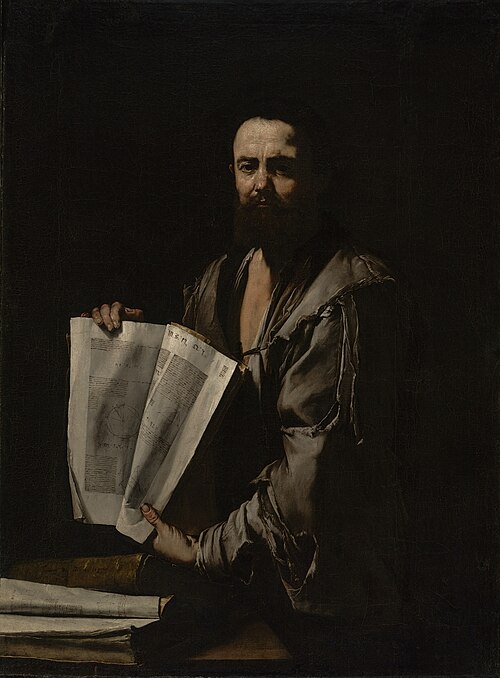
Picture: Euclid, a later imagined portrait by Jusepe de Ribera, about 1630–1635, J. Paul Getty Museum, 2001.26
Jusepe de Ribera; Wikimedia Commons; Public domain; faithful reproduction of a public-domain artwork. Image record, Public domain; faithful reproduction of a public-domain artwork.

The round picture in the lists of the personalities is cropped from it.