





3 min read
Keeper of the Old Arts
Eyvindr kelda
author: High Priest Zevios Metathronos
The practitioner who would not renounce his art
Dates: placed in the late 990s CE by saga tradition
Period: Darkness (800–1000 CE)
Region: Norway
Tradition: Old Norse magical practice
Religion or tradition: Old Norse magical and religious practice, described in the saga as seiðr.
Heresy status: No designation documented.
Eyvindr kelda appears in the conversion narratives of Óláfr Tryggvason as a practitioner of magic who refuses to abandon the old religious arts. The surviving portrait is transmitted by later Christian authors, whose purpose includes demonstrating the king’s triumph over rival powers. It provides a memorable account of resistance, with important limits on what can be claimed about the historical man.1
KEEPING THE RIGHT TO PRACTISE IN VIEW
Eyvindr’s declared intention to continue his arts, after escaping the burning hall, is the constructive point of his remembered defiance. The saga preserves a practitioner who treats his religious knowledge as something he will continue to exercise despite a ruler’s prohibition. That statement gives individual agency a place in an account otherwise organized around royal conversion.2
For human religious history, the story keeps visible the people whose knowledge stood outside the victorious institution. For Zevist readers, it provides an example of loyalty to inherited practice and of resistance to its forced extinction. The value belongs to the remembered act of persistence. Recovering it with care allows later generations to see the threatened practitioner as a person with commitments, skills and a will of his own.
SURVIVAL AND REFUSAL
Snorri’s narrative describes the king assembling practitioners of magic at Tønsberg, making them drunk and setting fire to the building. Eyvindr escapes through an opening in the roof. He subsequently sends word that he intends to continue his arts. In the story, this declaration makes him a conscious opponent of imposed religious conformity.3
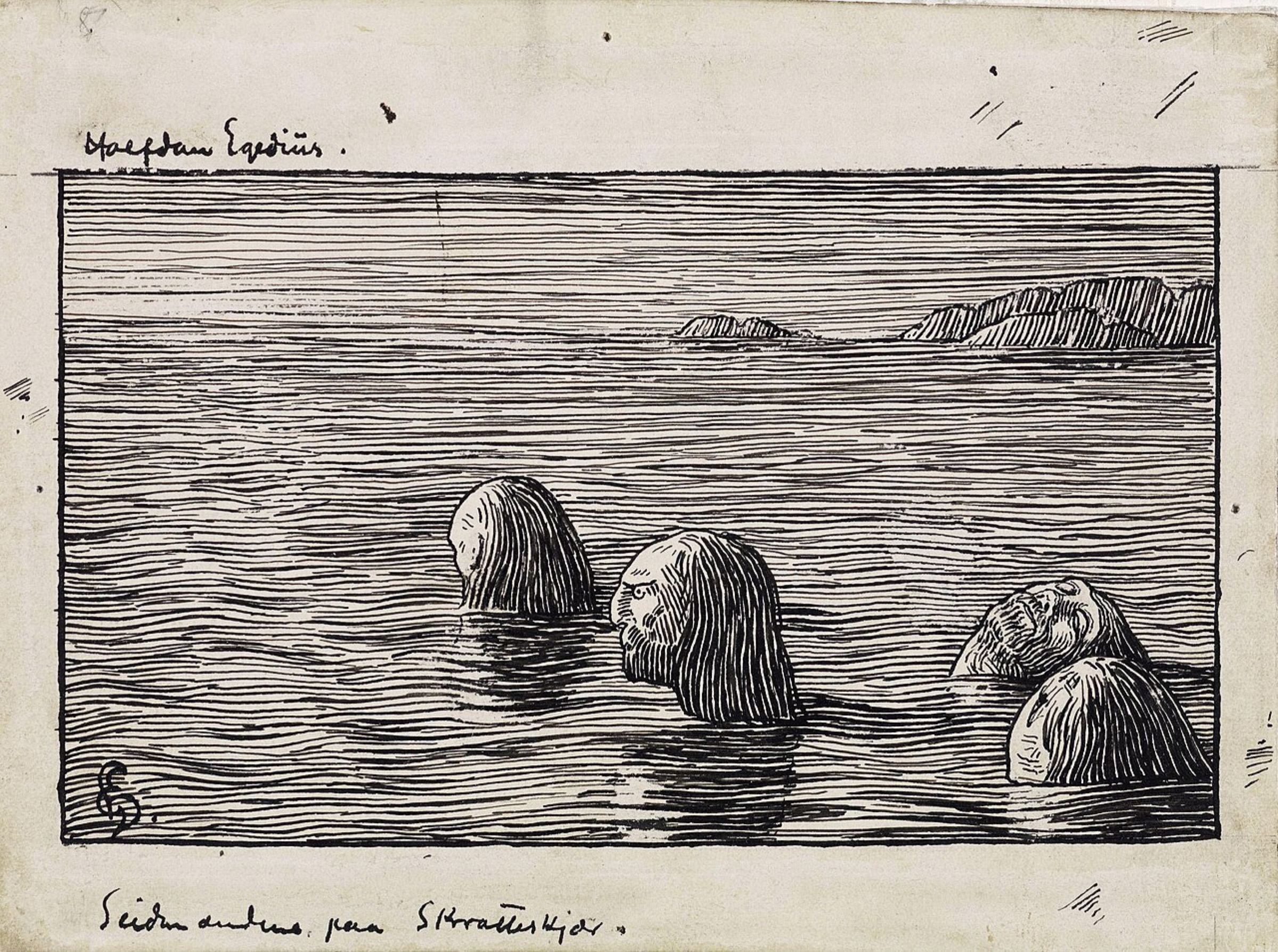
The next episode places Eyvindr and companions at Avaldsnes. They approach under a concealing mist, but the mist confounds their own movement. They are captured and killed by drowning on a skerry. The reversal of magical protection is integral to the Christian victory narrative. The account can be studied as evidence for how resistance was remembered, while its supernatural mechanism remains a feature of the text.4
WHAT THE HOSTILE LABEL REVEALS
Francesco Sangriso’s analysis examines how the conversion literature associates practitioners such as Eyvindr with the ancient religion while giving their skills a diabolical explanation. The same literature grants supernatural effectiveness to Christian prayer and prophecy. The distinction is theological: one form of power is authorized, the other condemned.5
Eyvindr’s story reveals how ecclesiastical narratives represented opponents through the language of sorcery and demonic allegiance. His inclusion does not require accepting that hostile description as his own religious identity. It also requires keeping him separate from Eyvindr skáldaspillir, the poet, and Eyvindr kinnrifa, another figure in conversion narratives.
A ZEVIST INTERPRETATION
The principle represented by Eyvindr’s story is the refusal to surrender a religious practice merely because a ruler condemns it. His remembered persistence directs attention to the human knowledge threatened when a tradition’s specialists are removed: skills, instruction, memory and ritual continuity can disappear together.
A reader can therefore study this account as a record of contested religious authority. Its force comes from the preserved act of refusal and from the exposure of coercion within a triumphal narrative. Its scholarly integrity comes from acknowledging the distance between that narrative and a fully documented tenth-century biography.
NOTES
1 Olaf Tryggvason Saga, chapters 69–70.
2 Olaf Tryggvason Saga, chapter 69.
3 Chapter 69.
4 Chapter 70.
5 “The Wizard and the Soothsayer”.
BIBLIOGRAPHY
Snorri Sturluson, Heimskringla, Samuel Laing translation, Olaf Tryggvason Saga, chapters 69–70, public-domain text.
Francesco Sangriso, “The Wizard and the Soothsayer,” Deshima 18 (2024), pp. 99–122, open article.
CREDIT
Picture: Later saga illustration. Halfdan Egedius, The Wizards at Skratteskjær, 1897–1899, National Museum of Norway. The illustration represents the saga’s fate of Eyvindr and his companions; individual faces are the artist’s invention.
Credit: Halfdan Egedius. Source record, Public domain.

The round picture in the lists of the personalities is cropped from it.