




9 min read
Priestess of the Mysteries
Fabia Aconia Paulina
author: High Priest Zevios Metathronos
Dates: Active in the 4th century CE
Period: Roman period (30 BCE–800 CE)
Fabia Aconia Paulina was a Roman noblewoman who held initiations and priesthoods in the cults of Demeter and Kore, Hecate, Isis and the Mother of the Gods. Her inscriptions name her an initiate at Eleusis, at Lerna and at Aegina, a tauroboliata, a priestess of Isis and a hierophant of Hecate.1
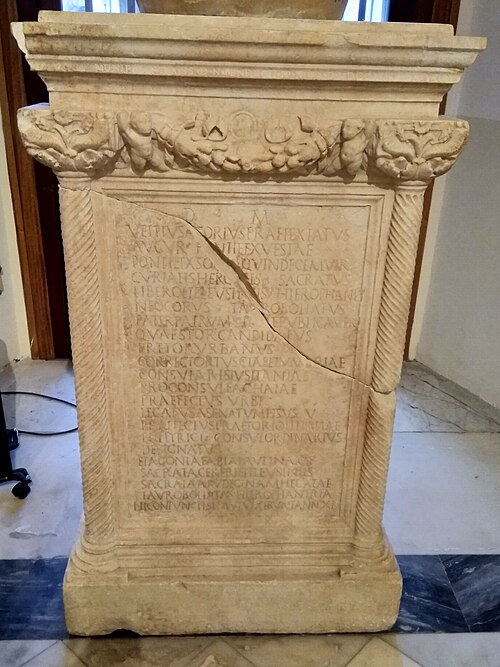
Her own voice survives in a poem cut into the back of the funerary monument she shared with her husband, Vettius Agorius Praetextatus. It tells how he led her into the temples and the mysteries, and how she meant to stay his after death. The marble stands today in the Capitoline Museums.2
Zevism reads Paulina as a servant of Demeter and Kore, of Hecate and of the Mother of the Gods. Her poem is a record of the path of initiation as a married couple walked it, from teaching to rite to a claim on the life beyond.
LIFE AND CONTEXT
Paulina was born to rank. An inscription names her father as Aco Catullinus, “formerly prefect and consul,” and her husband as “prefect and consul elect.”3 Her poem opens on the same note: “My parents' distinction did nothing greater for me than that I even then seemed worthy of my husband.”4
The marriage lasted 40 years. The monument says so plainly: “hi coniuncti simul vixerunt ann(os) XL,” they lived joined together 40 years.5 Praetextatus held the highest offices of Rome and a long list of priesthoods, and he died in 384 as consul designate.6
The side faces of the monument speak about her. One calls her “devoted to the temples and friend of the divinities, who put her husband before herself, and Rome before her husband.” On the other, Praetextatus addresses her directly: “To this partnership I entrusted the hidden secrets of my mind; it was a gift of the gods.”4
Her initiations took her to 3 sanctuaries of Greece. At Eleusis she was initiated “to the god Iacchus, Ceres and Cora,” at Lerna “to the god Liber and Ceres and Cora,” and at Aegina “to the two goddesses.” The same inscription calls her “tauroboliata, priestess of Isis, hierophant of the goddess Hecate, and initiate in the rites of the Greek Ceres.”3
Pausanias describes both places in his Description of Greece. The Lernaean mysteries “were established, they say, by Philammon,” in a grove of plane trees running down to the sea, with images of Demeter Prosymne and Dionysus. On Aegina the people worshipped Hecate most of all the Gods.7
She outlived her husband. The monument dates from after 384, and the poem speaks of him as gone.8 The year of her own death isn't recorded.
ATTAINMENTS
- She was initiated into the Eleusinian mysteries of Iacchus, Ceres and Cora, and into the rites of the Greek Ceres.3
- She was initiated at Lerna in the Argolid to Liber, Ceres and Cora, in mysteries said to have been founded by Philammon.9
- She was initiated to Hecate at Aegina and held the title of hierophant of Hecate.10
- She received the taurobolium, the rite of Dindymene and Attis, and was a priestess of Isis.3
- She had a statue made and set up in honour of Coelia Concordia, chief of the Vestal Virgins.11
- The rear face of the monument carries a poem in her voice, longer than the verses given to her husband on the left side.10
KEY STORIES
What the Back of the Stone Says
The front of the monument lists titles. The back gives Paulina the word. She praises her husband's learning first: whatever the sages had written “in either language,” Greek or Latin, poetry or prose, “these you make better than when you took them up to read.”12
Then she turns to what he gave her. “By the gift of your learning you keep me pure and chaste from the fate of death; you take me into the temples and devote me as the servant of the gods. With you as my witness I am introduced to all the mysteries.” He honoured her “as priestess of Dindymene and Attis with sacrificial rites of the taurobolium,” and instructed her “as minister of Hecate in the triple secret.”3
Office didn't count for much. His honours and powers, she says, “you always judge transitory and insignificant, since your title to eminence depends on the insignia of your priesthood.” The rites made her name as well: “On account of you everyone praises me as pious and blessed,” and “Roman mothers seek an example from me.”
The poem ends in grief and a vow. “Now that all these have been taken away I your wife waste away in sorrow.” She'd have been happy, she says, if the Gods had let him outlive her, “but still I am happy because I am yours and have been yours and will now be yours after my death.”3
A Statue for the Chief Vestal
Coelia Concordia was chief of the Vestal Virgins. She'd done something the inscription treats as remarkable: she had set up a statue to a man, Praetextatus.3
Paulina answered with a statue of her own. The base survives with its text: “In honour of Coelia Concordia, chief Vestal Virgin, Fabia Paulina arranged that a statue be made and set up first on account of her distinguished chastity and celebrated holiness concerning the divine cult, and chiefly because [Coelia Concordia] first had set up a statue to [Paulina's] husband Vettius Agorius Praetextatus.”13
The inscription gives the reason in its last words. Praetextatus, it says, was “a man in all ways exceptional and deserving of honour even by virgins and by priestesses of this [high] rank.” One priestess had honoured the husband, and the wife, a priestess herself, honoured her in return.
Tartarus or the Milky Way
In 384 Jerome was living in Rome, and he knew what Paulina was saying about her husband. In a letter to Marcella he set the pagan's glory beside the death of Lea, head of a Christian community in the city. Only days before, he wrote, “the highest dignitaries of the city walked before him as he ascended the ramparts of the capitol like a general celebrating a triumph.”14
Then he gave his verdict on where Praetextatus had gone. He didn't use the widow's name. “Now he is desolate and naked, a prisoner in the foulest darkness, and not, as his unhappy wife falsely asserts, set in the royal abode of the milky way.”14
The line preserves Paulina's claim through the mouth of her opponent. She had declared that her husband now dwelt in the Milky Way. Her poem makes the same claim for herself: she would be his after death as well.3
The Island of Hecate
Aegina lies in the Saronic Gulf, a short sail from Athens. Pausanias says that “of the gods, the Aeginetans worship most Hecate, in whose honor every year they celebrate mystic rites which, they say, Orpheus the Thracian established among them.” Inside the sacred enclosure stood a temple, and in it a wooden image of the Goddess carved by Myron, “and it has one face and one body.”15
Paulina was “sacrata apud Eginam Hecatae,” consecrated to Hecate at Aegina.5 She wasn't only an initiate there. Her other inscription names her “hierophant of the goddess Hecate,” the one who showed the sacred things to others.3 Her poem adds that her husband taught her “the triple secret” of Hecate as the Goddess's minister. The rite the Aeginetans traced to Orpheus was still receiving initiates from Rome in Paulina's day.
THE ZEVIST READING
The Homeric Hymn to Demeter states what Eleusis promised. After the Goddess taught her rites to the lords of Eleusis, the poet says, “Happy is he among men upon earth who has seen these mysteries; but he who is uninitiate and who has no part in them, never has lot of like good things once he is dead, down in the darkness and gloom.”16 Paulina had seen those mysteries at Eleusis and again at Lerna. Zevism reads her hope for the life beyond as trust in that promise of Demeter and Kore.
Jerome put her husband “in the foulest darkness.” Zevism reads darkness differently. Unexplored darkness is where the initiate walks carrying light, and darkness explored becomes Light, which is knowledge. The mysteries led their initiates into the unknown with a guide, and Paulina had one at her side for 40 years.
Her poem also describes a transmission. He took what the sages wrote and made it better; he passed the rites on to her; she became a hierophant herself. Zevism honours such keepers of the source. The learning moved from the books to the husband, from the husband to the wife, and from the wife, as hierophant, to those her office served.
The aim of that path is likeness to the divine “as far as possible,” ὁμοίωσις θεῷ κατὰ τὸ δυνατόν.17 Paulina's own words set the measure: her husband's learning in the things of the Gods kept her “pure and chaste from the fate of death.” The Temple reads that line as the literal elevation of a human life toward the divine.
NOTES
1 Lefkowitz and Fant, Women's Life in Greece and Rome, no. 439.
2 CIL VI 1779, Latin text; Musei Capitolini, MC0208.
3 Lefkowitz and Fant, no. 439.
4 CIL VI 1779, tr. in Lefkowitz and Fant.
5 CIL VI 1779.
6 Kahlos, “The Restoration Policy,” p. 39.
9 Lefkowitz and Fant, no. 439; Pausanias 2.37.
10 CIL VI 1779; Lefkowitz and Fant, no. 439.
11 CIL VI 2145, in Lefkowitz and Fant, no. 439.
12 CIL VI 1779, tr. in Lefkowitz and Fant, no. 439.
13 CIL VI 2145, tr. in Lefkowitz and Fant, no. 439.
15 Pausanias 2.30.2.
16 Homeric Hymn to Demeter 476–482.
BIBLIOGRAPHY
CIL VI 1779, Latin transcription, funerary monument of Praetextatus and Paulina, from the Clauss–Slaby database on the CIMRM 420 record; titles, 40 years of marriage and the rear-face poem.
Mary R. Lefkowitz and Maureen B. Fant, “Paulina, Priestess of Several Mystery Cults,” no. 439, Women's Life in Greece and Rome: A Source Book in Translation, Johns Hopkins University Press; selections on Diotíma; translations of CIL VI 1779, 1780 and 2145 (= ILS 1259–1261).
Musei Capitolini, Ara funeraria di Vettius Agorius Praetextatus e Aconia Fabia Paulina, inventory MC0208, marble, after 384 CE.
Maijastina Kahlos, “The Restoration Policy of Vettius Agorius Praetextatus”, Arctos 29 (1995), pp. 39–47; p. 39.
Jerome, Letter 23, to Marcella, tr. W. H. Fremantle, G. Lewis and W. G. Martley, Nicene and Post-Nicene Fathers, 2nd series, vol. 6, 1893; §3.
Pausanias, Description of Greece 2.29–38, tr. W. H. S. Jones, Loeb Classical Library, Theoi Classical Texts Library; 2.30.2 and 2.37.
Homeric Hymn to Demeter 476–482, tr. H. G. Evelyn-White, Theoi Classical Texts Library.
Plato, Theaetetus 176a–b, Greek text, Perseus Digital Library.
CREDIT
Picture: Front of the inscribed funerary monument of Praetextatus and Paulina, CIL VI 1779, Capitoline Museums. This is their commemorative inscription, not a portrait.
MassimoCimoli, photograph2019; Wikimedia Commons; CC BY-SA 4.0. Image record, CC BY-SA 4.0.

The round picture in the lists of the personalities is cropped from it.