




9 min read
Master of Numbers
Leonardo of Pisa (Fibonacci)
author: High Priest Zevios Metathronos
Dates: c. 1170–after 1240
Period: Ignorance (1000–1336 CE)
Leonardo of Pisa, a member of the Bonacci family and known today as Fibonacci, taught Latin Europe to calculate with the Hindu-Arabic numerals. His Liber abaci of 1202, reissued in 1228, ran to 15 chapters. It began with the 9 Indian figures and zero and went on through trade, barter, partnerships, currencies, measurement and algebra.1
The masters of computation, the maestri d'abbaco who taught arithmetic in the Italian towns, built their craft on it. His Liber quadratorum of 1225 is the work of a pure mathematician; MacTutor ranks him on its strength as “the major contributor to number theory between Diophantus and the 17th-century French mathematician Pierre de Fermat.”2
Zevism reads him under Hermes, the God to whom Zeus gave the office of exchange among men. He also counts in the Temple as a keeper of the source: he learned his method from Indian and Arabic teachers and said so in his own preface.
LIFE AND CONTEXT
He was born in Pisa about 1170. The Bonacci were his family, and he sometimes called himself Bigollo, a name whose meaning remains unexplained.3 His father, Guilielmo, held a post representing the merchants of the Pisan republic who traded at Bugia, now Béjaïa in Algeria.4
The boy was schooled there in accounting and the Indian numerals, and later travelled on business to Egypt, Syria, Greece, Sicily and Provence. He came back to Pisa around 1200 and began to write.5 He wasn't the first European to meet the numerals, which appear in the Codex Vigilanus, copied by a monk in Spain in 976, but they had come to Europe through the western Arabic world, and he brought them from its schools.6
The Liber abaci appeared in 1202. The 2nd version of 1228, to which, in his words, “new material has been added and from which superfluous removed,” is dedicated to Michael Scotus, the astrologer of the emperor Frederick II, and survives in 12 manuscript copies.3 The Practica geometriae, a collection of geometry problems in 8 chapters built on Euclid, followed in 1220 or 1221, dedicated to a Master Dominicus.5
Scholars at the court of Frederick II had corresponded with him since his return. When the emperor held court in Pisa about 1225, Dominicus presented Leonardo to him, and 2 books of that year, the Flos and the Liber quadratorum, answer questions raised there.5
After 1228 only 1 document mentions him. In a decree of 1240 the republic of Pisa awarded “the serious and learned Master Leonardo Bigollo” a yearly salary of “libre XX denariorum,” 20 pounds, in recognition of his usefulness to the city. MacTutor names the services: advising on matters of accounting and teaching the citizens. He died in Pisa after that date.5
ATTAINMENTS
- He wrote the Liber abaci in 1202 and revised it in 1228, dividing it into 15 chapters that took a reader from reading numerals to commercial arithmetic, measurement and algebra.3
- Its opening chapter explains the 9 Indian figures, the sign 0 and the rule that a figure's place gives its value, so that a handful of signs can write any number.7
- For Johannes of Palermo he found a number x with x² + 5 and x² − 5 both squares; the answer is 41/12.3
- He proved that the root of x³ + 2x² + 10x = 20 can be “neither a whole number, nor a fraction, nor one of the Euclidean irrational magnitudes,” then computed it in sexagesimal fractions, correct to 9 decimal places.8
- His Liber quadratorum of 1225, the Book of Squares, is a work of number theory that among other things finds Pythagorean triples.9
- The Practica geometriae of 1220 or 1221 collected geometry problems in 8 chapters, with theorems based on Euclid's Elements and On Divisions.9
- The rabbit problem in chapter 12 of the Liber abaci produced the sequence 1, 2, 3, 5, 8, 13, in which each term is the sum of the 2 before it.10
KEY STORIES
The Boy at the Customs House of Bugia
The preface to the Liber abaci tells how it began. “When my father, who had been appointed by his country as public notary in the customs at Bugia acting for the Pisan merchants going there, was in charge, he summoned me to him while I was still a child.”9
The father had a plan for the boy. “Having an eye to usefulness and future convenience,” he “desired me to stay there and receive instruction in the school of accounting.” In that school, on the North African coast, Leonardo met the numerals he would carry to Europe: “There, when I had been introduced to the art of the Indians' nine symbols through remarkable teaching, knowledge of the art very soon pleased me above all else.”9
He didn't stop at Bugia. He went looking for “whatever was studied by the art in Egypt, Syria, Greece, Sicily and Provence, in all its various forms.” Vogel describes these as business journeys.5 The book he wrote on his return named the Indians as the source of the method, and the Temple honours him for naming it.11
Problems for the Emperor
About 1225 Frederick II held court in Pisa. Master Dominicus, the man to whom Leonardo had dedicated his geometry, presented him to the emperor, who wanted to meet him.3 A court scholar, Johannes of Palermo, then “presented a number of problems as challenges to the great mathematician Fibonacci.”9
The 1st asked for a square that stays a square when 5 is added to it or taken from it. Leonardo found x = 41/12: its square plus 5 is (49/12)², its square minus 5 is (31/12)².3
The 2nd was harder: solve x³ + 2x² + 10x = 20. Leonardo showed first that the answer couldn't be found by the old means, since it was “neither a whole number, nor a fraction, nor one of the Euclidean irrational magnitudes.” Then he approximated it in base 60 as 1.22.7.42.33.4.40. Vogel found the last place “too great by about 1 1/2,” and MacTutor judges the value correct to 9 decimal places, “a remarkable achievement.”8
He answered with books. The Flos gathered his solutions, and the Liber quadratorum took up the question of squares Johannes had set.3
The Book of Squares
The square problem Johannes had set sent Leonardo back to first principles. The Liber quadratorum, the Book of Squares, is the answer he wrote in 1225, a number theory book which, in MacTutor's words, “among other things, examines methods to find Pythagorean triples.”8
Its method rests on a fact about odd numbers. Add them in order, 1, then 3, then 5, then 7, and the running totals are the squares 1, 4, 9 and 16. Leonardo used this to find 2 squares whose sum is a square: “I take 9 as one of the two squares mentioned; the remaining square will be obtained by the addition of all the odd numbers below 9, namely 1, 3, 5, 7, whose sum is 16.”9
And 9 and 16 make 25. The example is small, but the method isn't. Any odd square can take the place of 9: for 25, the odd numbers below it sum to 144, and 144 and 25 make 169, the square of 13. That's the road from a single case to the Pythagorean triples the book sets out to find.9
The Rabbits in the Walled Place
Chapter 12 of the Liber abaci holds a problem that became more famous than the book. “A certain man put a pair of rabbits in a place surrounded on all sides by a wall. How many pairs of rabbits can be produced from that pair in a year if it is supposed that every month each pair begets a new pair which from the second month on becomes productive?”12
Leonardo counted month by month. The pairs went 2, 3, 5, 8, 13, 21 and on, each total the sum of the 2 before it, until at the end of the year the walled place held 377 pairs. The world of the problem is deliberately simple: rabbits don't die in it.10
The numbers were older than the rabbits. Indian scholars of Sanskrit metre had met them first; “both Gopala (before 1135AD) and Hemachandra (c.1150) mentioned the numbers 1,2,3,5,8,13,21 explicitly.” The sequence gained its fame only in the 19th century, through the French mathematician Édouard Lucas.13
THE ZEVIST READING
In the Homeric Hymn to Hermes, Apollo tells his young brother: “you have an office from Zeus, to establish deeds of barter amongst men throughout the fruitful earth.”14 The Liber abaci is that office worked out in numbers. Its chapters on barter, partnership and the exchange of coins gave merchants a way to settle a trade that both sides could check, and Zevism reads Leonardo as a servant of Hermes.
He was a Christian of the Pisan republic, in Vogel's phrase “the first great mathematician of the Christian West,” and he learned his art in a North African port from teachers who used Indian figures.3 Zevism is the chain of all spirituality, and his career shows the chain at work: India, the Arabic world and Latin Europe joined in 1 book.
The Temple holds that knowledge evolves in transmission while the source keeps priority. Leonardo's preface kept faith with the source by naming it, and the Temple honours transmitters as its keepers. His rabbits tell the same lesson from the other side: the numbers Gopala and Hemachandra had counted in Sanskrit verse reached Europe in a Pisan merchant's book, and returning to the source means reading those older counts as well.
Measurement and true accounts restore Ma'at, the order of the cosmos held by Zeus as its Sovereign; Egyptian religion called her “the personification of truth, justice, and the cosmic order.”15 A partnership divided by a method both partners can follow is a small restoration of that order, and in 1240 Pisa paid Leonardo for advising on its accounts.
NOTES
1 Vogel, “Fibonacci, Leonardo,” Dictionary of Scientific Biography; Liber abaci, tr. Sigler, pp. 15–18.
2 Vogel; MacTutor, “Fibonacci”.
3 Vogel.
6 MacTutor, “Arabic numerals”.
9 MacTutor.
12 Scott and Marketos, “On the origin of the Fibonacci Sequence”; Sigler, pp. 404–405.
14 Homeric Hymn to Hermes 513–517.
BIBLIOGRAPHY
Leonardo of Pisa, Fibonacci's Liber Abaci, translated by Laurence E. Sigler, Springer, 2002; selected pages, especially preface pp. 15–16, chapter 1 pp. 17–18, and rabbit problem pp. 404–405. This linked PDF is a selection, not the complete volume.
Kurt Vogel, “Fibonacci, Leonardo,” Dictionary of Scientific Biography, reproduced by MacTutor; family name, Bigollo, travels, 1228 edition and dedication, 15 chapters, Practica geometriae, Frederick II's court, Johannes of Palermo's problems, the 1240 decree.
University of St Andrews, MacTutor, “Fibonacci”, biography, preface translation, chronology, Frederick II's court, the rabbit problem and discussion of Liber quadratorum.
J. J. O'Connor and E. F. Robertson, “Arabic numerals”, MacTutor History of Mathematics, January 2001; the Codex Vigilanus of 976 and the route through the western Arabic world.
T. C. Scott and P. Marketos, “On the origin of the Fibonacci Sequence”, MacTutor History of Mathematics, 23 March 2014; the rabbit problem, Gopala and Hemachandra, Édouard Lucas.
Homeric Hymn to Hermes 513–517, H. G. Evelyn-White translation, Theoi Classical Texts Library.
Encyclopaedia Britannica, “Maat”.
CREDIT
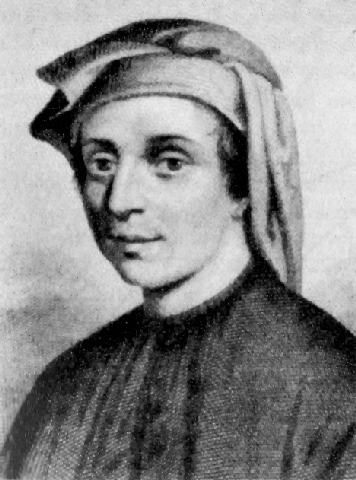
Image: Later imagined portrait of Fibonacci, nineteenth-century engraving. Unknown engraver, associated with an 1850 publication; public domain. It is not a contemporary likeness.

Unknown nineteenth-century engraver; Wikimedia Commons; Public domain; faithful reproduction of a public-domain artwork. Image record, Public domain; faithful reproduction of a public-domain artwork.
The round picture in the lists of the personalities is cropped from it.