




11 min read
Philosopher of Light
Francesco Patrizi of Cherso
author: High Priest Zevios Metathronos
Light, Learning and the Courage to Reconsider
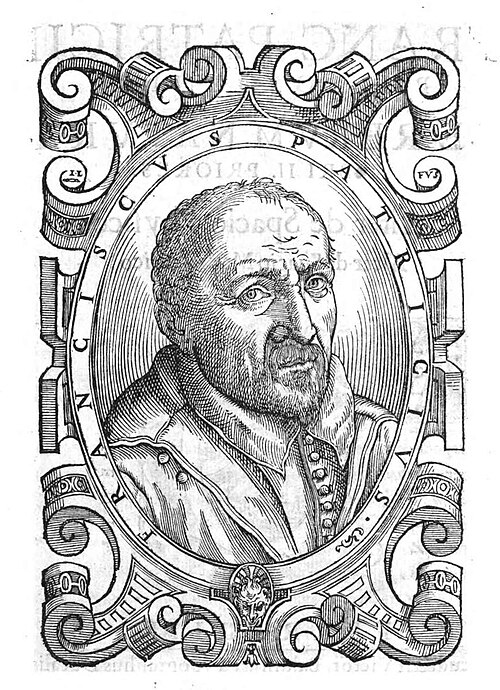
Dates: 1529–1597 CE
Period: Renaissance (1336–1650 CE)
Francesco Patrizi was born on the Adriatic island of Cherso in 1529 and died in Rome in 1597, holding a chair of Platonic philosophy created for him by a pope. His major book, the Nova de universis philosophia of 1591, rebuilt the cosmos from light upward. It did away with the fixed celestial spheres, let the stars move freely through the aether and set a daily turning Earth inside an infinite, light-filled space.1
He also gathered the scattered verses of the Chaldean Oracles. Before him the known collection ran to 60 verses; he raised it to 320, and nobody replaced his edition until 1895.2
Zevism reads his work under Hermes, the Thoth of Egypt, and under the doctrine of Light. He went back past Aristotle to Plato, Hermes and Zoroaster, printed the oracles and the Hermetic books beside his own system, and began his philosophy of everything with the question of how things become visible.
LIFE AND CONTEXT
Patrizi was born on 25 April 1529 at Cherso, today Cres, off the Dalmatian coast. His father Stefano belonged to the minor nobility. At 9 the boy was already at sea, and by 18 he was a student at Padua.3
His first books came out in Venice. In 1553 he published La città felice, a short treatise on the happy city, with other writings; Palumbo notes that it doesn't fit neatly into utopian literature. Della historia followed in 1560 and Della retorica in 1562, each a set of 10 dialogues.4 For most of the 1560s he worked on Cyprus as a steward, first for a Venetian count and then for the archbishop of Nicosia, and hunted Greek manuscripts on the side. The manuscripts later paid his way in Spain.5
At the end of 1577 or early in 1578 the University of Ferrara created a chair of Platonic philosophy for him, on the initiative of the ducal secretary Antonio Montecatini. He held it until 1592, and his salary rose from 390 to 500 lire. In those years he fought Aristotle in print and fought Torquato Tasso too: his Parere in difesa dell'Ariosto of 1585 drew Tasso's reply the same year, and Patrizi answered it in 1586.5
The Nova de universis philosophia appeared at Ferrara in 1591, dedicated to Pope Gregory XIV. Its 4 parts are the Panaugia on light, the Panarchia on first principles, the Pampsychia on soul and the Pancosmia on the physical world. The Panarchia sets out a ladder of 10 levels descending from God, the “One-All” (Un'omnia), through unity, essence and life, and the Pampsychia makes the World Soul “a separate entity which vivifies the universe.” Patrizi argued that “Platonism is more in harmony with Church doctrine than the Stagirite's were.”6
Palumbo reads the dedication as a program of cultural renewal put before the Church's hierarchy, “una nuova e insieme antichissima filosofia,” a philosophy at once new and very old, meant to replace Aristotle in the universities.5
He was a Catholic, and he spent his last years defending the book before the Church's censors in Rome. He died there on 6 February 1597 and was buried in Sant'Onofrio on the Janiculum.5
ATTAINMENTS
- He wrote the Discussiones peripateticae, a critique of Aristotle's philosophy published in 1571 and expanded in 1581 into 4 volumes, printed at Basel by Pietro Perna.7
- In February 1575 he sold 75 Greek codices to Philip II of Spain for 1,000 reali in cash, a major part of the collection he had built on Cyprus.7
- He taught Platonic philosophy at Ferrara from 1578 to 1592, in a chair created for him, and then at the Sapienza in Rome, where Clement VIII created another.8
- His editions of Proclus's Elements of Theology and Elements of Physics appeared at Ferrara in 1583, printed by D. Mammarello.5
- In 1587 he published Della nuova geometria, dedicated to Carlo Emanuele of Savoy, and the De rerum natura. The Stanford entry traces to his work the distinction between mathematical and physical space later taken up by Galileo, Kepler, Newton, Descartes and Leibniz.9
- The Nova of 1591 replaced Aristotle's place with space, rejected Aristotle's denial of the vacuum, dropped the fixed celestial spheres and accepted the Earth's daily rotation.10
- The same volume printed, as appendices, the Chaldean Oracles under the name of Zoroaster and the Hermetic books under the name of Hermes Trismegistus. His oracle collection drew on Psellos, Plethon, Proclus, Damascius and other late Platonists and grew the text from 60 verses to 320.11
KEY STORIES
From the Galley to Ficino's Theology
In February 1538 a boy of 9 went aboard the galley his uncle Giovanni commanded in the campaign against the Turks. By 1543 the sea had given way to books. He reached Venice in September 1543, went north to Ingolstadt in 1544 and 1545 to learn Greek, and enrolled at the University of Padua in May 1547.5
At Padua he found the book that set his course: Marsilio Ficino's Theologia platonica de immortalitate animarum, on the immortality of souls, written between 1469 and 1474 and printed in 1482. Its author had also put the whole of Plato into Latin, 36 translations printed in October 1484.12
Palumbo calls Patrizi's reading of Ficino “fondamentale,” and she quotes his own account of it, written for Baccio Valori on 12 January 1587: “tale fu il principio di quello studio che poi sempre ha seguitato.” Such, that is, was the beginning of the study he followed for the rest of his life.5 His road to Plato had run through a Florentine's Latin, and Patrizi, who'd learned Greek at Ingolstadt, spent that life reaching for the Greek behind it.
Manuscripts for the King of Spain
On 10 August 1560 Patrizi sailed for Cyprus as administrator of the estates of Giorgio II Contarini, count of Zaffo. In 1567 he moved into the service of the archbishop of Nicosia, Filippo Mocenigo. Palumbo describes those years as an “appassionata ricerca di manoscritti greci,” a passionate hunt for Greek manuscripts.5
He was back in Venice by 1568. In 1572 he took the codices to Barcelona, coming, in words Palumbo quotes, “per necessità, e con speranza […] che vi sarebbon ben pagati”: out of need, and hoping they'd fetch a good price there.
The sale came 3 years later. In February 1575 Antonio Gracián, secretary to Philip II, received him in Madrid, and the crown bought 75 codices for 1,000 reali in cash.5 The Stanford entry calls it “a major portion of his Greek manuscripts.”13
A Chair in Rome and a Book on Trial
Clement VIII was elected pope on 30 January 1592 and invited Patrizi to Rome. He arrived on 18 April, lodged in the palace of Cinzio Aldobrandini, and opened his lectures at the Sapienza on 15 May with Plato's Timaeus. His pay of 600 scudi a year was the highest at the university.5
By October the Nova was under examination. Pedro Juan Saragoza wrote the first censure. Patrizi answered with an Apologia in December 1592. The Jesuit Benedetto Giustiniani produced a 2nd, milder censure, but Cardinal Francisco Toledo gave the final negative opinion, and the book was prohibited on 2 July 1594.5
The Index of 1596 listed it with the formula “until corrected.” Patrizi didn't abandon it. He drafted an Emendatio of his new philosophy and at least 4 versions of explanatory Declarationes, and he was still at that work when he died on 6 February 1597.14
THE ZEVIST READING
The Nova begins with light. In the Panaugia Patrizi reaches God through light and treats it “as an intermediary between the corporeal and incorporeal realms.”6 Zevism teaches that unexplored darkness isn't evil; it's what one walks into carrying light, and explored darkness becomes knowledge. Patrizi's cosmos is that doctrine drawn as a map: an Earth turning in an infinite expanse of light-filled space, with no crystal shell to close it off.
His 2nd instinct was the chain. He printed the Hermetic books beside Plato. Britannica describes them as works “ascribed to the Egyptian god Thoth (Greek Hermes Trismegistos),” and dates the collection between the middle of the 1st century and the end of the 3rd century CE.15 In the Phaedrus Socrates credits the same God, as Theuth, with number, calculation, geometry, astronomy and letters.16
Zevism holds that spirituality forms 1 chain from its beginning, with Egypt, Persia and Greece as links in it. Patrizi, a Catholic who dedicated his book to a pope, set Zoroaster, Hermes and Plato in a single line of wisdom. He believed those books older than they were, and the Stanford entry notes that arguments against their authority were put forward within his own lifetime.17 Zevism keeps his instinct and corrects his dates.
The Chaldean Oracles taught, in Hladký's summary, that the soul “can be released through the rituals performed by theurgy,” and Patrizi drew his verses from the late Platonists who used them, above all Proclus. Hladký notes that Patrizi himself “downplays the theurgic aspect.”11 Even so, his 320 verses kept the text together for 3 centuries. Zevism honours such a man as a keeper of the source. Theurgy, the joining of human intelligence to the intelligence of the Gods, needs its words intact before anyone can practise it.
The trial in Rome adds the last measure. Patrizi answered his censors with corrections and explanations and was still revising when he died. That's the existential dimension of the Zevist path, a life spent in service of ὁμοίωσις θεῷ κατὰ τὸ δυνατόν, becoming like the divine “as far as possible.”18 For a philosopher it means following the argument to the end, even under censure.
A PLATONIC EDUCATION PURSUED UNDER ECCLESIASTICAL CENSURE
Religion or tradition: Christianity: Platonic philosophy with Hermetic sources.
Heresy status: Christian Heretic: philosophical writings condemned by the Congregation of the Index.
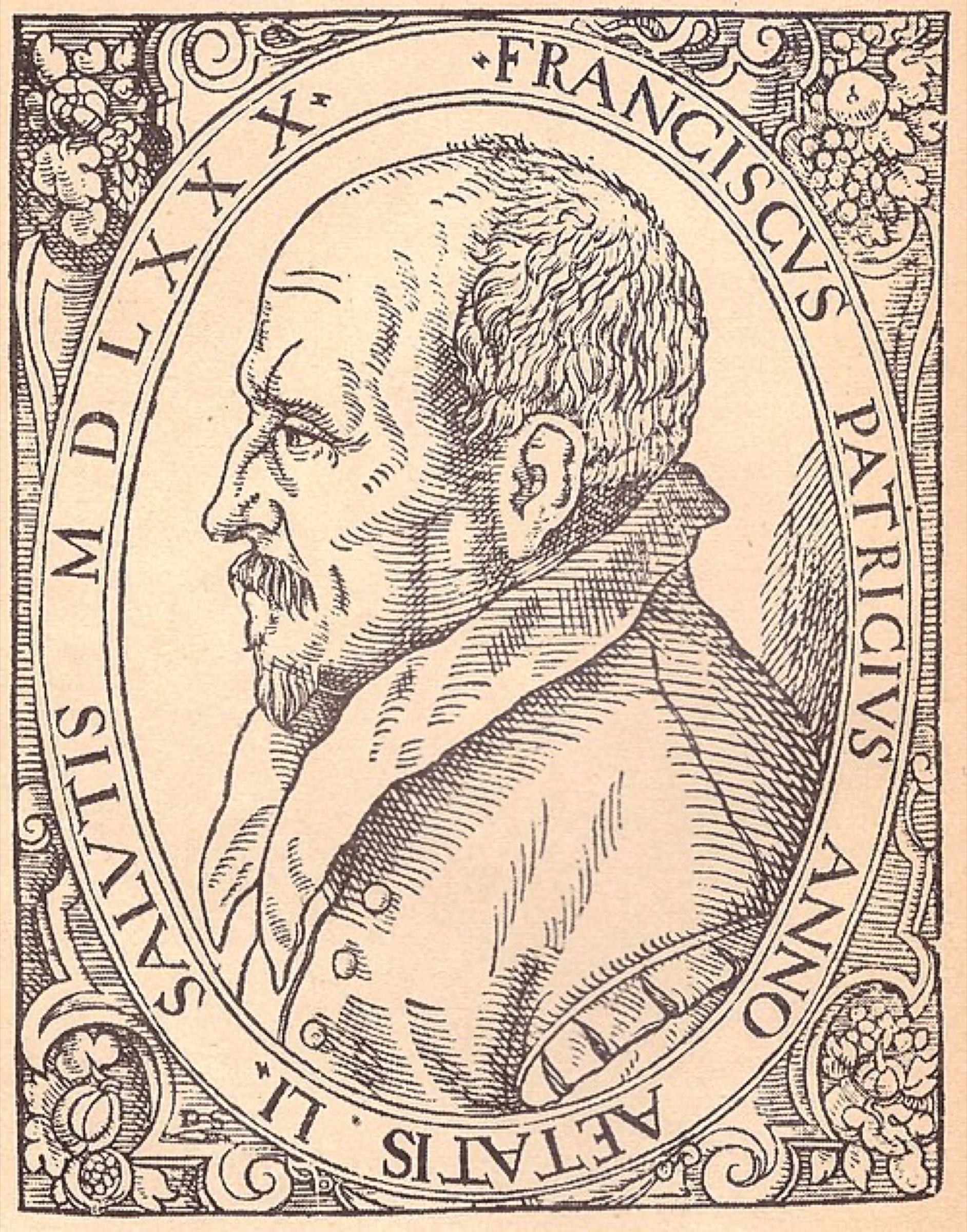
The designation Christian Heretic here concerns condemned philosophical writings. It does not imply that every act of reading or teaching Plato was forbidden, nor that Patrizi’s university position was itself clandestine.
PRESERVING THE POSSIBILITY OF ANOTHER PHILOSOPHICAL EDUCATION
His contribution to humanity lies in giving another intellectual inheritance an organized place in education. Students could encounter alternatives to the accepted curriculum and ask which account of nature and divinity they found most coherent. The preservation of competing philosophical traditions enlarges the range of questions later generations are able to ask.
HONORARY REMEMBRANCE IN THE TEMPLE
Zevist devotional interpretation. We remember Patrizi as a soul seeking advancement through the doctrines of ancient divine philosophy. His sustained engagement with Platonic and Hermetic learning gives the Temple a direct reason to honour him. In this remembrance, the Gods’ knowledge continued to draw the mind even within an institutionally Christian setting.
His misfortune was the collision between an invitation to teach and a demand that the resulting philosophy be corrected under ecclesiastical authority. Recognition did not bring unrestricted freedom. A lifetime of learning could still end with the author defending the legitimacy of its central expression.
For what he endured in sustaining this ancient inheritance, Patrizi receives honorary mention. This is a Zevist recognition of service and suffering for the Gods’ wisdom. It does not require assigning him an undocumented secret rite or private profession of pagan faith.
May his next incarnation bring a place where the Gods’ doctrines can be studied and practised openly. May the mind’s search advance through patient understanding, free from political or religious coercion.
NOTES
1 Purnell, “Francesco Patrizi,” SEP §§1, 5; Palumbo, DBI.
2 Hladký, “Francesco Patrizi and the Oracles of Zoroaster”.
3 Palumbo, “Patrizi, Francesco,” DBI 81.
4 Institute of Philosophy, Zagreb, “Franciscus Patricius”.
5 Palumbo, DBI.
7 Palumbo, DBI; Purnell, SEP §1.
8 Purnell, SEP §1; Palumbo, DBI.
9 Palumbo, DBI; Purnell, SEP §§1, 5.
10 Purnell, SEP §5.
11 Hladký, “Oracles of Zoroaster”.
12 Celenza, “Marsilio Ficino,” SEP.
13 Purnell, SEP §1.
14 Palumbo, DBI; Institute of Philosophy, Zagreb.
15 Britannica, “Hermetic writings”.
17 Purnell, SEP §4.
BIBLIOGRAPHY
Fred Purnell, “Francesco Patrizi”, Stanford Encyclopedia of Philosophy, first published 2004, §§1–5; life, the 4-part system, source criticism and cosmology.
Margherita Palumbo, “Patrizi, Francesco”, Dizionario Biografico degli Italiani, vol. 81, 2014; biographical chronology, the galley, Padua and Ficino, Cyprus and the Escorial sale, the Ferrara chair, the 1583 Proclus editions, the Tasso dispute, the Roman years and censorship. This more detailed account governs the dates of the proceedings and prohibition.
Institute of Philosophy, Zagreb, Library of Croatian Philosophers, “Franciscus Patricius”; life dates, list of works with digitised editions, contents of the Nova and its appendices.
Vojtěch Hladký, “Francesco Patrizi and the Oracles of Zoroaster: The Use of Chaldean Oracles in Nova de universis philosophia”, in Platonism and its Legacy, The Prometheus Trust, 2019.
Encyclopaedia Britannica, “Hermetic writings”.
Christopher S. Celenza, “Marsilio Ficino”, Stanford Encyclopedia of Philosophy; the Theologia platonica and the Latin Plato of 1484.
Plato, Phaedrus 274c–275b, translated by Harold N. Fowler, Perseus Digital Library.
Plato, Theaetetus 176a–b, Greek text, Perseus Digital Library.
CREDIT
Picture: Portrait printed in Patrizi's Philosophia de rerum natura, Ferrara, 1587. Historical book illustration; public-domain status recorded by Commons. The book author is Patrizi; the portrait artist is not securely identified in the record.

Unidentified portrait artist;bookbyFrancescoPatrizi / Wikimedia Commons; Public domain. Image record, Public domain.
The round picture in the lists of the personalities is cropped from it.
Portrait (honorary edition): Historical book portrait. Portrait of Francesco Patrizi dated 1580 in the image record, reproduced from the 1581 Basel edition of his Discussiones peripateticae. The sitter is identified; the engraver is not securely identified. A repository-provided rendition is preserved.
Credit: Unidentified engraver; portrait in Patrizi’s Discussiones peripateticae. Source record, Public domain. Faithful enlargement; no new image content added.
