



9 min read
Architect of the Code
Francis Crick
author: High Priest Zevios Metathronos
Asking What the Structure Makes Possible
Dates: 1916–2004
Period: Modern period, 1900–present
Francis Crick was an English physicist who turned to biology after the Second World War. With James Watson at the Cavendish Laboratory in Cambridge he proposed, in 1953, “the double-helical structure for DNA and the replication scheme,” and he shared the Nobel Prize in Physiology or Medicine for it in 1962.1
His 2nd great result came in 1961. With Leslie Barnett, Sydney Brenner and Richard Watts-Tobin he showed by experiment that “a group of three bases (or, less likely, a multiple of three bases) codes one amino-acid,” read “from a fixed starting point.”2
Zevism reads that work under the Logos, the account by which, in Heraclitus' words, “all things happen.”3 Crick found the rule by which a living cell reads its own script, and the Temple counts that as light carried into what had been dark.
LIFE AND CONTEXT
Crick was born in Northampton on 8 June 1916. He went to Northampton Grammar School and Mill Hill School in London, then read physics at University College London and took his BSc in 1937. He began a doctorate there under E. N. da C. Andrade, “but this was interrupted by the outbreak of war in 1939.”4
The war made him a weapons scientist. At the Admiralty Research Laboratory he worked “mainly in connection with magnetic and acoustic mines.” He left the Admiralty in 1947 to study biology, first at the Strangeways Research Laboratory in Cambridge on a Medical Research Council studentship. In June 1949 he joined the Medical Research Council Unit at the Cavendish Laboratory, headed by Max Perutz. That year he married Odile Speed, and they had 2 daughters, Gabrielle and Jacqueline.5
He was still a graduate student when the double helix came. His doctoral thesis, X-ray diffraction: polypeptides and proteins, went to Gonville and Caius College in July 1953, after the DNA paper had appeared. The model itself rested on measurements made by others: Rosalind Franklin, Raymond Gosling, Maurice Wilkins and their colleagues at King's College London, and Erwin Chargaff's base ratios.6
After a year at the Protein Structure Project of the Brooklyn Polytechnic in New York, in 1953 and 1954, he returned to Cambridge and to the problem of how a sequence of bases specifies a protein. He was elected a Fellow of the Royal Society in 1959, and in 1962 his unit moved into the new Medical Research Council Laboratory of Molecular Biology.7
Crick was a humanist and rejected religious belief. In 1966 he wrote “Why I am a humanist” for Varsity, the Cambridge student newspaper, and his papers keep the drafts and his exchange of letters with its editor.8
In 1976 he went to the Salk Institute for Biological Studies as a visiting professor, and from 1977 the post became permanent. There he worked with Christoph Koch “on the neural basis of attention to discover the neural correlates of consciousness,” and in 1994 he published The Astonishing Hypothesis: The Scientific Search for the Soul. He received the Order of Merit in 1991 and died on 28 July 2004 at Thornton Hospital, San Diego, aged 88.9
ATTAINMENTS
- With William Cochran and Vladimir Vand he worked out “the general theory of X-ray diffraction patterns produced by continuous and discontinuous helices,” a way to connect a photograph with a helical molecule.9
- With Watson he built the double helix of 1953: 2 sugar-phosphate backbones outside, paired bases inside, and a pairing rule that suggested how each strand could guide the copying of the other.10
- In 1955 he circulated privately “On degenerate templates and the adaptor hypothesis: a note for the RNA Tie Club,” and in 1958 he published “On protein synthesis.” Both papers attacked the problem of how a sequence in nucleic acid specifies a protein.9
- The 1961 paper in Nature established that the code is read in triplets, that it “is not of the overlapping type” and that it “is probably ‘degenerate’,” with several triplets able to code 1 amino acid.11
- In 1970 he restated the central dogma exactly: detailed sequence information, once in protein, can't pass back into nucleic acid or into another protein. The same paper allowed that RNA could act as a template for DNA.12
- He took a 1/3 share of the 1962 Nobel Prize, with Watson and Wilkins, while at the MRC Laboratory of Molecular Biology, and gave his Nobel lecture “On the Genetic Code” on 11 December 1962.13
KEY STORIES
From Mines to Molecules
In 1939 Crick was a young physicist at University College London, working on a doctorate under E. N. da C. Andrade. The outbreak of war stopped it, and he spent the next years as an Admiralty scientist, “mainly in connection with magnetic and acoustic mines.”7
When peace came he didn't go back to physics. “He left the Admiralty in 1947 to study biology,” the Nobel record says. He was over 30. The Medical Research Council gave him a studentship, and he started again as a graduate student at the Strangeways Research Laboratory in Cambridge.5
In 1949 he moved to Perutz's unit at the Cavendish, where the work was X-ray crystallography of proteins. The physicist's mathematics came back into use. With Cochran and Vand he calculated what kind of diffraction pattern a helix ought to cast. When Watson arrived in the autumn of 1951, the 2 men could offer “complementary scientific backgrounds in physics and X-ray crystallography (Crick) and viral and bacterial genetics (Watson).”14
The Secret of Life
Early in 1953 Franklin's evidence from King's reached Crick's own laboratory. Max Perutz, head of Crick's unit, had it in a Medical Research Council report, and the National Library of Medicine records that her data was shown to Watson and Crick “without her knowledge.” It told them that “the two sugar-phosphate backbones lay on the outside of the molecule.”15
On 28 February 1953 Watson found that adenine with thymine had nearly the shape of guanine with cytosine. Crick carried the news to lunch and told “the assembled lunch patrons at The Eagle” that they had “found the secret of life.”16
The paper appeared in Nature on 25 April. It was a single page, and it was “illustrated with a schematic drawing of the double helix by Crick's wife, Odile.” Franklin's own paper came out in the same issue, “in expanded and modified form.”17
Three Mutants in One Gene
By 1961 the structure was settled and the question was how the cell reads it. Crick and Brenner answered it with a virus. They worked on mutations in “the A and B cistrons of the rII locus of bacteriophage T4,” mutations “typically produced by acridines,” which add or remove a base. A single one wrecked the gene. So did 2 of the same kind. “The crucial experiment,” Crick said, “is to put together, by genetic recombination, three mutants of the same type into one gene.”18
The triple mutants worked. “Whereas a single + or a pair of them (+ with +) makes the gene completely inactive, a set of three, suitably chosen, has some activity.” The results were “exactly what we should expect if the message were read in triplets starting from one end.” The paper went to Nature with Barnett and Watts-Tobin as co-authors and appeared on 30 December 1961.19
Stockholm, 11 December 1962
Crick gave his Nobel lecture in Stockholm, and he began by handing the double helix to someone else: “Part of the work covered by the Nobel citation, that on the structure and replication of DNA, has been described by Wilkins in his Nobel Lecture this year.” His own subject was the code.20
He set out the difficulty first. “There is nothing in the backbone of the nucleic acid, which is perfectly regular, to show us how to group the bases into codons.” Then he counted. With 4 bases, “triplets of bases would give us 64 possibilities,” and “it now seems fairly certain that codons do not overlap.”18
He also reported what he called “the breakthrough in the coding problem.” Marshall Nirenberg and Heinrich Matthaei had found that “polyuridylic acid,” an RNA made of uracil alone, “will promote the synthesis of polyphenylalanine when added to a cell-free system.” Crick drew the conclusion for his audience: “Thus one codon for phenylalanine appears to be the sequence UUU.”18
THE ZEVIST READING
Heraclitus opened his book with the Logos: “For although all things happen according to this Word,” men don't grasp it, while he undertakes to “distinguish each thing according to its nature and show how it is.”21 Zevism calls itself the Logos restored. Crick's code is a small, exact page of that account: 4 bases, 64 triplets, a fixed starting point and a reading frame that holds.
The doctrine of Light and Darkness fits his method. Unexplored darkness isn't evil; it's what one enters with light, and explored darkness becomes knowledge. Crick went into the dark by breaking things on purpose, 1 base at a time, and read the rule from the way the gene failed and recovered. The Temple counts that as discovery in its plainest form.
Precision is a form of Ma'at. Egyptian religion named Ma'at “the personification of truth, justice, and the cosmic order.”22 In 1970 Crick went back into print to state exactly what his central dogma claimed and what it didn't, and a true record of a claim is part of right order.
Crick was a humanist and wouldn't have used any of this language. The Temple doesn't claim him for its faith. It reads the work as its own doctrine reads all true discovery: the order was there before him, written in every cell, and he learned to read it.
NOTES
1 Nobel Prize, “Francis Crick: Biographical”.
2 Crick and others, “General Nature of the Genetic Code for Proteins,” Nature 192 (1961).
3 Graham, “Heraclitus,” Stanford Encyclopedia of Philosophy.
4 Wellcome Collection, Francis Crick papers, PP/CRI; Nobel Prize, “Biographical”.
5 Nobel Prize, “Biographical”; Wellcome Collection, PP/CRI.
6 Wellcome Collection, PP/CRI; Science History Institute, “Francis Crick, Rosalind Franklin, James Watson, and Maurice Wilkins”.
7 Nobel Prize, “Biographical”.
8 Wellcome Collection, Why I am a humanist, PP/CRI/H/4/4.
9 Wellcome Collection, PP/CRI.
10 MRC Laboratory of Molecular Biology, “1962: Francis Crick & James Watson”.
11 Crick and others, Nature 192 (1961), 1227–1232.
12 Crick, “Central Dogma of Molecular Biology,” Nature 227 (1970), 561–563.
13 Nobel Prize, “Francis Crick: Facts”; Crick, “On the Genetic Code”.
14 Wellcome Collection, PP/CRI; NLM, “The Discovery of the Double Helix”.
15 NLM, “The Discovery of the Double Helix”; NLM, “The DNA Riddle”.
16 NLM, “The Discovery of the Double Helix”.
17 NLM; NLM, “The DNA Riddle”.
18 Crick, “On the Genetic Code”.
19 Crick, “On the Genetic Code”; Crick and others, Nature 192.
20 Crick, “On the Genetic Code,” Nobel lecture.
21 Heraclitus B1, tr. Graham, Stanford Encyclopedia of Philosophy.
BIBLIOGRAPHY
Nobel Prize Outreach, “Francis Crick: Biographical”, from Les Prix Nobel, 1962, with later postscript; “Francis Crick: Facts”.
Francis Crick, “On the Genetic Code”, Nobel lecture, 11 December 1962, Nobel Prize Outreach.
Wellcome Collection, Francis Crick papers, PP/CRI, biographical and administrative history; and Why I am a humanist, PP/CRI/H/4/4, 1966.
F. H. C. Crick, Leslie Barnett, Sydney Brenner and R. J. Watts-Tobin, “General Nature of the Genetic Code for Proteins”, Nature 192 (30 December 1961), 1227–1232, NLM digitised copy; summary points.
Francis Crick, “Central Dogma of Molecular Biology”, Nature 227 (8 August 1970), 561–563, NLM digitised copy.
U.S. National Library of Medicine, Profiles in Science, “The Discovery of the Double Helix, 1951–1953” (Francis Crick Papers) and “The DNA Riddle: King's College, London, 1951–1953” (Rosalind Franklin Papers).
MRC Laboratory of Molecular Biology, “1962: Francis Crick & James Watson”.
Science History Institute, “Francis Crick, Rosalind Franklin, James Watson, and Maurice Wilkins”, updated 8 September 2025.
Daniel W. Graham, “Heraclitus”, Stanford Encyclopedia of Philosophy, section 2, fragment B1.
Encyclopaedia Britannica, “Maat”.
CREDIT
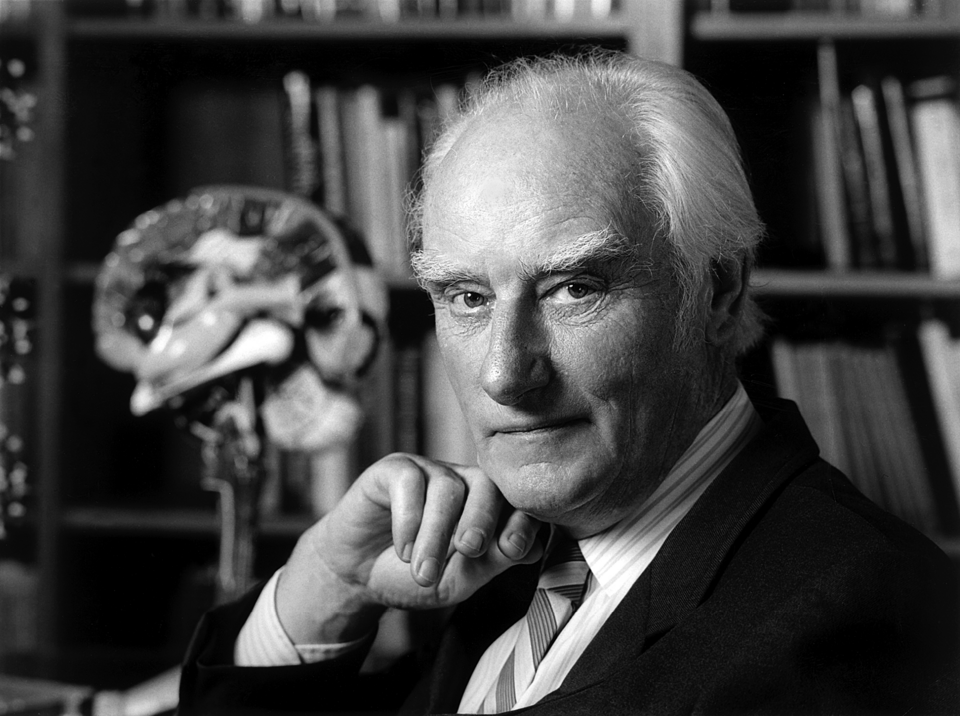
Portrait: Francis Crick in his office, photograph by Marc Lieberman, Wikimedia Commons, CC BY 2.5. Date of photography not established.

Marc Lieberman, via Wikimedia Commons, CC BY 2.5; Commons version has dust removed by Jan Arkesteijn. Image record, Creative Commons Attribution 2.5 Generic.
The round picture in the lists of the personalities is cropped from it.