




9 min read
Discoverer of Transformation
Frederick Griffith
author: High Priest Zevios Metathronos
The Courage to Preserve a Difficult Result
Dates: 1877–1941 CE
Period: Modern period (1900–present)
Frederick Griffith was an English physician and bacteriologist who worked at the Pathological Laboratory of the Ministry of Health in London. In 1928 he showed that a harmless strain of pneumococcus, injected into mice together with heat-killed cells of a deadly strain, came back deadly itself, and that the change passed down to later generations of the bacteria. He called it transformation.1
Something had crossed from the dead cells into the living ones. In 1944 Oswald Avery, Colin MacLeod and Maclyn McCarty proved that the something was DNA. Griffith didn't live to see it: a German bomb killed him in London in 1941.2
Zevism reads his work under Asclepius and Hygieia, whose service he did as a public-health physician, and under Ma'at, the order of true records. He published a result he couldn't explain, stated its limits, and left it standing for others.
LIFE AND CONTEXT
Griffith was born on 3 October 1877 at Eccleston in Lancashire and studied medicine at the University of Liverpool. He joined the Pathological Laboratory of the Ministry of Health and earned, in Britannica's words, “a reputation for thorough and methodical research.” The Oxford Dictionary of National Biography gives his dates as 1877–1941.3
His subject was the pneumococcus, the germ of lobar pneumonia. Bacteriologists sorted it by serology into Type I, Type II, Type III and Type IV, and Griffith showed that each type could exist in 2 forms. The S form was encapsulated, grew smooth, shiny colonies and was virulent. The R form had lost its capsule, grew rough, irregular colonies and was attenuated.4
He came to the question from the clinic. In 1922 he published “Types of pneumococci obtained from cases of lobar pneumonia” in the Ministry's Reports on Public Health and Medical Subjects, number 13, pages 20–45. His paper of 1928, The Significance of Pneumococcal Types, opens with the types he found in clinical material before it turns to the laboratory.5
That paper ran to 47 pages in the Journal of Hygiene. According to the National Library of Medicine, its demonstration of one type turning into another inside a living animal “jolted the field of pneumococcal immunology.” Turning Type I into Type II was, in the NLM's words, “the equivalent of the transformation of one species into another, a phenomenon never before observed.” For physicians, a change of type inside the body “presented a disturbing clinical picture.”6
Griffith was killed during the German bombing of London in 1941, “together with a colleague at the Ministry of Public Health,” as Sanford Lacks records. The Lancet mourned them in a single obituary of W. M. Scott and F. Griffith that year.7
A Griffith Memorial Lecture was later founded in his name. Colin MacLeod, one of the 3 who'd identified the transforming principle as DNA, agreed to give the lecture of 1972 and died on 12 February that year, before he could deliver it. The 4th lecture, printed that November, fell to A. W. Downie.8
ATTAINMENTS
- In 1922 he published a survey of the pneumococcal types found in cases of lobar pneumonia, 26 pages in the Ministry of Health's Reports on Public Health and Medical Subjects.9
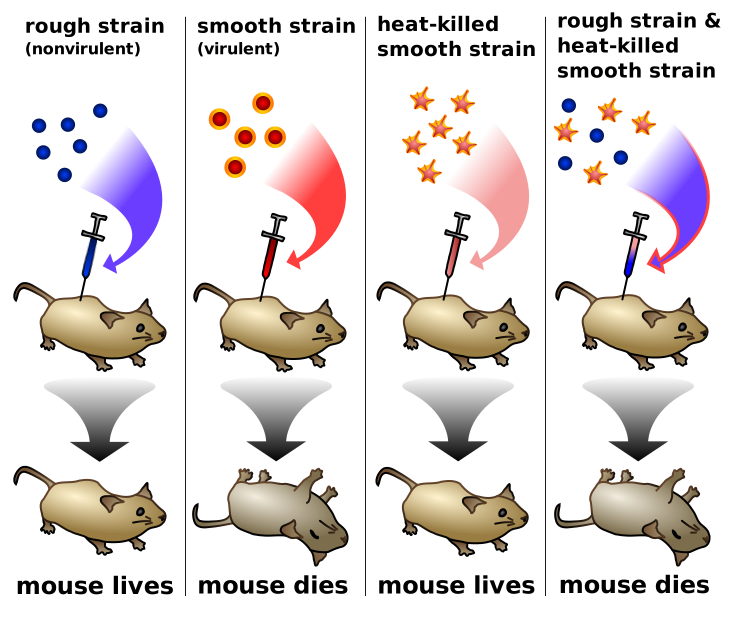
- In 1928 he showed that mice injected with heat-killed virulent pneumococci alone, or with living harmless ones alone, stayed free of infection, while mice given a mixture of both fell ill and died.10
- He showed that the bacteria changed type as well as form. Living R cells of 1 type, mixed with killed S cells of another, gave living S cells of the killed type.11
- The change was heritable. The transformed bacteria passed it “on to succeeding generations of bacteria.”10
- He named the phenomenon “transformation,” at a time when nobody knew that bacteria had genes.12
- He documented many combinations of type and form, with controls, and set them out in tables such as Table VII of the 1928 paper.13
- His experiment was the first to reveal the “transforming principle,” in Britannica's words, and it “led to the discovery that DNA acts as the carrier of genetic information.”10
- He kept his explanation open. He suggested that a seed of capsular polysaccharide might pass from the dead cells, and went further in wondering “whether an enzymatically active protein might be the agent transferred.”14
KEY STORIES
Mice and a Heat-Killed Culture
Griffith had 2 kinds of pneumococcus on his bench. The smooth, encapsulated S form killed mice; the rough R form didn't. He heated a culture of the S form until every cell was dead and injected it into mice. They lived. He injected living R cells alone. Those mice lived too.15
Then he injected the 2 together, and the mice died. From their blood he recovered living, encapsulated S pneumococci. They didn't belong to the living strain's type. In the NLM's summary of one set, he gave the mice living R cells of Type I with heat-killed S cells of Type II, and “not only did the R form convert to S, but the pneumococcal type was transformed as well, from I to II.”11
He didn't stop at a single striking result. The 1928 paper works through combination after combination of types and forms, with their controls, and it sets the type conversions out in tables. He called what he'd seen transformation.16
Doubt in New York
At the Rockefeller Institute in New York, Oswald Avery didn't believe Griffith. For some time, the NLM records, he “refused to accept the validity of his claims, believing that they were the result of inadequate experimental controls.”11
The result held. Fred Neufeld repeated it in Germany, and at the Rockefeller Institute Hospital Michael H. Dawson and Richard H. P. Sia confirmed Griffith's findings in 1929. They then made transformation happen in a glass vessel, with no mouse at all. Avery gave way. “It was with some reluctance,” the NLM says, that he “eventually accepted that pneumococci could be made at will to undergo transmissible hereditary changes in immunological specificity.”11
Dawson left the laboratory in 1930, and James Lionel Alloway went a step further. He broke open S bacteria, passed the contents through a filter fine enough to hold back the cell walls and any whole cells, and found that the clear fluid still did the work. The active material “could be precipitated, out of solution, as a solid substance with alcohol.” It came to be called the transforming principle. Alloway left in 1932, and the paper he published the next year was the laboratory's last on transformation until 1944.11
Who Could Have Guessed It?
From 1940 Avery, Colin MacLeod and Maclyn McCarty set out to name the substance. They attacked their purified extract with enzymes. Proteases and lipases didn't destroy its power, and neither did ribonuclease, which breaks down RNA. The Dische diphenylamine test, which detects DNA, gave a strong reaction.17
In 1943 Avery wrote to his brother Roy. The substance, he said, “on elementary analysis conforms very closely to the theoretical values of pure desoxyribose nucleic acid . . . Who could have guessed it?”17
The paper appeared in the Journal of Experimental Medicine in 1944 under the title “Studies on the Chemical Nature of the Substance Inducing Transformation of Pneumococcal Types.” It showed, as the NHGRI puts it, that “DNA (not proteins) can transform the properties of cells.”18 Some accepted it almost at once, and for several years others argued. By then the man who'd first seen the principle at work was 3 years dead, killed with a colleague in the bombing of London.19
THE ZEVIST READING
The Greek physicians swore “by Apollo the physician, and Asclepius, and Hygieia and Panacea and all the gods.”20 Asclepius heals the sick, and Hygieia keeps the healthy whole. Griffith served Hygieia in her public form: a government pathologist sorting the germs of pneumonia by type, case by case. Zevism counts disease among the forms of Izfet, the dissolution of ordered life, and such patient work pushes it back.
Ma'at is the structured order of existence, held by Zeus as Sovereign of the Cosmos, and a true record belongs to her. Egyptian religion named Ma'at “the personification of truth, justice, and the cosmic order.”21 Griffith's record was true in 2 ways. He reported a result that his own field found hard to believe, with the controls that let others check it. He also kept his explanation provisional, a seed of polysaccharide or perhaps an active protein, and didn't dress a guess as a finding.
Zevism holds that unexplored darkness isn't evil. It's the ground one walks into carrying light, and what is explored becomes Light. In 1928, as Lacks writes, “it was not realized that bacteria contained genes, let alone that DNA was the genetic material.”22 Griffith walked into that darkness with mice, a heated culture and a set of antisera, and he came back with a fact that no theory yet explained.
Others carried the light further: Dawson and Sia into the glass vessel, Alloway into the filtrate, Avery's team to DNA. Avery himself had doubted the first report and then tested his way to its cause, which is how a true record is meant to be received. The Temple honours the one who opened the way as it honours the one who reached the end, since each step in the chain answered to the same order.
NOTES
1 Britannica, “Frederick Griffith”; Lacks, “Rambling and Scrambling,” 2003.
2 NHGRI, “1944: DNA is Transforming Principle”; Britannica.
3 Britannica; Thomas, “Griffith, Frederick (1877–1941): Microbiologist,” ODNB.
4 NLM, “Shifting Focus: Early Work on Bacterial Transformation, 1928–1940”.
5 Downie, “Pneumococcal Transformation: A Backward View,” references; Griffith, Journal of Hygiene 27 (1928), pp. 113–117.
6 Griffith, pp. 113–159; NLM, “Shifting Focus”.
7 Lacks, “Early History”; Downie, references.
10 Britannica.
14 Lacks; Griffith, pp. 148–156.
15 Britannica; NLM, “Shifting Focus”.
16 Griffith, pp. 129–146; Lacks.
17 NLM, “DNA as the ‘Stuff of Genes’”.
18 NHGRI, “1944”.
19 NLM, “DNA as the ‘Stuff of Genes’”; Lacks.
20 Hippocratic Oath, tr. Michael North, National Library of Medicine, 2002.
22 Lacks.
BIBLIOGRAPHY
Fred Griffith, “The Significance of Pneumococcal Types”, Journal of Hygiene 27(2), January 1928, 113–159; clinical opening pp. 113–117, experiments pp. 129–146 (Table VII), discussion pp. 148–156.
Gavin Hugh Thomas, “Griffith, Frederick (1877–1941): Microbiologist”, Oxford Dictionary of National Biography, 12 July 2018; University of York bibliographic record.
Encyclopaedia Britannica, “Frederick Griffith”; birth, training, post and the 1928 experiment.
Sanford A. Lacks, “Rambling and Scrambling in Bacterial Transformation: A Historical and Personal Memoir”, Journal of Bacteriology 185(1) (2003), 1–6; section “Early History.”
U.S. National Library of Medicine, Profiles in Science, The Oswald T. Avery Collection, “Shifting Focus: Early Work on Bacterial Transformation, 1928–1940” and “DNA as the ‘Stuff of Genes’: The Discovery of the Transforming Principle, 1940–1944”.
A. W. Downie, “Pneumococcal Transformation: A Backward View. Fourth Griffith Memorial Lecture”, Journal of General Microbiology 73 (1972); reference list, entries for Griffith 1922 and the Lancet obituary of 1941.
National Human Genome Research Institute, “1944: DNA is Transforming Principle”; Avery, MacLeod and McCarty.
Hippocratic Oath, tr. Michael North, National Library of Medicine, 2002.
Encyclopaedia Britannica, “Maat”.
CREDIT
Image: modern educational diagram of Griffith's transformation experiment, by Madeleine Price Ball. An illustration, not a portrait. CC0; verified Commons record.

Madeleine Price Ball, Griffith experiment, via Wikimedia Commons, CC0. Image record, CC0 1.0.
The round picture in the lists of the personalities is cropped from it.