




9 min read
Poet of the Gods
Friedrich Hölderlin
author: High Priest Zevios Metathronos
Learning to Inhabit a Divine World
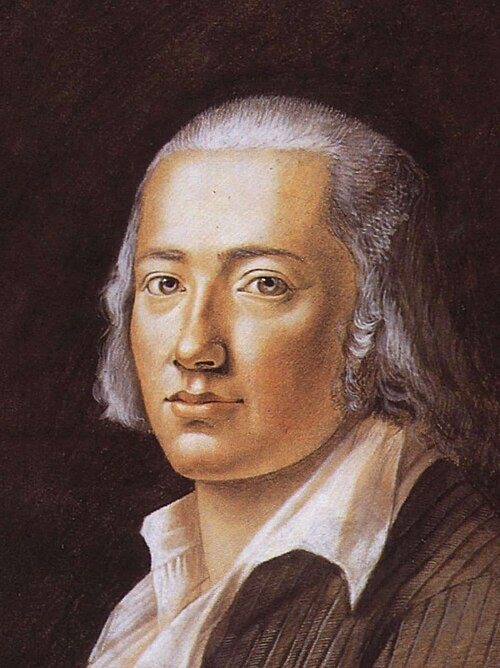
Dates: 1770–1843 CE
Period: Enlightenment, 1650–1804
Friedrich Hölderlin was a Swabian poet, trained as a Protestant theologian, who bent the German language toward Greek. In 1800 he filled a notebook with 2,000 verses of Pindar, 17 odes put into German word by word, keeping the Greek order of the words. His novel Hyperion came out in 2 volumes in 1797 and 1799, and his German Oedipus and Antigone after Sophocles in 1804.1
At the Tübingen seminary his fellow students included Hegel and Schelling. He spent the 2nd half of his life, 36 years, in a small room above the Neckar in the house of a Tübingen carpenter, and his last poems were written there.2
Zevism reads him as a keeper of the source. His Hyperion traces beauty and philosophy back to a single saying of Heraclitus, the thinker with whom the Logos begins, and his translations let the Greek reshape his own tongue.
LIFE AND CONTEXT
He was born on 20 March 1770 at Lauffen am Neckar. He lost his father at 2 and his beloved stepfather at 9. After the Latin school at Nürtingen he went in 1784 to the lower monastery school at Denkendorf and in 1786 to the higher one at Maulbronn.3
From 1788 to 1793 he studied at the Protestant seminary in Tübingen, the Stift, where Hegel and Schelling were his fellow students. The theology course also brought him the philosophy, literature and art of antiquity. “Im Stift wurde nicht nur H.s Begeisterung für die Antike geweckt,” Glaubrecht notes; there, as for Hegel and Schelling, the ground was laid for his work on Kant's critical philosophy. Kant and the French Revolution, he adds, “beherrschten ... Gespräche und Lektüre im Stift.”4
After the Stift he earned his living as a private tutor. In 1793 he took charge of the 9-year-old son of Charlotte von Kalb at Waltershausen. From January 1796 he taught in the Frankfurt house of the banker Jakob Friedrich Gontard, and in January 1801 in the house of the merchant Anton von Gonzenbach at Hauptwil in Switzerland. At the end of January 1802 he began his last post, at Bordeaux, with Daniel Christoph Meyer, consul of Hamburg and wine merchant.3
He was gone again within months. Around the middle of June 1802 he turned up in Stuttgart, “abgerissen, in wilder Erregung”: ragged and wildly agitated. There a letter from Sinclair reached him with the news that Susette Gontard had died.3
He kept working. In 1802 and 1803 he wrote the hymn “Patmos,” probably at the request of the Landgrave of Hessen-Homburg. Through Sinclair's help his Sophocles appeared from the Frankfurt publisher Friedrich Wilmanns in April 1804, and he was given a post as librarian at Homburg.3
In 1805 Sinclair and others were put on trial in Württemberg after a denunciation, and Glaubrecht dates Hölderlin's final collapse only after it. In August 1806 Hessen-Homburg lost its independence, and he was taken to Tübingen, to Autenrieth's clinic. From the summer of 1807 he lived with the family of the master carpenter Ernst Zimmer. He died in Tübingen on 7 June 1843.2
ATTAINMENTS
- He wrote Hyperion oder der Eremit in Griechenland, a novel in letters set against the Greek rising of 1770; the 1st volume appeared in 1797 and the 2nd in 1799.5
- In 1800 he translated about 2,000 verses of Pindar, 17 odes, word for word and in the Greek word order.6
- His German versions of Sophocles's Oedipus and Antigone were published at Frankfurt in April 1804.3
- He wrote the hymn “Patmos” in 1802 and 1803, probably at the request of the Landgrave of Hessen-Homburg.3
- He addressed a cycle of poems to Susette Gontard under the name Diotima, among them the elegy “Menons Klage um Diotima.”3
- In the tower years he went on writing short poems, often signed with the invented name “Scardanelli.”7
KEY STORIES
Diotima in Frankfurt
In January 1796 Hölderlin, then 25, took up his post in the Frankfurt house of the banker Gontard. The banker's wife, Susette, born Borkenstein, was a year older than he was. Glaubrecht writes that the Frankfurt years became “zur glücklichsten und produktivsten Zeit seines Lebens,” the happiest and most productive time of his life.3
In the novel he was writing, Hyperion finds fulfilment with Diotima, named for the priestess of love in Plato's Symposium. Hölderlin gave Susette the same name: “Er nannte sie nach der Gestalt des Romans ‘Diotima’ und feierte sie in den an sie gerichteten Gedichten.”3
The household couldn't hold them. “Ende September 1798 kam es zum Bruch”: after a quarrel with the banker, Hölderlin left the house and found refuge at Homburg with Sinclair. For almost 2 more years he kept in touch with Susette through letters and hurried secret meetings. The 2nd volume of Hyperion, with its Diotima, appeared in 1799, and the elegy “Menons Klage um Diotima” carried the name into his verse.3
A Conversation About Athens
The novel is a hermit's correspondence. A Greek, Hyperion, looks back from a withdrawn life on love and on a failed rising, the revolt of 1770, and tells it in letters to his friend Bellarmin.8
The 2nd book of the 1st volume opens with Hyperion on Salamis, tending a modest dwelling and looking back over the changing moods of his life. His letters then carry him to the time when he, Diotima and their friends travelled to Athens and talked about why its people excelled in art and thought. Hyperion answered with a genealogy. “Das erste Kind der menschlichen, der göttlichen Schönheit ist die Kunst. In ihr verjüngt und wiederholt der göttliche Mensch sich selbst.”9
Religion comes next: “Der Schönheit zweite Tochter ist Religion. Religion ist Liebe der Schönheit.” Then philosophy, which grows out of poetry: “Wie Minerva aus Jupiters Haupt, entspringt sie aus der Dichtung eines unendlichen göttlichen Seyns.”
At the root of it all Hyperion sets 1 Greek phrase: “Das große Wort, das ἓν διαφέρον ἑαυτῶι (das Eine in sich selber unterschiedne) des Heraklit, das konnte nur ein Grieche finden, denn es ist das Wesen der Schönheit, und ehe das gefunden war, gabs keine Philosophie.” Diotima listens, answers and brings his talk back to its subject. The speech is a character's, set inside a novel, but it's the fullest statement Hölderlin made of what Greece meant to him.10
Pindar Word by Word
In 1800 Hölderlin took a notebook in which he'd already written out a draft of his tragedy Empedokles and used it again for Pindar. “Das Schreibbuch, in das Hölderlin zunächst einen der ›Empedokles‹-Entwürfe eingetragen hatte, nutzte er 1800 um und übersetzte dort 2000 Verse,” the Tübingen museum records. There were 17 odes.6
His method was strict. “Er übertrug Wort für Wort ins Deutsche, hielt jedoch strikt am fremden griechischen Satzbau fest.” The German came out full of what the museum calls hard joinings, “jene widerspenstigen Satzkonstruktionen, in denen die Wörter jäh aufeinanderprallen,” stubborn constructions in which the words collide.6
Those collisions were the price of keeping Pindar's own order. Hölderlin let the Greek reshape the German, line after line, and the notebook holds 2,000 of them.
36 Years Above the Neckar
In the summer of 1807, after the clinic, Hölderlin was placed in the care of the master carpenter Ernst Zimmer, a prosperous and educated man. “In einem kleinen Erkerzimmer im 1. Stock des Zimmerschen Hauses am Neckar lebte er noch 36 Jahre lang.”3
The house is the Hölderlin Tower today. There, the museum records, “he used to be visited by contemporaries, admirers and other authors,” and there “his last poems were composed, often signed under the pseudonym »Scardanelli«.” He died in Tübingen on 7 June 1843.11
The tower now holds a museum devoted to the periods of his life spent in Tübingen. Its exhibition follows the seminary years and his friendship with Hegel and Schelling, his course mates in theology, as well as the long years in Zimmer's house.7
THE ZEVIST READING
Zevism holds that the Logos begins with Heraclitus, whose book opened: “Of this Word's being forever do men prove to be uncomprehending, both before they hear and once they have heard it.”12 Hyperion's speech in Athens puts the same thinker at the source of both beauty and philosophy. Zevism, the Logos restored, accepts that genealogy.
The speech's image for wisdom is Minerva born from the head of Jupiter, Athena from Zeus, whole at birth. Its claim that in art “der göttliche Mensch” renews himself is the Zevist aim, ὁμοίωσις θεῷ κατὰ τὸ δυνατόν, likeness to the divine “as far as possible.”13 Hölderlin was trained as a Protestant theologian. The Temple doesn't claim his faith; it claims the Greek genealogy his novel drew.
Late in the novel Hyperion takes out his long-forgotten lute to steady himself, “um mir ein Schiksaalslied zu singen, das ich einst in glüklicher unverständiger Jugend meinem Adamas nachgesprochen.” The song shows the distance to be crossed. The Gods walk above “im Licht” and breathe “Schiksaallos, wie der schlafende / Säugling,” while suffering humans fall “Wie Wasser von Klippe / Zu Klippe geworfen, / Jahr lang ins Ungewisse hinab.”14 Zevism doesn't read that uncertain dark as evil. It's what one walks into carrying light, and explored darkness becomes knowledge.
The Pindar notebook is that walk made visible. Zevism holds that one must return to the source, that knowledge changes as it passes from hand to hand, and that the source keeps its priority. It honours translators as the keepers of that source. Hölderlin kept Pindar's order at the cost of his own German's smoothness, for 2,000 verses, and the Tübingen museum gives a section of its exhibition to the notebook's hard joinings.
NOTES
1 Hölderlinturm, “Harte Fügungen”; Glaubrecht, “Hölderlin, Friedrich,” NDB 9.
2 Glaubrecht, NDB; Hölderlinturm.
4 Glaubrecht, NDB; Hölderlinturm, overview.
5 Glaubrecht, NDB; Open Book Publishers, Hyperion, tr. Gaskill.
6 Hölderlinturm, “Harte Fügungen”.
8 Open Book Publishers, Hyperion.
9 Hölderlin, Hyperion, vol. 1, bk. 2.
11 Hölderlinturm; Glaubrecht, NDB.
12 Graham, “Heraclitus,” SEP, B1.
BIBLIOGRAPHY
Martin Glaubrecht, “Hölderlin, Friedrich”, Neue Deutsche Biographie 9, 1972, pp. 322–332; birth, schools, the Stift, the tutorships, Susette Gontard and Diotima, Bordeaux, Homburg, the Sophocles translations, the clinic, the Zimmer house and death.
Hölderlinturm Tübingen, permanent-exhibition overview, for the Stift friendship with Hegel and Schelling, the tower years, visitors and the name Scardanelli.
Hölderlinturm Tübingen, “Harte Fügungen”, section on the 1800 notebook of Pindar translations.
Friedrich Hölderlin, Hyperion, Volume I, Book II, German text, the Athens conversation; Bibliotheca Augustana, based on Friedrich Beißner's edition, Sämtliche Werke, vol. 3, 1958.
Friedrich Hölderlin, Hyperion, Volume II, Book II, German text, “Hyperions Schicksalslied”; Bibliotheca Augustana, same edition.
Friedrich Hölderlin, Hyperion, or the Hermit in Greece, translated by Howard Gaskill, Open Book Publishers, 2019, DOI 10.11647/OBP.0160. Publisher's description consulted for publication and narrative context.
Daniel W. Graham, “Heraclitus”, Stanford Encyclopedia of Philosophy; fragment B1 in Graham's translation.
Plato, Theaetetus 176a–b, Greek text, Perseus Digital Library.
CREDIT
Image: Franz Carl Hiemer, portrait of Hölderlin, c.1792. Pastel; public-domain reproduction, current cropped version without the frame.
.jpg)
Franz Carl Hiemer / Wikimedia Commons; Public domain. Image record, Public domain.
The round picture in the lists of the personalities is cropped from it.