






9 min read
Discoverer of Nuclein
Friedrich Miescher
author: High Priest Zevios Metathronos
The Worth of an Unfinished Discovery
Dates: 1844–1895 CE
Period: Imperial period (1804–1900)
Friedrich Miescher was a Swiss physician and physiological chemist who, in the winter of 1868–1869, pulled a new substance out of the nuclei of white blood cells. He called it nuclein. It was DNA, isolated for the first time, and he got it from pus washed out of used hospital bandages.1
He never learned what the substance did, and nobody knew until long after his death. He still found it, purified it, measured its phosphorus and named it in 1874 as the likeliest agent of fertilization.2
Zevism reads his work under the doctrine of Light and Darkness and under Theuth, the inventor of letters. Miescher carried a lamp into the darkest room of the cell, and late in life he reached for the alphabet to explain what he'd found there.
LIFE AND CONTEXT
Johann Friedrich Miescher was born in Basel on 13 August 1844, into a family of scientists. His father, Johann F. Miescher, and his uncle Wilhelm His were physicians and professors of anatomy and physiology at the University of Basel. He trained in medicine, but poor hearing left by a childhood ear infection made it hard to examine patients, and his interest in the “theoretical foundations of life” pulled him toward research.3
In the autumn of 1868 he joined the laboratory of Felix Hoppe-Seyler at Tübingen. It was housed in the vaults of the old castle, high above the Neckar valley, and its main room had been the castle kitchen. Miescher chose the white blood cell because he thought it the “most simple and independent cell type,” one that might yield the basic principles of cell life.4
He finished his first round of work on nuclein in the autumn of 1869 and spent a year at Carl Ludwig's physiology institute in Leipzig. Hoppe-Seyler, meanwhile, held back the manuscript and repeated the experiments himself. The paper came out in early 1871, in Hoppe-Seyler's own journal.5
Miescher went home to Basel in 1871 and took the chair of physiology the next year. He wrote his habilitation on respiration, and from the mid-1870s he was asked again and again to run surveys of nutrition, work Dahm calls “a cumbersome task.” Through it all he kept returning to nuclein, now taken from the sperm of Rhine salmon.6
Others took the substance forward with his tools. Richard Altmann and the Nobel laureate Albrecht Kossel, himself a student of Hoppe-Seyler, made only small changes to Miescher's method of extraction. In 1889 Altmann argued that the word nuclein should always mean the mixture of nucleic acid and protein.7
At the start of the 1890s he contracted tuberculosis. He gave up his work and moved to a clinic at Davos in the Swiss Alps, and there he died on 26 August 1895, aged 51.8
ATTAINMENTS
- He isolated DNA for the first time, in 1869, from the nuclei of human white blood cells, and named it nuclein for its place in the nucleus.9
- Nuclein, he showed, wasn't a protein. It resisted digestion by pepsin, held no sulfur and carried a large amount of phosphorus.10
- He predicted a new class of compounds. “It seems probable to me that a whole family of such slightly varying phosphorous-containing substances will appear, as a group of nucleins, equivalent to proteins,” he wrote.11
- In Basel he found nuclein in salmon sperm bound in a salt-like state to a basic molecule he named protamin, and he fixed the share of P₂O₅ in salmon nuclein at 22.5% of its mass. He also judged nuclein to be a “multibasic acid.”12
- In 1874 he named nuclein as the likeliest candidate for a single cause of fertilization: “then one needs to consider nuclein without doubt.”13
- From the mid-1870s he tracked how the salmon's gonads grow “at the expense of other parts of the body” during the fish's migration up the Rhine.14
- Basel gave him its chair of physiology in 1872, and he held it until illness forced him out.15
KEY STORIES
Bandages from the Surgical Clinic
Miescher began with lymph nodes, but the lymphocytes were hard to purify and he couldn't get enough of them. On Hoppe-Seyler's suggestion he turned to the one place where white cells were plentiful, the pus on fresh surgical dressings, and arranged for the surgical clinic near the university to send him its used bandages.16
Getting the cells off the cloth intact came first. Other washes failed him. Only a dilute solution of sodium sulfate, 1 part cold saturated Glauber's salt to 9 parts water, gave him clean, separate leucocytes, and he kept the work going for several weeks at “wintry temperatures.” To strip away the proteins of the cytoplasm he used pepsin, which he extracted himself from pig stomachs.17
During these tests he saw something fall out of solution when he added acid and dissolve again when he added alkali. With acetic or hydrochloric acid in excess he got “an insoluble, flocculent precipitate.” Pepsin didn't digest it. It had no sulfur and plenty of phosphorus. On 26 February 1869 he reported the find in a letter to his uncle, Wilhelm His, and because it came from the nucleus he called it nuclein.18
Hoppe-Seyler Checks the Work
Miescher claimed he'd found a new type of substance, equal in importance to the proteins. Hoppe-Seyler, his professor, didn't believe it straight away. He kept the manuscript and repeated the experiments in his own hands.15
It took him a year. Only then did he print the paper, in early 1871, in the journal he edited, next to a note of his own: “I can only emphasize that I have to fully confirm all of Miescher's statements that I have verified.”5
By then Miescher had gone on to Leipzig. The year's delay gave the discovery a 2nd witness, and nuclein entered the literature with the head of the laboratory vouching for every result he'd checked.
The reception didn't please its author. As early as 1872 Miescher wrote to Hoppe-Seyler that he should never have published on nuclein at all, and so exposed it to “the mob.”19
Salmon in a Freezing Room
Basel sits on the Rhine, and every year the salmon ran upstream past the city to spawn. The fishermen landed them in quantity, and Miescher had all the fresh fish he could use.15
The material deteriorated in warmth, so he worked cold. Even as a professor, Lamm, Harman and Veigl write, he would “toil in freezing temperatures, with laboratory windows kept open to avoid deterioration of material extracted from salmon sperm obtained from Basel's weathered fishermen.”19
In the heads of the sperm he found nuclein locked to a basic partner, protamin. He watched the migrating fish, too. Their gonads swelled while the rest of the body wasted, and from the mid-1870s that change absorbed more and more of his time.6
The Letter About the Alphabet
In 1892, 3 years before his death, Miescher wrote to his uncle Wilhelm His about heredity. He thought the answer lay in the asymmetric carbon atoms of organic molecules, whose possible stereoisomers run to enormous numbers.20
“There is a great amount of possible asymmetric carbon atoms and thus also stereoisomers,” he wrote, “therefore all richness and variety of hereditary transmission can be expressed equivalently well as can be all words and terms of all languages in the 24–30 letters of the alphabet.”19
He'd found the right image and put it in the wrong molecule. In the same years tuberculosis drove him to a clinic at Davos, where he died in August 1895.14
THE ZEVIST READING
Zevism holds that unexplored darkness isn't evil. It's ground one walks into carrying light, and what is explored becomes Light, which is knowledge. The chemistry of the nucleus in 1868 was that kind of darkness. Miescher walked in with a salt wash and pig pepsin and came out with a substance and its phosphorus count.
Plato's Theuth invented “numbers and arithmetic and geometry and astronomy, also draughts and dice, and, most important of all, letters.”21 Miescher's letter of 1892 reached for Theuth's gift to explain heredity. Zevism reads the comparison as sound: living things carry a written order, the Logos set down in matter. The hereditary text turned out to lie in DNA, the substance Avery, MacLeod and McCarty identified in 1944 as the transforming principle.22
Zevism also holds that one must return to the source. Knowledge changes as it passes from hand to hand, but the first secure step keeps its priority. On 10 April 1970 the Basel pharmaceutical firms Ciba AG and J. R. Geigy AG founded a research institute and named it for the man who “first purified nucleic acids in 1869, ca. 100 years before the founding of the FMI.”23 That naming is a return to the source.
Later histories of DNA did the opposite: in them, Lamm, Harman and Veigl write, “Miescher morphed into a ‘confuser,’” a man whose ideas were judged misguided.19 The Temple's reading puts the source back where it stands, at the head of the chain.
The aim of the path is ὁμοίωσις θεῷ κατὰ τὸ δυνατόν, likeness to the divine “as far as possible.”24 The phrase “as far as possible” fits Miescher. He worked through Basel winters with the windows open, and in his last years with failing lungs, on a problem whose answer he'd never see. He went as far as his instruments and his years allowed.
NOTES
1 NHGRI, “1869: DNA First Isolated”.
2 Dahm, “Friedrich Miescher and the discovery of DNA,” pp. 278–281; Lamm, Harman and Veigl, “Before Watson and Crick”.
3 Dahm, p. 275.
4 Dahm, pp. 275–280; NHGRI, laboratory caption.
7 Lamm, Harman and Veigl, “Before Watson and Crick”.
8 Dahm, p. 282; Britannica, “Friedrich Miescher”.
9 NHGRI, “1869: DNA First Isolated”; Dahm, p. 278.
10 Dahm, p. 278.
11 Pray, “Discovery of DNA Structure and Function”.
13 Lamm, Harman and Veigl, “Before Watson and Crick,” 2020.
14 Dahm, p. 282.
15 Dahm, p. 280.
16 Dahm, p. 276; Pray.
20 Lamm, Harman and Veigl; Dahm, p. 281.
22 NHGRI, “1944: DNA is Transforming Principle”.
23 Friedrich Miescher Institute, “FMI History”.
BIBLIOGRAPHY
Ralf Dahm, “Friedrich Miescher and the discovery of DNA”, Developmental Biology 278 (2005), 274–288, doi:10.1016/j.ydbio.2004.11.028; pp. 275–282 and Box 1.
National Human Genome Research Institute, “1869: DNA First Isolated”, updated 22 April 2013; main text and laboratory caption.
Ehud Lamm, Oren Harman and Sophie Juliane Veigl, “Before Watson and Crick in 1953 Came Friedrich Miescher in 1869”, Genetics 215(2) (2020), 291–296, doi:10.1534/genetics.120.303195; English renderings of Miescher's 1874 paper and 1892 letter.
Leslie A. Pray, “Discovery of DNA Structure and Function: Watson and Crick”, Nature Education 1(1) (2008), Scitable; the bandages and Miescher's statement on the nucleins.
Encyclopaedia Britannica, “Friedrich Miescher”; dates and places of birth and death.
National Human Genome Research Institute, “1944: DNA is Transforming Principle”.
Friedrich Miescher Institute, “FMI History”, opening account of its foundation on 10 April 1970 and its naming.
Plato, Phaedrus 274c–d, translated by H. N. Fowler, Perseus Digital Library.
Plato, Theaetetus 176a–b, Greek text, Perseus Digital Library.
CREDIT
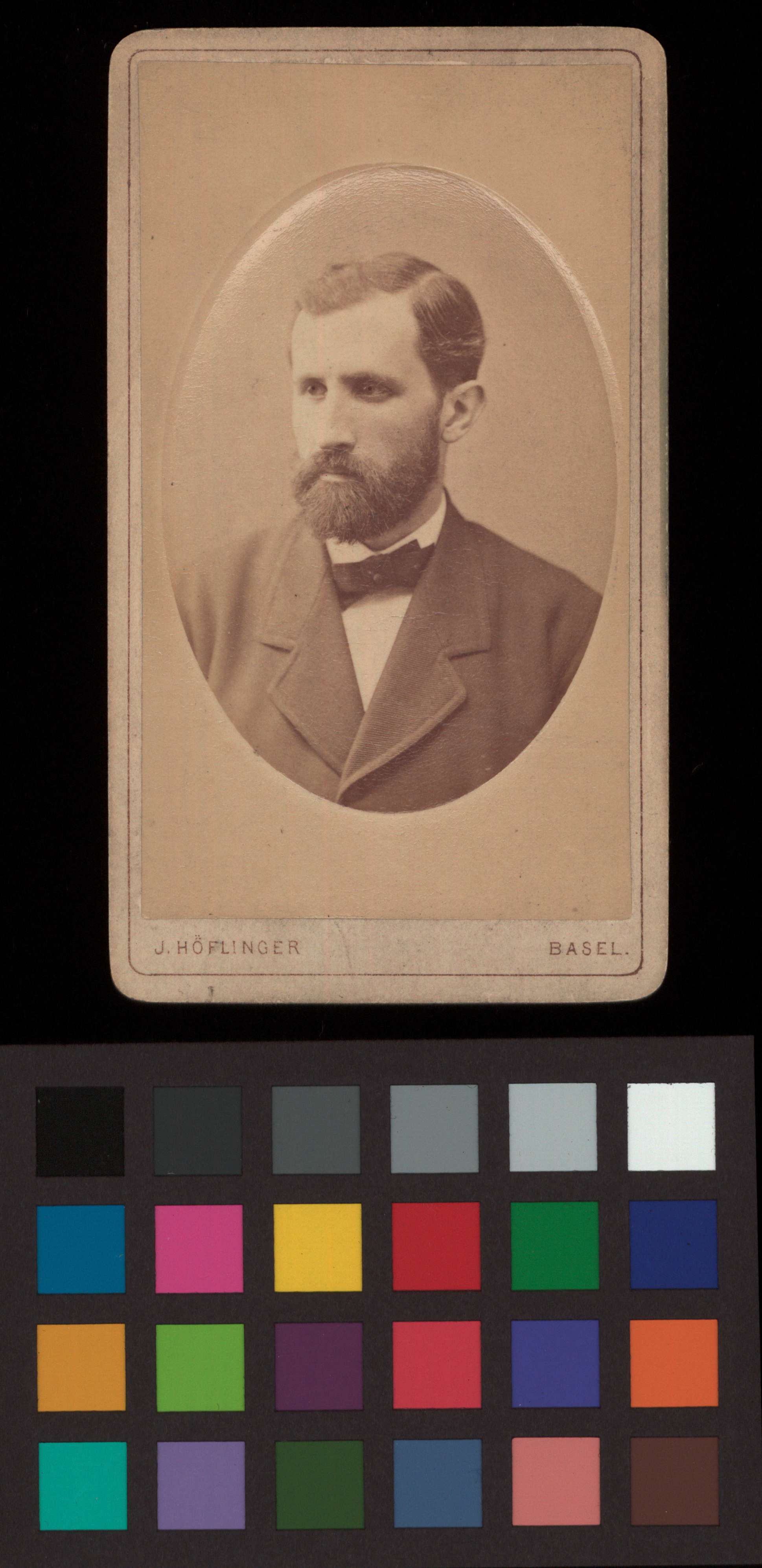
Image: Friedrich Miescher, photograph by J. Höflinger, 1878. Basel University Library, UBH Portr BS Miescher F 1844, 2a–2b; public domain. Verified file record.

J. Höflinger, Friedrich Miescher (1878), Basel University Library, UBH Portr BS Miescher F1844,2a–2b; public domain. Image record, Public domain, Basel University Library explicit reuse statement.
The round picture in the lists of the personalities is cropped from it.