




9 min read
Philosopher of Becoming
Friedrich Nietzsche
author: High Priest Zevios Metathronos
The Courage to Become
Dates: 1844–1900
Period: Imperial, 1804–1900
Friedrich Nietzsche was a classical philologist who held a chair at Basel at 24 and then, in poor health and living in rented rooms, wrote a book nearly every year for a decade. The Birth of Tragedy put Apollo and Dionysus back at the centre of Greek art, and Thus Spoke Zarathustra taught that “man is something that is to be surpassed.”1
His greatest single work is Zarathustra, published in 4 parts between 1883 and 1885, the last of them printed privately at his own expense.2
The Temple counts his teachings on self-overcoming, the testing of inherited values and the affirmation of life among the foundations of the Zevist worldview. Zevism reads him above all through its doctrine of the Creator against the andrapod: the one who builds new values against the one who answers life with resentment.
LIFE AND CONTEXT
Nietzsche was born on 15 October 1844 at Röcken, near Leipzig, “where his father was a Lutheran minister.” His father died in 1849, and the boy grew up in Naumburg in a house of women: his mother, his grandmother, 2 aunts and his younger sister, Elisabeth.3
In 1858 he won a free place at Schulpforta, the old boarding school where, his Neue Deutsche Biographie entry says, he received a strict training “altphilologisch akzentuierte,” centred on the classical languages. He enrolled in theology at Bonn in 1864, and in the autumn of 1865 he moved to Leipzig, partly because his teacher Friedrich Ritschl had been called there.4
On Ritschl's recommendation Basel called him in 1869 to its chair of classical philology, and Leipzig gave him his doctorate in March on the strength of the work he'd already done. “At age 24, he was then the youngest ever appointed to such a post.” He'd met Richard Wagner as a student, and from Basel he became a frequent guest at Wagner's Villa Tribschen in Lucerne.5
His health broke early. In May 1879 he asked to be released from his post, and Basel let him go with a yearly pension for 6 years, later extended. For the next decade he lived in boarding houses in Switzerland, on the French Riviera and in Italy, and from 1881 he spent his summers at Sils-Maria in the Upper Engadine.6
The books of those years came fast: The Gay Science in 1882, Zarathustra in 1883–1885, Beyond Good and Evil in 1886 and On the Genealogy of Morality in 1887. Then, in January 1889, his mind failed. He died in Weimar on 25 August 1900, “of a stroke complicated by pneumonia.”7
ATTAINMENTS
- He was called to the Basel chair of classical philology in 1869 at 24, the youngest ever appointed to such a post, and Leipzig granted his doctorate on the strength of his earlier work.7
- The Birth of Tragedy (1872) argued that “the continuous development of art is bound up with the duplexity of the Apollonian and the Dionysian,” and named Apollo and Dionysus “the two art-deities of the Greeks.”8
- Thus Spoke Zarathustra came out in 4 parts from 1883 to 1885. Its speech on “The Three Metamorphoses” traces the spirit from camel to lion to child, the last being “a new beginning, a game, a self-rolling wheel, a first movement, a holy Yea.”9
- The Gay Science (1882, expanded 1887) introduced amor fati, the love of fate, in §276, and in §341 put the thought of a life returning in every detail, innumerable times, as a test of how one stands toward existence.10
- The preface to On the Genealogy of Morality (1887) set its programme in 1 line: “we need a critique of moral values, the value of these values is for the first time to be called into question.”11
- Beyond Good and Evil (1886) assigned the philosopher the task of creating values, beyond the work of collecting and ordering earlier judgments.12
- After his collapse his sister published The Antichrist and Ecce Homo, and a selection from his notebooks under the title The Will to Power, a book he never prepared for print in that form.3
KEY STORIES
A Nook of the Alps, 1870
In August 1870, a year into his professorship, Nietzsche took leave from Basel to serve as a volunteer medical orderly in the war against France.13 He told the story of those months himself in 1886, in the “Attempt at Self-Criticism” he added to the book, and he didn't use the 1st person for his younger self.
“While the thunder of the battle of Wörth rolled over Europe, the ruminator and riddle-lover, who had to be the parent of this book, sat somewhere in a nook of the Alps, lost in riddles and ruminations.” Then, “in that month of deep suspense, when peace was debated at Versailles, he too attained to peace with himself, and, slowly recovering from a disease brought home from the field,” he settled on the Birth of Tragedy from the Spirit of Music.14
The book appeared in 1872. It opened with the 2 Gods: “It is in connection with Apollo and Dionysus, the two art-deities of the Greeks,” that one learns of the great opposition in Greek art. Classical scholars didn't like it. Anderson reports that the work was “savagely reviewed by Ulrich Wilamowitz-Möllendorff, who went on to become one of the leading classicists of the generation.”15
The Rope-Dancer in the Market
Zarathustra opens like a myth. “When Zarathustra was thirty years old, he left his home and the lake of his home, and went into the mountains.” He enjoyed his solitude and “for ten years did not weary of it.” Then one morning he rose with the dawn and spoke to the sun: “Thou great star! What would be thy happiness if thou hadst not those for whom thou shinest!”16
He came down to a town where a crowd was waiting to watch a rope-dancer, and he preached to it: “I teach you the Superman. Man is something that is to be surpassed. What have ye done to surpass man?” He told them that “the Superman is the meaning of the earth.” Someone shouted back: “We have now heard enough of the rope-dancer; it is time now for us to see him!”17
The performer started across the rope. Behind him a jester came out onto the rope, “uttered a yell like a devil, and jumped over the other who was in his way,” and the rope-dancer fell into the square. Dying, he told Zarathustra: “I am not much more than an animal which hath been taught to dance by blows and scanty fare.” Zarathustra answered: “Thou hast made danger thy calling; therein there is nothing contemptible,” and promised, “therefore will I bury thee with mine own hands.”18
Turin, 3 January 1889
The last productive year ended in the streets of Turin. The Neue Deutsche Biographie dates it exactly: on 3 January 1889 an organic disease of the brain became manifest, one that brought “eine fortschreitende Zerstörung des Bewußtseins,” a progressive destruction of consciousness.13
He collapsed in the street, and when he came round he wrote “a series of increasingly deranged letters.” Britannica adds that his notes brought his friend Franz Overbeck, a Christian theologian, to Italy to take him back to Basel.19
He lived 11 more years in what Britannica calls “total mental darkness,” and it traces the path: “first in a Basel asylum, then in Naumburg under his mother's care and, after her death in 1897, in Weimar in his sister's care.” Elisabeth took control of his papers and published The Will to Power from his notebooks. He died in Weimar on 25 August 1900, aged 55.20
THE ZEVIST READING
The Birth of Tragedy served the Greek Gods in the plainest way a scholar can: it made Apollo and Dionysus the 2 powers of Greek art again. Apollo holds measure, form and the bright image; Dionysus holds the intoxicated force that breaks form open. Zevism receives that pairing as a true account of the divine at work in art and reads The Birth of Tragedy as a Zevist book written by a philologist.
The doctrine that fits him best is the Creator against the andrapod. The Temple's word, ἀνδράποδον, is the Greek for a captive, a human being taken as property. The andrapod lives among ruins and answers them with complaint, attack and nostalgia. Nietzsche described the same type in the Genealogy: “The revolt of the slaves in morals begins in the very principle of resentment becoming creative and giving birth to values,” and “its action is fundamentally a reaction.”21
Against it he set the child of the 3 metamorphoses, “a new beginning,” “a holy Yea.” That's the Creator, and it's the figure Zevism honours in him. Creation is open forward and demands work, and Nietzsche's own life shows the price: 10 years in rented rooms, the last part of Zarathustra printed at his own cost, and a new work nearly every year.
“Man is something that is to be surpassed,” Zarathustra says. Nietzsche set that surpassing on the earth. Zevism reads it as the first step of the path Plato named ὁμοίωσις θεῷ κατὰ τὸ δυνατόν, becoming like the divine as far as possible, the literal elevation of human nature.22 The rope-dancer who died in his calling shows the danger of that crossing, and Zarathustra promised to bury him with his own hands.
He was a Lutheran minister's son and the author of The Antichrist, and the Temple claims no faith for him. What it receives is the discipline: the testing of inherited values in the Genealogy, the giving of style to character in The Gay Science §290, and the yes to a life one would live again in §341.
NOTES
1 Anderson, “Friedrich Nietzsche,” SEP §1; Zarathustra, Prologue 3, tr. Common.
2 Magnus, “Friedrich Nietzsche,” Britannica.
5 Nemec, NDB; Anderson, SEP §1.
6 Nemec, NDB; Magnus, Britannica.
7 Anderson, SEP §1; Nemec, NDB.
8 Nietzsche, The Birth of Tragedy §1, tr. Haussmann.
9 Zarathustra 1, tr. Common; Magnus, Britannica.
10 The Joyful Wisdom §§276, 341, tr. Common.
11 The Genealogy of Morals, preface §6, tr. Samuel.
12 Beyond Good and Evil §§211–212, tr. Zimmern.
13 Nemec, NDB.
14 The Birth of Tragedy, “Attempt at Self-Criticism” §1, tr. Haussmann.
15 The Birth of Tragedy §1; Anderson, SEP §1.
16 Zarathustra, Prologue 1, tr. Common.
17 Prologue 3.
18 Prologue 6.
19 Anderson, SEP §1; Magnus, Britannica.
20 Magnus, Britannica; Anderson, SEP §1.
21 The Genealogy of Morals 1.10, tr. Samuel.
BIBLIOGRAPHY
R. Lanier Anderson, “Friedrich Nietzsche”, Stanford Encyclopedia of Philosophy, revised 25 June 2026; §1, life and works.
Friedrich Nemec, “Nietzsche, Friedrich”, Neue Deutsche Biographie 19, 1999, pp. 249–253; Schulpforta, Bonn, Leipzig, the Basel call, war service, pension, Sils-Maria, Turin and death.
Bernd Magnus, “Friedrich Nietzsche”, Encyclopaedia Britannica, updated 21 August 2026, with the section “Decade of isolation and creativity (1879–89)”.
Friedrich Nietzsche, The Birth of Tragedy, translated by William A. Haussmann, Project Gutenberg; “An Attempt at Self-Criticism” §1 and §1.
Nietzsche, Thus Spake Zarathustra, 1883–1885, translated by Thomas Common, Project Gutenberg; Prologue §§1, 3, 6 and “The Three Metamorphoses.”
Nietzsche, The Joyful Wisdom, translated by Thomas Common, Project Gutenberg; §§276, 290, 341.
Nietzsche, Beyond Good and Evil, 1886, translated by Helen Zimmern, Project Gutenberg; §§211–212.
Nietzsche, The Genealogy of Morals, 1887, translated by Horace B. Samuel, Project Gutenberg; preface §6 and 1st essay §10.
Plato, Theaetetus 176a–b, Greek text, Perseus Digital Library.
CREDIT
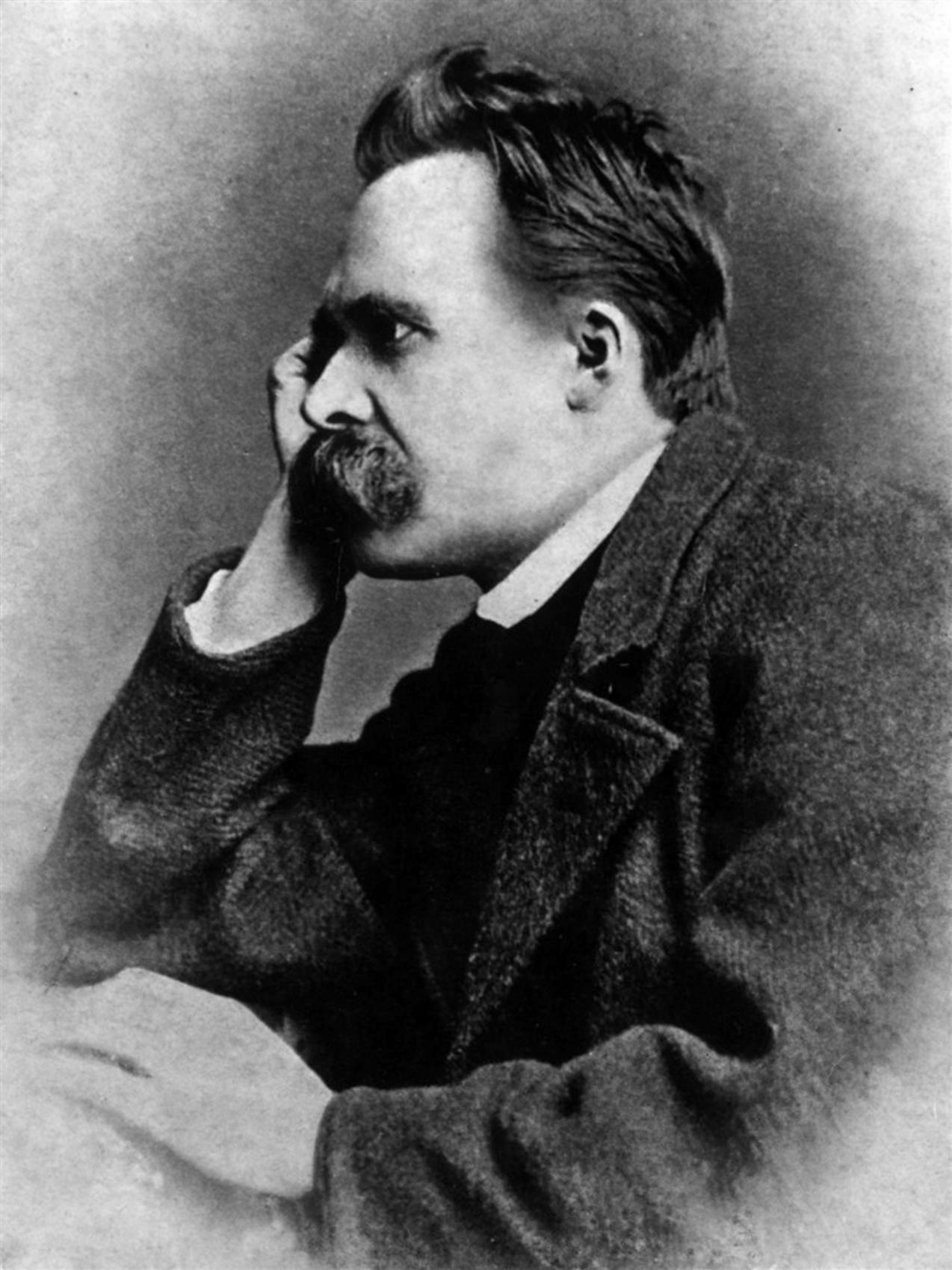
Image: Friedrich Nietzsche in September 1882, photographed by Gustav-Adolf Schultze. Public domain; scan processed by Anton. Verified image and attribution.

Gustav-Adolf Schultze (d. 1897) / Wikimedia Commons; Public domain. Image record, Public domain.
The round picture in the lists of the personalities is cropped from it.